 Bitaigen Research
 Investors can obtain Bitcoin asset yields through centralized lending platforms, Wrapped Bitcoin (WBTC) on Ethereum, or Bitcoin layer‑2 network solutions. These diversified income streams give Bitcoin holders flexible options for growing their assets.

In this article we outline the various yield‑generation paths available to Bitcoin holders—from centralized lending to cross‑chain WBTC DeFi, and layer‑2 locking schemes such as Babylon and Stacks. We focus on the key conditions and potential risks of each method, helping you quickly assess whether you qualify for staking. Subsequent sections provide practical steps, so read on carefully.
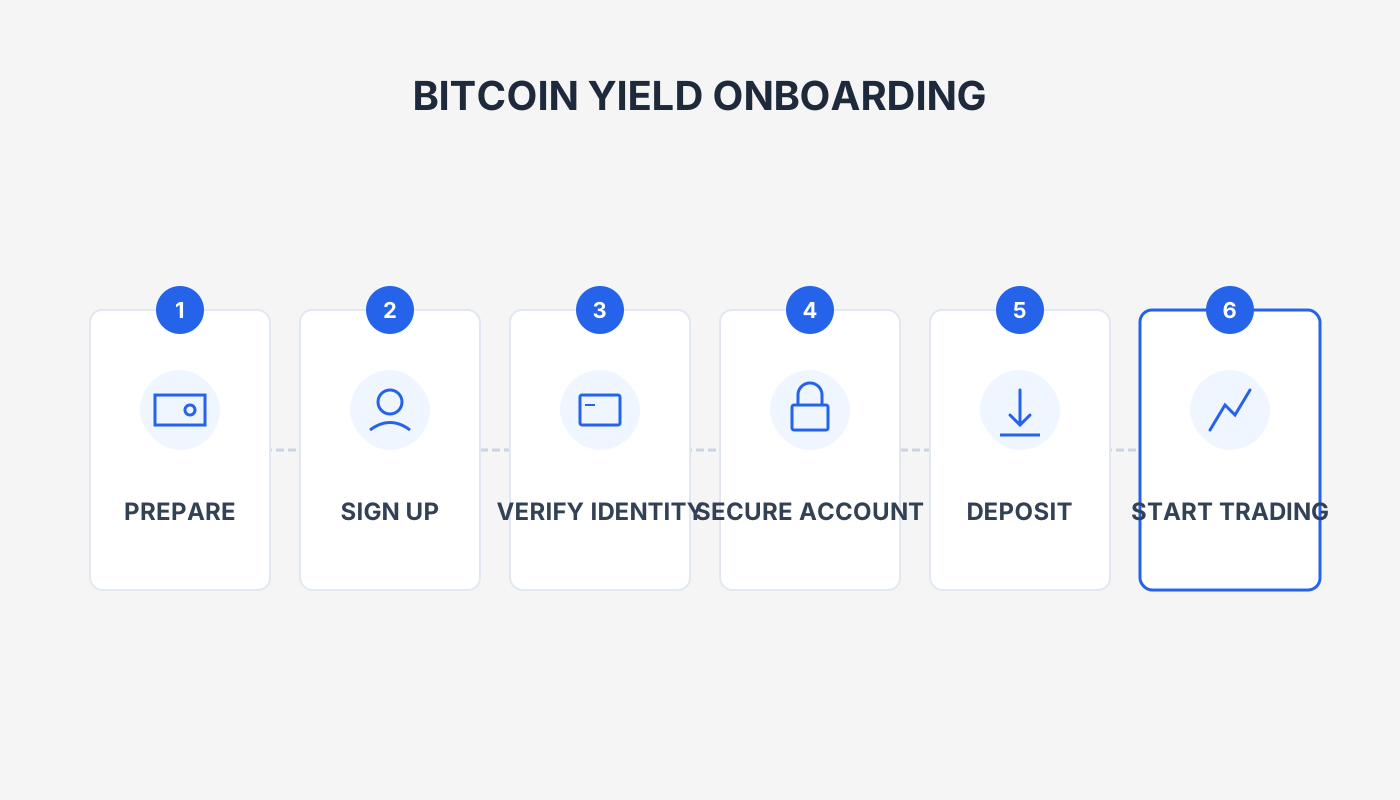
How to Determine Whether You Can Stake Bitcoin (BTC)? An Introduction to Bitcoin Yield‑Generation Methods
Key Takeaways
To know if you can stake Bitcoin, check whether you hold bridgeable WBTC or use a layer‑2 protocol that supports native locking, such as Babylon or Stacks.
Although Bitcoin (BTC) does not support native staking, holders can generate yields via centralized lending platforms, Wrapped Bitcoin (WBTC) on Ethereum, and Bitcoin‑related networks like Babylon and Stacks.
- WBTC lets BTC owners participate in Ethereum‑based DeFi platforms (e.g., Aave, Curve) by providing lending, liquidity‑pool, and yield‑farming opportunities, but it introduces bridge and smart‑contract risks.
- Protocols such as Babylon and Stacks employ native timelock scripts or a “stacking” mechanism that rewards participants without moving BTC off the Bitcoin blockchain.
Custody, smart‑contract, and regulatory risks remain. The Bitcoin community continues to debate whether these yield‑generation methods align with its decentralization and minimal‑trust principles.
Unlike proof‑of‑stake (PoS) chains such as Ethereum or Cardano, Bitcoin secures its network through proof‑of‑work (PoW) mining. However, the rise of decentralized finance (DeFi) and second‑layer innovations now enables BTC holders to earn passive income through centralized lending, WBTC, and layer‑2 solutions like Babylon and Stacks. This article examines the underlying mechanics, risk considerations, and technical progress of these approaches, all while leaving the core Bitcoin protocol untouched.
Staking vs. Mining
- Staking: On PoS chains (e.g., Ethereum, Solana), participants lock tokens to become validators, are randomly selected to propose blocks, and receive rewards. The larger the amount staked, the higher the probability of selection.
- Mining: On PoW chains (e.g., Bitcoin, Litecoin), miners use high‑hash‑rate hardware to solve a cryptographic puzzle; the first to solve it earns the block reward. Mining consumes significant energy and hardware resources.
Bitcoin’s PoW design means it does not support a native staking mechanism. BTC‑based yield methods (lending, layer‑2 protocols) differ fundamentally from PoS staking. Note that some platforms offer “liquid staking” services where users receive a token that represents the staked asset (e.g., stETH), enabling combined staking‑plus‑DeFi returns.
Ways to Earn Yield on Bitcoin
Even though Bitcoin’s PoW consensus prevents native staking, several alternative avenues allow BTC holders to generate passive income. These solutions typically involve third‑party platforms or bridging BTC to another blockchain.
1. Centralized Lending Platforms
| Platform | Operating Model | Main Risks |
|---|---|---|
| Binance Earn | Deposit BTC; platform loans it to institutional borrowers | Custody risk, platform insolvency |
| Nexo | Same as above | Regulatory‑compliance risk |
| Ledn | Same as above | Transparency risk |
Centralized platforms pay interest on deposited BTC on a daily or monthly basis. Users must trust the platform’s ability to meet withdrawals and its security practices. The collapses of Celsius, BlockFi and similar firms have highlighted these risks.
2. WBTC on Ethereum
WBTC is an ERC‑20 token fully backed 1:1 by BTC and custodially held by BitGo. Holders can use WBTC on DeFi protocols such as Aave and Curve to:
- Lend and earn interest
- Provide liquidity and collect fees
- Participate in yield‑farms for additional token rewards
These actions unlock DeFi potential but also introduce BitGo custodial risk, bridge vulnerabilities, and smart‑contract security concerns.
3. Bitcoin Layer‑2 Network Platforms
- Babylon: Uses a timelock script on the Bitcoin chain, locking BTC as collateral to secure its PoS network. Rewards are distributed in the native BABY token, split 50 % BTC / 50 % BABY.
- Stacks: Employs a Proof‑of‑Transfer (PoX) mechanism; STX holders lock roughly two weeks of STX to earn Bitcoin rewards. This process does not lock BTC itself, creating an economic link between BTC and STX.
Did you know? After completing “The Merge” in 2022, Ethereum became the world’s largest PoS network, cutting its energy consumption by more than 99.95 % and being hailed as one of the most environmentally friendly blockchains.
How to Earn Yield on Centralized Lending Platforms Using BTC
- Choose a Platform: Prioritise platforms with strong reputation and clear compliance. (U.S. residents must use Binance.US rather than the global Binance site.)
- Complete KYC: Submit identity documents as required by the platform.
- Deposit BTC: Transfer your BTC to the address provided by the platform.
- Select a Product: Choose between “flexible” (withdraw anytime) or “fixed‑term” (locked) products.
- Confirm Terms: Review interest rates, interest‑calculation method, and any early‑withdrawal fees.
- Monitor Returns: Periodically check your account statements; at maturity you can withdraw both principal and accrued interest.
Using Binance Earn as an example, three product categories are offered:
- Simple Earn: Flexible or locked, stable returns, interest paid daily or at maturity.
- Dual Investment: Returns depend on the settlement price of two assets; carries higher risk.
- On‑chain Yield: Binance bridges funds to DeFi protocols such as Aave, offering variable yields and covering gas fees on your behalf.
Tip: Yield rates and lock‑up periods differ markedly across products; compare them carefully before committing.
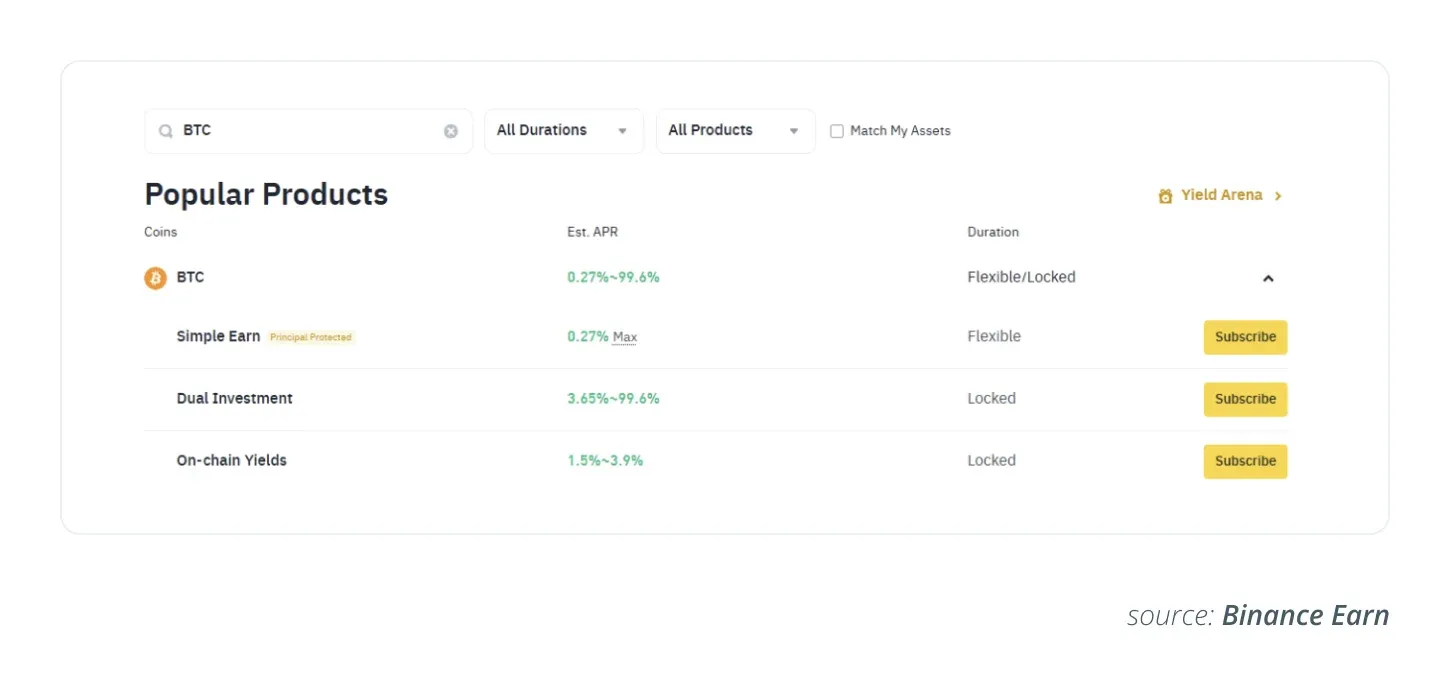
Simple Earn – BTC can be placed in a fixed‑term or flexible‑term plan, with interest paid daily or as a lump sum at maturity.
Dual Investment – Funds are settled at a predetermined target price and date; the payout may be in the original asset or an alternative one.
On‑chain Yield – Funds are allocated to DeFi protocols; Binance absorbs the gas costs. During periods of high network congestion, withdrawals may experience delays.
How to Earn Yield Using WBTC on Ethereum
Using Curve as an example, follow these steps:
- Convert BTC to WBTC: Use a centralized exchange (e.g., Binance) or a decentralized bridge (e.g., RenBridge). WBTC is custodially held by BitGo.
- Transfer to a Web3 Wallet: Send the WBTC to MetaMask or another ERC‑20‑compatible wallet, and keep enough ETH to cover gas fees.
- Connect to the DeFi Protocol: Open Curve.fi and select the appropriate WBTC liquidity pool.
- Deposit into the Pool: Confirm the amount and submit the transaction.
- Earn Returns: Receive interest or fee rebates proportionally to the pool’s trading volume.

How to Earn Yield Using Bitcoin (BTC) Layer‑2 Networks
Layer‑2 solutions generate returns by locking BTC or related tokens. Below is a step‑by‑step guide for Babylon:
Babylon Yield‑Generation Workflow
- Prepare a Compatible Wallet: Use a wallet that supports native SegWit (bc1q) or Taproot (bc1p) addresses, such as OKX or Phantom. Avoid wallets that enable Ordinals.
- Visit the Babylon Staking App: Log in to the Babylon Stake platform, which launched its Genesis mainnet on 10 April 2025.
- Connect Your Wallet: Authorise the platform to access your wallet and sign the required transactions.
- Select a Validator (Operator): Choose from over 250 operators (e.g., Galaxy, Figment) to delegate your stake and help secure the network.
- Set Transaction Fees: Use the default fee or customise it; higher fees result in faster confirmation.
- Lock BTC: Enter the amount you wish to lock, confirm, and monitor the status in real time on the app.
- Claim Rewards: Rewards are distributed in BABY tokens, with a 50 % BTC / 50 % BABY split.
Note: Tax treatment of crypto earnings varies widely across jurisdictions. In many countries, the receipt of rewards may be treated as ordinary income, while the subsequent sale of the underlying BTC could be subject to capital‑gains tax. Consult a local tax professional for guidance.
Innovative Mechanisms of Bitcoin Layer‑2 Protocols
Layer‑2 protocols dramatically improve Bitcoin’s scalability and functionality. Babylon and Stacks each introduce distinct reward models while preserving Bitcoin’s security foundation.
Babylon’s Native Timelock Script
- Locks BTC in a self‑custodial, timelocked script on the Bitcoin chain.
- The script serves as collateral, ensuring the security of Babylon’s PoS network.
- Operates on a non‑custodial model; no bridging or wrapping is required, and it connects directly with the Cosmos ecosystem.
- Stakers can delegate to a validator and earn BABY tokens, creating a cross‑chain delegation and re‑staking capability.
Stacks’ Stacking Mechanism
- STX holders lock approximately two weeks of STX to support network consensus.
- Through Proof‑of‑Transfer (PoX), locked STX earn Bitcoin rewards.
- No BTC is locked; the mechanism essentially bridges STX value to BTC.
- Operations can be performed via platforms like Okcoin or Xverse.
Coinbase Bitcoin Yield Fund (CBYF) Overview
On 1 May, Coinbase Asset Management launched the Coinbase Bitcoin Yield Fund (CBYF) for institutional investors outside the United States. The fund follows a conservative cash‑and‑futures‑arbitrage strategy, capturing spreads between spot and futures markets while avoiding high‑risk activities such as leveraged loans or naked options selling.
- Target net annualised return: 4 %–8 % (denominated in BTC).
- Suited for Bitcoin holders seeking relatively stable, modest yields.
Risks Associated with BTC Yield Generation
| Risk Type | Typical Manifestation | Potential Impact |
|---|---|---|
| **Custody Risk** | Centralised platforms or BitGo holding user BTC | Platform bankruptcy or hack leading to loss of assets |
| **Smart‑Contract Risk** | Bugs in bridges or DeFi protocol code | Theft of assets or contract failure |
| **Liquidity Risk** | Locked projects or low‑liquidity pools | Difficulty exiting positions during market stress |
| **Network Maturity** | Emerging layer‑2 tech may be immature | Upgrade failures or security gaps |
| **Market Risk** | Sharp BTC price swings | Yield may be offset by price depreciation |
| **Regulatory Risk** | KYC/AML compliance checks | Asset freezes or tax obligations (see note above) |
Future Evolution of BTC Yield Models
The Bitcoin yield ecosystem is evolving rapidly through layer‑2 protocols and DeFi innovation. Babylon and Stacks already provide trust‑minimized reward schemes, and future developments may bring more native, non‑custodial Bitcoin value‑capture tools that leverage cryptographic advances while preserving Bitcoin’s censorship‑resistance.
Nonetheless, a segment of Bitcoin purists worries that monetisation mechanisms could dilute Bitcoin’s core identity as a hard‑currency store of value, fueling ongoing debates about utility versus security.
---
This article has covered how to assess whether you can stake Bitcoin and the most common BTC yield‑generation methods. For deeper analysis of Bitcoin staking, search for previous Bitaigen (比特根) articles or continue browsing the related links below. Thank you for your continued interest and support!
*Translation by AI*
Related Reading
- Is Bitcoin Staking Worth It? BTC Yield & 2026 Price Prediction
- Perpetual DEX Guide: Safety, Leverage & Liquidity
- What is a DEX? Best Decentralized Exchanges Guide 2026
💡 Register on Binance with referral code B2345 for the maximum trading fee discount. See Binance complete guide.



