
 Bitaigen Research
 ERC-20, BEP-20, TRC-20: Understanding Token Standards Across Blockchains
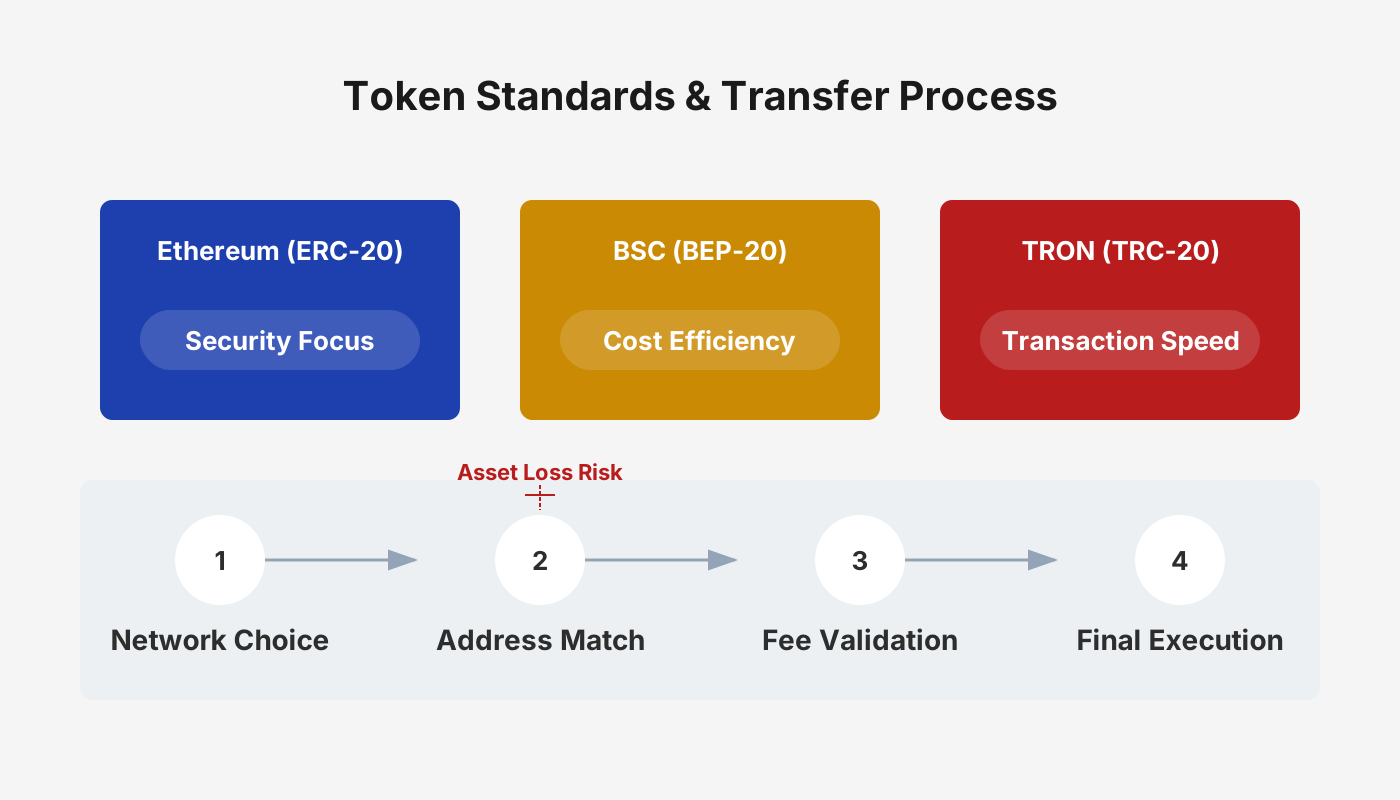
ERC-20, BEP-20, and TRC-20 are token standards on different blockchains. When transferring tokens, you must select the appropriate network on the same chain, ensuring that the address matches, fees are low, and settlement is fast.
In this article we outline the core differences between major token standards such as ERC-20, BEP-20, and TRC-20, and combine them with real‑world transfer scenarios to help you decide when to choose a low‑fee chain, how to guarantee address compatibility, and how to avoid loss of assets. Read on to master the key points of cross‑chain transfers and improve both safety and efficiency.
What Are BEP-20 / ERC-20 / TRC-20?
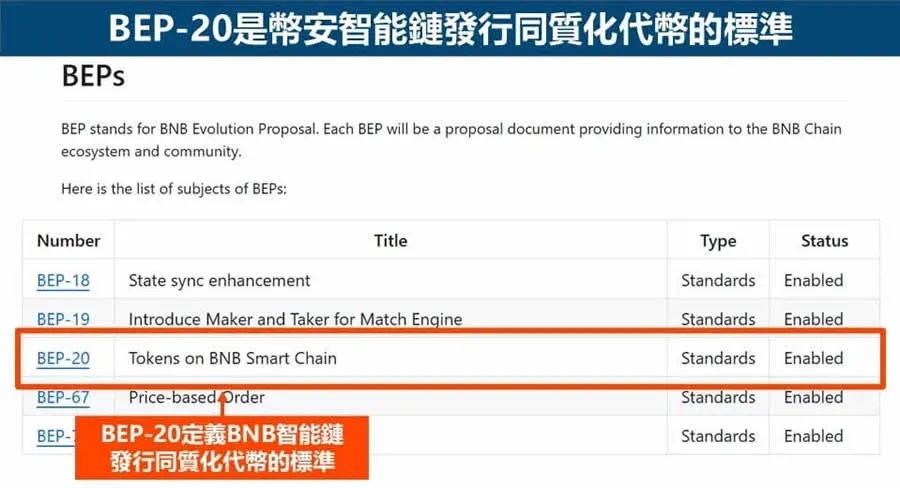
BEP-20, ERC-20, TRC-20 are token‑standard identifiers that distinguish different blockchain networks.
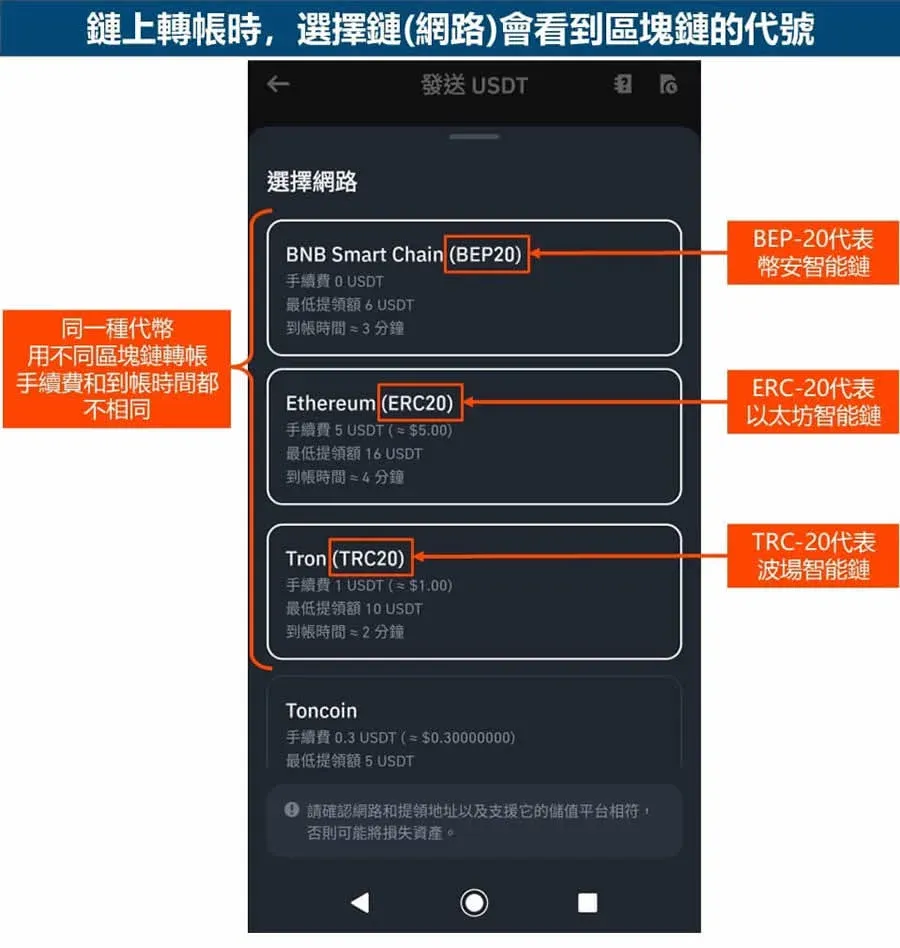
When you perform an on‑chain transfer, the system will ask you to choose a “network” (or “chain”). Common options include BEP-20, ERC-20, TRC-20, etc., which correspond to:
| Standard | Underlying Blockchain | Typical Use‑Case |
|---|---|---|
| **ERC-20** | Ethereum | Sending ETH and tokens issued on Ethereum |
| **TRC-20** | TRON | Sending USDT and other tokens issued on TRON |
| **BEP-20** | Binance Smart Chain (BSC) | Low‑fee chain commonly used by Binance users |
In addition to the three above, there are many other smart‑chain networks such as Solana, EOS, Optimism, Arbitrum One, Scroll, Base, Polygon POS, each supporting its own set of tokens. Verify the supported tokens yourself before using them.
The Same Coin Can Be Sent Over Multiple Chains
Take USDT as an example. Common transfer networks include BEP-20, ERC-20, TRC-20. The differences between chains lie in:
- Confirmation speed (number of blocks required)
- Gas fees (type of coin used for payment and amount)
- Compatible wallets (whether both sender and receiver support the chain)
Generally, it is advisable to select the chain that both parties support and that offers the lowest fees.
Different Exchanges / Wallets Support Different Chains – Verify Before Transferring
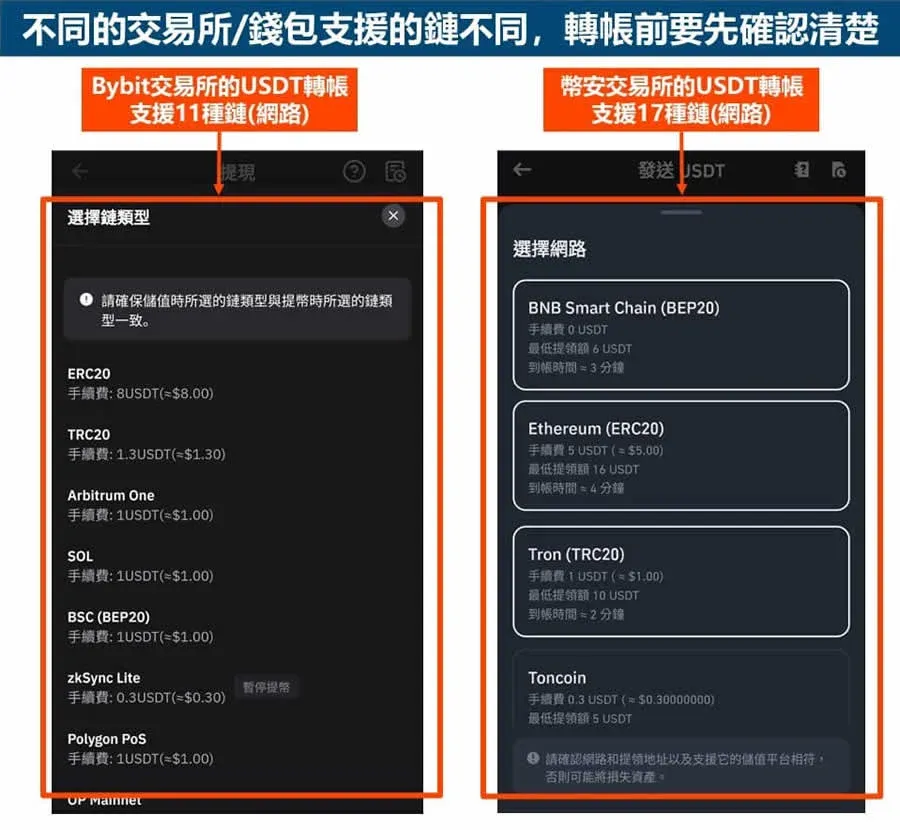
Exchanges and wallets implement different technical stacks, so the set of supported blockchains varies.
For example:
- Binance (the world’s largest exchange by volume) supports BEP-20, ERC-20, TRC-20, Solana, Optimism and a total of 17 chains.
*U.S. users must use Binance.US, which may have a more limited set of supported networks.*
- Bybit only supports 11 chains.
If you want to move USDT between an exchange and a wallet, you must pick a network that is compatible on both ends. The same principle applies to any other platform – always confirm the mutually supported chain before initiating a transfer.
Choosing the Wrong Chain Can Result in Permanent Loss of Funds
Selecting the wrong chain leads to a failed transfer and may permanently lose the assets.
The core rule for on‑chain transfers is that the sending wallet/exchange and the receiving wallet/exchange must use the same blockchain.
For instance, if the recipient generates a USDT address on the TRON chain, the sender must also send USDT on the TRON chain to that exact address. If one party picks ERC‑20 while the other picks TRC‑20, the funds cannot be recognized on the target chain and will be lost.
Pay Special Attention to Similarly Named Chains
| Exchange | Displayed Chain/Network Name | Equivalent Name on Other Exchanges |
|---|---|---|
| Binance | Polygon POS | Polygon‑ERC20 |
| Binance | Arbitrum One | Arbitrum‑ERC20 |
When you encounter ambiguous naming, prefer the clearly identified chain that both parties support. If no suitable option exists, contact the exchange’s support team or perform a small test transfer first, confirming success before moving larger amounts.
Key Considerations When Selecting a Chain: Limits, Fees, Settlement Time
When choosing a chain for a transfer, evaluate the following factors together:
- Whether both sides support the chain
- Minimum withdrawal amount (different chains may have different minimums imposed by the exchange)
- Fees (including on‑chain gas fees and any exchange‑charged fees)
- Settlement time (how long block confirmations take)
Using USDT as an example, some chains have a minimum transfer of 10–20 USDT, while others allow as little as 1 USDT. Fees and confirmation speeds also vary by chain, so users should pick the network that best matches their needs.
The Essence of Token Standards
A token standard is a technical specification that enables non‑programmers to issue their own tokens on an existing public blockchain.
In the early days, creating a new coin required building a native chain and recruiting miners – a costly endeavor. Token standards changed that by providing a uniform contract interface, allowing anyone to launch tokens on mature chains such as Ethereum, TRON, or Binance Smart Chain.
Each standard can only be used on its corresponding chain; for example, BEP‑20 tokens exist solely on BSC, while fungible tokens on Ethereum must follow ERC‑20. Consequently, token standards serve as an important identifier for distinguishing different chains.
Token vs. “Token” (Terminology)
In the blockchain world, assets issued via a token standard are called tokens. They do not have their own native blockchain like Bitcoin (BTC) or Ether (ETH), and they are not created through mining. The total supply is either fixed at issuance or potentially unlimited. Common tokens include BNB, DOGE, USDT, among others.
Tokens are classified as:
- Fungible Tokens: e.g., ERC‑20, BEP‑20, where each unit is interchangeable.
- Non‑Fungible Tokens (NFTs): e.g., ERC‑721, BEP‑721, each token carries a unique ID representing a distinct asset.
Overview of Common Token Standards
| Standard | Host Blockchain | Main Characteristics | Typical Tokens |
|---|---|---|---|
| **ERC‑20** | Ethereum | First and most widely adopted fungible token standard | ETH, USDT, USDC, SHIB |
| **TRC‑20** | TRON | Low fees, fast transfers | USDT (TRON version) |
| **BEP‑20** | Binance Smart Chain | ERC‑20 compatible, low fees | BNB, USDT, DOGE |
| **Solana** | Solana | High throughput, low latency | SOL, USDC (Solana version) |
| **Bitcoin** | Bitcoin mainnet | Native chain, slower confirmations | BTC |
| **Lightning Network** | Bitcoin (off‑chain) | Ultra‑fast, low‑fee off‑chain payment network | BTC (Lightning) |
1. ERC‑20: Ethereum’s Fungible Token Standard
ERC stands for Ethereum Request for Comment. ERC‑20 was published in 2015 and remains the earliest and most ubiquitous fungible token standard. Almost every token in the Ethereum ecosystem adheres to this specification.
2. Solana: High‑Speed Public Chain
Solana’s native token is SOL. With a throughput of thousands of transactions per second, Solana is often dubbed an “Ethereum killer.” In 2023, Visa extended its settlement network from Ethereum to Solana, expanding the use cases for USDC on that chain.
3. TRC‑20: TRON’s Token Standard
TRC‑20 is the token standard on the TRON network. Its most famous token is USDT (TRC‑20), which enjoys fees far lower than ERC‑20 and even faster settlement, making it a popular choice for many users.
4. BEP‑20: Binance Smart Chain Standard
BEP‑20 mirrors the ERC‑20 specification on BSC, enabling fungible token issuance with low transaction costs and rapid confirmations. This has attracted numerous DeFi projects to adopt the standard.
5. Bitcoin: Native Chain Asset
Bitcoin (BTC) can only be transferred on its native blockchain. With a block produced roughly every 10 minutes and typically requiring 5–6 confirmations, settlement takes about 50–60 minutes, making it more suitable for value storage than high‑frequency trading.
6. Lightning Network: Bitcoin’s Off‑Chain Scaling Layer
The Lightning Network aggregates multiple off‑chain transactions and settles them on the Bitcoin main chain in a single batch, achieving near‑instant confirmation and negligible fees. However, off‑chain transactions remain exposed to technical risks until settlement, so users should employ reliable nodes and robust security practices.
Quick Takeaways
- ERC‑20, BEP‑20, and TRC‑20 are token standards on different blockchains; always select the same chain when transferring.
- Mismatched chains cause transfer failures and may lead to irreversible loss of funds.
- When choosing a chain, weigh settlement speed, minimum transfer limits, and fees together.
- Other common standards include Solana, Bitcoin, and the Lightning Network.
After understanding these points, you can safely and cost‑effectively move cryptocurrencies between platforms. For deeper dives into each token standard, stay tuned to Bitaigen’s upcoming series.
Note: Crypto gains may be taxable in your local jurisdiction. Consider consulting a tax professional and be aware of reporting requirements for fiat conversions (e.g., USD via SEPA or SWIFT).
Related Reading
- ERC‑20 Explained: Ethereum Token Standard, Benefits & Limits
- Ethereum ERC‑20 Tokens: Guide to Standards, Uses & Examples
- ERC-20 Token Standard: Core Functions, Events & Practices
💡 Register on Binance with referral code B2345 for the maximum trading fee discount. See Binance complete guide.



