
 Bitaigen Research
In this article we systematically outline the concept of TVL, its calculation methodology, and its pivotal role within the DeFi ecosystem. The goal is to help readers quickly grasp the logic and significance behind this key metric, and to gain deeper insight into platform health and market trends. We also provide concrete examples that demonstrate how to accurately obtain and interpret TVL data, offering a reference point for informed decision‑making.
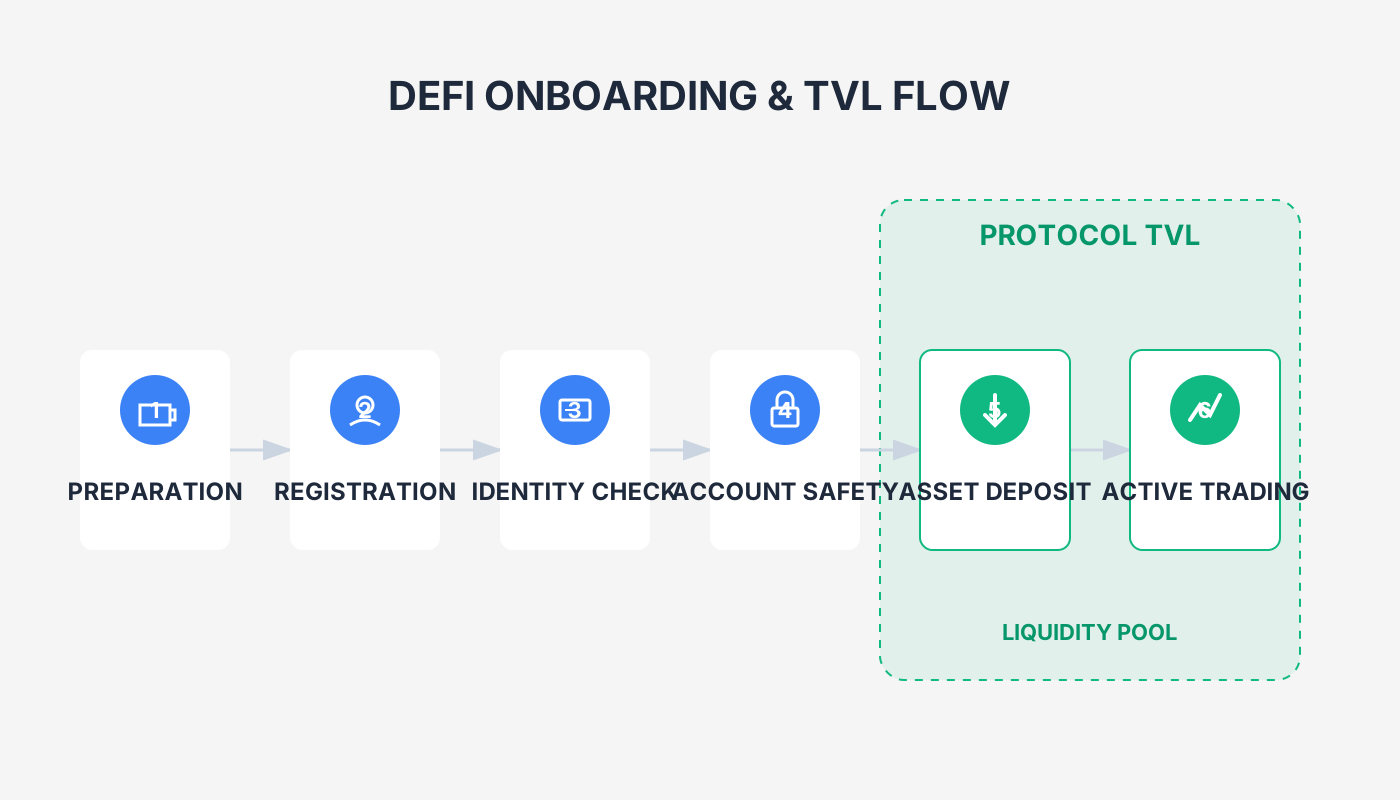
What Is TVL?
TVL (Total Value Locked) refers to the aggregate value of assets that are locked inside the smart contracts of a particular DeFi protocol or blockchain. The figure is obtained by multiplying the quantity of each locked asset by its current market price and summing the results, expressed in USD. TVL serves as an important gauge of a protocol’s popularity and liquidity; higher numbers typically indicate a more attractive and ostensibly secure platform.
How Is TVL Calculated?
The steps to compute TVL are relatively straightforward:
- Count the amount of each asset held in liquidity pools – this includes stablecoins, tokens, and other digital assets.
- Multiply each amount by its corresponding market price (quoted in USD), yielding the dollar value of each asset class.
- Aggregate the values of all assets; the total is the protocol’s TVL.
The formula can be expressed as:
TVL = Asset Quantity × Asset Price (USD)
*Example*: A platform holds 1,000 ETH (priced at $3,300 each) and 10,000 USDT (priced at $1 each). Its TVL is
1,000 × 3,300 + 10,000 × 1 = $3,310,000.
TVL and Its Relationship to DeFi
TVL is tightly linked to a DeFi protocol’s success, manifesting in several ways:
- Attractiveness Indicator: A larger TVL signals stronger user trust and deeper liquidity.
- Yield Measurement: Inflows of capital often accompany higher yields and greater activity.
- Competitiveness Benchmark: TVL reflects a protocol’s relative standing in the market and forms a core component of ranking lists.
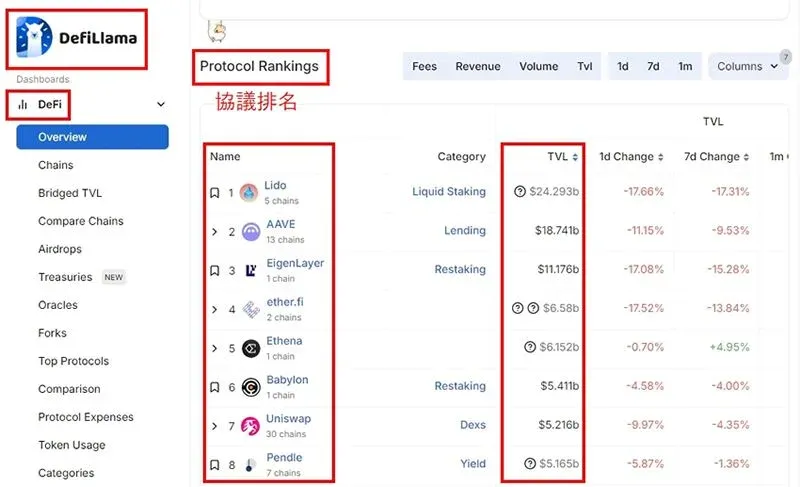
DeFi TVL Rankings (as of February 2025)
| Rank | Platform | Approx. TVL (USD billion) |
|---|---|---|
| 1 | **Lido** | 2.956 |
| 2 | **Aave** | 2.114 |
| 3 | **EigenLayer** | 1.352 |
| 4 | **Ether.fi** | 0.792 |
| 5 | **Binance Staked ETH** *(US users should access this via Binance.US)* | 0.629 |
These projects span decentralized lending, liquidity mining, and staking services, forming the backbone of the DeFi ecosystem.
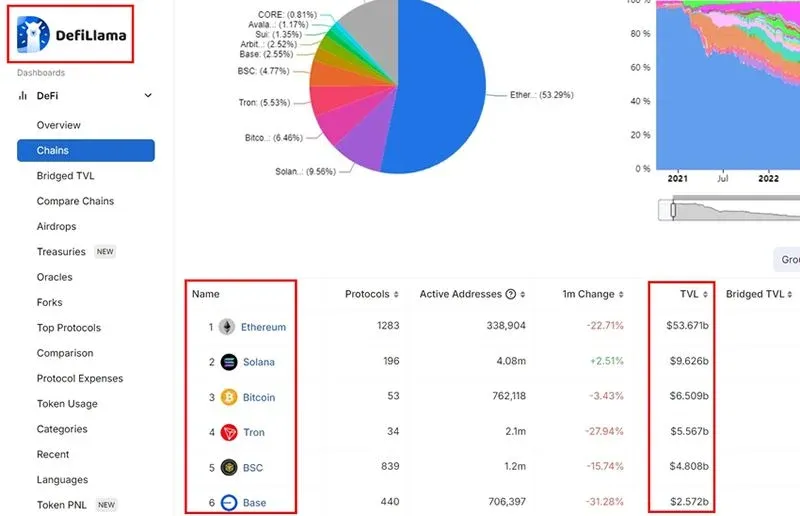
Cryptocurrency TVL Rankings
| Rank | Blockchain | Approx. TVL (USD billion) |
|---|---|---|
| 1 | **Ethereum** | 6.293 |
| 2 | **Solana** | 1.025 |
| 3 | **Bitcoin** | 0.689 |
| 4 | **Tron** | 0.632 |
| 5 | **BSC** | 0.542 |
Ethereum, as the primary chain for DeFi, accounts for more than 50 % of total TVL and continues to lead the space.
Main Drivers Behind TVL Fluctuations
- Cryptocurrency price volatility: Increases in the price of major assets such as ETH or BTC push TVL higher, while declines have the opposite effect.
- Capital inflows and outflows: Deposits or withdrawals by investors directly raise or lower TVL.
- Product innovation and incentive mechanisms: New yield models or liquidity‑mining campaigns can attract additional assets.
- Regulatory developments and market confidence: Changes in regulation and the perceived stability of stablecoins also influence TVL trends.
How Investors Can Leverage TVL for Analysis
- Monitor TVL trends: Protocols that exhibit a steady, long‑term upward trajectory are generally more appealing.
- Combine TVL with trading volume and yields: The ratio of volume to TVL (VOL/TVL) helps assess how efficiently capital is being used.
- Examine asset composition: A diversified asset mix within TVL reflects a protocol’s resilience to market shocks.
Why TVL Should Not Be Combined with PoS Staking Value
Under a Proof‑of‑Stake (PoS) consensus, staked assets serve to secure the network, which is fundamentally different from the liquidity‑locking nature of TVL in DeFi protocols. The key distinctions are:
- Different purpose: PoS staking is intended to maintain network security; the funds are locked and cannot be utilized elsewhere during the staking period. In contrast, TVL assets in DeFi typically retain both liquidity and yield‑generating capabilities.
- Liquidity disparity: PoS‑staked assets are illiquid and, even after unlocking, are not meant to be immediately liquidated. TVL assets can be traded or reinvested within the protocol at any time.
- Measurement relevance: Adding the two figures together creates conceptual confusion and fails to accurately represent either a protocol’s true liquidity or the network’s security level.
In short, TVL is a liquidity metric, whereas PoS staking value is a security metric. Their purposes and mechanisms are distinct, making a combined calculation illogical.
Summary
TVL is a vital indicator of the scale and activity of the DeFi ecosystem, but relying on TVL alone does not provide a complete picture. A comprehensive assessment should also consider capital mobility, yield rates, asset distribution, and the regulatory environment. As Layer‑2 solutions and cross‑chain technologies evolve, the distribution of TVL continues to shift. Understanding and correctly interpreting TVL equips participants with a more holistic view of DeFi’s development trajectory.
Note: Crypto gains may be taxable in your jurisdiction; consult a local tax professional for guidance. When moving fiat into or out of crypto platforms, use SEPA or SWIFT transfers where applicable.
For more introductory guides on TVL, follow the other articles published by Bitaigen.
Related Reading
- Smart Contracts: Core Principles & Use Cases in DeFi & NFTs
- USDC兑换人民币全攻略:火币、币安等平台操作步骤与注意要点
- Understanding TVL: What Total Value Locked Means in Crypto
💡 Register on Binance with referral code B2345 for the maximum trading fee discount. See Binance complete guide.



