
 Bitaigen Research
Crypto staking has become one of the most popular ways to earn passive income in the cryptocurrency market. But what exactly is staking? How does it work? Who is it suitable for? This guide systematically explains the mechanics, potential returns, risks, and step‑by‑step onboarding process for crypto staking.
In this article we methodically break down the fundamentals of crypto staking, its yields and risks, and provide practical instructions for running a solo validator as well as delegating to a validator. The goal is to help beginners quickly assess whether staking fits their asset allocation, and to give experienced participants ideas for optimizing returns. If you want to learn how passive income can be generated on decentralized networks, keep reading.
What Is Crypto Staking?
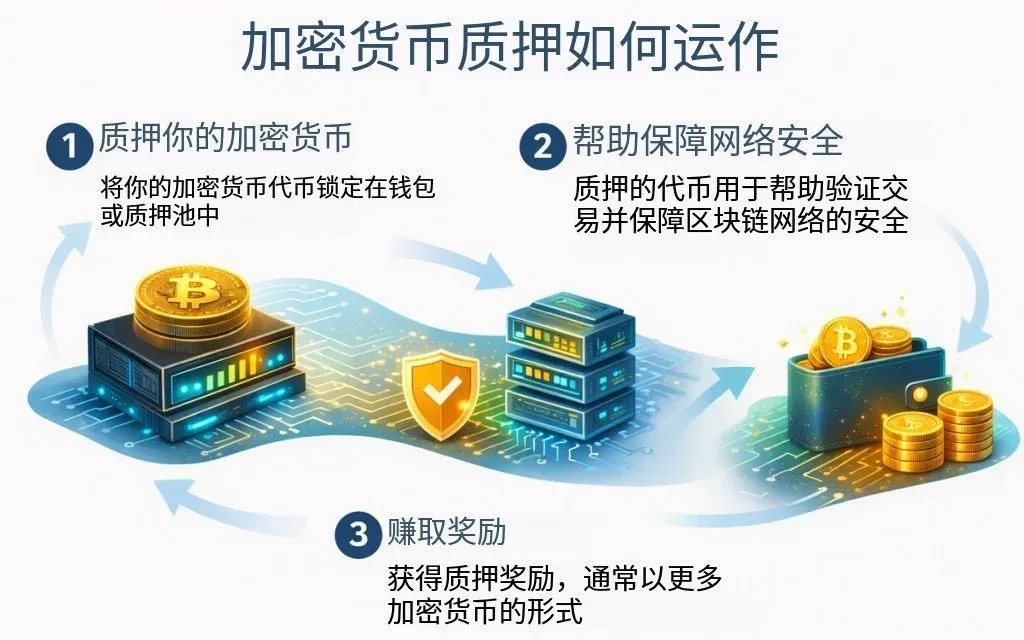
Staking means locking up a cryptocurrency on its blockchain network to support the network’s operation and security. In return, the network distributes rewards in the same token.
The process is analogous to a bank term deposit—your funds sit for a predetermined period and earn interest. While your tokens are locked, they are used to validate transactions and maintain the integrity of the blockchain, and you receive staking rewards for that participation.
Unlike traditional finance, staking occurs in a decentralized environment without banks or financial intermediaries; everything is executed by on‑chain protocols.
Types of Staking
There are several ways to participate in staking, each with different technical requirements, responsibility levels, and risk profiles.
✓ Solo Staking
Solo staking (running a private validator) means you operate your own validator node. This approach requires a certain level of technical knowledge, dedicated hardware, and usually a relatively large amount of the native token. While the potential yield can be higher, the associated responsibilities and risks are also greater.
✓ Delegated Staking
In delegated staking, you delegate your tokens to a validator who handles the technical work on your behalf. This is the most common method because it does not require technical expertise, making it ideal for newcomers who want to get started quickly.
✓ Staking Through an Exchange
Most centralized exchanges offer simplified staking services, generally divided into two categories:
- Flexible Staking – No fixed lock‑up period, typically lower annual percentage yields (APY).
- Locked Staking – A set lock‑up period, generally offering a higher APY.
This route is user‑friendly, but it carries custodial risk—your assets are held by the exchange rather than in your personal wallet. U.S. users should use Binance.US or another compliant platform rather than the global Binance service.
How Much Can You Earn From Staking?
Staking returns are usually expressed as an APY (Annual Percentage Yield), which reflects the compounded annual return.
What Is APY in Staking?
APY represents the expected growth of your staked amount over one year, assuming the network conditions remain stable. For example, a 6 % APY theoretically means you would earn roughly 6 % of the staked principal over a year.
Why Does the Annual Yield Change?
APY is not fixed; it fluctuates based on several factors, including:
- The total amount of tokens participating in staking
- Inflation or new token issuance mechanisms
- The performance and fee structure of individual validators
- Staking demand and the chosen lock‑up duration
Changes in any of these variables can cause the yield to rise or fall.
How Does Staking Actually Work?
Staking is built on the Proof‑of‑Stake (PoS) consensus mechanism, which replaces the energy‑intensive Proof‑of‑Work (PoW) model. In a PoS blockchain:
- Tokens are used to gain the right to participate in network consensus
- Selected validators verify transactions and create new blocks
- Honest operation earns rewards
- Malicious or negligent behavior results in penalties
Economic incentives align participants’ interests with the security and stability of the network.
Risks of Crypto Staking
Although staking can generate passive income, several risks must be considered:
- Slashing / Penalties – Validators that act improperly or violate protocol rules may have a portion of their staked tokens confiscated.
- Lock‑up and Liquidity – Some networks require tokens to remain locked for a set period, limiting the ability to sell or transfer them instantly.
- Market Risk – Even if staking yields are positive, a decline in the token’s market price can erode the overall value of your holdings.
*Note: In many jurisdictions, staking rewards may be treated as taxable income. Be sure to consult local tax regulations.*
Is Staking Worth It?
Staking may be appropriate if:
- You intend to hold your crypto assets for the long term.
- You want passive earnings without actively trading.
- You have confidence in the long‑term value and sustainability of the underlying blockchain network.
Conversely, if you require high liquidity or employ a short‑term, high‑frequency trading strategy, staking might not be suitable.
How to Start Staking on an Exchange
Exchange‑based staking is a low‑friction entry point for users with no technical background. The steps are straightforward:
- Choose a reputable exchange that offers staking services.
- Create an account and complete identity verification (KYC).
- Deposit or purchase the token you wish to stake.
- Select a staking product (flexible or locked).
- Review the APY, lock‑up period, and reward distribution frequency.
- Monitor your rewards through the exchange’s dashboard.
Conclusion on Crypto Staking
Staking provides a viable method for generating passive income while contributing to the security and operation of blockchain networks. Much like earning interest on a bank deposit, token holders can put their assets to work and receive a return.
Before committing funds, make sure you understand the applicable APY, associated risks, and any lock‑up terms. For long‑term investors, staking can be a component of a robust, diversified portfolio.
Frequently Asked Questions (FAQ)
Is crypto staking safe?
Staking is relatively safe, but it still carries risks such as slashing, lock‑up periods, and price volatility. Safety depends on the specific network and the staking method you choose.
Is staking worthwhile?
Staking tends to suit users who hold assets for the long haul and seek passive income, rather than active short‑term traders.
Which cryptocurrencies are best for staking?
There is no single “best” coin; selection should consider APY, network stability, and the project’s long‑term outlook. Ethereum and Solana are often cited among mainstream options.
How does staking work in practice?
In practice, you lock your tokens on a PoS network, indirectly participate in transaction validation, and receive passive rewards proportional to your contribution.
---
That concludes the article “What Is Crypto Staking? Principles, Returns, Risks and How to Operate.” For more staking‑related information, search for previous Bitaigen (比特根) articles or continue browsing the related posts below. Stay tuned to Bitaigen for future updates!
💡 Register on Binance with referral code B2345 for the maximum trading fee discount. See Binance complete guide.



