
 Bitaigen Research
 BRC20 is an experimental token standard on the Bitcoin blockchain that lacks smart contracts; ERC20 is a mature token protocol on Ethereum that supports full contract functionality. The two differ significantly in platform, technical implementation, and ecosystem compatibility.
BRC20 and ERC20 are both token standards responsible for the issuance and circulation of digital assets. Although they differ by only one letter on the surface, the reality entails multiple distinctions in technical implementation, ecosystem environment, and usage methods. The following sections explain these differences in detail.
From the three major dimensions of technology, ecosystem, and use cases, we systematically outline the key differences between BRC20 and ERC20, allowing readers to quickly grasp their fundamental distinctions. Subsequent sections will provide a detailed side‑by‑side comparison to help you make more informed decisions when selecting projects or allocating assets.
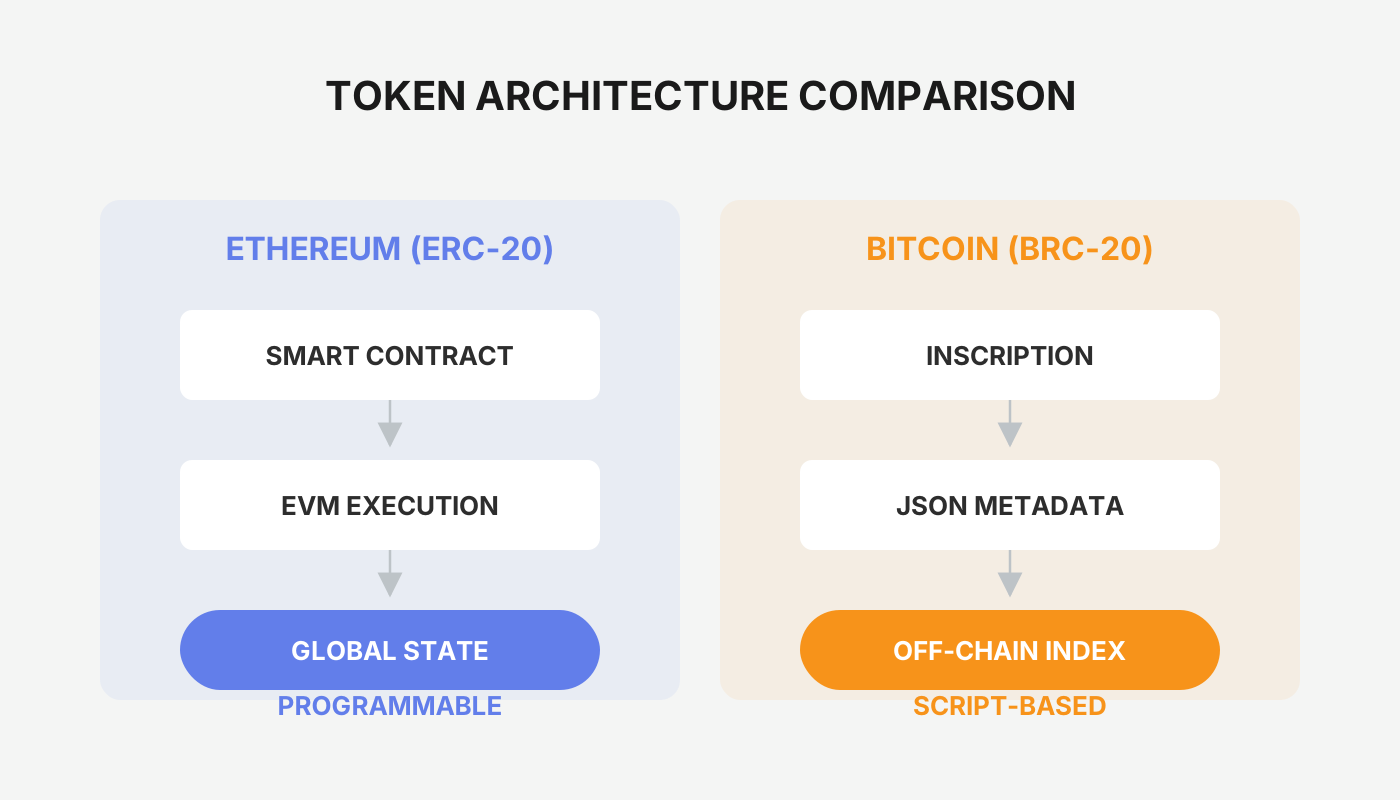
What are the actual differences between BRC20 and ERC20?
Below are several core differences to help you compare quickly:
| Dimension | **BRC20** | **ERC20** |
|---|---|---|
| **Smart contracts** | Relies on Bitcoin’s **Ordinal** protocol and does not use EVM contracts | Based on the Ethereum Virtual Machine (EVM) and written in Solidity as full contracts |
| **Blockchain platform** | Runs on the Bitcoin main chain and is an experimental token standard | Runs on the Ethereum public chain and is the mainstream token issuance protocol |
| **Compatibility & ecosystem** | Primarily limited to the Bitcoin network; ecosystem tools are relatively scarce | Compatible with multi‑chain wallets, DEXs, DeFi protocols; ecosystem is mature and widespread |
| **Issuance method** | Implemented by inscribing data onto the smallest unit, a satoshi (Inscription) | Implemented by deploying a contract and calling functions such as `mint` |
| **Transaction cost** | Influenced by Bitcoin’s fee structure and can be highly volatile | Influenced by Ethereum gas fees; costs can be reduced via Layer‑2 solutions |
1. Different smart‑contract approaches
Although both concepts stem from the idea of smart contracts, BRC20 uses Ordinal JSON data to mint tokens directly on the Bitcoin blockchain, lacking the programmability of traditional contracts; ERC20, on the other hand, implements complex transfer, allowance, and other functionalities through EVM contracts.
2. Different blockchain platforms
BRC20 is an experimental standard on the Bitcoin chain that employs the Ordinals protocol to assign a unique serial number to each satoshi; ERC20 is the standard protocol on the Ethereum network, featuring a complete governance mechanism and a large developer community.
3. Different compatibility
Because Ethereum is widely adopted, ERC20 tokens can be used directly in most wallets, decentralized exchanges, and DeFi applications; BRC20 tokens currently circulate mainly within a handful of Bitcoin‑specific tools, making their universality relatively limited.
What is BRC20?
BRC20 is a token standard built on the Bitcoin network, inspired by Ethereum’s ERC20. It leverages the Ordinals protocol to assign a unique serial number to each smallest Bitcoin unit (a satoshi), thereby creating non‑replicable digital‑asset markers known as BTC‑NFTs.
- Creation method: By inscribing text, images, audio, video, or other data onto a satoshi (called an *Inscription*), a fungible token is formed.
- Originator: Anonymous on‑chain analyst Domo, whose goal was to enable the issuance and transfer of fungible tokens on the Bitcoin chain.
- Technical characteristics: It does not rely on smart contracts or the EVM; any standard Bitcoin wallet can be used to mint and trade these tokens.
The above outlines the main differences between BRC20 and ERC20, as well as the basic concept of BRC20. For more information on BRC20, please follow the coverage from Bitaigen (比特根).
*Note: When converting fiat to crypto, transactions typically use USD and may be processed via SEPA or SWIFT channels depending on your region. U.S. residents should use Binance.US rather than the global Binance platform. Additionally, cryptocurrency gains may be subject to taxation in your local jurisdiction, so consider consulting a tax professional.*
Related Reading
- Understanding ERC20: Definition, Implementation, and Its Role in Ethereum DeFi
- ERC20 Guide: Standards, Gas & Secure Token Storage
- BEP20 vs ERC20: Guide to Cross‑Chain Token Conversion
💡 Register on Binance with referral code B2345 for the maximum trading fee discount. See Binance complete guide.



