
 Bitaigen Research
 We examine the concept of preconfirmations from a technical‑evolution perspective, analyze their crucial role in Based Rollup, and assess the potential impact of this mechanism on transaction latency and security. The goal is to help readers quickly grasp the core value of this cutting‑edge solution—please read on for an in‑depth understanding.
What Is Preconfirmations (Preconfs) Technology?
Preconfirmations (also called Preconfs) are essentially reliable “advance commitments” that are provided before a transaction is finally recorded on‑chain.
For example, when you reserve a table at a restaurant and the venue confirms your seat, that guarantee you receive before you actually arrive works like a preconfirmation; it lets you plan the rest of your itinerary without having to wait in line.
The idea is not brand‑new. Early Bitcoin community discussions introduced “0‑conf”, treating a transaction as valid before the block containing it receives its final confirmation, thereby shortening the waiting period for users. In 2023, Uri Klarman migrated this concept to Ethereum, proposing “Chained Preconfirmations”, which stresses that later preconfirmers can inherit the trustworthiness of earlier ones. Primev then deepened the notion, launching a “pre‑conf” bidding mechanism that enables a coalition of block builders to commit to including specific transactions during a defined window, allowing users to participate in a preconfirmation auction.
Primev’s mev‑commit is a decentralized platform focused on MEV‑transaction coordination. It uses real‑time cryptographic commitments and an efficient bidding system to provide reliable execution guarantees for high‑frequency trades that require rapid confirmation, including preconfirmations.
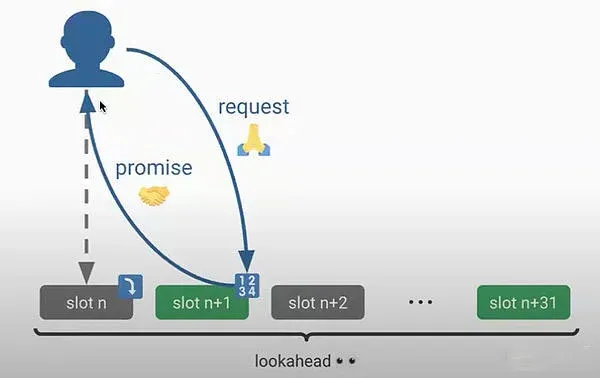
Building on this foundation, Justin Drake introduced “Based preconfirmations”, aiming to provide users with instantaneous preconfirmation signals while preserving fully decentralized ordering on L1, thereby compensating for the slower confirmation speed inherent to L1‑sequenced Rollups.
---
Why Do Based Rollups Need Preconfirmation Technology?
- In October 2020, Ethereum co‑founder Vitalik Buterin released the Ethereum Roadmap Centered on Rollups, which has since resulted in a multi‑Rollup ecosystem. While Rollups dramatically improve scalability and user experience, they also introduce new challenges of fragmentation and decision‑making costs. Developers must juggle many Rollups, switching between distinct chains, and the presence of centralized sequencers raises concerns about transaction censorship and MEV extraction, causing some users to bear unfair fees or sub‑optimal experiences.
- To address the limitations of centralized sequencers, two major directions have emerged: shared sequencers and Based Rollup. Shared sequencers offer a unified ordering service but, as third‑party entities, they struggle with trust and incentive alignment. Based Rollup, on the other hand, directly relies on Ethereum L1 proposers for ordering, boosting decentralization. However, its transaction‑confirmation latency is still bounded by the L1 block interval (≈ 12 seconds), making it hard to achieve the “soft‑confirmation” speed that centralized sequencers can provide.
---
The Proposal and Evolution of the Based Preconfirmations Mechanism
Early Conception
The term Based Rollup first appeared in Vitalik Buterin’s 2021 article *An Incomplete Guide to Rollups*, which introduced the notion of “Total Anarchy”: a fully decentralized environment where anyone can submit a batch at any time without restrictions.
In March 2023, Justin Drake expanded on this in *Based rollups—superpowers from L1 sequencing*, clarifying the core of a Based Rollup (also known as an L1‑sequenced Rollup): the generation and ordering of Rollup blocks are performed by Ethereum L1 proposers, while L2 builders package transactions and submit the resulting batch to L1. This design does not increase the load on L1 validators but inherits L2 security and liveness directly from L1.
First Preconfirmation Proposal
In November 2023, Drake tackled the confirmation‑delay problem of Based Rollup by proposing Based preconfirmations. The core ideas were:
- Re‑staking mechanism – L1 proposers must accept additional penalty conditions to qualify for preconfirmation rights.
- Inclusion lists (ILs) – Proposers must possess the ability to force‑include specific transactions on‑chain.
Optimized Variant
Drake later refined the concept, simplifying it as follows: a subset of validators voluntarily assumes the ordering role, while the remaining validators act solely as “includers,” responsible for writing transactions to the chain without participating in ordering. The ordering validator can reshuffle the includers’ transactions and even inject extra ones. Users submitting a transaction have two possible pathways:
- Low‑fee path – Send the transaction to a backup mempool, where includers incorporate it for a modest fee.
- High‑fee path – Communicate directly with the next ordering validator, paying a higher preconfirmation fee to secure faster inclusion.
Compared with the initial proposal, the optimized version leverages Ethereum L1’s economic security directly, eliminating the need for extra penalty layers and reducing reliance on dedicated infrastructure.
---
Real‑World Deployments: Projects Built on Preconfirmation
Taiko – A Pioneer’s Implementation
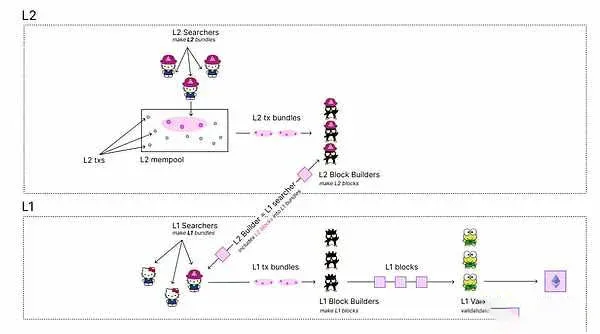
Since the second half of 2023, Taiko has been working toward a Based Rollup architecture. Its network consists of decentralized proposers running a custom client called `taiko-geth`, which stay in sync with the L2 mempool. When a proposer detects a batch of profitable transactions, it packages the L2 block and submits it to Ethereum L1.
The transaction flow proceeds as follows:
- A user’s transaction first lands in the L2 mempool.
- L2 searchers select profitable transactions and assemble them into a block.
- L1 searchers, acting as proposers for the L2 block, order those transactions and embed the complete L2 block into an L1 block.
- L1 validators then confirm and record the data on the Ethereum mainnet.
To improve efficiency, Taiko incorporates a preconfirmation mechanism: proposers broadcast the list of transactions they intend to include before the block is officially posted, and they can publish preconfirmed sub‑batches to L1 in stages, reducing the cost of a single data publication.
To avoid conflicts where multiple proposers might submit blocks containing the same transactions, Taiko implements leader election: at any given moment only one proposer holds the exclusive right to submit a block, while any competing block is rolled back, preventing fee loss due to contention.
Puffer UniFi – Re‑shaping Cross‑Chain Liquidity with Preconfirmations
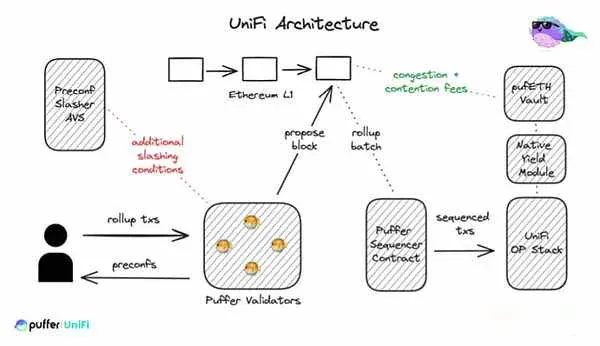
Puffer Finance’s UniFi also adopts a Based Rollup model, outsourcing transaction ordering to Ethereum L1. Its preconfirmation workflow relies on Native Restaking validators:
- A user’s transaction is first handled by validators who have already restaked on Ethereum.
- Within roughly 100 ms, the validator returns a preconfirmation promise, informing the user that the transaction has been received and will appear in a forthcoming block.
- To enforce validator performance, UniFi deploys an AVS (Attestation Validation Service) that imposes additional penalties for defaults.
- After the preconfirmation, the validator bundles the transaction with others and submits the batch to L1. UniFi’s `Sequencer Contract` receives the batch and guarantees that it cannot be rolled back.
The roadmap indicates that UniFi’s testnet is slated for launch in September 2024, with the AVS mechanism synchronizing with mainnet deployment in Q4 2024.
UniFi’s ambition is to solve cross‑chain liquidity fragmentation. Because a single L1 validator orders multiple Rollups, users can move assets between Rollups without using a bridge. For instance, Alice’s tokens on Rollup A can be directly pledged as collateral for a loan on Rollup B, with both transactions settling in the same Ethereum block.
---
Other Noteworthy Preconfirmation Innovations
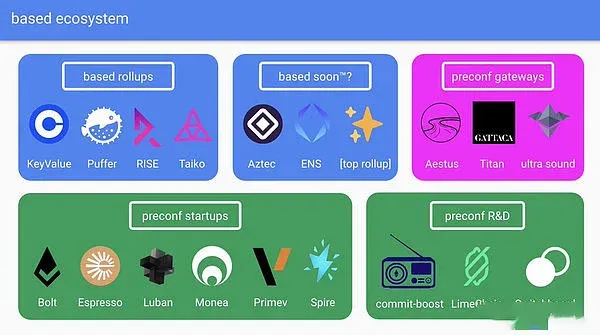
- Primev’s mev‑commit platform can supply preconfirmation services to any Based Rollup and proposes a hybrid solution that combines Inclusion Lists (IL) with blob preconfirmations.
- Espresso introduced Proposer‑Promised preconfirmations, allowing Rollups to customize proposer ordering and slashing conditions.
- Spire built a Preconfirmation Registry that offers ETH‑staked operators and independent stakers a channel to publish preconfirmations.
- Chainbound’s Bolt protocol lets Ethereum proposers make explicit commitments about the contents of their blocks.
Researchers are also exploring the concept of a preconfirmation gateway to simplify the user experience. A gateway would act on behalf of users, handling the complex interactions required for preconfirmation, delegating rights to a professional central service that communicates with proposers and maintains node availability. Projects such as Aestus, Titan, and Ultra Sound have already made progress in this direction.
---
Summary
Liquidity fragmentation remains a pressing issue in today’s Rollup landscape. Adam Cochran, partner at Cinneamhain Ventures, highlighted on Twitter that Based Rollup could become a key pathway to alleviate economic pressure on Ethereum Layer 2. Preconfirmation technology plays a decisive role in enhancing the user experience of Based Rollup and shortening transaction‑confirmation times. As projects like Taiko and Puffer UniFi continue to iterate, and innovative solutions from Primev, Espresso, and others emerge, preconfirmation is steadily maturing. We will keep monitoring developments in this space and bring readers the latest first‑hand information.
Please note: Cryptocurrency gains may be subject to tax in your local jurisdiction; consult a qualified tax professional for advice.
*Compiled by the editorial team at Bitaigen (比特根). Thank you for reading!*
Related Reading
- 2026's Top 10 Secure Crypto Exchanges – Rankings & Review
- USDC vs USDT: Key Differences, Compliance, and Security Explained
- Double Spending Explained: Causes, Safeguards & Risks
💡 Register on Binance with referral code B2345 for the maximum trading fee discount. See Binance complete guide.



