
 Bitaigen Research
 Bitway Project Overview
The core of the Bitway project is to combine the risk‑management framework of traditional finance with the on‑chain transparency of decentralized finance, creating a hybrid model known as DeTraFi. DeTraFi is designed to satisfy the growing demand of digital‑asset investors for high‑quality, composable yields: it keeps execution and settlement publicly verifiable on‑chain while adhering to institution‑grade asset‑allocation and custodial standards. The model does not replace either DeFi or TradFi; instead, it acts as a bridge between the two, allowing retail users to capture stable returns derived from traditional finance without the need for massive capital or cumbersome processes.
From an industry perspective we decode Bitway’s DeTraFi model, explaining how it merges traditional‑finance risk controls with DeFi’s on‑chain transparency to open the door to institution‑level returns for retail investors. This article outlines the platform’s core mechanisms and token economics, helping you grasp the key concepts quickly. Later sections provide deeper analysis, so a thorough read is recommended.
How DeTraFi Works
- Advantages of DeFi: globally accessible, on‑chain transparent, borderless.
- Advantages of TradFi: mature risk controls, stable long‑term returns, strict capital allocation.
DeTraFi brings TradFi risk parameters onto the on‑chain execution layer, enabling assets in a decentralized environment to enjoy institution‑grade safety and yields. All asset allocations, executions, and financial records are publicly posted on the blockchain; users only need to provide modest capital to participate in audited strategies.
---
Bitway Platform Overview
Bitway has built a strategic layer that sits atop on‑chain infrastructure, solving the problem of digital assets being scattered across multiple chains, wallets, and exchanges, which makes unified yield generation difficult. Through a trusted neutral layer, the platform directs on‑chain liquidity toward institution‑grade earning opportunities, achieving:
- A blend of on‑chain transparency + off‑chain efficiency.
- Conversion of idle assets into capital that can generate yields.
- Operation on the BNB Smart Chain and the proprietary Bitway Ledger (a Bitcoin‑compatible dPoS L1), with cross‑chain support via bridges such as ɃTCT.
The project was incubated by EASY Residency, endorsed by YZi Labs, and has deep cooperation with the Binance Wallet (US users should access Binance services via Binance.US). This partnership lays the groundwork for large‑scale community incentives.
---
Bitway Earn: How the Yield Product Is Implemented
Bitway Earn uses an audited staking vault on BNB Chain to offer market‑neutral, delta‑neutral yield strategies. The workflow is as follows:
- Users deposit stablecoins such as USDT, USDC, etc., into the vault. The system instantly mints a corresponding vault token (e.g., bwUSDT) and starts accruing interest.
- The vast majority of the deposited funds are transferred to institution‑grade custodial accounts (multi‑sig wallets, regulated exchanges, or trusted third parties). Only a small on‑chain reserve is kept to support standard unstaking (7‑day notice) or emergency instant unstaking.
- The assets are then fed into optimized market‑neutral strategies that capture funding‑rate differentials or execute sophisticated arbitrage to generate stable returns.
- All profits are settled back into the vault on a regular schedule; users can withdraw principal and earnings at any time, and the vault tokens they hold always represent full ownership of the underlying assets.
In addition, the platform runs a BW points system that grants extra incentives to active participants.
---
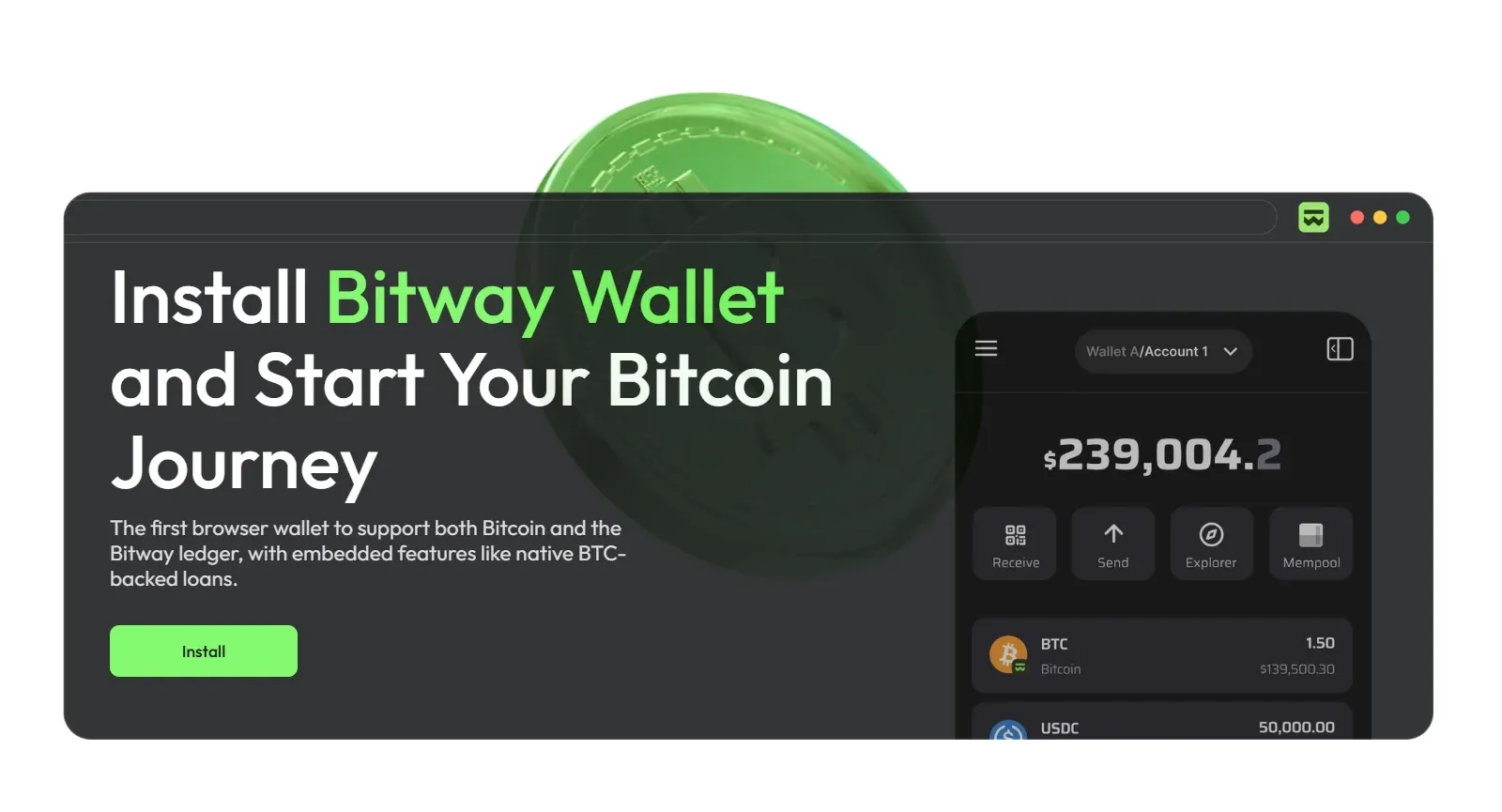
Bitway Ledger and Deep Bitcoin Integration
Bitway Ledger is a dPoS L1 chain specifically designed for Bitcoin, built on Cosmos‑SDK and CometBFT to achieve fast consensus and high throughput. Its core features include:
- Full compatibility with Bech32 / Bech32m (Taproot, native SegWit) addresses, allowing users to sign transactions directly with Bitcoin wallets such as OKX Wallet, Unisat, Ledger, Xverse, etc., without needing an EVM address.
- An embedded light client (SPV) that can verify main‑net Bitcoin transactions with just six confirmations, combined with cosmos.crypto.segwit for private‑key/public‑key validation, ensuring seamless interaction between Bitcoin and the Ledger.
- Key components:
- Bitway Lending – a trust‑less BTC‑collateralized loan system built on discrete‑log contracts, equipped with decentralized oracles, open liquidity pools, and automatic liquidation.
- ɃTCT Bridge – a validator network that employs FROST threshold signatures to enable secure Bitcoin movement across multiple chains.
These designs create a closed loop that lets BTC move freely between different blockchains while maintaining the highest security standards.
---
Overview of ɃTCT (Bitcoin Token)
ɃTCT is the native token of Bitway Ledger, locked 1:1 with Bitcoin on the main net. Compared with the Lightning Network, ɃTCT offers:
- Static addresses that can be used directly in existing Bitcoin wallets, eliminating the need for one‑time invoices or dynamic routing fees.
- Gas‑free peer‑to‑peer transfers, supporting instant L1 settlement, batch transactions, continuous streams, and conditional releases.
- Security model: based on Bitway validators’ TSS threshold signatures, with withdrawal windows and global/per‑address caps to prevent massive sudden outflows.
- Cross‑chain convenience: a one‑click IBC router enables seamless migration to other chains; the FROST key‑refresh mechanism allows validator rotation without affecting vault addresses, enhancing long‑term resilience.
The design of ɃTCT removes the practical barriers that have kept Bitcoin largely a store of value, turning it into a flexible on‑chain medium of exchange.
---
Bitway Token (BTW) Details
The BTW token is the core governance and incentive instrument of the Bitway ecosystem, serving multiple functions such as revenue distribution, payments, fundraising, and community governance. Token specifics are:
- Token name: Bitway
- Symbol: BTW (the “by the way” note in the original Chinese has been omitted for clarity)
- Native chain: BNB Smart Chain (mainnet), with extensions to Bitway Ledger and future plans for additional chains.
- Total supply: 10,000,000,000 BTW
Because the Token Generation Event (TGE) has not yet commenced, the circulating supply is still being planned. Early allocation is outlined below:
Utility: BTW rewards participants in Bitway Earn, provides liquidity for lending and other products, and creates a positive incentive loop. Holders can vote on protocol upgrades, economic parameters, and treasury allocations, directly influencing the long‑term roadmap on both BNB Chain and Bitway Ledger.
In addition, BTW stakers may delegate to validators to take part in dPoS consensus, earn network‑fee rewards, and use the token to pay for all on‑chain transaction fees.
---
Summary
Through the DeTraFi model, Bitway blends institution‑grade risk management with decentralized on‑chain transparency, delivering a complete pathway from idle assets to yield‑generating capital. The platform’s flagship products—Bitway Earn, Bitway Lending, and Bitway Wallet—work in concert with the Bitcoin‑compatible Bitway Ledger and the ɃTCT bridge to construct a cross‑chain, cross‑ecosystem yield ecosystem. The BTW token plays a pivotal role in governance, incentives, and network operation, supplying the momentum needed for sustainable community growth.
*Note*: Crypto gains may be taxable in your jurisdiction; consult local tax regulations. When dealing with fiat on‑ramps, the platform primarily supports USD via SEPA/SWIFT channels.
The above provides a detailed overview of the Bitway (BTW) token, its mechanics, tokenomics, and overall operation. For further information, continue following reports from Bitaigen (比特根).
Related Reading
💡 Register on Binance with referral code B2345 for the maximum trading fee discount. See Binance complete guide.



