
 Bitaigen Research
 We systematically outline BlockDAG’s technical architecture, hybrid consensus mechanism, and the mobile‑first X1 mining model in this article, and we dive deep into the BDAG token’s economic model, development roadmap, and pre‑sale participation details, helping readers gain a comprehensive understanding of the project’s innovative value and application prospects. It is worth a careful read.
Overview of BlockDAG (BDAG)
BlockDAG is a brand‑new Layer‑1 public chain built on a Directed Acyclic Graph (DAG) structure, aiming to break through the speed, scalability, and energy‑consumption bottlenecks that traditional blockchains face. By processing transactions in parallel, employing a hybrid PoW + DAG consensus, and offering a mobile‑centric X1 mining application, BDAG enables ordinary smartphone users to take part in network security and revenue sharing. The project has already closed a $338 million pre‑sale financing round, selling a total of 23.8 billion tokens, and is gradually constructing the underlying infrastructure for high‑demand scenarios such as DePIN, GameFi, and fintech.
Key Features
- DAG Parallel Architecture – Unlike linear blockchains that record transactions sequentially, BlockDAG allows multiple transactions to be validated simultaneously, markedly increasing throughput while reducing fees.
- Hybrid PoW + DAG Consensus – Maintains decentralized security while cutting energy consumption.
- X1 Mobile Mining – Ordinary smartphones can contribute hashing power, lowering the barrier to entry and encouraging mass participation.
- Multi‑Scenario Adaptation – Especially well‑suited for DePIN, real‑time payments, gaming, and high‑frequency financial services.
Token Functionality and Economic Model
The BDAG token is the core asset of the entire ecosystem and serves several primary purposes:
| Purpose | Description |
|---|---|
| **Staking & Validation** | Holders can lock BDAG to provide computing power to the network and earn block rewards. |
| **Mobile Mining Rewards** | Tokens earned through the X1 app are sent directly to the user’s wallet. |
| **Governance & Voting** | Token holders can participate in on‑chain governance proposals and influence protocol upgrades. |
| **Transaction Fees** | All on‑chain transactions require BDAG to pay fees, creating a baseline demand. |
| **Smart‑Contract Deployment** | Future dApps will consume BDAG as execution fuel. |
The total token supply and allocation details are fully disclosed in the whitepaper. The project team promises a “no‑vesting pass” during the pre‑sale phase, allowing purchasers to unlock all their tokens in a single transaction once the token lists.
Note: Crypto gains may be taxable in many jurisdictions. Participants should consult local tax regulations and consider filing obligations under SEPA, SWIFT, or other fiat‑to‑crypto channels where applicable.
Pre‑Sale Participation Process
BlockDAG is currently running an official pre‑sale. Investors can subscribe to tokens within the price window of $0.0010 – $0.0016 per BDAG during the window that opened on March 1 2024. The pre‑sale will run until the “no‑vesting pass” stage concludes on August 11 2025.
- Start Date: 2024‑03‑01
- End Date: 2025‑08‑11 (no‑vesting pass window)
- Accepted Currencies: USDT, ETH, BNB
- Minimum/Maximum Limits: Currently unlimited; tokens can be unlocked immediately after purchase (only during the no‑vesting window)
Participation is straightforward: open the project’s official pre‑sale page, connect the Bitget wallet, select the desired payment currency, and complete the swap. If the purchase is made within the no‑vesting window, the tokens will be distributed in a single tranche when the mainnet launches; otherwise, they will vest according to the schedule announced by the project.
Role of the Bitget Wallet
Bitget provides a one‑stop pre‑sale gateway with an integrated DApp browser, allowing users to access platforms such as PinkSale, Pump.fun, and Solanium without leaving the wallet. The wallet supports multiple chains—including Ethereum, BNB Chain, and Solana—offers secure signing, whitelist verification, and airdrop collection. Please note that Bitget does not support fiat on‑ramps, does not endorse any project, and users are responsible for conducting their own due diligence.
Listing Plan and Exchange Arrangements
BlockDAG aims to complete a global listing around August 11 2025, with the inaugural trading pair being BDAG/USDT. To date, more than 20 centralized exchanges have confirmed they will list the token; the full roster will be announced via official channels in due course.
- Deposit Opening: Expected 2025‑08‑11
- Trading Commencement: Tentatively 2025‑08‑11
- Withdrawal Rules: Withdrawals may be processed within 24 hours of listing, following each CEX’s standard procedures
Differences Between CEXes and DEXes
Centralized exchanges (e.g., MEXC, Binance) provide high liquidity, comprehensive trading tools, and custodial asset management. Decentralized wallets (e.g., Bitget) let users retain full control of their private keys, enabling self‑custody that aligns with the philosophy of decentralized finance. Both models have merits; participants should choose the venue that best fits their risk tolerance and operational preferences. U.S. users should use Binance.US or other U.S.-compliant platforms rather than the global Binance site.
Price Outlook and Influencing Factors
BDAG’s market performance will be shaped by a combination of macro‑crypto conditions, real‑world ecosystem adoption, and the project’s milestone execution.
- Macro Environment: Bitcoin price trends, regulatory developments, and overall liquidity cycles can all cause volatility for BDAG.
- Ecosystem Adoption: The scale of X1 mining users, integration of DePIN projects, and the launch of smart contracts are key drivers of token demand.
- Technical Progress: Successful cross‑chain asset support, ASIC hardware releases, and the rollout of DeFi suites will provide long‑term value support.
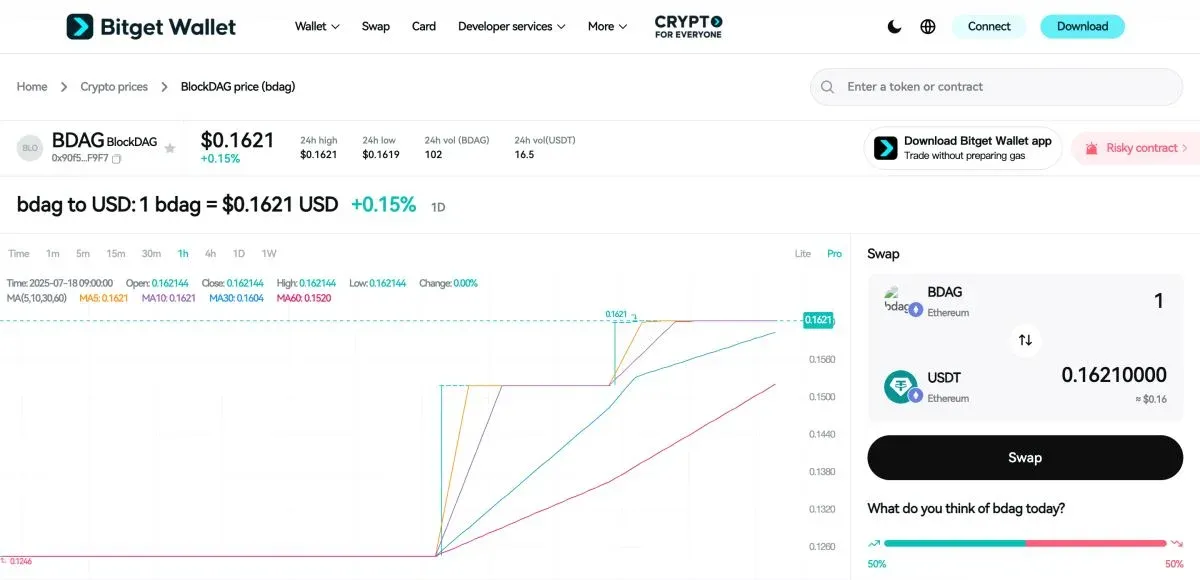
Most analysts currently estimate that BDAG’s initial trading range after listing could sit between $0.02 – $0.05. Should ecosystem expansion proceed smoothly, the token might climb to $0.08 – $0.10 by year‑end. Prospective participants should evaluate market volatility, regulatory risk, and project timelines before committing capital.
Roadmap and Key Milestones
| Timeframe | Milestone |
|---|---|
| **Q1 2025** | Complete security audit, improve browser performance tools, begin internal mainnet testing. |
| **Q2 2025** | Enable cross‑chain assets (USDT, USDC), integrate Trust and Plus Wallets, expand X1 mobile mining, release BDAG ASIC hardware. |
| **Q3 2025** | Launch DeFi suite (DEX, lending, bridge, launchpad), roll out on‑chain analytics browsers, accelerate dApp development and prepare governance modules. |
These milestones are designed to position BDAG as a scalable Layer‑1 that can be deployed across DeFi, mobile mining, and infrastructure‑level Web 3 applications.
Team and Partners
Core Members
- Antony Turner – CEO / Founder, with extensive fintech and blockchain entrepreneurship experience; former COO of a Swiss crypto investment firm.
- Dr. Youssef Khaoulaj – Chief Security Officer, veteran in cybersecurity and smart‑contract auditing; previously served Intelcia Group and a central bank.
- Steven Clarke‑Martin – Senior Advisor, over 20 years in decentralized technology, providing policy and technical counsel to multiple institutions.
- Marius Bock – Chief Project Manager, 25 years in blockchain and fintech, contributed to IOHK/Cardano wallet development.
- Joshua Sack – Mining Lead, PoW and network‑security specialist, responsible for expanding the mobile‑mining ecosystem.
Strategic Partnerships
The project has forged collaborations with entities such as Inter Milan, Seattle Kraken, Seattle Kraken (note: likely Seattle Kraken hockey team), HackerEarth, SpaceDev, and others. These partnerships aim to bring blockchain technology into sports, culture, developer education, and other diverse use‑cases, boosting BDAG’s ecosystem visibility and real‑world deployment opportunities.
Primary Use Cases
- Distributed Physical Infrastructure Networks (DePIN) – Low‑latency, high‑throughput design fits IoT micro‑payment scenarios like distributed energy, mesh networking, and similar applications.
- Mobile Mining – The X1 app enables anyone with a smartphone to contribute hashing power, lowering entry barriers and fostering inclusive Web 3 participation.
- Real‑Time Financial Payments – Parallel processing capability supports high‑frequency, low‑cost cross‑border remittances and merchant payments.
- Smart Contracts & dApps – The upcoming contract layer will provide the execution fuel for DeFi, NFT marketplaces, and other decentralized services.
Closing Remarks
BlockDAG (BDAG) is not merely a hype‑driven concept; it is a full‑stack Layer‑1 solution built around a DAG architecture, mobile‑first mining, and tangible ecosystem deployment. Backed by strong pre‑sale financing, a clear technical roadmap, and a diverse set of partners, BDAG offers early investors, developers, and users who wish to engage with the next generation of Web 3 infrastructure a concrete value entry point.
Frequently Asked Questions
1. What is BlockDAG (BDAG) and how does it work?
BlockDAG is a Layer‑1 blockchain that uses a DAG structure, allowing transactions to be validated in parallel while retaining PoW security and energy efficiency. This results in faster confirmation times and higher scalability.
2. What specific roles does the BDAG token play?
BDAG is used for network staking, mobile‑mining rewards, on‑chain governance, fee payments, and future smart‑contract execution. It is the sole value carrier within the ecosystem.
For more details on the BlockDAG (BDAG) pre‑sale, please refer to related articles on Bitaigen.
Related Reading
- BlockDAG Architecture, Roadmap & Hybrid Consensus Overview
- BlockDAG (BDAG) Token: Mainnet, TGE & Listings in Feb 2026
- BlockDAG (BDAG) Price Forecast 2026‑2030: Will It Rise?
💡 Register on Binance with referral code B2345 for the maximum trading fee discount. See Binance complete guide.



