
 Bitaigen Research
From both technical and economic perspectives, we deeply dissect the core mechanisms of the Hyperlane network and the design logic of the HYPER token, helping readers understand the governance philosophy, incentive model, and cross‑chain innovation potential behind the airdrop. By objectively evaluating market performance and ecosystem deployment, this article offers reference points for judging the project’s outlook—please continue reading.
Price trajectory of the Hyperlane (HYPER) token
Since the public airdrop on 22 April 2025, the market performance of the HYPER token has experienced noticeable volatility. The airdrop allocated 57 % of the total supply directly to the community to encourage early participation and embody a decentralized ownership ethos. By the end of April 2025, the token price briefly surged to a historical high of roughly $0.35, after which a typical correction occurred, bringing the price down to the current level of about $0.165. The current market capitalization stands at approximately $28.3 million, with a circulating supply of 175.2 million tokens, representing 17.5 % of the peak supply of 1 billion tokens. Token price is influenced by overall crypto‑market sentiment as well as concrete progress from Hyperlane, such as new chain integrations and partnership announcements. The protocol also implements a quarterly reward program based on developer and end‑user activity, which could provide additional price support as the network grows.
*Note: Gains from cryptocurrency transactions may be taxable in your local jurisdiction. Please consult a tax professional for guidance.*
Overview of HYPER token economics
The total supply of HYPER is fixed at 21 billion tokens, allocated as follows:
- Finance: 25 % (used for business development and community activities)
- Marketing: 20 % (covers global marketing, viral campaigns, paid and organic media)
- Rewards: 15 % (includes staking incentives, airdrops and other promotional mechanisms)
- Listing: 10 % (supports HYPER listings on major exchanges)
- Development: 30 % (funds ongoing feature iteration and technical upgrades)
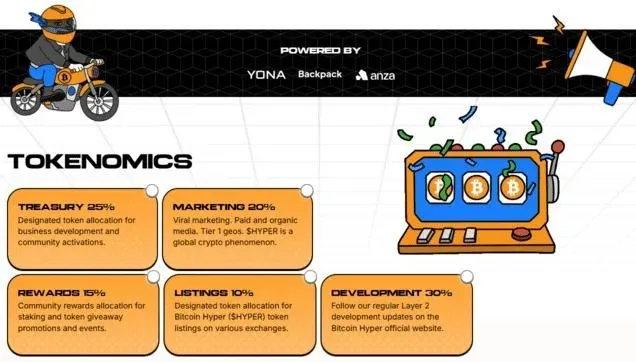
Image source: bitcoinhyper.fun
Current key metrics and interesting statistics
- Market cap around $28.3 million, ranking roughly 750th by market cap.
- Circulating supply 175.2 million tokens, out of a maximum supply of 1 billion, yielding a circulation ratio of 17.5 %.
- Supports more than 150 blockchain networks and 5 virtual machines, placing it among the leading interoperability protocols.
- Daily trading volume ranges between $24 million and $28 million, primarily concentrated on centralized exchanges such as Binance (U.S. users should use Binance.US), Bybit, and MEXC.
- Since launch, cumulative cross‑chain asset transfers have exceeded $5 billion, demonstrating real‑world usage scenarios and adoption.
- Post‑airdrop peak price of $0.35; the current price reflects a decline of roughly 53 % from that high.
- Within the community holding model, 57 % belongs to users, 25 % to the core team, 10.9 % allocated to investors, and 7.1 % placed in the foundation treasury.
What is Hyperlane?
Hyperlane is an open‑source cross‑chain interoperability layer designed to break down barriers between disparate blockchains without requiring permission. The protocol supplies the underlying messaging infrastructure that enables smart contracts on any supported chain to interact directly with contracts on other supported chains, covering simple token transfers to complex multi‑chain applications. Compared with traditional centralized bridging solutions, Hyperlane adopts a modular architecture that lets developers define their own security models rather than being forced into a one‑size‑fits‑all approach.
How Hyperlane works
Decentralized node network
The protocol deploys decentralized nodes across multiple chains. These nodes collectively validate and process cross‑chain messages, ensuring transparency, resistance to attacks, and greater user autonomy.
Core interoperability layer
Hyperlane’s core technology provides a unified interoperability layer for each chain. All cross‑chain messages and transactions are recorded on a public, immutable ledger, enabling secure and efficient communication.
Modular security framework
The protocol utilizes plug‑in cross‑chain security modules (ISMs). Developers can select from economic security, optimistic security, or dynamic security schemes based on their business requirements. Dynamic security can automatically route messages, applying different security tiers for low‑value versus high‑value transactions.
Message transmission flow
- Dispatch: A user or application calls `dispatch` on the Outbox contract of the source chain, writing the message into an ever‑growing Merkle tree and generating a cryptographic proof.
- Verification: Validators sign the Merkle root that aggregates a batch of messages, rather than signing each message individually, enhancing censorship‑resistance.
- Relay: Relayers use the signed proof to call the Inbox contract on the destination chain, securely delivering the message to its target.
Warp Routes cross‑chain bridging
Warp Routes offer a low‑slippage, fast, and low‑cost solution for token bridging. Developers can bridge any token between supported chains using a simple command‑line interface. Relayers earn fees through an open incentive mechanism and do not need to lock assets.
Technical implementation details
Hyperlane implements message sending and receiving by deploying smart‑contract “mailboxes” (Inbox/Outbox) on each supported chain. A message is inserted as a leaf node into the Merkle tree of the source chain’s Outbox, then a zero‑knowledge proof guarantees its existence and validity. Validators sign the Merkle root, forming cross‑chain consensus; relayers, armed with this signature, invoke the target chain’s Inbox contract, writing the message into that chain’s state. The entire workflow operates without centralized validators, relying solely on on‑chain contracts and a decentralized node network.
Team and backing capital
Hyperlane was founded by a team with extensive experience in blockchain infrastructure and venture capital. Co‑founder Asa Oines previously served as Chief Engineer at Celo, where he led the core protocol architecture; Nam Chu Hoai, also from Celo, provides full‑stack blockchain engineering support; Jon Kol previously worked at Galaxy handling venture investments and operational strategy, offering critical guidance for commercial partnerships and financing. The project secured a $18.5 million seed round led by Variant, with participation from Galaxy Ventures, CoinFund, Asymmetric, Hypersphere, Circle, Figment, Blockdaemon, Kraken Ventures, and NFX, underscoring industry confidence in Hyperlane’s solution to interoperability challenges.
Current status within the ecosystem
Hyperlane has become a key player in the cross‑chain interoperability space. Its permission‑less deployment model allows any blockchain to integrate the protocol without approval from a central team, dramatically accelerating ecosystem expansion. Hundreds of cross‑chain applications run daily on Hyperlane’s infrastructure, and the protocol has already integrated with projects such as NERO Chain and Fuse Network, further extending its reach across diverse ecosystems. As blockchain architecture shifts from single‑chain to multi‑chain designs, Hyperlane’s decentralized validator network and customizable security modules successfully overcome the single‑point‑of‑failure and security bottlenecks that plagued early bridge solutions.
Future development roadmap
The next focus is to improve infrastructure scalability while steadfastly adhering to security and decentralization principles. The roadmap outlines plans to strengthen developer tooling and SDKs, lowering the barrier for building cross‑chain applications, and to provide chain‑specific support based on individual network characteristics. Simultaneously, Hyperlane will continue introducing additional cross‑chain security module options and refining verification mechanisms to boost overall security without sacrificing efficiency. As more Layer‑1 and Layer‑2 networks join, Hyperlane aims to become the foundational communication layer for the multi‑chain ecosystem.
Why Hyperlane is crucial for the crypto industry
Hyperlane’s permission‑less deployment redefines the paradigm of blockchain interoperability, removing the constraints imposed by centralized bridges. Its modular security model lets developers tailor solutions to specific risk appetites and use‑cases, delivering truly flexible and secure cross‑chain applications. Supporting over 150 chains and 5 virtual machines positions Hyperlane as an indispensable infrastructure for a multi‑chain future. As blockchain networks become increasingly specialized and proliferate in number, the seamless interoperability that Hyperlane provides will be a key enabler for unlocking the full potential of decentralized technologies.
Conclusion
Hyperlane is reshaping the landscape of cross‑chain communication by delivering permission‑less, universal cross‑chain messaging. With its open architecture, modular security design, and strong community and capital backing, it has already demonstrated a distinctive competitive edge in the crypto sector. Confronted with both technical and adoption challenges, Hyperlane’s continuous innovation and clear roadmap position it to become a core pillar of future decentralized technology. Whether you are new to blockchain or a seasoned professional, the project merits attention and participation in its growing ecosystem.
---
For a comprehensive view of the Hyperlane (HYPER) token, you may consult previous Bitaigen (比特根) articles or continue browsing the related links below. Thank you for supporting Bitaigen (比特根)!
*All fiat transactions referenced in this article are assumed to be conducted via standard SEPA or SWIFT networks where applicable.*
Related Reading
- Bitcoin Hyper (HYPER) Review: Layer‑2 Smart Contracts, Staking & Near‑Instant Lo
- Hyperlane (HYPER) Token: Cross‑Chain Messaging & Economics
- Hyperlane Cross‑Chain Framework: Design, Value & Price Surge
💡 Register on Binance with referral code B2345 for the maximum trading fee discount. See Binance complete guide.



