
 Bitaigen Research
 InfoFi Track Evolution and Outlook Overview
==========================================
In the crypto ecosystem, information itself is gradually being regarded as a tradable asset. From Kaito’s “Yap‑to‑Earn” model to Cookie.fun’s point system, the value of attention and narrative is being re‑defined. Below we systematically explain the full picture of InfoFi from the perspectives of industry background, core concepts, key projects, entry methods for everyday users, and potential risks, and we also provide practical guidance and pitfall‑avoidance tips.
As the Bitaigen editorial team, we have mapped out the origins, core mechanisms, and ecosystem layout of InfoFi to help readers quickly grasp the value logic behind information assets. The article balances industry trends with actionable paths, includes risk warnings, and is worth reading to capture the next wave of the attention economy.
Industry Drivers and Rise Logic
The emergence of InfoFi is not accidental; it is the result of several converging trends:
- AI and Large‑Model Enablement: In recent years, large language models (LLMs) and natural‑language‑processing technologies have achieved efficient harvesting and sentiment analysis of massive social, news, and on‑chain behavior data, providing the technical foundation for quantifying and pricing information.
- Demand from the Attention Economy: In crypto markets, “attention precedes price” has become the norm. Project hype often foreshadows price swings. InfoFi materializes this leading signal, allowing investors to directly wager on information flows.
- Evolution of Airdrop Models: Traditional airdrops focus on user actions (such as token holdings or on‑chain interactions) and are prone to automation by bots. InfoFi shifts the focus to “who is speaking and how many people see it,” turning dissemination itself into a token‑earning channel and creating a native mining model for the information age.
These three factors reinforce each other, making the asset‑ization of information possible and opening a new pathway for ordinary investors to move from “watching coins” to “trading information.”
The Essence and Definition of InfoFi
InfoFi (Information Finance) centers on converting previously hard‑to‑quantify resources—project attention, KOL reputation, narrative activity, and the like—into tradable, price‑discoverable financial instruments. In short, information is treated as a “new asset” within this framework. It serves both as a speculative tool and as a signal‑extraction engine, enabling market participants to bet on information heat and helping investors capture early opportunities amid noise.
Unlike traditional finance where stocks, bonds, or pure digital tokens are traded, InfoFi focuses on “invisible resources” such as attention and information. Building on SocialFi, it goes a step further: not only does it incentivize content creation, but it also reshapes how information value is measured through algorithms and incentive mechanisms, driving a structural transformation of attention capital.
Representative Projects and Gameplay Overview
Several products have already emerged within the InfoFi ecosystem. Below they are grouped by impact.
1. Kaito
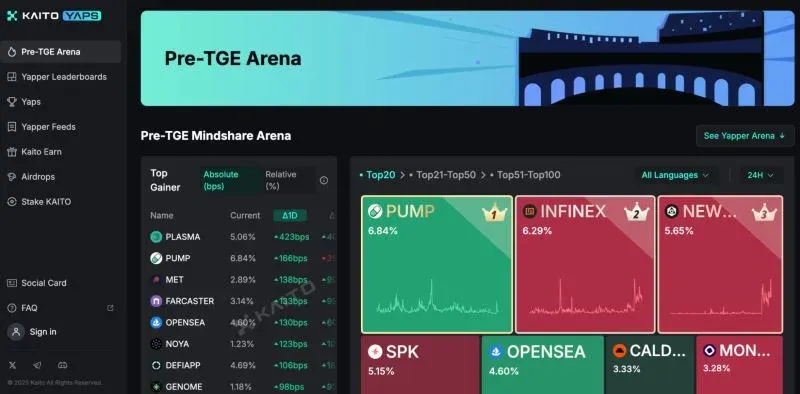
- Mechanism Summary: As a pioneer of InfoFi, Kaito introduced the Yaps point system, using AI to quantify a user’s influence and content contribution on X (formerly Twitter). Users earn Yap scores by posting high‑quality tweets and interacting with high‑reputation accounts, then appear on the platform leaderboard.
- How to Participate: Register for Kaito Yaps, connect your X account and crypto wallet, and consistently produce original content while engaging in community discussions.
- Potential Rewards: Top‑ranked users can receive the platform’s native token, priority access to IDOs and NFT sales, and Yaps can also be spent to unlock platform functionalities.
2. Cookie.fun
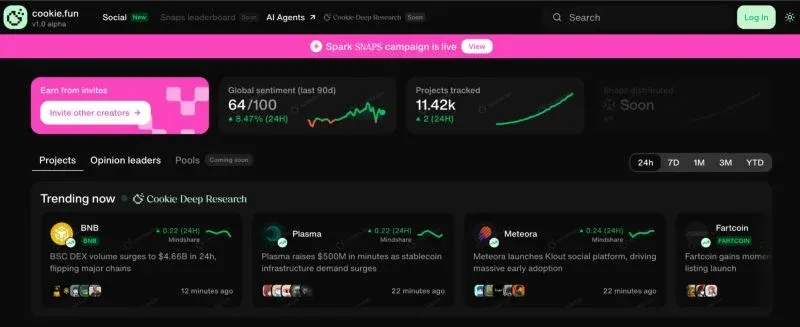
- Mechanism Summary: Powered by the Cookie DAO, this AI‑driven data‑panel project awards Snaps points to users who publish content around officially designated topics (e.g., Spark, CookieDAO). The platform simultaneously monitors mindshare, social trends, and sentiment metrics.
- How to Participate: Tweet on X containing the required hashtags and the project’s official account, or earn points by inviting new users and staking COOKIE tokens.
- Potential Rewards: High Snaps scores can earn OG badges, possible airdrops, and access to advanced features such as Cookie Deep Research, thereby boosting a user’s community influence rating.
3. Galxe (Starboard)
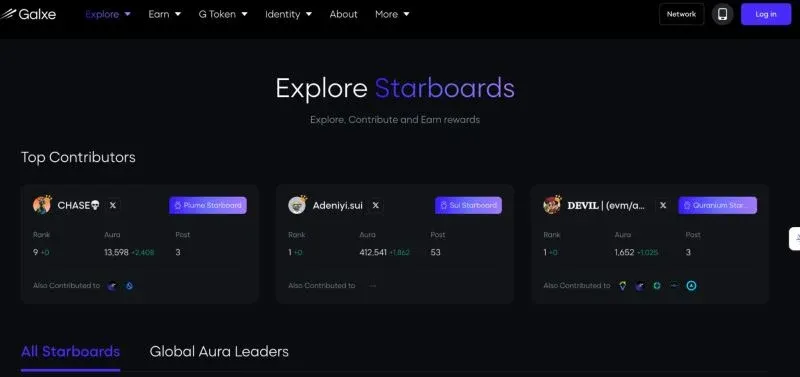
- Mechanism Summary: Starboard blends on‑chain actions with off‑chain content, employing AI sentiment analysis to generate Aura reputation points. Users can raise their Aura by publishing high‑quality tweets related to partner projects such as Plume, 0G, or Dango.
- How to Participate: Produce X‑based content about the listed projects, or complete traditional Galxe tasks.
- Potential Rewards: Users with high Aura may receive project‑specific rewards (NFTs, tokens) and enjoy preferential treatment in subsequent campaign participation thresholds.
4. Ethos Network
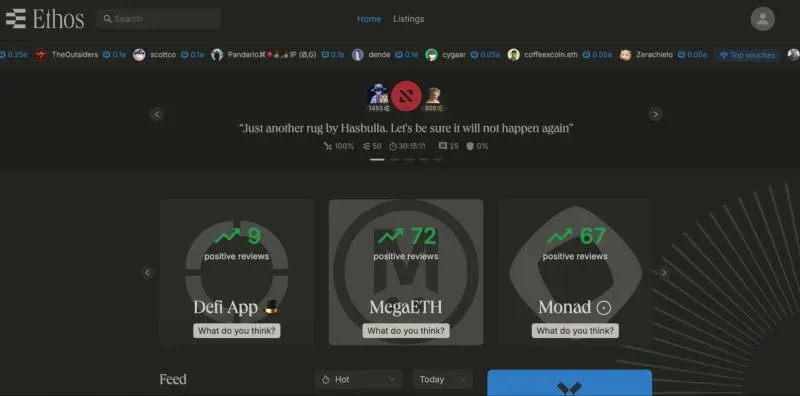
- Mechanism Summary: Constructs an on‑chain reputation system where participants generate decentralized “credit scores” through positive, neutral, or negative evaluations, guarantees, and trust/distrust vote trades.
- How to Participate: Evaluate other users, cast votes, provide guarantees, or engage in Ethos Markets’ credibility prediction contests.
- Potential Rewards: Elevating one’s reputation score grants access to trust resources; trading trust votes or earning XP can qualify users for airdrops, turning reputation into a long‑term asset.
5. Noise
- Mechanism Summary: Built on data streams from Kaito and similar services, Noise is an attention‑index trading platform where users speculate on the trend of a crypto project’s mindshare with high leverage, rather than trading the token’s price directly.
- How to Participate: After receiving an invitation, enter the platform and select a target in the mindshare market for trading.
- Potential Rewards: If a user correctly anticipates that a project’s attention will rise, they can position early and capture price differentials via leverage. The project is still in testing, and future airdrops may accompany its launch.
6. GiveRep
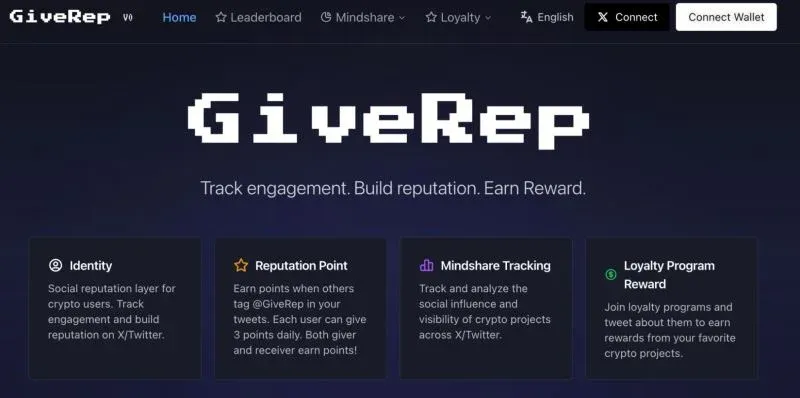
- Mechanism Summary: A SocialFi protocol on the Sui blockchain that transforms Twitter activities (tweets, engagements, tags) into on‑chain reputation assets $REP, forming a Trophy Score and Reputation Point system.
- How to Participate: Tag @GiveRep in a tweet or join a specific project’s Loyalty Program.
- Potential Rewards: Points can be swapped for REP or partner‑project tokens, building a multidimensional on‑chain identity profile and granting long‑term community recognition or airdrop eligibility.
Project Positioning Comparison: Kaito leans toward professional KOLs with a relatively opaque algorithm; Cookie.fun emphasizes community participation with transparent scoring rules. The two exemplify the professional and mass‑adoption pathways within InfoFi. In addition, newcomers such as Wallchain, MirraAI, XHunt, QuoteChain, and DexCheck continuously enrich the ecosystem, innovating around content contribution, attention trading, and reputation assessment.
Typical Entry Paths for Retail Investors
Ordinary investors can capture value or earnings on the InfoFi track through several avenues:
- Content Creation for Points (Write‑to‑Earn)
Consistently publish high‑quality tweets, in‑depth posts, or thread series on platforms like Kaito, Cookie.fun, or Galxe to accumulate Yaps, Snaps, Aura, etc. The primary investment here is time and creativity, making it suitable for long‑term commitment. Users should stay vigilant against bot‑generated accounts and learn to differentiate genuine KOLs from noise.
- Direct Trading of Information Assets
Buy and sell attention indexes or reputation scores on platforms such as Noise and Ethos. This approach demands strong judgment of information trends, real‑time monitoring of market sentiment, and swift execution.
- Supplementary Investment Decision‑Making
Use data from Kaito’s heat‑ranking, Ethos’s reputation scores, and similar metrics as reference points to gauge project quality and community vigor. Information‑side data often captures consensus shifts before price movements.
- Project Token Investment
Track early‑stage InfoFi projects’ tokenomics, team credentials, and technical roadmaps for medium‑ to long‑term positioning. This method carries both risk and upside and is best suited for investors with patience and a diversified portfolio.
- Testnet Participation and Airdrops
Actively join new projects’ testnets, community tasks, or content‑contribution programs to qualify for early airdrop rewards. Most InfoFi initiatives incentivize active users with airdrops prior to mainnet launch, keeping entry costs relatively low.
Each path emphasizes different resources and skill sets; users can combine them flexibly according to personal strengths and interests.
Risk Warnings and Pitfall‑Avoidance Guide
Although InfoFi opens fresh opportunities, it also hides several categories of risk that require caution:
- Echo Chambers and Filter Bubbles
Heavy reliance on InfoFi tools may lead to consumption of algorithmically curated, homogeneous viewpoints. Proactively seek diverse sources to avoid being trapped in an echo chamber.
- Community Quality and Bot‑Inflated Activity
Scrutinize whether discussions possess technical depth and a variety of perspectives. A surge of identical marketing copy or a high proportion of automated accounts often signals artificial volume.
- Transparency of Point Mechanisms
For projects that award “points” or “visibility credits,” read the whitepaper carefully to confirm that scoring rules are public and incentives are reasonable. Prioritize platforms with clear mechanisms and robust DAO governance.
- Independent Judgment
Data and leaderboards supplied by InfoFi should be treated as reference material; final decisions must stem from personal research. Cross‑verify information across multiple channels to prevent blind herd behavior.
- Due Diligence
Investigate the project team, technological implementation, token economics, and governance structure. Only with a comprehensive understanding can participants engage while keeping risk manageable.
Regulatory Note: In many jurisdictions, gains from trading crypto‑related assets—including information‑based tokens or reputation points—may be subject to tax. Users should consult local tax advisors to ensure compliance with applicable laws.
Fiat On‑Ramp Guidance: When converting fiat to crypto for participation, global users typically use USD transfers via SEPA or SWIFT. U.S. residents must use Binance.US or other regulated U.S. exchanges rather than the global Binance platform.
Future Development Trends and Industry Impact
InfoFi is reshaping the perception of information value and may evolve along several major trajectories:
- Deeper Integration with DeFi
On‑chain reputation scores from Ethos could become credit criteria for DeFi lending, allowing high‑trust users to obtain lower interest rates or more favorable collateral ratios. DeFi quant strategies may also incorporate InfoFi sentiment indices as trading signals.
- Synergistic Evolution with SocialFi
Social tokens for content creators will receive more equitable pricing through quantified attention metrics, enabling mid‑tier creators to gain meaningful exposure and revenue streams.
- Rise of AI Participants
AI agents could act as active traders in InfoFi markets, executing information arbitrage and risk‑hedging strategies. Future ecosystems might feature AI‑centric prediction markets or smart research systems that feed InfoFi data back into broader applications.
- Organized Narratives and Consensus Mechanisms
Information will become increasingly structured and organized within community collaboration, with tokens serving as narrative carriers that tightly couple information flow and value flow. Project teams and communities will proactively design topics and incentives, fostering self‑generated value creation.
Overall, InfoFi is empowering data sovereignty for users and expanding the boundaries of the attention economy. As the track matures, more mechanisms characterized by community co‑governance and open data will emerge, making information production and distribution fairer and more pluralistic. For retail participants, grasping the essence of InfoFi, leveraging the right tools, and exercising disciplined risk management will be key to capturing the next wave of alpha.
This concludes our systematic review of what InfoFi is, its developmental background, project mechanics, and future trends. Enjoy exploring the world of information finance safely and responsibly!
Related Reading
- InfoFi Explained: On-Chain & Off-Chain Data Fusion in Web3
- Kaito Token Soars 70%: InfoFi & Attention Economy Explained
- InfoFi: On‑Chain Reputation, Attention & Prediction Markets
💡 Register on Binance with referral code B2345 for the maximum trading fee discount. See Binance complete guide.



