
 Bitaigen Research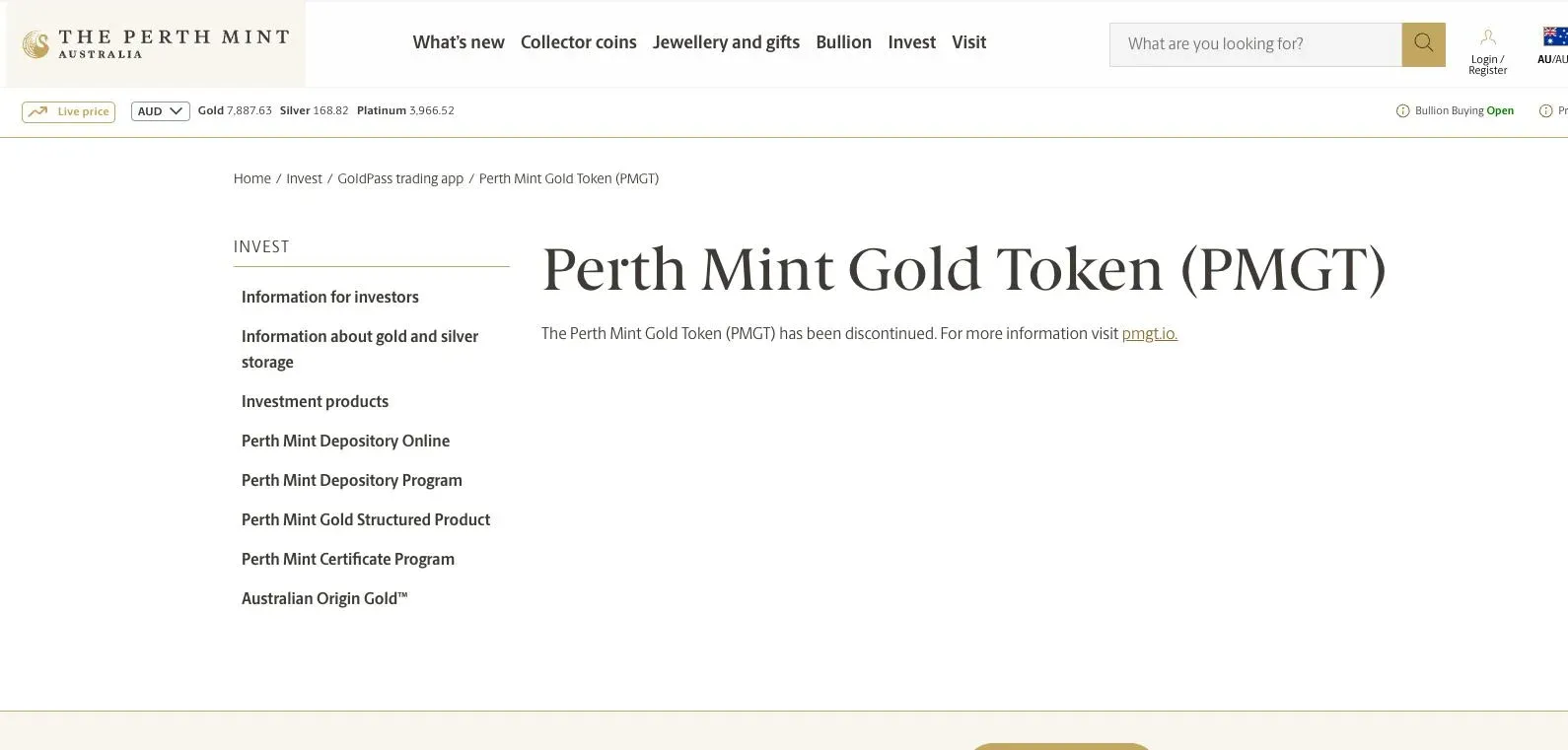
In this article we conduct an in‑depth analysis of the issuance mechanism, asset backing, and on‑chain operation of the Perth Mint Gold Token (PMGT). By combining industry trends, we provide a systematic forecast of its price trajectory over the next several years. A comprehensive interpretation of the technical details and regulatory framework is offered to help readers understand the potential value and risks of the project. Continue reading for the full analysis.
Project Overview — What Is the Perth Mint Gold Token and How Does It Work
The Perth Mint Gold Token (PMGT) was launched in 2019 by Trovio (formerly InfiniGold) in partnership with the Perth Mint, which is owned by the Government of Western Australia. The token follows the ERC‑20 standard on Ethereum and is 1:1 backed by a GoldPass certificate that represents physical gold held by the Perth Mint, creating a direct correspondence between the on‑chain token and off‑chain, government‑guaranteed gold.
Holders can first obtain a GoldPass certificate and then mint it into PMGT for on‑chain transfer; conversely, PMGT can be redeemed on the platform back into a GoldPass, which can subsequently be exchanged for physical gold or cash (USD, SEPA/SWIFT transfers). From a technical perspective, PMGT relies on Ethereum’s consensus mechanism for transfers and settlement, while gold custody and the smart‑contract logic are maintained separately by the Perth Mint and Trovio.
In 2023, both parties announced the termination of the project: Trovio ceased support for the smart contract, and the Perth Mint declared that the GoldPass and PMGT platforms would cease production. Since then, the token exists only as a legacy asset, with liquidity and ongoing support severely constrained.
Main Features
- Gold backing (historical): Each PMGT corresponds to one GoldPass certificate, which is underpinned by gold fully allocated by the Perth Mint and enjoys a government guarantee.
- ERC‑20 portability: Conforms to the Ethereum standard, allowing transfers via compatible wallets and, while active, use in DeFi scenarios.
- GoldPass interchangeability: Enables two‑way conversion between the token and GoldPass, ultimately redeemable for physical gold or cash.
- Regulatory endorsement: The project leveraged government‑backed gold to attract investors seeking regulated gold exposure on a public blockchain.
- Termination and manual redemption: The product has been discontinued; new holders can only realize value by submitting a manual redemption request, as the original automated mechanisms are no longer operational.
Token Economics — The Role of PMGT
Historically, the amount of PMGT issued was directly tied to the quantity of gold tokenized via GoldPass, with no fixed cap. The current on‑chain view shows a total supply of approximately 1.17 K PMGT, of which only a few hundred (roughly 115‑300) are in circulation. This reflects extensive redemptions and liquidations that occurred after the shutdown.
Because trading has virtually halted, real‑time market capitalization is largely meaningless. Some data providers still list a nominal price close to the gold‑linked value, but given the minuscule circulating supply and near‑zero 24‑hour volume, the practical market cap often reads $0 or falls below six figures. In theory, a fully diluted valuation would equal the quoted price multiplied by total supply, yet in a liquidity‑starved, delisted environment such calculations are purely illustrative.
The token was originally intended to provide:
- On‑chain exposure to gold;
- A tradable ERC‑20 representation of a metal;
- A value bridge among physical gold, digital certificates, and blockchain tokens.
Following termination, PMGT no longer fulfills these functions; its sole remaining value lies in the holder’s ability to obtain the corresponding gold or cash through the issuer’s manual redemption process.
Market Position and Competitive Advantages
During its active phase, PMGT differentiated itself from other tokenized‑gold projects by combining “government‑guaranteed gold + reputable institution.” Its brand endorsement, physical backing, and ERC‑20 compatibility appealed to investors seeking compliance and transparency.
Today, the token has effectively exited the competitive landscape. Other tokenized‑gold initiatives continue to operate and expand, whereas PMGT’s smart contract no longer accepts new transactions, and the official team has issued a delisting notice. It now serves more as an early‑stage case study within the tokenized‑commodity space, illustrating the exit risks that RWA (real‑world asset) projects may encounter under regulatory and operational pressure.
Primary Risks
- Termination risk: The product is officially closed; holders must complete redemption within a limited window, which may be hindered by policy changes or time constraints.
- Liquidity risk: Multiple price‑tracking platforms report virtually zero 24‑hour volume, resulting in an effective market cap of $0 and making secondary‑market exit extremely difficult.
- Counterparty risk: Redemption requires a manual request to the PMGT support team, tying outcomes to the issuer’s execution capability and communication efficiency.
- Technical risk: Although the contract remains viewable on Etherscan, it receives no official maintenance; any potential vulnerabilities are unlikely to be patched.
- Compliance risk: Media coverage of regulatory disputes and Trovio’s decision to cease support suggest the project may have faced legal and supervisory challenges.
- Price‑discovery risk: Sparse trading activity prevents prices from reflecting realizable value; a single trade can wildly distort price metrics.
Adoption and Ecosystem Indicators Worth Monitoring
Because the project is terminated, current adoption metrics primarily track residual holdings rather than growth prospects. The preview page on CoinMarketCap shows:
- Total supply around 1.17 K PMGT;
- Circulating supply under 120 tokens;
- Approximately 200‑300 holders.
Other aggregation sites report similar figures, confirming that the holder base has shrunk to three‑digit numbers.
Key points to watch include:
- Circulating supply and holder count: A declining trend signals ongoing redemptions; a plateau may indicate that some holders have not completed the process or have lost access.
- Market cap and trading volume: Persistently near‑zero readings highlight an almost dormant market, even though the quoted price still hovers near the historic gold‑peg level.
- Official documentation updates: Announcements on pmgt.io and the Perth Mint’s channels regarding cut‑off dates, manual redemption instructions, or liquidation progress are critical for the remaining holders.
PMGT Trade‑Price Analysis and 2026‑2030 Outlook
Historical data show that PMGT’s trade price once tracked closely with gold, reaching peaks in the $1,800‑$1,900 range, with occasional anomalous spikes above $70,000 (likely due to extreme illiquidity or data errors). At present, most platforms still display a nominal price near $1,800, but 24‑hour volume is effectively zero and market‑cap figures are inconsistent, indicating that these prices serve more as references than executable offers.
From 2026 to 2030, the token’s quoted price is no longer the primary concern for holders; the decisive factor is whether value can be realized through manual redemption. On‑chain transactions, if any, will be exceedingly rare and largely detached from the broader narrative of tokenized gold.
Scenario Assumptions
The following scenarios illustrate possible outcomes for legacy holders and do not constitute investment advice:
- Conservative scenario: The redemption window tightens further, and legal or procedural obstacles prevent some holders from cashing out. Secondary‑market liquidity remains near zero, causing the token price to diverge sharply from gold’s market value.
- Base scenario: The manual redemption process remains functional for several years, allowing most holders to exit at a level close to the current spot gold price (after reasonable fees). On‑chain trades stay minimal, and the token gradually fades from the market.
- Optimistic scenario: The issuer extends or streamlines redemption services, possibly partnering with third‑party intermediaries. Limited OTC venues continue to trade small amounts at a fair gold‑peg price, enabling holders to realize value with relative ease.
All scenarios presume the Ethereum network continues to operate normally and that the Perth Mint and its support channels keep providing the necessary services, with only the accessibility and efficiency of redemption varying over time.
Drivers Explained
- Conservative: Documentation requirements, cut‑off dates, and jurisdictional hurdles, combined with product termination and lack of exchange listings, impede redemption for a subset of holders, effectively stripping the token of value despite any gold price movements.
- Base: The existing manual redemption mechanism remains viable for a few years, allowing most holders to receive value comparable to the prevailing gold price less reasonable costs. As tokens are redeemed or burned, the on‑chain remainder shrinks, leaving only balances lost due to forgotten keys or unresponsive owners.
- Optimistic: Improvements to the process, an extended redemption window, or the involvement of an intermediary raise the redemption rate substantially. Simultaneously, a handful of secondary or OTC platforms can offer trades near the gold‑peg, preserving modest liquidity. In this environment, the underlying gold price dictates the absolute value received by holders.
Useful Official Links
- Official page (Perth Mint PMGT overview)
https://www.perthmint.com/invest/goldpass/perth-mint-gold-token-pmgt/
- PMGT main site and support portal
https://www.pmgt.io
- Manual redemption contact form
https://pmgt.io/support/
- Smart‑contract address (Etherscan)
https://etherscan.io/token/0xaffcdd96531bcd66faed95fc61e443d08f79efef
Frequently Asked Questions
Is the Perth Mint Gold Token (PMGT) still operating?
No. Both the Perth Mint and the PMGT team have confirmed that the product and its smart contract are no longer supported.
Can I still redeem my PMGT?
According to the instructions on pmgt.io, remaining holders may only redeem by submitting a manual redemption request. The outcome depends on the issuer’s policies and timing.
Why does CoinMarketCap still show a PMGT page?
The page is displayed in “preview” mode, showing historical supply figures and a minimal amount of trade data. It reflects residual on‑chain information rather than an active trading market.
Does PMGT still track the price of gold?
In theory the token remains pegged to GoldPass, which is linked to gold. In practice, due to termination, thin trading, and the manual redemption requirement, the quoted price on screen does not accurately represent the realizable value for holders.
Is PMGT a suitable investment target for 2026‑2030?
Given the product’s termination, extremely low liquidity, and reliance on manual redemption, PMGT is not appropriate as a forward‑looking investment instrument. Holders should focus on redemption progress rather than treating it as a tradable asset.
Closing Remarks
The Perth Mint Gold Token represents an early institutional experiment in the tokenized‑gold space, attempting to combine government‑backed physical gold with a GoldPass certificate and an ERC‑20 token. Its subsequent shutdown highlights the profound impact of regulatory, operational, and commercial sustainability challenges on real‑world‑asset projects, and forces remaining holders to depend on a meticulous liquidation process.
Looking ahead to 2026‑2030, the core discussion around PMGT has shifted from price movements to whether redemption can be completed smoothly, whether support channels will persist, and what risk lessons can be drawn from this case study of tokenized commodities. Users holding the token should prioritize reviewing the latest official guidance, carefully assess the risks associated with near‑zero liquidity, and devise an appropriate exit strategy.
*Note: Cryptocurrency transactions may give rise to taxable events. Participants should consult local tax regulations and, if necessary, seek professional advice to ensure compliance.*
💡 Register on Binance with referral code B2345 for the maximum trading fee discount. See Binance complete guide.



