
 Bitaigen Research
 What Is Debridge (DBR)?
Debridge (ticker DBR) is a decentralized protocol whose core consists of generic cross‑chain messaging + value transfer. It offers non‑pooled cross‑chain asset swaps and function calls, enabling atomic interactions across multiple blockchains.
After three years of operation and the milestone of more than $10 billion in cumulative transaction volume, one of the co‑founders jokingly asked, “WTF is deBridge?”. So, what exactly is deBridge? What value does it bring to users and to the broader ecosystem? Let’s explore the details together with the editors at Bitaigen (比特根).
From the perspectives of technology, ecosystem, and end‑users, we break down deBridge’s core mechanisms, its long‑term value proposition, and the steps to claim the airdrop. We also provide an objective price outlook in line with current market trends. If you want to understand why this cross‑chain protocol is gaining attention and how to participate safely, keep reading for the full analysis.
deBridge (DBR) Current Price
Debridge (DBR) is trading at $0.02321. In the last 24 hours it recorded a trading volume of $780.99 K, a market cap of $41.7 M, and a market share of 0.0055 %. The price has moved ‑1.77 % over the past 24 hours.
Note: Crypto gains may be taxable in your jurisdiction. Be sure to consult a tax professional and comply with local tax regulations. For fiat on‑ramps and withdrawals, the global market generally uses USD, SEPA, or SWIFT transfers.
DBR Price Data
| Metric | Value |
|---|---|
| 24 h Volume | $780.99 K |
| All‑time High | $0.05764 |
| 24 h High | $0.02425 |
| All‑time Low | $0.005 |
| 24 h Low | $0.02296 |
DBR Market‑Cap Information
- Market cap: $41.7 M
- Fully diluted market cap: $231.7 M
- Market‑cap / FD‑market‑cap ratio: 18 %
- Market sentiment: Bullish
DBR Supply Details
- Circulating supply: 1.8 B DBR
- Total supply: 10 B DBR
- Maximum supply: 10 B DBR
What Is deBridge?
deBridge links multi‑chain applications through a “generic cross‑chain message + value transfer” model. It allows a single transaction to carry both CALLDATA and assets, naturally supporting composable cross‑chain contracts (e.g., pre‑investment checks, post‑investment callbacks, cross‑chain commands, etc.). Its 0‑TVL (no pooled liquidity) transaction network routes value on‑demand between chains, reducing attack surface and the risk of funds being locked up in a central pool.
Pain Points Addressed by deBridge
- Uncertain cross‑chain stablecoin costs: Fees vary widely from one chain to another.
- Message‑asset separation: Traditional bridges often require a message to be sent first, followed by a separate asset transfer.
- High custodial / pooling risk: Concentrating assets in a bridge pool creates an attractive target for attackers.
deBridge solves these issues by sending message + asset in the same transaction, employing validator signatures together with a delayed fault‑tolerance mechanism, thereby improving cross‑chain composability and robustness.
Technical Architecture
Generic Messaging Layer
The protocol gathers transaction parameters on the source chain and creates a unique hash. Once the message achieves finality on the destination chain, the original CALLDATA is executed, optionally accompanied by an asset transfer. This delivers an atomic “call + settlement” experience.
Validators & Slashing Layer
A set of decentralized validators submits and signs cross‑chain messages. When a predefined signature threshold is reached, the message is considered delivered. Signatures are recorded on a decentralized data layer, allowing any executor on the destination chain to submit the signature bundle and complete the delivery. Governance can introduce delegated staking and slashing, making validators and their delegators financially liable for misbehavior.
Liquidity Network (DLN)
DLN is a 0‑TVL, self‑organizing order‑matching network: users place orders on the source chain, solvers fulfill them on the destination chain, and then reclaim the source‑chain assets. The fee structure consists of a fixed message fee + variable protocol fee (4 bps) + operational overhead/solver profit. The official documentation recommends using the `create‑tx` API to inject real‑time fee parameters.
dePort Custodial Bridge
dePort offers a “lock‑mint / unlock‑burn” bridge for native assets, creating synthetic assets (deAsset) usable on the destination chain. This is ideal for tokens that need to extend their utility onto a new blockchain.
*Image Source: X*
Tron Integration: Amplifying Stablecoin Liquidity and User Base
In August 2025, deBridge announced its launch on Tron, becoming the 16th IaaS (Infrastructure‑as‑a‑Service) onboarding chain and instantly interoperable with 25 other chains. According to *thedefiant*, Tron’s ≈3‑second block time, massive USDT reserves, and mobile‑first user base make it a perfect match for deBridge’s real‑time cross‑chain use cases. The official fee schedule lists a fixed cross‑chain message fee of 4 TRX with a 20‑block confirmation period.
How Does deBridge Connect to Tron USDT Liquidity?
Stablecoins on Tron are bridged to networks such as Ethereum and Solana via deBridge. Developers can directly trigger asset transfers together with message calls, enabling low‑slippage payments, arbitrage, and cash‑flow management, thereby bringing Tron‑based stablecoins into a broader DeFi ecosystem.
Tokenomics (DBR): Governance, Staking, and Ecosystem Incentives
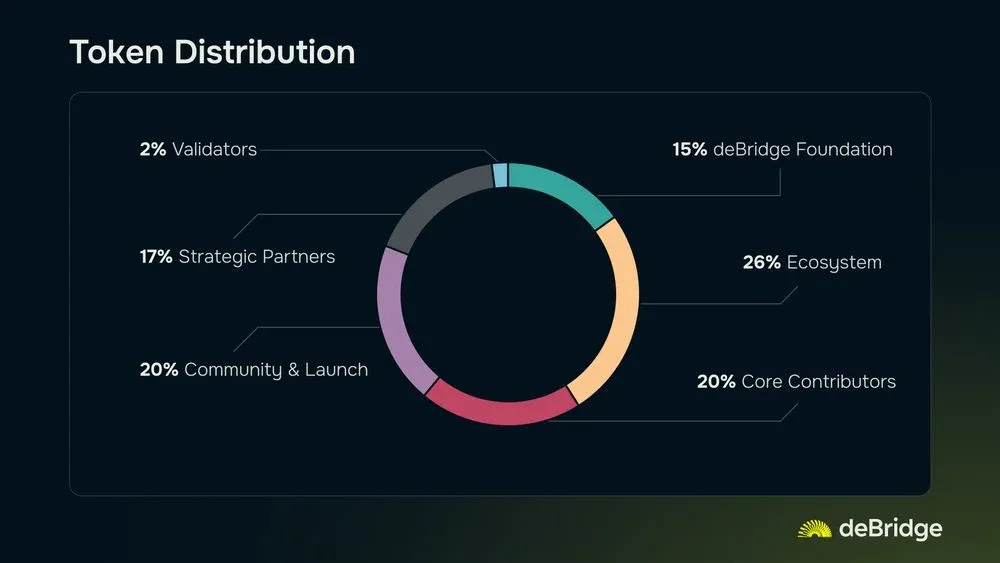
According to the information published on debridge.finance, the total DBR supply is 10 billion, allocated as follows:
| Category | Share |
|---|---|
| Community & Launch | 20 % |
| Ecosystem | 26 % |
| Core Contributors | 20 % |
| Foundation | 15 % |
| Strategic Partners | 17 % |
| Validators | 2 % |
After the Token Generation Event (TGE), the community and ecosystem portions are released immediately, while the remainder vests starting six months after TGE, linearly over three years on a quarterly basis. DBR is used for governance and staking: holders can stake to participate in governance votes and parameter adjustments, and they provide slashing‑eligible collateral for validators, thereby raising the economic security frontier for cross‑chain messages.
Ecosystem & Partnerships: Who Is Using deBridge?
Public‑Chain & Layer‑2 Integrations (IaaS On‑boarding)
deBridge already supports the major L1/L2 networks and continues to expand. In addition to Ethereum, Solana, BNB Chain, Polygon, Arbitrum, Optimism, Base, and Linea, recent additions include Berachain, Abstract, Zircuit, Flow, Mantle, Plume, Sophon, and Sei, as well as the official Tron integration (fixed 4 TRX message fee, 20‑block confirmation). These chain‑level integrations provide predictable costs and broader reach for stablecoin and application liquidity.
Wallets / Aggregators / Protocol Integrations (Application Layer)
The ecosystem partners span wallets, DEXs, aggregators, lending/derivatives platforms, payment and acquiring services, NFT/gaming projects, governance tools, and oracles. The official use‑case list supplies standardized call examples for each scenario, helping developers combine the “message + asset” model into their applications.
Official Bridge & Infrastructure Partnerships
Several “official bridges/bridge aggregators” have incorporated deBridge as a routing layer (e.g., the BNB Chain Bridge now leverages deBridge to provide real‑time cross‑chain experiences), unifying entry points and improving user conversion rates.
Tron Ecosystem Synergy
Tron’s large stablecoin pool and mobile‑centric user base are linked to more than 25 networks via deBridge, fitting high‑frequency use cases such as payments, settlement, and fund allocation. Official statistics on account counts and historical transaction volume further underline the protocol’s penetration potential.
Risk Disclaimer
Cross‑chain uncertainty primarily stems from chain‑level events (downtime, re‑orgs, delayed finality) that can cause messages or funds to revert. When integrating, it is advisable to implement a unified “quote‑valid‑until + timeout‑cancel + automatic‑retry + refund or reroute” mechanism on both front‑end and back‑end. Fees may rise during periods of network congestion (fixed message fee + variable fee + gas/operational cost + solver profit).
Roadmap
- Short‑term: Focus on accessibility and determinism, expand network and routing (including the critical Tron path), standardize fee and confirmation parameters, and improve SDK/API observability and error‑code reporting.
- Mid‑term: Advance security and liquidity, roll out governance and staking/slashing mechanisms, deepen DLN liquidity and match‑rate, and enhance real‑time execution hooks/callbacks.
- Long‑term: Achieve intent‑based routing, account abstraction, and fee sponsorship, deliver compliance modules and analytics dashboards, and support enterprise‑grade use cases such as payments, trading, and settlement.
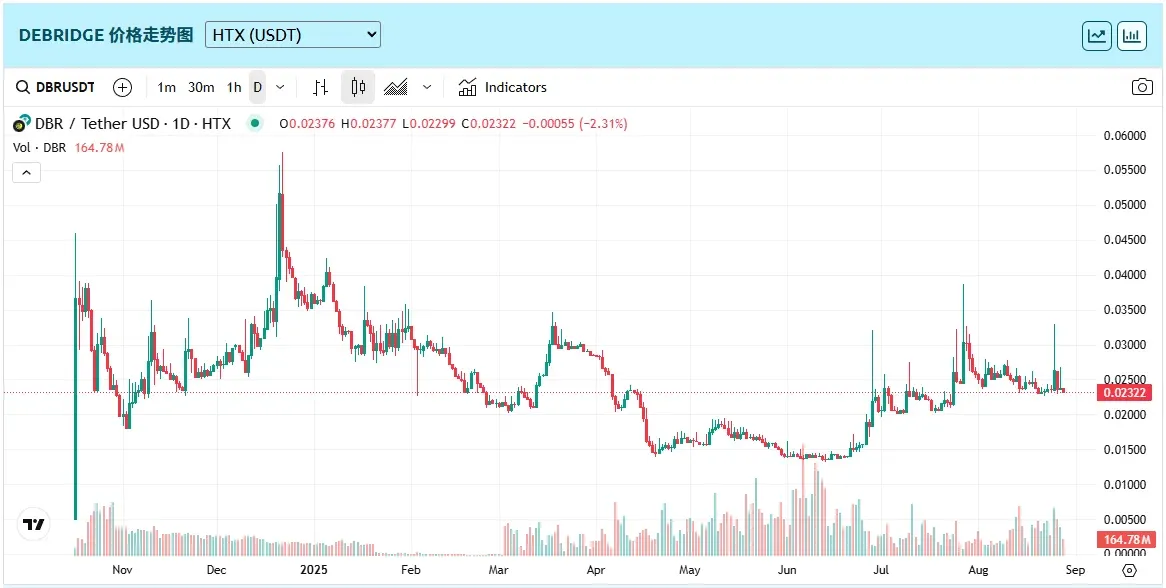
Historical Price of deBridge (DBR)
| Timeframe | Price Change | Percent |
|---|---|---|
| 1 H | ‑$0.0001 | ‑0.43 % |
| 24 H | ‑$0.0004295 | ‑1.82 % |
| 7 D | ‑$0.0003767 | ‑1.60 % |
| 30 D | ‑$0.004266 | ‑15.55 % |
| 1 Y | ‑$0.01725 | ‑42.69 % |
deBridge (DBR) Price Forecast
- 2025: Average price $0.0232, range $0.01183 – $0.03433.
- 2026‑2030: Forecasted peak up to $0.06154, implying a potential total return of roughly +100 %.
| Year | Low | High | Avg. | Estimated Growth |
|---|---|---|---|---|
| 2025 | $0.01183 | $0.03433 | $0.0232 | — |
| 2026 | $0.021 | $0.0302 | $0.02876 | +24 % |
| 2027 | $0.0168 | $0.04128 | $0.02948 | +27 % |
| 2028 | $0.023 | $0.05095 | $0.03538 | +52 % |
| 2029 | $0.03928 | $0.05007 | $0.04316 | +86 % |
| 2030 | $0.04242 | $0.06154 | $0.04662 | +100 % |
2025‑2031 Forecast Overview
- 2025: Average price range $0.022558 – $0.046331, implying a potential upside of ~99.5 %.
- 2026‑2031: Low of $0.006827, high of $0.101012; should the upper bound be reached, 2029 could see a 186.41 % increase versus the current price.
| Year | Low | Avg. | High |
|---|---|---|---|
| 2026 | $0.006827 | $0.01852 | $0.030213 |
| 2027 | $0.0073035 | $0.01253 | $0.017756 |
| 2028 | $0.012198 | $0.022897 | $0.033596 |
| 2029 | $0.032012 | $0.066512 | $0.101012 |
| 2030 | $0.014886 | $0.03369 | $0.052493 |
| 2031 | $0.017423 | $0.028159 | $0.038896 |
2031‑2036 Forecast Overview
| Year | Low | Avg. | High |
|---|---|---|---|
| 2031 | $0.017423 | $0.028159 | $0.038896 |
| 2032 | $0.0267047 | $0.059175 | $0.091645 |
| 2033 | $0.082698 | $0.151464 | $0.220231 |
| 2034 | $0.032455 | $0.069503 | $0.106552 |
| 2035 | $0.040852 | $0.062828 | $0.084803 |
| 2036 | $0.069465 | $0.1597039 | $0.249942 |
The above forecasts are for reference only and do not constitute investment advice.
More Than a “Bridge” – A New On‑Chain Infrastructure
deBridge originated from the team’s frustration in 2021 while pursuing cross‑chain arbitrage: the lack of efficient, real‑time cross‑chain interaction. Consequently, deBridge was created to enable truly instantaneous liquidity coordination among users, applications, and blockchains.
Who Is It Built For?
- Users: Capture on‑chain opportunities the moment they appear, enhancing DeFi freedom.
- Applications: Allow projects to connect to multiple chains rapidly, potentially accelerating growth tenfold.
- Public Chains: Enable any chain to attract external assets, users, and dApps, expanding ecosystem size.
Core Philosophy
- Real‑time Migration: Offer “one‑click migration to Solana”‑style instant cross‑chain experiences.
- User‑Friendly: Avoid excessive jargon; emphasize “easy, usable, and profitable”.
- Asset‑Focused: Do not act as a custodial bridge; concentrate on real‑time asset trading and liquidity.
Long‑Term Vision: On‑Chain “Starlink”
- Build a 5‑year‑plus infrastructure that becomes the on‑chain Starlink, delivering “one‑click connection for every user, app, and asset”.
- Support account abstraction, fee sponsorship, and enterprise‑grade payment/settlement scenarios at scale.
- Establish the most ambitious DAO in DeFi, providing sustainable governance and incentive mechanisms.
deBridge Airdrop Interaction Guide
1. Use the Bridge
- Deposit ETH into your wallet on the Arbitrum network.
- Visit the link: `https://app.debridge.finance/r/6902`.
- Connect your wallet
Related Reading
- deBridge Rewards: Cross‑Chain, OKX Wallet & Points
- 2025 Ethereum DeFi Landscape: $7.9B Spot ETF Fuels Maturity
- Web3 Payments: Decentralized Networks, Token Flow & Trends
💡 Register on Binance with referral code B2345 for the maximum trading fee discount. See Binance complete guide.



