
 Bitaigen Research
 Zora is an on‑chain SocialFi protocol deployed on the Base network. This article provides an in‑depth analysis of Zora’s operational mechanics, the $ZORA token model, creator incentive schemes, financing and growth status, and the key risks users need to be aware of.
From technical, economic, and risk perspectives, we systematically outline Zora’s SocialFi mechanism on Base, the $ZORA token model, and creator incentive programs, helping readers quickly assess the ecosystem’s potential and possible pitfalls. Subsequent sections will present deeper analysis and practical takeaways.
What exactly is Zora, and why has this on‑chain social network suddenly attracted so much attention?
Zora is an on‑chain social network and decentralized protocol that combines digital media creation, discovery, and trading. The project originally launched in 2020 as a traditional NFT marketplace, and has since evolved into a far‑larger ecosystem than its early days. Zora positions itself as a “hyperstructure” for the native creator economy of the internet, offering a foundational infrastructure that lets creators tokenize their content and identity without relying on centralized platforms.
The entire ecosystem is driven by two core layers that complement each other. The first layer is the Zora protocol – an open‑source, permission‑less set of smart‑contract building blocks. The second layer is the $ZORA token, an ERC‑20 token deployed on the Base network. This token incentivizes various activities on the platform, rewards creator contributions, and injects liquidity into newly launched creator markets. The combination of the two layers constructs a system that can translate social interactions directly into economic value.
How much funding has Zora raised, and who are the backers behind it?
Zora has raised approximately US $62.6 million across four rounds of preferred‑stock financing. In April 2022, Haun Ventures led a US $50 million Series C round, with participation from Coinbase Ventures and Kindred Ventures. By May 2022, the project’s valuation had reached US $600 million.
The company’s financial health has improved markedly in recent years. In 2023, Zora switched its revenue model to a fixed fee of roughly US $1.44 per NFT mint, yielding positive results. In 2024, Zora generated US $17 million in revenue with a net loss of only US $2.7 million; by comparison, the net loss in 2022 was US $14.4 million, indicating a steady move toward financial stability.
How Zora operates on Base: architecture, fees, and scalability explained
Zora runs on Base, an Ethereum Layer‑2 network built on the OP Stack. The network offers near‑zero gas fees and extremely high transaction throughput, making it suitable for a social platform that processes thousands of micro‑transactions daily and can effectively lower user costs.
Key components of the technical design include:
- Optimistic Rollup: Base processes transactions off‑chain and periodically batches them to the Ethereum mainnet, combining Ethereum’s security with low‑cost advantages.
- 0x Swap API integration: The ecosystem involves complex multi‑hop trades (e.g., USDC → $ZORA → creator coin → post coin). Zora leverages 0x’s custom routing to achieve low‑latency trades across millions of daily‑generated liquidity pools.
- Proof‑of‑Stake (PoS) consensus: The $ZORA token benefits from Ethereum’s underlying high‑efficiency PoS mechanism.
Detailed breakdown of Zora’s SocialFi model: how creators actually earn money
Zora pioneered a paradigm called “SocialFi,” linking social interaction directly to economic value. Every interaction on the platform can potentially generate financial returns for creators and participants.
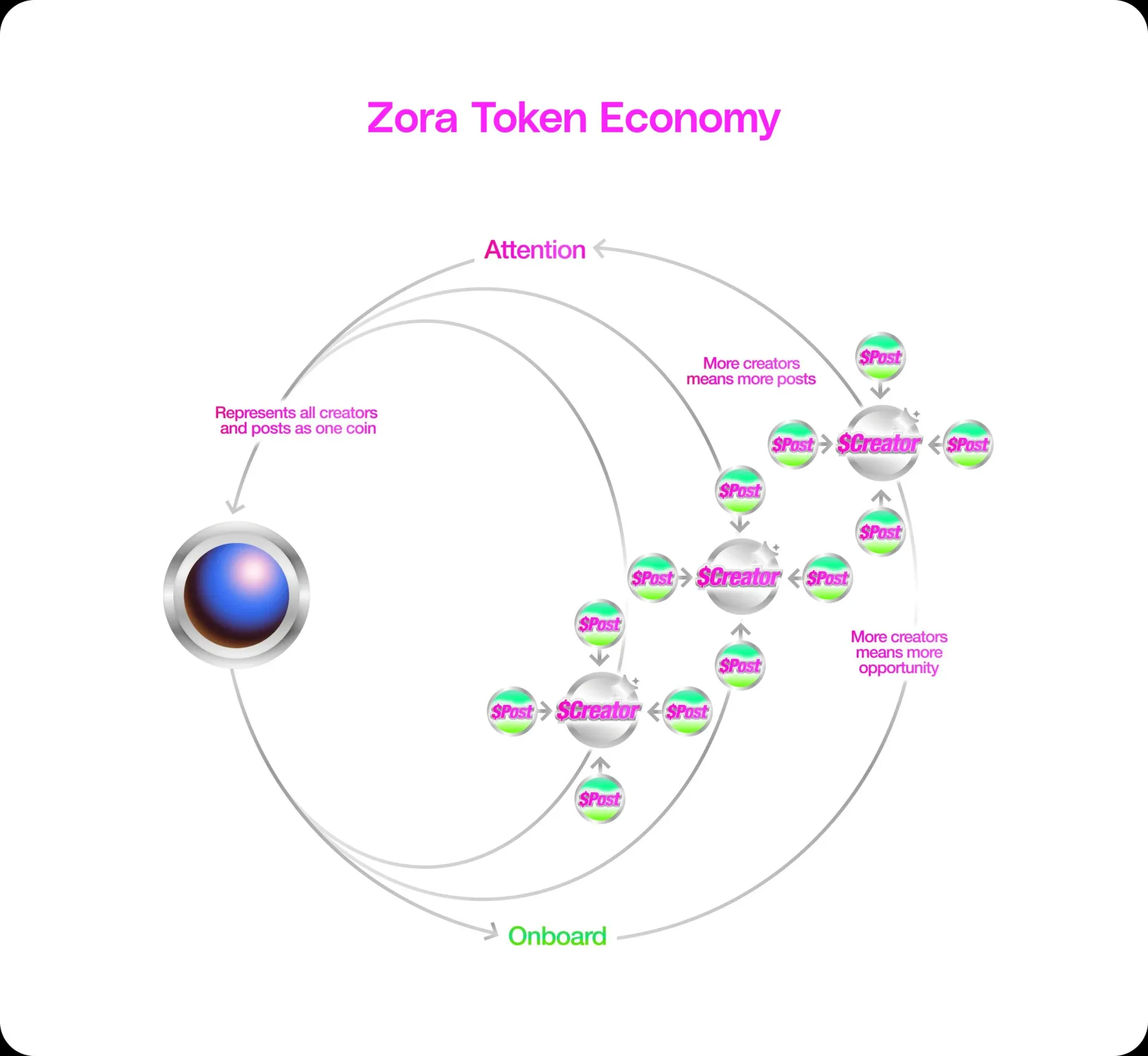
Zora’s token economics: how creators profit (source: Zora)
The system operates through tokenized social elements. Each user’s personal data exists as a “Creator Coin,” an ERC‑20 token; each individual post is also minted as a token and linked to the creator’s coin, forming a layered token economy whose value can flow throughout the content ecosystem.
This economic flywheel gives creators continuous incentive to stay engaged. Creators receive 1 % of every transaction involving their tokens; additionally, 50 % of the creator‑coin supply will be linearly released to creators over five years, encouraging long‑term content creation rather than short‑term speculation. Only creators who build genuine audiences and consistently produce high‑quality content can capture the maximum upside.
Who built Zora? Meet the team behind the SocialFi experiment
Jacob Horne is the CEO and co‑founder of Zora Labs, Inc. Prior to founding Zora, he led product at Coinbase and helped launch USDC. Horne created Zora to escape what he calls “platform capitalism” – the model in traditional social media where centralized companies control creators’ content and audiences while extracting value. Zora’s goal is to let creators truly own everything they create.
The core team also includes COO LaDarius “Dee” Goens (responsible for business operations and strategy) and CTO Tyson Battistella (overseeing all technical development of the protocol). The combination of deep crypto‑industry experience and solid engineering expertise positions Zora as a notable player in the SocialFi space.
$ZORA token economics in detail: supply, distribution, and real‑world utility
The total supply of $ZORA is fixed at 10 billion tokens, all of which are already circulating. In the initial allocation, Zora Labs, Inc. retained 1,999,999,887 $ZORA. The specific figures are:
Users hold the token in non‑custodial wallets; Zora Labs has no authority to access or safeguard any user funds. Once the token contract is deployed, it is immutable, meaning the company cannot modify, pause, or upgrade it. This design offers strong security guarantees, but also implies that if a vulnerability is discovered later, it cannot be patched.
Recent developments: Base App integration, acquisition of Mint.fun, and sharp user growth
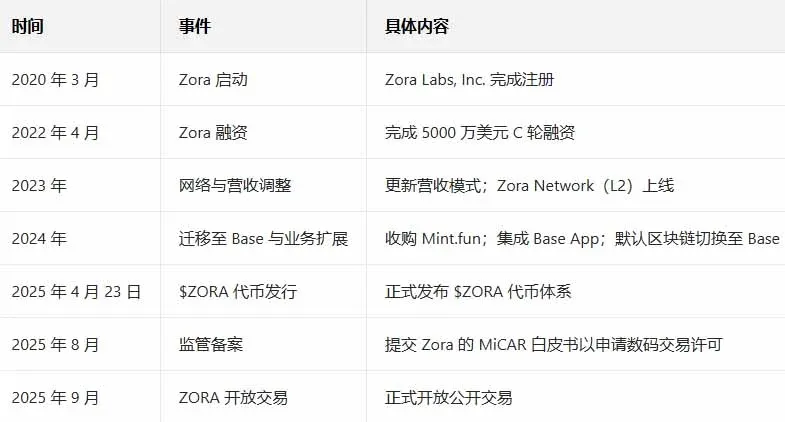
The past year has been pivotal for Zora, achieving several milestones. In July 2024, Zora integrated with Coinbase’s Base App, significantly boosting platform activity; daily token creations rose from 6,000 to nearly 50,000. Later that year, Zora acquired Mint.fun from Context Inc., removing a potential competitor and further expanding its capabilities.
On the compliance front, Zora Labs submitted a whitepaper in August 2025 to align with the European Union’s MiCAR (Markets in Crypto‑Assets Regulation) requirements, aiming to obtain a trading licence for the European Economic Area.
Are there risks associated with $ZORA? Key regulatory, market, and technical risks
Holding $ZORA carries several risks that merit close attention; the official documentation lists the following concerns, and anyone considering the token should evaluate them carefully.
- Regulatory uncertainty: Laws in the United States and the European Union are still evolving. The implementation of MiCAR could introduce new restrictions or require Zora Labs to obtain licences that are currently difficult to secure.
- Market volatility: The documentation describes $ZORA as a token for “entertainment and social interaction,” meaning its price could experience partial or total loss.
- Technical risk: Because the token contract is immutable, any post‑deployment bugs or vulnerabilities cannot be fixed by Zora Labs; the company holds no “admin key,” so it cannot reverse fraudulent transactions or help users recover lost private keys. $ZORA is also not covered by any EU investor compensation or deposit guarantee scheme.
Tax note: Crypto‑related gains, including any profit from selling $ZORA, may be taxable in the holder’s jurisdiction. Users should consult local tax advisors to ensure compliance with applicable tax laws.
Zora versus traditional social media: why creators are taking notice
The differences in operating models between Zora and legacy social platforms explain why the crypto community is paying attention.
Traditional platforms act like landlords, controlling an entire building and charging rent to tenants; Zora, by contrast, provides the infrastructure so creators can build their own economic systems and profit directly.
What Zora means for the future of the creator economy
Zora represents a fundamental shift in the relationship between creators, platforms, and audiences. Creators are no longer merely users renting someone else’s network; they own tokens that represent their content and identity. Every trade and interaction creates value that flows back to the creator rather than to platform shareholders.
Financial data suggests the model can be sustainable: the net loss narrowed from US $14.4 million in 2022 to US $2.7 million in 2024, showing substantive progress. The explosive growth after Base App integration also validates genuine user demand for this type of platform.
For seasoned users and researchers, Zora offers an intriguing SocialFi economics case study. The contract’s immutability enhances security but also imposes limits; the pursuit of MiCAR compliance demonstrates the team’s attention to regulation. Whether this approach becomes a standard for creator economies or remains a niche experiment will depend on future performance and broader market adoption.
Frequently Asked Questions
What is Zora in the crypto space?
Zora is an on‑chain social network and protocol that allows creators to tokenize their content, personal data, and posts, turning social interactions directly into economic value.
How does Zora work?
Zora runs on the Base network, using smart contracts to mint creators’ personal data and posts as tokens, enabling trade, revenue sharing, and permission‑less participation.
How is Zora different from ordinary NFTs?
Zora goes beyond traditional NFTs by turning personal data and posts into liquid market assets rather than one‑off collectible items.
How can creators earn money on Zora?
Creators earn a 1 % cut of every transaction involving their tokens and receive additional income from the gradual release of creator‑coin supply over five years, rewarding sustained content creation.
What is the purpose of the $ZORA token?
$ZORA incentivizes platform activity, provides liquidity for creator markets, and aligns the interests of users, creators, and traders within the Zora ecosystem.
Is Zora currently profitable?
Zora generated US $17 million in revenue in 2024 and markedly reduced its losses, indicating a trajectory toward financial sustainability.
Are there risks to investing in Zora?
Yes. Risks include regulatory uncertainty, token price volatility, and the impossibility of fixing bugs in an immutable smart contract.
Is Zora built on Ethereum?
Yes. Zora operates on Base, an Ethereum Layer‑2 network that uses Optimistic Rollup technology to deliver low fees and high throughput.
Can Zora compete with traditional social media?
Zora challenges ad‑driven platforms by giving creators true ownership of their content and direct earnings from interactions, bypassing the centralized monetization model.
Why is Zora important for the future of creators?
Zora demonstrates how creators can own their audience, content, and revenue streams without relying on centralized platforms or advertising‑based monetization.
💡 Register on Binance with referral code B2345 for the maximum trading fee discount. See Binance complete guide.



