
 Bitaigen Research
 Opinion is a decentralized prediction market where users can trade macro‑level events directly and earn PTS points by providing liquidity, executing limit orders, or holding contracts.
Opinion is a decentralized prediction market that lets you trade real‑world events such as interest‑rate decisions, inflation data, elections, and cryptocurrency news, instead of noisy proxies like BTC, gold, or stocks. Opinion was initially built on the Monad testnet; its mainnet will launch exclusively on BNB Chain, combining an AI oracle, on‑chain order‑book infrastructure, and DeFi‑ready contracts to turn economic beliefs into tradable assets.
In addition to trading, Opinion runs the OPINION Points System (PTS), a weekly rewards program that distributes points to active traders, liquidity providers, and holders of conditional tokens. These points are expected to play a core role in future incentive schemes and Opinion airdrop allocations, and early users who meet activity thresholds may receive extra benefits.
In this guide you will learn what the Opinion prediction market is, how its trading and pricing models work, and how to earn points on the platform through PTS, liquidity mining, and referral activities.

In this article we break down the core concepts of the Opinion decentralized prediction market, decode its trading mechanism, point‑reward system, and liquidity‑mining workflow. By offering a clear pros‑and‑cons comparison, we help readers quickly assess the platform’s potential value and provide practical ideas for earning PTS points. The following sections will detail step‑by‑step procedures, so a thorough read is recommended.
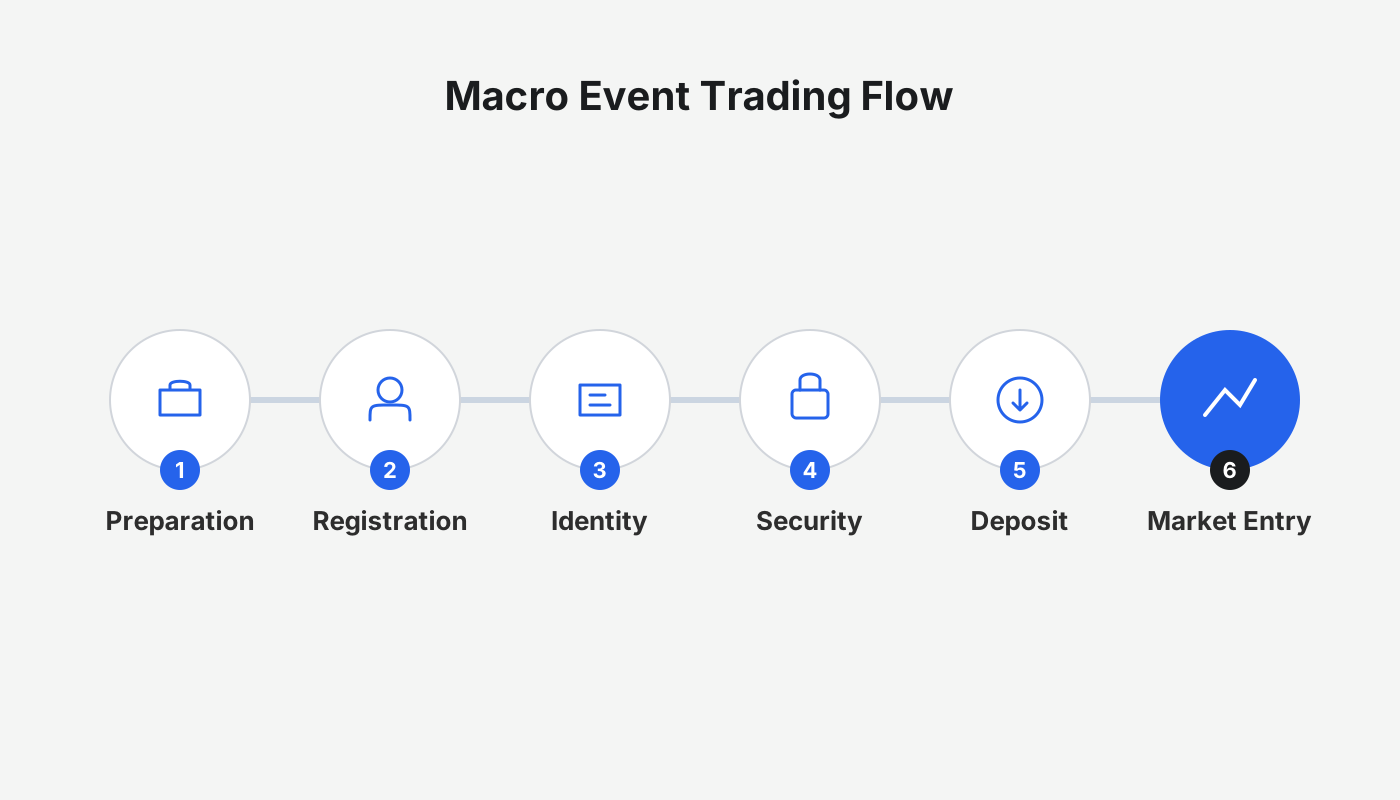
What is the Opinion prediction market from Opinion Labs?
Opinion Labs, launched in 2024, is a prediction‑market and oracle protocol designed to create decentralized opinion markets and consensus oracles. Its flagship product, the Opinion Prediction Exchange (often referenced as Opinion.Trade or O.LAB), lets you trade “yes/no” contracts on macro data, policy decisions, and other real‑world events.
- Trade events directly: No need to place orders through BTC or bonds; you can trade events such as “the Federal Reserve cuts rates by 25 bps at the next meeting” or “U.S. CPI exceeds 3 %”.
- Clear settlement: Each contract has a rule set; if the outcome occurs the contract settles to $1, otherwise to $0, eliminating the noise typical of traditional markets.
- Democratized economic trading: Macro‑risk is standardized as on‑chain assets, serving both retail and institutional participants.
What can you trade on Opinion?
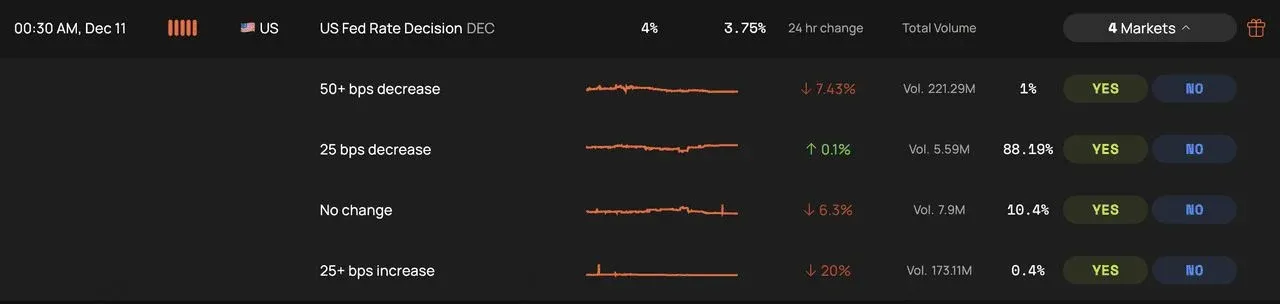
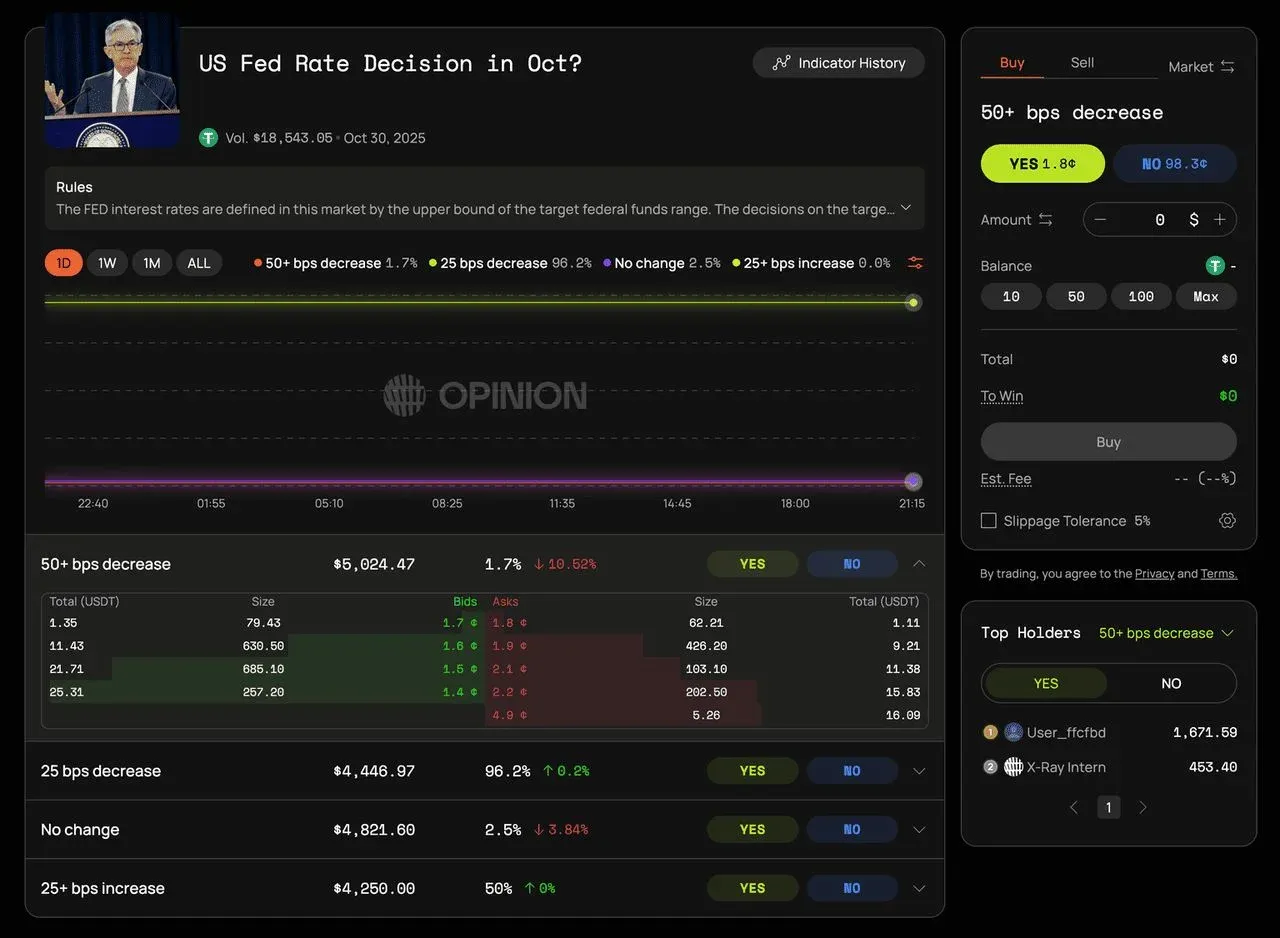
*Federal Reserve rate‑decision poll on the Opinion prediction‑market platform | Source: Opinion*
Opinion lets you trade yes/no markets on macro‑economics, crypto trends, political outcomes, and community events. Every market has explicit rules, a transparent AI‑oracle interpretation, and a price that reflects the real‑time implied probability.
- Macro‑economics & Central Banks
- “Will the Federal Open Market Committee (FOMC) cut rates by 25 bps at the December meeting?”
- “Will Euro‑zone Q1 Consumer Price Index (CPI) year‑over‑year exceed 3.0 %?”
- Cryptocurrency & Markets
- “Will Bitcoin (BTC) close above $100,000 on 31 Dec 2025?”
- “Will an Ethereum (ETH) ETF be approved in the United States before Q2 2026?”
- Politics & Policy: election results, policy votes, regulatory announcements.
- Community Activities: platform‑specific or social events with clearly defined outcomes.
How the Opinion Prediction Exchange works: the Opinion Stack
Opinion consists of four layers, the Opinion Stack, which power the exchange and its ecosystem:
- Opinion.Trade – the real‑time prediction exchange where you browse markets, trade yes/no shares, and manage your portfolio.
- Opinion AI – a decentralized multi‑agent AI oracle responsible for market‑rule design, parsability standards, and narrative‑rich economic releases or policy statements.
- Opinion Metapool – a unified liquidity infrastructure that aggregates liquidity across markets, boosting depth, reducing spreads, and improving price discovery.
- Opinion Protocol – a universal token/contract standard that lets prediction markets be used as collateral, structured products, or hedging tools within other DeFi protocols.
These layers abstract “economic risk” into programmable primitives, enabling DeFi applications to adjust parameters based on CPI expectations, lenders to price risk with probability, and institutions to bundle prediction contracts into structured products.
How do price and probability work?
On Opinion, the price of each share represents the market’s probability estimate for the outcome. For example, a “Yes” price of $0.65 implies a 65 % chance of occurring. If the event materializes, the share settles to $1; otherwise it settles to $0. Prices update in real time as trades occur, and you can sell early if the odds become favorable.
Order book, market orders, and limit orders
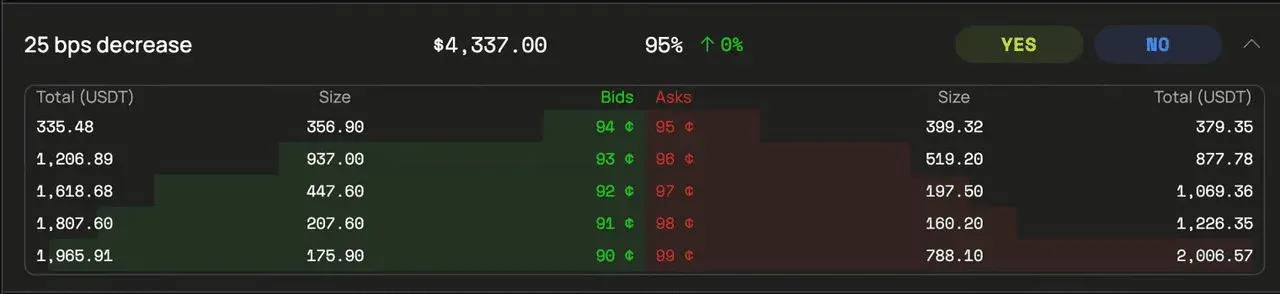
*Order book on Opinion | Source: Opinion documentation*
Opinion uses a Centralized Limit Order Book (CLOB):
- Market orders (takers): Execute instantly at the best available price, “eating” liquidity from the order book.
- Limit orders (makers): Specify a target price and quantity; the order sits on the book until it is matched, possibly partially.
The bid side (green) shows the highest buyer price, while the ask side (red) shows the lowest seller price; the gap between them is the spread. For power users, placing tight, reasonably priced limit orders near the current odds both improves fill probability and is a key way to earn higher PTS scores.
Fee structure
Opinion only charges fees to takers; makers are generally fee‑free:
- Takers pay, makers free: Market orders or instantly executable orders incur a fee; deep‑liquidity limit orders have a 0 % fee.
- Dynamic fee curve: Fees range from 0 % up to roughly 2 %, peaking when the probability is around 50 % (maximum uncertainty) and tapering toward 0 % or 100 % where certainty is higher.
- Minimum threshold: Orders must be at least ≈ $5, with a minimum fee of $0.50 to avoid excessive gas consumption on micro‑trades. Fees are quoted in the settlement asset (e.g., USDT).
- Stackable discounts: User tier, promotions, and referrals can stack, offering up to 100 % fee reduction (still subject to the $0.50 minimum fee).
This structure incentivizes users who provide deep limit‑order liquidity to trade at lower cost and earn more PTS, while takers pay higher fees when uncertainty is greatest.
Mainnet deployment
Opinion launched on the Monad testnet in early 2025 and will roll out its mainnet exclusively on BNB Chain. BNB Chain’s low fees, fast finality, and rich DeFi ecosystem enable efficient operation and liquidity integration, and the launch is backed by key native supporters such as YZi Labs.
How to start trading on the Opinion exchange
Below is a step‑by‑step guide for beginners, helping you trade on Opinion safely and confidently.
Step 1: Connect a wallet or social account
- Visit the Opinion app and click Connect Wallet.
- Supported Web3 wallets include MetaMask, Base App, and any other EVM‑compatible wallet that works on BNB Chain. Approve the connection and sign the login message.
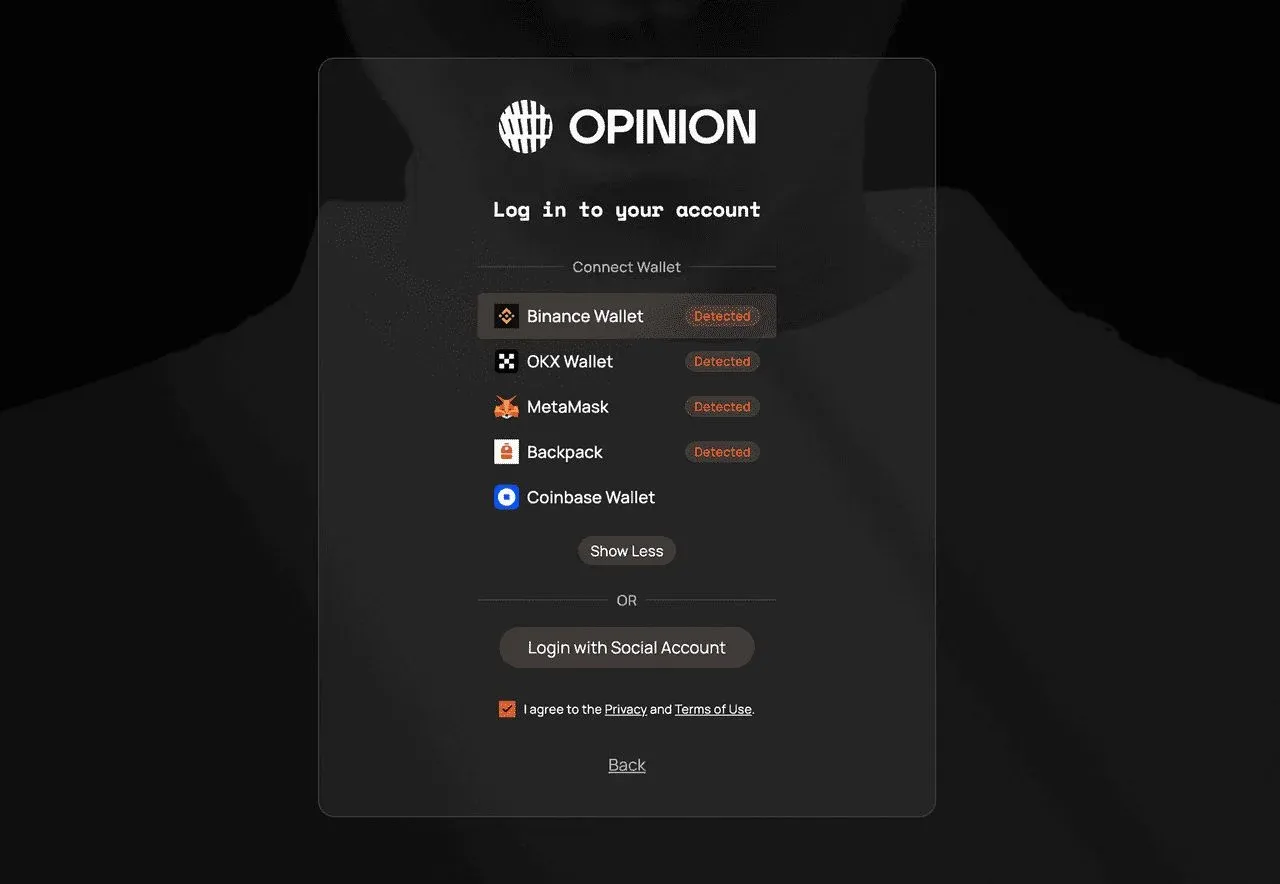
*Source: Opinion documentation*
You can also log in with Google or X (Twitter) and then link a wallet.
Step 2: Deposit trading assets
Make sure your wallet holds USDT, USDC, or other BNB‑Chain stablecoins. You can purchase them on exchanges such as BingX and bridge to BNB Chain, or transfer directly on‑chain. Follow the UI prompts to deposit or approve token spend.
Step 3: Choose a prediction market
- Navigate to the Markets or Popular page to browse open markets.
- Use filters (macro, crypto, politics, etc.) to locate events that interest you.
- Click a market to view its Description & Rules, Historical price chart, Current odds, and Order book.
Step 4: Execute your first trade
In the trading panel:
- Select Yes or No.
- Choose Market for immediate execution, or Limit to set your own price.
- Enter the amount in USD or the number of shares.
- Confirm and sign the transaction.
After execution, the position appears in Portfolio, where you can monitor size, average entry price, current mark price, and unrealized P&L in real time.
*Source: Opinion documentation*
Step 5: Manage P&L and open orders
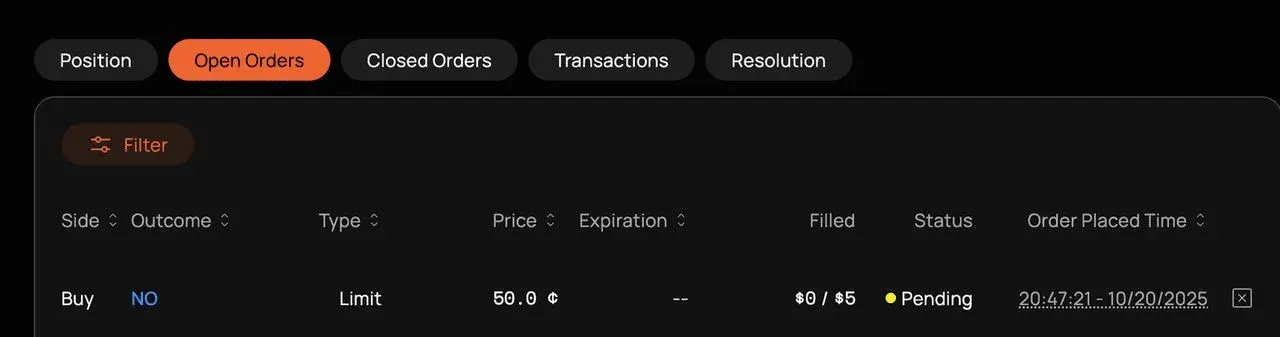
*Open orders on Opinion | Source: Opinion documentation*
- Open Orders tab: View, edit, or cancel limit orders that have not been fully filled.
- Portfolio/Positions: Shows unrealized P&L expressed in USD or percentage.
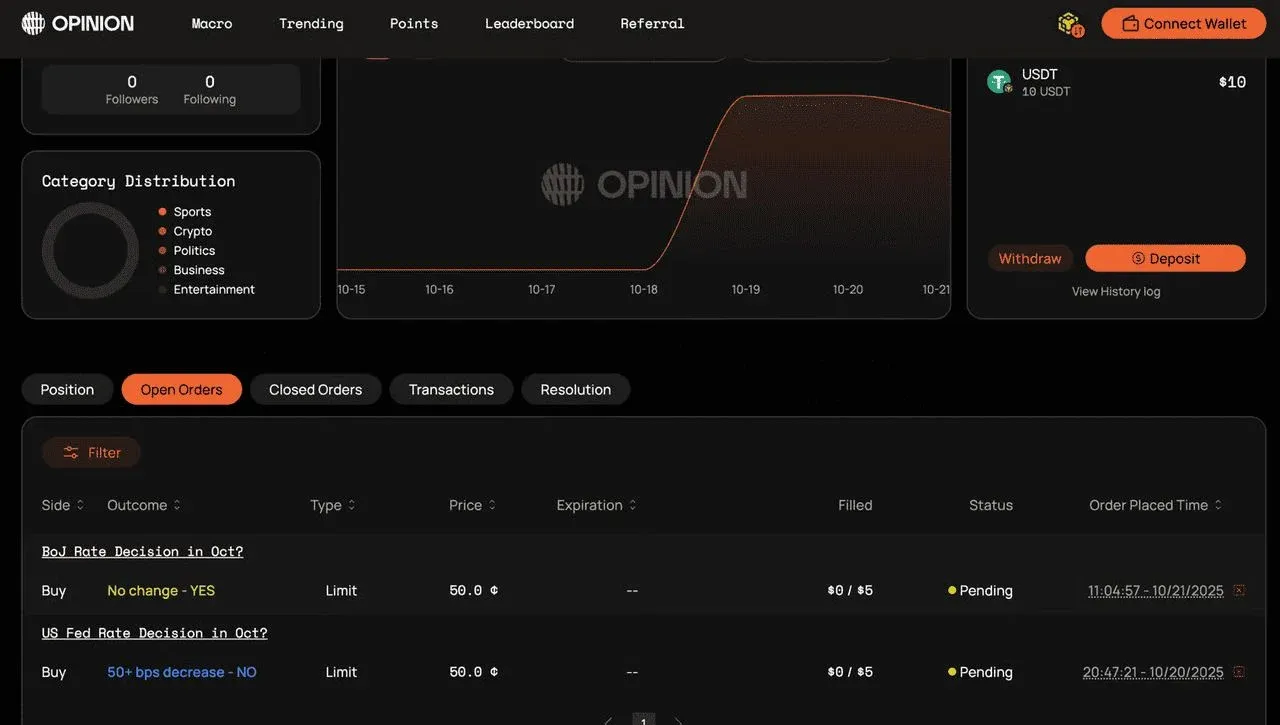
*Portfolio on Opinion | Source: Opinion documentation*
- Net Asset Value = current position market value + available balance.
- You can close a position early by selling shares back to the order book, or hold until the oracle resolves the outcome.
What is the OPINION Points System (PTS)?
The OPINION Points System (PTS) is the platform’s core incentive mechanism, rewarding users who contribute to liquidity and price discovery. Points may later be converted into token allocations, fee rebates, or other incentives. While there is no fixed redemption rate, the share of points you earn will influence your weight in future distributions.
Design goals:
- Incentivize profitable, information‑driven trading strategies.
- Reward high‑quality liquidity provision and long‑term participation, dampening short‑term noise.
- Build a “truth machine” that supplies high‑quality prediction data to institutions and DeFi protocols.
Eligibility requirements for PTS rewards
Each week you must meet the following minimum activity thresholds:
- Trading volume ≥ $200 (measured in the settlement asset).
This requirement filters out wash‑trading and ensures points go to genuine contributors.
Once you qualify, you enter the weekly fixed‑points pool competition (approximately 100,000 points per week), which is allocated proportionally to relative contribution. The leaderboard updates weekly.
Participating in the Opinion airdrop: three main ways to earn points
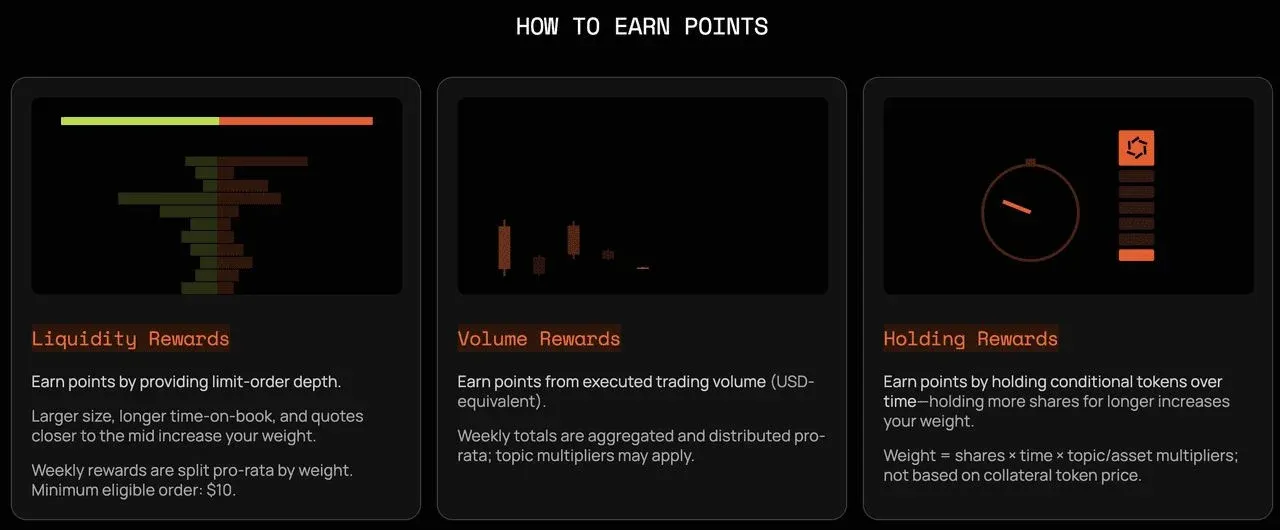
*How to earn points and join the Opinion airdrop | Source: Opinion*
1. Provide liquidity with limit orders
- Place orders near the current odds; the closer the order is to the mid‑price, the larger the size, and the longer it stays on the book, the higher the weight.
- Orders with a nominal value ≥ $10 count as effective liquidity and are eligible for rewards.
- Example: If the “Fed December rate cut” market has odds of 0.20, a limit order buying at 0.19 earns more points than an order at 0.10 because the former improves price‑discovery depth.
Limit orders are typically fee‑free; accumulating them over time can generate a sizable compound effect.
2. Trade with conviction to earn volume rewards
- Large, well‑timed trades based on real information earn more PTS.
- Trading volume is measured by the USD‑equivalent nominal value across all markets.
- Certain flagship macro markets carry a multiplier that boosts the corresponding volume reward.
This mechanic encourages traders who push markets toward fair value rather than those who merely ping small orders.
3. Hold positions to earn holding rewards
- Points ∝ (number of shares × holding time × theme multiplier).
- Long‑term holding in designated markets yields more PTS than rapid flipping.
- The design motivates users to back their beliefs with time, while also strengthening liquidity stability around key events.
Tips for maximizing points
| Action | How the weight is boosted |
|---|---|
| **Early‑stage liquidity provision** | Supplying deep orders on newly listed or early‑phase markets receives a higher multiplier, which later tapers to the standard rate |
| **Designated markets** | Opinion may flag special markets (e.g., major central‑bank decisions) with extra rewards |
| **High‑quality trading pattern** | Submit informed limit orders before and after major data releases to improve price accuracy and reduce noise |
The PTS dashboard shows your current score, earned rewards, weekly snapshots, and ranking in real time.
Referral program: earn discounts and potential rewards
- After accumulating roughly $1,000 in trading volume, you can generate a unique referral code/link.
- Invitees who trade using your code receive up to a 10 % fee discount on taker fees.
- Referrers receive a portion of the invitee’s fees back or additional point rewards.
Discounts can stack with other fee promotions but cannot drop below the minimum fee. Once a referral code is bound to an account it cannot be changed; choose wisely.
The program aims to attract active, long‑term traders and aligns with the PTS incentive structure.
How Opinion differs from Polymarket and Kalshi
| Platform | On‑chain implementation | Pricing mechanism | Regulatory status | Key features |
|---|---|---|---|---|
| **Opinion** | BNB Chain (decentralized) | CLOB + AI oracle | No specific regulation (Web‑based) | Integrated AI oracle, cross‑market liquidity pool, PTS rewards |
| Polymarket | Ethereum (layer‑2) | Automated Market Maker (AMM) | Operates under U.S. “no‑license” model, limited to certain jurisdictions | Large user base, extensive event catalog |
| Kalshi | Centralized (US‑based) | Order‑book & market maker | SEC‑registered exchange, regulated in the United States | Traditional compliance, fiat settlement |
*Note: Crypto‑related gains, including any converted value of PTS or trading profits, may be taxable in your jurisdiction. Consult a tax professional for guidance.*
---
Important for U.S. users: If you wish to acquire the stablecoins needed for trading on Opinion, you must use Binance.US (or another U.S.-compliant exchange) rather than the global Binance platform, due to
Related Reading
- Opinion Protocol Review: Decentralized Prediction Market
- Binance Crypto Trading: Top Liquidity & Security for New Traders
- VIRTUAL Token: Liquidity, Payments & AI Governance
💡 Register on Binance with referral code B2345 for the maximum trading fee discount. See Binance complete guide.



