
 Bitaigen Research
 Ethereum staking has become a hot topic in the crypto space recently. Its core idea is to lock a certain amount of Ether (ETH) on‑chain, thereby participating in the consensus process of the Ethereum 2.0 network as a validator and earning corresponding rewards. Below we will explain this mechanism from multiple dimensions in a systematic way.
In this article we systematically outline the core principles of Ethereum staking, the operational workflow, and its role in the Proof‑of‑Stake (PoS) consensus. The goal is to help readers quickly grasp the value and risks of the mechanism. By digging into validators’ duties and the reward model, you will gain a clearer picture of future network security and yield structures, making the piece well worth a careful read.
Basic Concept of Staking
Staking refers to depositing the ETH you hold into a designated wallet so that it remains locked on the blockchain, in exchange for the right to validate blocks and receive rewards. In theory, any token holder who meets the required conditions can perform this operation on a chain that uses a Proof‑of‑Stake consensus. The Ethereum network requires each validator to stake at least 32 ETH; once the appropriate software is activated, the validator assumes responsibilities such as data storage, transaction processing, and new‑block creation, thereby contributing computing power to network security and earning newly minted ETH.
Proof‑of‑Stake (PoS) Consensus Mechanism
Under a PoS model, token holders obtain block‑production rights by locking up their coins, and rewards are distributed proportionally to the amount staked. This differs from Bitcoin‑style Proof‑of‑Work (PoW) systems, where block‑production chances are allocated based on the amount of computational power a miner contributes. PoS’s main advantage is that it does not require power‑hungry hardware; simply holding and locking the token is enough to participate. If a validator acts against the network’s interests or behaves maliciously, the protocol can confiscate all or part of the staked tokens as a punitive “slashing” penalty.
Why Ethereum Is Moving to PoS
The migration from PoW to PoS aims to achieve several goals:
- Reduce energy consumption – PoW mining is energy intensive, whereas PoS relies only on stake.
- Increase throughput – PoS paves the way for upgrades such as sharding that can boost transaction capacity.
- Promote decentralization – In recent years, mining competition has concentrated hash power in a few large pools, and the ever‑rising cost of mining hardware has raised the entry barrier. PoS lowers hardware requirements, allowing everyday users to become validators and potentially creating a more distributed node landscape.
The Ethereum 2.0 roadmap also includes sharding technology, which is intended to further improve the chain’s processing capability.
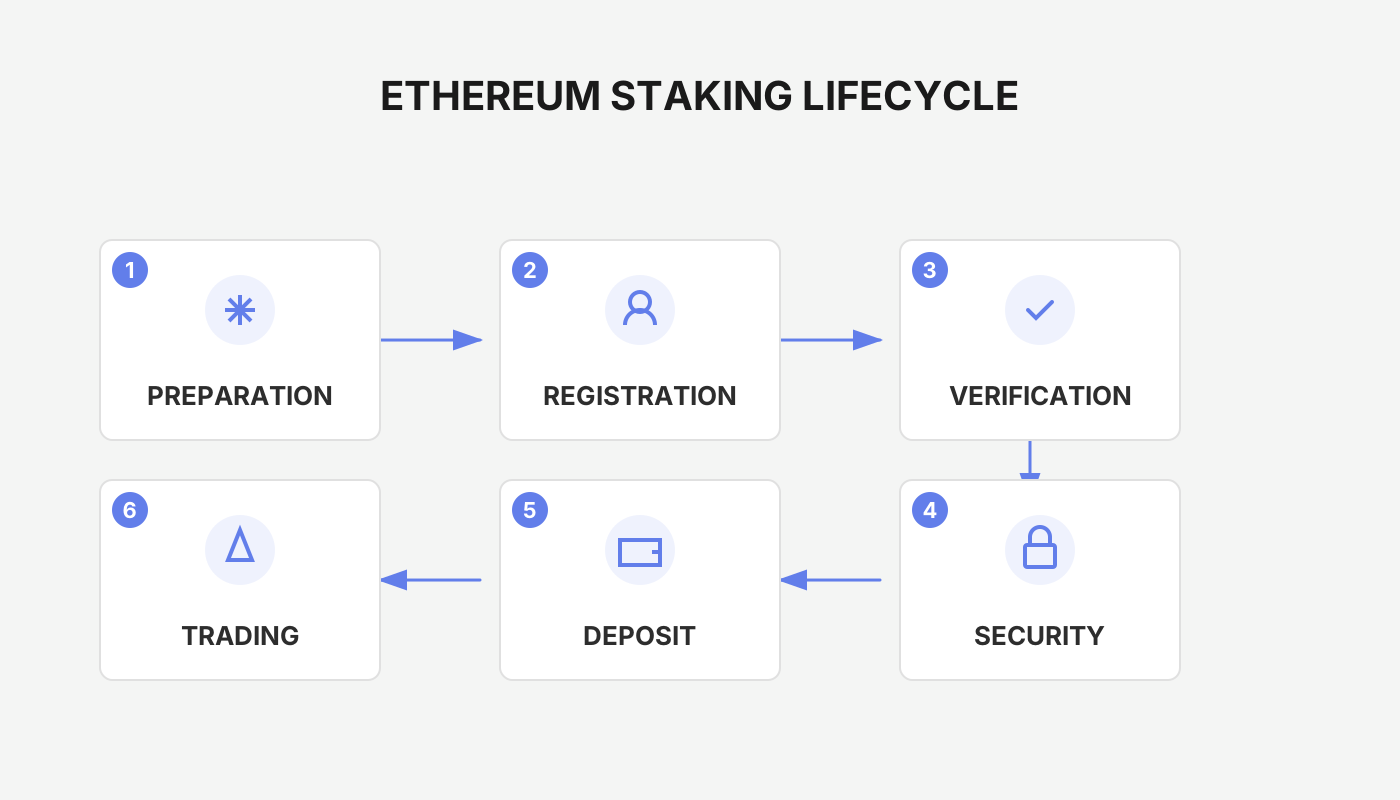
Detailed Staking Procedure
- Lock the assets – Prepare at least 32 ETH and send it to the official staking contract.
- Run a node – Deploy a validator client on a regular desktop or laptop and keep the node online.
- Earn rewards – As the node continuously participates in block validation, the protocol distributes rewards at an approximate annual rate of 4 %–10 %.
During this process, a node that goes offline or commits other violations may incur a small fine. No specialized mining rigs are required; any device capable of maintaining a stable internet connection is sufficient.
Comparison with Other PoS Projects
| Project | Consensus Model | Staking Threshold | Typical Annual Yield |
|---|---|---|---|
| **Tezos** | Liquid PoS (LPoS) | 8 000+ XTZ (if you run your own node) | ~7 % |
| **Algorand** | Pure PoS (secret‑selection) | No minimum | ~5 % |
| **Qtum** | Pure PoS | No minimum | ~7 % |
| **EOS, Cosmos** | DPoS and variants | Varies by chain | — |
Each of these chains emphasizes different implementation details: Tezos uses a “baking” concept and allows token holders to delegate validation to others; Algorand rewards every holder automatically without requiring active participation; Qtum lowers the entry barrier through native tooling that simplifies user involvement.
How Staking Pools Operate
Staking pools aggregate many users’ ETH into a single validator node, with the pool operator handling node maintenance and uptime. Well‑known providers include Binance, Crypto.com, Kraken, among others. (For users located in the United States, the equivalent service is Binance.US, which complies with U.S. regulations.) Users simply deposit their tokens into the exchange or a dedicated wallet, and then share the rewards generated by the pool in proportion to their holdings. Pooling reduces the technical burden for individual participants and improves the likelihood of being selected as a validator.
Returns and Potential Risks
- Yield side: By locking ETH, holders can obtain a relatively stable passive income while also supporting the blockchain ecosystem they believe in. Conversions to fiat (e.g., USD) can be performed via SEPA, SWIFT, or other traditional banking channels on supported platforms.
- Risk factors:
- Liquidity lock‑up – While ETH is staked, it cannot be sold instantly; a sharp market downturn could prevent timely loss‑cutting.
- Reward volatility – The value of staking rewards may be insufficient to offset a decline in ETH’s market price.
- Third‑party exposure – Delegating tokens to a pool requires trust in the operator’s security practices. Private‑key leaks or custodial mishandling can lead to loss of assets.
Consequently, participants should safeguard their private keys diligently and avoid handing them over to untrusted parties. Note: Crypto gains may be taxable in your jurisdiction; be sure to consult local tax regulations and report any staking income accordingly.
Overall Assessment of Ethereum Staking
Overall, staking is a cornerstone of the ETH 2.0 ecosystem, serving both as the foundation of network security and as a revenue channel for token holders. To become a qualified validator you must meet the 32 ETH minimum and keep your node continuously online. Opting for a staking pool lowers the technical entry barrier, but introduces custodial risk that must be managed carefully. It is also worth remembering that after initiating a stake, withdrawing the ETH typically requires a 5–7 day waiting period before the tokens become available again. In cases of misconduct or technical failure, a portion—or even the entirety—of the staked assets may be slashed.
With the information presented above, readers should now have a more comprehensive understanding of “Ethereum staking” and be able to decide, based on the disclosed yields and risks, whether to join this ecosystem.
Related Reading
- Understanding Liquid Staking: Concepts & Operational Flow
- Crypto Staking: Mechanisms, Types & Liquid Staking Guide
- Binance BNB Fixed‑Term Staking: Earn APR, Mining & Launchpool Benefits
💡 Register on Binance with referral code B2345 for the maximum trading fee discount. See Binance complete guide.



