
 Bitaigen Research
 Understanding the underlying technical logic is key to evaluating a project's value. To this end, we conduct a deep dive into the operational mechanisms of Filecoin. This article will guide you through the complete mining workflow, from data sealing to proof generation, and analyze the core characteristics of its storage power growth, helping you see through the technical moat behind FIL. We invite you to read on and explore the mysteries of decentralized storage with us.
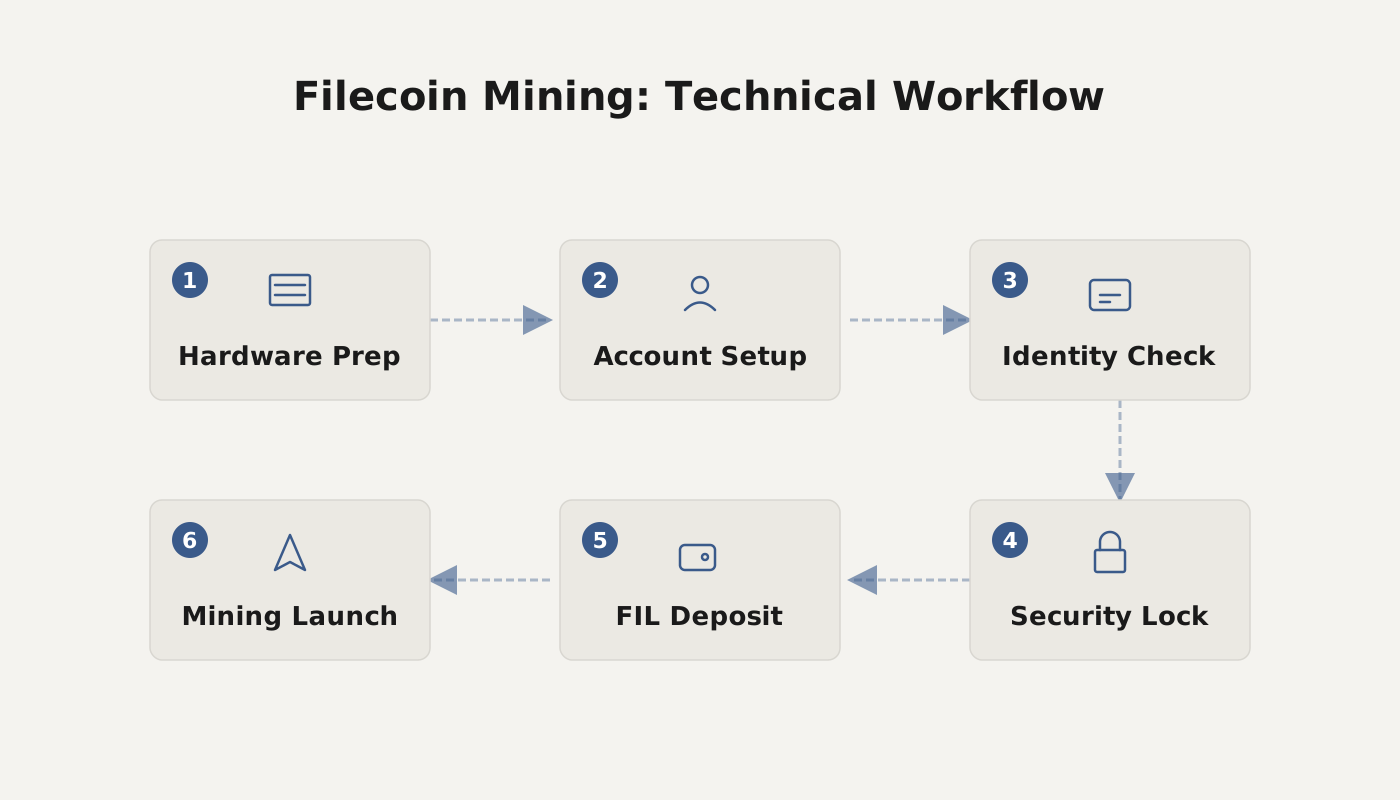
For cryptocurrency investors, understanding the underlying technical logic is the key to evaluating a project's value. This article will provide a deep dive into the mining principles, operational workflows, the core significance of sector sealing, and the main characteristics of the Filecoin (FIL) network.
The Filecoin mining principle is based on providing verifiable physical storage space. Its workflow includes initial collateral (pledging), data sealing, generating Proof of Replication (PoRep), and submitting Proof of Spacetime (PoSt). Its core characteristic is that storage power is not static; instead, it continuously grows as effective storage data is sealed and accumulated.
What Are Miners and Mining?
In most blockchain protocols, miners are the core participants responsible for maintaining network validity and security. Traditional blockchains distribute tokens as Block Rewards to miners who successfully generate new blocks. Filecoin utilizes this exact same mechanism.
The Filecoin blockchain produces blocks through a continuous process called "leader election." Miners who win the election are selected to mine new blocks and receive FIL token rewards. Block rewards are the core of the Filecoin economic model, designed to subsidize storage miners for providing reliable and useful storage capacity to the network.

Types of Miners in the Filecoin Network
The incentive mechanism of the Filecoin network is built upon the interactions of different roles and users, primarily consisting of the following two types of miners:
- Storage Miners: Responsible for providing data storage space to the network and submitting proofs of storage.
- Retrieval Miners: Responsible for helping users quickly extract and download the data they need.
Three Major Income Sources of Investing in IPFS/Filecoin
Participating in the development of the Filecoin network primarily offers three avenues of income:
- Block Rewards: Earned by winning leader elections to receive newly minted block rewards distributed by the system, which are released according to specific algorithmic rules.
- Storage Fees: Paid in USD-equivalent FIL by storage users to miners for storing their data, which are released linearly over the storage agreement period.
- Retrieval Fees: Paid by users when they access and download content. If a retrieval miner needs to fetch data from a storage miner, they will also pay a fee to that storage miner.
*Note on Global Transactions and Taxes: In the global market, transactions, hardware purchases, and service fees are typically denominated in USD. Global users can fund their accounts via SEPA or SWIFT bank transfers to acquire FIL on compliant exchanges. Please note that cryptocurrency gains, including block rewards and storage earnings, may be subject to income or capital gains taxation depending on your local jurisdiction.*

Barriers and Methods of IPFS/Filecoin Mining
Unlike Bitcoin mining, which relies on pure computational chips (such as ASIC miners) to perform hash collisions, IPFS/Filecoin mining is essentially a process of "data storage and verification." Because the network must guarantee the absolute security of user data, the technical operations and maintenance (O&M) barriers are exceptionally high. Consequently, it is very difficult for ordinary individuals to participate independently simply by purchasing a single piece of physical hardware.
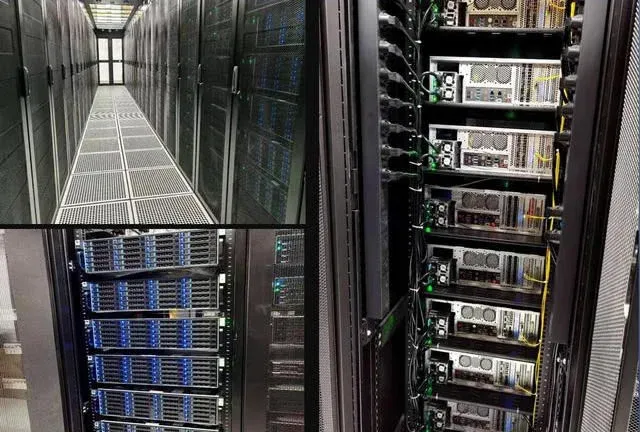
Currently, the two main participation methods in the market are:
- Independent Cluster Hosting: Individuals purchase independent server clusters configured by professional manufacturers and pay ongoing professional O&M fees.
- Cloud Storage Power Services: Directly purchasing storage power shares provided by mining service providers, which are maintained collectively by a professional technical team.
*Note for US-based participants: For users located in the United States looking to acquire FIL for staking or trading, please note that US users must use Binance.US or other compliant local platforms rather than the global Binance exchange.*
IPFS/Filecoin Mining Process and Key Characteristics
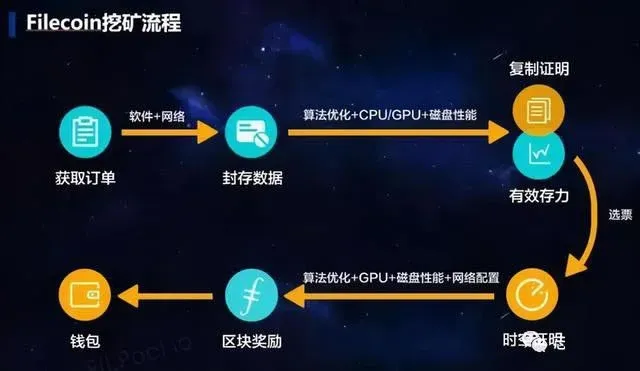
The Filecoin mining network features three distinct characteristics:
- Storage Power is Mining Power: Effective storage power is accumulated through continuous calculation, sealing, and packaging of real data, rather than merely relying on idle physical storage space.
- Initial Collateral (Pledge) Mechanism: To ensure the stability of storage services, miners must pledge a certain amount of FIL tokens to the network before sealing data.
- Linear Release Rules: Block rewards generated from mining are not fully credited immediately. Only 25% is released on the day of block creation, while the remaining 75% is released linearly over a 180-day period.
Because the entry barriers and technical requirements of Filecoin mining are extremely high, and storage power requires time to accumulate, storage power cannot be expanded rapidly in the short term.
Filecoin Sector Sealing and Detailed Mining Workflow
Sector Sealing is the most computationally intensive and core stage of Filecoin mining. Its standard workflow is as follows:
- Node Initialization: Install the mining software, create a node, join the Filecoin network, complete on-chain data synchronization, and create a wallet.
- Initial Collateral (Pledging): Deposit the FIL tokens required for pledging into the wallet address (which can be acquired through market purchase or borrowing; contact: hugoschan).
- Data Sealing: The miner receives storage orders and fills data into sectors of 32GiB or 64GiB, followed by data sealing (this process takes the longest time).
- Proof Generation and Verification: Generate a Proof of Replication (PoRep) to prove that the data has been correctly stored. This proof is compressed using zero-knowledge proofs (zk-SNARKs) and submitted to the blockchain.
- Power Conversion and Block Production: Once the verification succeeds, the sector is converted into effective storage power. Miners leverage their effective storage power to participate in leader elections, submit Proof of Spacetime (PoSt), obtain block packaging rights, and earn block rewards.
*Note: Miners with greater storage power have a higher win rate (the probability of receiving a ticket) and block production rate (the probability of earning block rewards).*

A Vivid Metaphor: Understanding Filecoin Mining through "Harvesting Wheat"
We can compare the process of Filecoin mining to "harvesting and storing wheat":
- Storage Clusters (Miners): Equivalent to "empty sacks" for holding wheat. Hard drives that have not sealed data are like empty sacks and cannot generate actual value.
- Sector Sealing (Acquiring Storage Power): Equivalent to the process of "harvesting wheat." Sealing data through computing clusters is like using a combine harvester to cut the wheat.
- Storage and Block Rewards: Bagging the harvested wheat and storing it in a warehouse is equivalent to sealing data into hard drives. Selling the wheat for cash is like obtaining block rewards by submitting proofs. The more data sealed, the greater the storage power, and the higher the earnings.
- Slashing Mechanism: If the wheat in the warehouse is damaged by mice or spoiled by moisture due to poor management, losses will occur. Similarly, if a sector with sealed data fails to pass the Proof of Spacetime (PoSt) challenge, the miner's storage power will be deducted, and the pledged FIL will be slashed (forfeited).
Unlike Bitcoin mining, which features constant hashing power, Filecoin mining power is continuously accumulated as data sealing increases. Therefore, the faster the sealing efficiency, the more rapidly the effective storage power grows, leading to higher block production rates and token yields.
The Essence and Long-Term Value of Filecoin
The core value of Filecoin lies in its ecosystem development, which aims to provide secure, reliable, and decentralized real data storage for global users. The collateral, release, and baseline mechanisms designed by the project team are intended to ensure that data can be preserved over the long term without loss or corruption.
The vision of Filecoin is to become a "decentralized network designed to store humanity's most important information."
Understanding this essence makes it clear why the network requires such strict collateral and slashing mechanisms. If one merely views it as a short-term arbitrage "mining machine game," they are highly likely to face predicaments such as insufficient collateral in actual operations.
With the development of the industry, some divergence and hard forks have emerged in the market (such as Filecash/FIC on October 14 and Filestar/STAR on October 30; contact: hugoschan). This stems from differing interpretations of the network's core essence among various groups.
In the future, global data storage demands are expected to grow exponentially. A deep understanding of IPFS and Filecoin's underlying mechanics is vital for analyzing its long-term viability in the decentralized infrastructure space.
Related Reading
💡 Register on Binance with referral code B2345 for the maximum trading fee discount. See Binance complete guide.



