 Bitaigen Research
 In this article we systematically outline the core concepts and operational workflow of an IDO, helping founding teams understand the advantages, steps, and common pitfalls of issuing tokens directly on a decentralized exchange. By comparing traditional financing models, you can quickly assess whether this approach fits your project. Subsequent sections provide practical guides and are worth a careful read.
IDO (Initial DEX Offering) is a financing model that allows crypto projects to sell tokens directly to the public on decentralized trading platforms such as Uniswap, PancakeSwap, or Raydium. The project team uses a smart contract to accept base assets (ETH, BNB, SOL, USDT, etc.) from investors, and once the fundraising period ends the token instantly gains liquidity and can be traded on‑chain.
Why Choose an IDO?
- Low entry barrier and minimal cost: No hefty listing fees and no need to pass the lengthy review process of a centralized exchange.
- Transparent and trustless: All actions are recorded on the blockchain and are publicly verifiable.
- Instant liquidity: A trading pair is created as soon as the token is launched, enabling rapid price discovery.
- Fair participation: Most projects do not impose whitelist or quota restrictions, giving retail participants a genuine chance.
Comparison of IDO with Other Issuance Methods
| Model | Distribution Channel | Regulation / Review | Fees | Participation Threshold |
|-------|----------------------|---------------------|------|--------------------------|
| ICO | Project website or centralized platform | Minimal, higher risk | Relatively low | Relatively loose, but prone to rug pulls |
| IEO | Centralized exchange (e.g., Binance Launchpad) | Exchange conducts strict vetting | Higher | Must satisfy the exchange’s listing standards |
| IDO | Decentralized exchange (DEX) or dedicated launchpad | Basic vetting by the DEX or platform | Low | Anyone with a wallet can join |
Standard IDO Workflow (Typical Example)
- Project preparation: Define total token supply, allocation ratios (team, liquidity, community, etc.), issuance price, and soft/hard caps.
- Listing channel: Choose a dedicated launchpad for review, or publish directly on a DEX.
- Fundraising phase: Investors connect their wallets and submit base assets in exchange for the new token.
- Liquidity injection: Pair the raised funds with the token to create a liquidity pool (LP).
- Trading launch: The token becomes publicly tradable immediately, completing price discovery.
How to Plan an IDO for Your Own Token?
1. Project Planning and Community Building
- Draft a whitepaper and design tokenomics (total supply, fees, distribution percentages).
- Build a community on Twitter, Telegram, Discord, etc., and prepare an official website and marketing assets.
2. Chain Selection
- Ethereum: Mature ecosystem, but gas fees are relatively high.
- BSC: Low fees, suitable for cost‑sensitive projects.
- Solana: Fast and cheap transactions; recently popular among meme projects.
- Other options such as TON, Arbitrum, Base, and more can be evaluated according to specific needs.
3. Deploy the Token Contract
- Write the contract using Solidity (ERC‑20) or Solana SPL standards, or use a no‑code platform to deploy.
- Ensure the contract is audited to avoid security vulnerabilities.
4. Choose the Issuance Platform
- DEXes: Uniswap (ETH), PancakeSwap (BSC), Raydium / Pump.fun (SOL), etc.
- Specialized launchpads: DAO Maker, GTokenTool, and similar services offering dedicated entry points.
5. Fundraising Settings
- Decide whether to run a pre‑sale or a single, fair launch. Set the token price, soft/hard caps, and the fundraising duration.
6. Add Liquidity
- Create a token‑base‑currency pair on the chosen exchange. It is advisable to lock or burn the LP tokens to boost investor confidence.
7. Marketing and Post‑Launch Operations
- Leverage KOLs, airdrops, community events, and other tactics to increase exposure.
- After launch, monitor trading activity and, if needed, activate market‑making tools (e.g., volume‑boost bots, bundled purchases).
- Later, you can introduce staking, governance, or other features to expand the ecosystem.
Compliance & Security Note: Complete any required KYC/AML procedures according to your jurisdiction, obtain a third‑party audit of the smart contract, manage gas fees responsibly, and guard against network congestion. Crypto gains may be taxable in many countries; consult a local tax professional. Users in the United States should use Binance.US or other regulated U.S. platforms rather than the global Binance site. For fiat conversions, USD payments typically flow through SEPA or SWIFT channels.
Recommended Practical Tool: GTokenTool
GTokenTool is a “one‑click token issuance” platform that supports multiple chains (Solana, BSC, TON, ETH, Arbitrum, Base, etc.). It offers a visual interface that lets you create tokens, run IDOs or pre‑sales, add liquidity, set up staking farms, lock tokens, mint NFTs, conduct bulk airdrops, and manage market cap—all without writing code. The platform implements transparent smart contracts and includes anti‑scam verification mechanisms, backed by an active Telegram community.
Below is a concise walkthrough of using GTokenTool to execute an IDO on Solana (the steps are similar on other chains):
- Preparation
- Install the appropriate wallet (Phantom for SOL, MetaMask for EVM chains).
- Ensure the wallet holds sufficient gas assets (SOL, BNB, etc.).
- Gather basic token information: name, symbol, total supply, logo (PNG).
- Access the Platform
- Open https://sol.gtokentool.com and click Connect Wallet in the upper‑right corner to link your wallet.
- Create the Token
- Navigate to the Create Token or SPL Token Creator page and fill in the required fields.
- It is recommended to enable Revoke Mint / Freeze / Update Authority to prevent future unlimited minting or freezing.
- Confirm and pay a small fee; the contract address (CA) is generated within seconds.
- Configure the IDO / Pre‑sale
- In the IDO/Pre‑sale module (https://www.gtokentool.com/idov2) set the issuance price, soft/hard caps, fundraising period, and other parameters, then launch the sale.
- Inject Liquidity
- Use the platform’s liquidity‑addition tool, or manually create a token‑base‑currency LP on Raydium, PancakeSwap, etc.
- For added credibility, consider burning or locking the LP tokens.
- Marketing & Ongoing Maintenance
- Deploy bulk airdrops, bundled purchases, anti‑sniping features, and other utilities to grow the community.
- Activate a market‑cap bot to increase trading activity, continuously monitor on‑chain performance, and address common issues (e.g., token not showing up—add the CA manually; transaction failures—check gas limits or RPC endpoints).
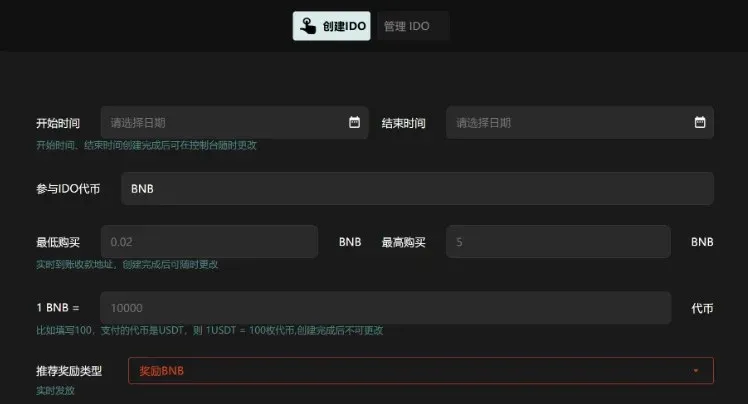
Practical Tip: Even a first‑time user can complete the entire workflow in roughly one hour. The main costs are gas fees and a modest platform service charge, making it suitable for teams with limited budgets.
Risk Alerts & Best Practices
- Security First: Revoke any unnecessary contract permissions, lock or burn LP tokens, never share private keys, and always use official URLs to avoid phishing.
- Fee Management: Keep an eye on on‑chain gas costs and platform fees; BSC and SOL generally offer lower expenses than Ethereum.
- Market Volatility: Crypto asset prices can swing dramatically, and many projects fail to survive long‑term. Diversify your exposure and act rationally.
IDOs provide an efficient fundraising channel for projects while giving investors early‑stage access to potential growth opportunities. With low‑bar platforms like GTokenTool, even teams lacking development expertise can swiftly launch a token and bring an IDO to market.
This concludes the article. For more details on IDOs, search for previous Bitaigen (比特根) articles or continue reading the recommended content below. Stay tuned to Bitaigen for future updates!
💡 Register on Binance with referral code B2345 for the maximum trading fee discount. See Binance complete guide.



