
 Bitaigen Research
 In this article we outline the asset‑management logic that underpins fully‑backed stablecoins, examine their similarity to Money‑Market Funds, and conduct an in‑depth analysis of the legal risk that the U.S. Securities and Exchange Commission (SEC) could classify BUSD, USDC and USDT as securities under the Howey Test or a broader securities definition. The goal is to help readers pinpoint the core issues of the regulatory debate.
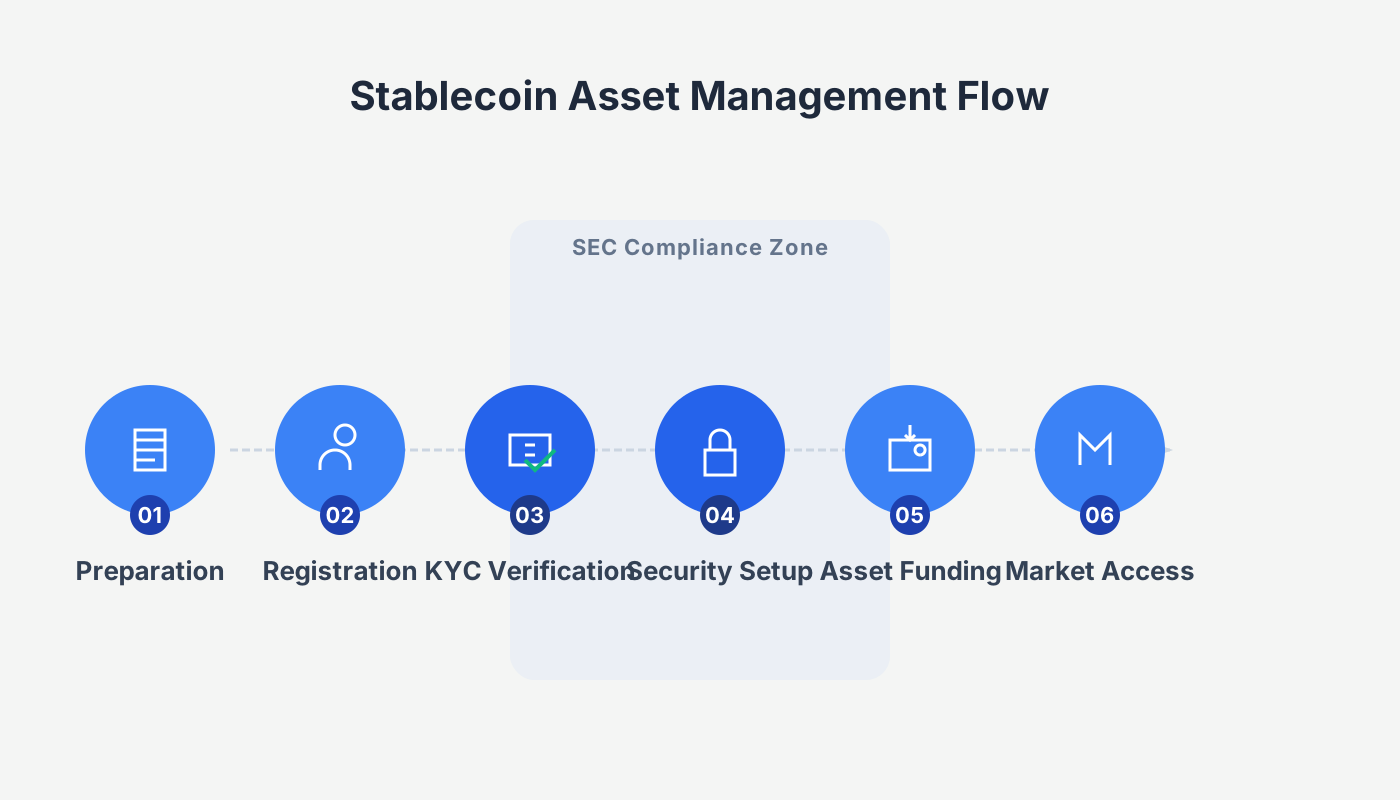

Fully‑backed stablecoins that allocate their assets to short‑term securities such as government bonds operate in a manner comparable to Money‑Market Mutual Funds, satisfy the expansive definition of “security” under U.S. securities law, and could therefore be deemed securities.
Community Question: Why Do Stablecoins Appear Not to Meet the Howey Test?
The Howey Test is the four‑pronged framework the U.S. SEC uses to determine whether an arrangement constitutes an “investment contract” and thus falls under securities regulation:
- Investment of money
- Investment in a common enterprise
- Expectation of profits
- Profit derived from the efforts of others rather than the investor’s own activities
Community members often argue that stablecoins cannot be securities because they do not promise a return, leading to confusion about the applicability of the Howey Test.
Definition of a Security: Beyond the Howey Test
The United States 1933 Securities Act provides an exceptionally broad definition of securities. In addition to “investment contracts,” it encompasses:
- Notes, stocks, treasury bills, bonds, and debt instruments
- Any agreement that participates in profit distribution, options, and similar rights
- Any certificate, receipt, or instrument that evidences an interest in an interest‑bearing or income‑producing asset
Venture‑capital founder Adam Cochran points out that, as long as the SEC deems an asset to meet regulatory criteria, virtually any asset class could be classified as a security; relying solely on the Howey Test does not settle the matter.
Are Stablecoins Equivalent to Money‑Market Mutual Funds (MMMFs)?
Adam Cochran further argues that BUSD, USDC, USDT and other fully‑backed stablecoins, whose reserves consist heavily of government securities, effectively function like Money‑Market Mutual Funds (MMMFs).
Definition: An MMMF is a security issued by a company that primarily invests in high‑liquidity, short‑term, credit‑worthy instruments such as commercial paper, certificates of deposit, Treasury bills, and repurchase agreements. In the United States, MMMFs are regulated by the SEC with the explicit aim of keeping the fund’s net asset value (typically USD 1.00) stable.
The reserve‑asset composition of stablecoins—dominated by short‑term Treasury securities and other highly liquid instruments—mirrors the portfolio composition of traditional MMMFs.
No Interest Paid, Yet Still Potentially a Security?
Cochran explains that the provision of interest is not a prerequisite for an instrument to be classified as a security. If investors entrust value to an issuer and rely on the issuer’s management of that value, the arrangement may fall outside any exemption and remain within the scope of securities regulation, even in the absence of any explicit yield.
---
Conclusion: Under the current U.S. regulatory framework, fully‑backed stablecoins, because of their asset allocation and operational model, could be treated as MMMFs, thereby fitting the broad definition of a security.
*Note: Gains from the sale or exchange of cryptocurrencies may be subject to taxation in the investor’s local jurisdiction. Recipients should consult a qualified tax professional to understand their obligations.*
Related Reading
- Tokenized Stocks: Unlock US Equity Access with Stablecoins
- CEX vs DEX: Liquidity, Security & Compliance Trends
- Is Trading on OKX Legal? Guide to Compliance & Deposits
💡 Register on Binance with referral code B2345 for the maximum trading fee discount. See Binance complete guide.



