
 Bitaigen Research
Simple Definition: A Digital Wrapper for Real‑World Stocks
Tokenized stocks are essentially digital tokens that represent the ownership of one share of a listed company, functioning as a digital certificate of ownership on a blockchain.
- Real‑world stock: e.g., a genuine share of Apple (AAPL) or Tesla (TSLA).
- Custodian: a regulated, audited financial institution or trust company that holds the underlying shares.
- Digital certificate: the token itself, issued on a public chain such as Ethereum, Solana, or a permissioned ledger.
The token’s value stays 1:1 asset‑backed to the market price of the underlying share. If AAPL trades at US $170, the corresponding tokenized AAPL (tAAPL) is theoretically worth US $170. When the company pays a dividend, token holders are entitled to receive it as well, typically distributed in a stablecoin or an equivalent digital asset.
It is important to note that investors do not hold a traditional brokerage certificate; they hold a digital asset fully backed by real‑world shares, granting them the economic benefits of the stock in a legally recognised manner.
Mechanism: The Architecture Behind the Token
The cornerstone of tokenized stocks is the 1:1 asset‑backed principle: every token minted must be matched by an actual share held in custody. Currently, two primary implementation models are in use.
Model 1: Issuer‑Platform Separation
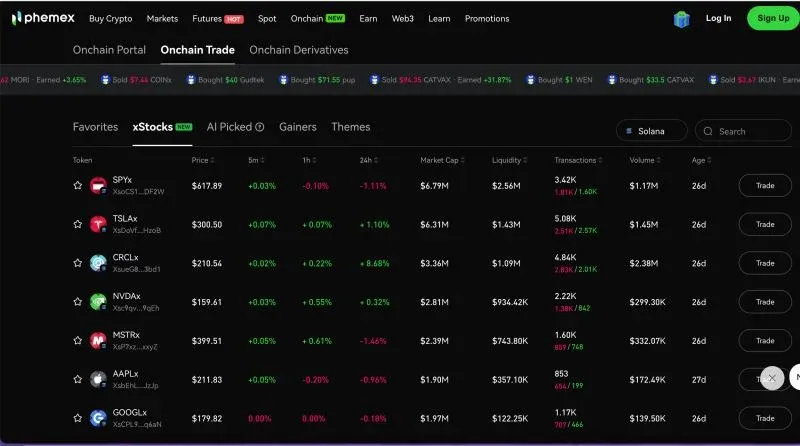
In this model, the issuer is responsible for acquiring and custodising the shares, while the trading platform provides secondary‑market liquidity. Using Phemex as an example, the workflow is:
- Regulated issuer purchases the asset
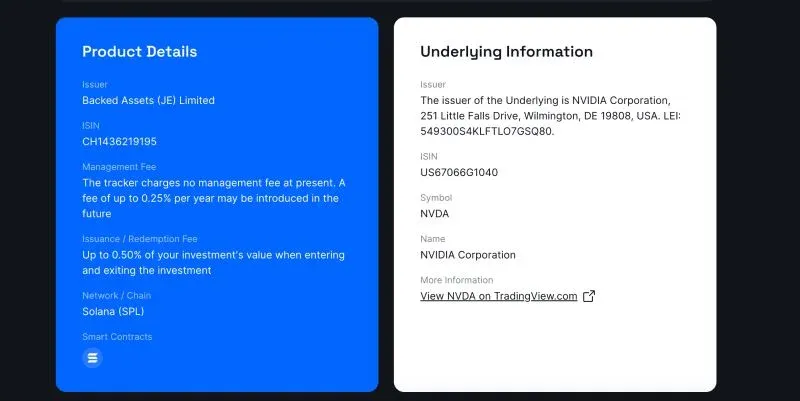
- The issuer (e.g., Backed Finance) holds a Swiss or EU regulatory licence and buys genuine shares on the U.S. market through a prime broker such as Interactive Brokers (IBKR).
- Independent custody
- The shares are deposited with a regulated independent custodian (e.g., Clearstream) or a dedicated account at the prime broker, insulating token holders from the issuer’s or exchange’s bankruptcy risk.
- 1:1 minting on a public chain
- Once custody is confirmed, the issuer mints an equivalent number of tokens on a public blockchain like Solana or Ethereum (e.g., NVDAx), maintaining a strict 1:1 ratio that can be audited publicly.
- Issuance and trading
- The minted tokens are listed on crypto exchanges such as Phemex, offering global investors order‑book matching, liquidity, and a user‑friendly interface.
The key feature of this model is that the issuer bears the compliance responsibility, while the platform acts merely as a front‑end distribution channel, reducing its own regulatory burden. A similar approach was trialled by FTX in 2020; although the platform collapsed due to unrelated fraud, the technical process itself had no fundamental flaw, underscoring the importance of issuer integrity.
Model 2: Vertically Integrated Broker‑Issuer (Robinhood Method)
This is a “closed‑loop” model in which the platform handles the entire chain—from share acquisition to token issuance. Using Robinhood as an illustration:
- In‑house acquisition and custody: Robinhood’s European subsidiary holds a Lithuanian securities licence, allowing it to legally purchase and custodian U.S. equities and ETFs.
- Private‑chain minting: Corresponding tokens are minted on Arbitrum or on Robinhood’s proprietary Robinhood Chain.
- Closed‑loop trading: All buying and selling occur inside the platform; the on‑chain state is synchronised but the ecosystem remains isolated, limiting composability with external DeFi protocols.
Because this model requires a full securities licence, it is difficult to replicate. While it offers tight control, it also restricts cross‑platform interoperability.
Clear Comparison: Tokenized Stocks vs. Traditional Stocks vs. Contracts for Difference (CFDs)
| Feature | **Tokenized Stock** | Traditional Stock | CFD |
|---|---|---|---|
| **Ownership** | Direct ownership of a digitally‑backed token, voting rights attached to the underlying share | Holds a physical or electronic certificate, voting rights attached | No ownership; only the price difference is traded |
| **Trading Hours** | 24 / 7 / 365, settlement occurs on‑chain instantly | Limited to exchange hours (e.g., US East Coast 9:30 – 16:00) | Usually 24 / 5, subject to exchange schedules |
| **Access Barrier** | Global internet access; restrictions only where the issuer is prohibited | Must open an account with a locally regulated broker; geographic limits apply | Prohibited for retail investors in some jurisdictions (e.g., United States) |
| **Settlement Speed** | Seconds to minutes on the blockchain | T+1 in the US, or next business day in many markets | Immediate profit/loss settlement; underlying asset never changes hands |
| **Granularity** | Native support; minimum unit can be as low as 0.0001 token | Minimum lot size set by broker | Position size can be any amount |
| **DeFi Composability** | High; can be used as collateral, liquidity provision, etc. | Not usable directly in DeFi | Asset locked in traditional systems; no direct DeFi integration |
Pros and Cons: A Balanced View for the Modern Investor
Advantages
- Global liquidity: Anyone with an internet connection can buy tokens representing U.S. listed equities, breaking down regional financial barriers.
- Round‑the‑clock trading: Markets are not constrained by traditional exchange closing times, allowing investors to react to news and events in real time.
- Partial ownership democratization: Expensive shares such as BRK.A or AMZN become accessible through low‑priced tokens, enabling finer portfolio diversification.
- Programmable efficiency: On‑chain trades settle almost instantly, and tokens can serve as collateral or liquidity provision in DeFi, unlocking yield strategies that are difficult to achieve with conventional assets.
Potential Risks
- Regulatory uncertainty: The U.S. SEC has not approved these products for retail investors in the United States, creating higher compliance risk in certain jurisdictions.
- Issuer trustworthiness: Even with an independent custodian, the issuer’s honesty remains crucial; the FTX collapse serves as a reminder to conduct thorough due‑diligence on platforms.
- Liquidity fragmentation: The same underlying stock may appear on several platforms under different token symbols, scattering order books and widening bid‑ask spreads.
- Smart‑contract vulnerabilities: Tokens are governed by smart‑contract code; bugs or attacks could lead to loss of assets, making audit reports and security practices essential to monitor.
Conclusion: The Future of Investing Is Taking Shape
Tokenized stocks are not a fleeting novelty; they signal a fundamental shift in financial infrastructure. By marrying established traditional assets with the efficiency of blockchain technology, tokenized stocks enable global investors to participate in mainstream equity markets with low barriers and continuous access. While regulatory frameworks are still evolving and the credibility of issuing entities remains a pivotal factor, the potential for democratizing wealth creation is significant. For investors who are aware of the associated risks, tokenized stocks offer an innovative avenue for diversification and place us at the forefront of financial innovation.
*Please note that cryptocurrency gains may be subject to tax in your local jurisdiction; consult a tax professional to understand your obligations.*
The above constitutes the full content of “What Are Tokenized Stocks? How Do They Work? Are They Safe? An In‑Depth Guide.” For additional information, please refer to other articles published by Bitaigen.
Related Reading
💡 Register on Binance with referral code B2345 for the maximum trading fee discount. See Binance complete guide.



