
 Bitaigen Research
 Nowadays, decentralized finance (DeFi) and traditional finance no longer merely coexist; they are beginning to intertwine and influence each other. Because of this, understanding the main characteristics of the two systems is essential. This article explores and explains the primary differences between traditional finance (TradFi) and DeFi.
The Bitaigen editorial team believes that the convergence of traditional finance and DeFi is reshaping the way assets circulate. This article will help readers clarify the core distinctions between the two by examining institutional frameworks, operational mechanisms, and regulatory differences, and will also offer thoughts on future trends—worth a careful read.
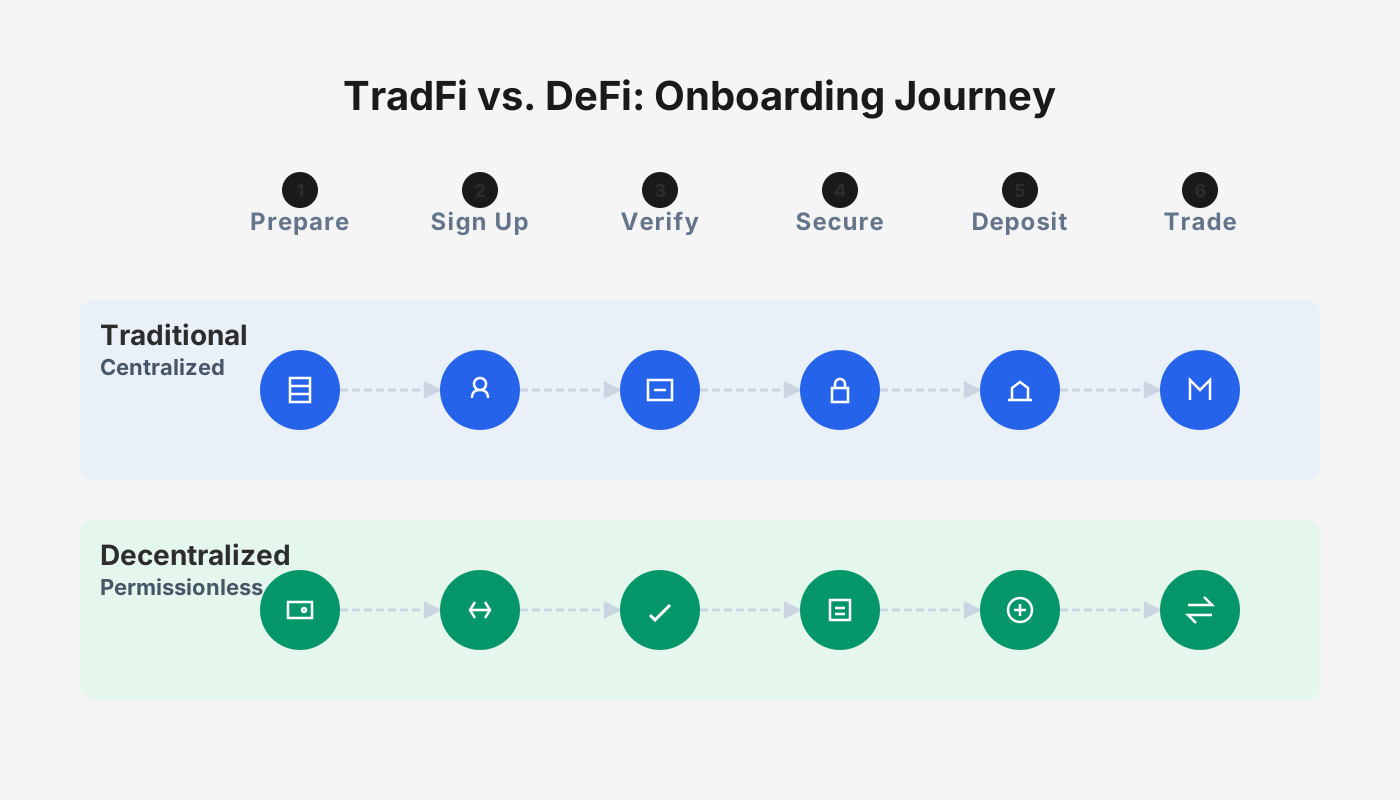
1. What is Traditional Finance (TradFi)? How Does It Operate?
TradFi is a conventional financial system centered on centralized institutions such as central banks and commercial banks, using fiat currency for deposits, borrowing, and payments. DeFi, by contrast, is built on blockchain smart contracts to deliver decentralized financial services; the two differ fundamentally in fund control, transparency, and regulation.
Traditional finance refers to the long‑standing financial ecosystem composed of central banks, commercial banks, and the everyday payment infrastructure we all use. Fiat money, credit cards, and debit cards are all components of TradFi. This architecture is clear, the toolbox is rich, and it relies on centralized entities for operation. Although it is not completely transparent, it is widely regarded as a trustworthy mainstream financial network.
2. What is Decentralized Finance (DeFi)? How Does It Operate?
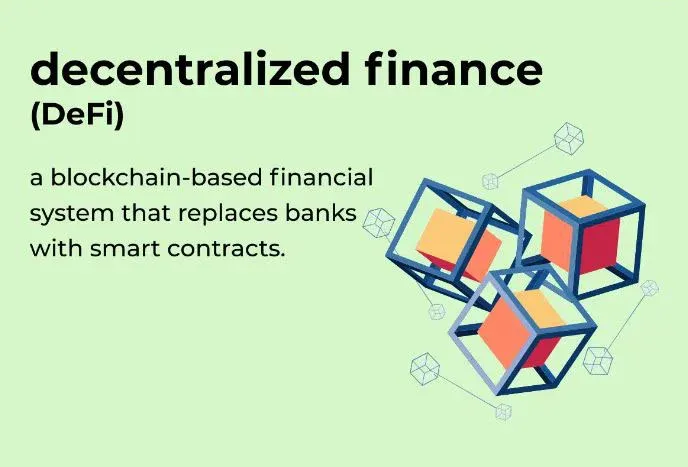
DeFi is a financial system built on blockchain technology. It discards banks and other intermediaries, using smart contracts to handle lending, trading, interest‑earning, and other activities. All actions revolve around cryptocurrencies and digital assets, creating a brand‑new financial ecosystem that does not require traditional money.
3. Core Differences Between Traditional Finance and Decentralized Finance
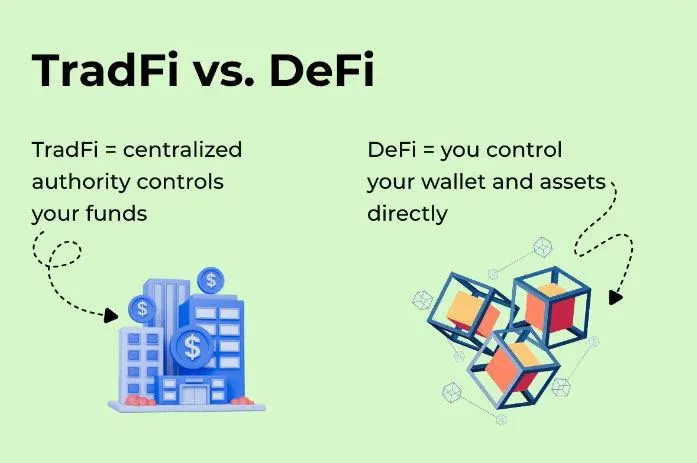
Traditional financial services and DeFi differ fundamentally in how funds are handled. DeFi has no central authority; anyone with a wallet and an internet connection can participate directly, and every transaction is publicly recorded on a public blockchain, giving users full control of their assets. By contrast, TradFi banks and financial institutions act as intermediaries, holding the legal ownership of the majority of financial assets and managing funds centrally. The two also diverge sharply in entry barriers, security, regulation, and privacy.
4. DeFi vs. TradFi: Detailed Comparison
To make comparison easier, the following sections analyze key dimensions of the two systems one by one.
Fund Control
In TradFi, banks manage the funds users deposit, and they can freeze accounts, reverse transactions, or set limits. DeFi stores assets in the user’s own wallet; only the holder of the private key can move the funds, and no institution needs to approve a transaction. This model gives users total autonomy, but it also means all risk rests on the user.
Asset Ownership
TradFi provides a claim right to assets, while the actual ownership remains with the broker or bank that holds custody. DeFi delivers true ownership of cryptographic assets—once the asset resides at a user’s address, it belongs to that user, eliminating custodial risk.
Geographic Reachability
Traditional finance is constrained by regional regulations and banking networks, requiring proof of residence and other documents. DeFi only needs an internet connection and a crypto wallet; anyone anywhere can use it, completely breaking down geographic barriers.
Intermediaries
TradFi relies on banks, payment processors, brokers, clearing houses, and regulators at every step. While this improves system stability, it slows down speed and raises costs. DeFi uses smart contracts to automatically enforce rules, removing intermediaries and enabling near‑instant settlement. However, smart‑contract bugs or design flaws can introduce irreversible systemic risks.
Transaction Speed
Traditional finance transfers often take several days, and cross‑border payments are even slower. DeFi transactions can be completed within seconds to minutes after blockchain confirmation, depending on network conditions. Even when the network is congested and fees rise, overall speed remains noticeably faster than the traditional system.
Availability
Banks are subject to business hours, holidays, and infrastructure limitations; services pause outside working hours. DeFi operates 24 hours a day, 365 days a year, allowing users to remit, trade, or borrow at any time. Nevertheless, system failures or network congestion lack dedicated customer‑service support.
Fee Structure
Traditional finance fees are numerous—maintenance fees, withdrawal fees, wire‑transfer fees, etc.—and are often hidden in fine print. DeFi fees are primarily determined by blockchain gas costs and platform rules, offering a more transparent structure, though fees can swing dramatically during periods of high demand.
Cost Transparency
In TradFi, fee calculations are rarely disclosed, making it hard for users to estimate actual expenses. In DeFi, fees and smart‑contract logic are on‑chain and publicly queryable, providing high transparency, albeit with the need for users to monitor gas‑price volatility themselves.
Transparency
Traditional finance keeps internal operations, risk management, and loan recipient information behind closed doors. DeFi records every transaction, contract code, and asset flow publicly, enhancing trust, but transparency does not automatically equate to safety.
Consumer Protection
TradFi offers multiple layers of protection such as deposit insurance, fraud refunds, chargebacks, and legal recourse. DeFi lacks comparable mechanisms; if a user makes a mistake or falls victim to an attack, assets are generally unrecoverable, relying only on personal security practices or community reputation.
Regulation
Traditional finance is subject to strict regulation; compliance audits help keep the system robust but also slow innovation. DeFi often operates in a regulatory vacuum, which accelerates iteration but can also foster scams and high‑risk behavior. Evolving regulatory landscapes may shape the competitive dynamics between the two in the future.
Security
TradFi depends on institutional security systems, including encrypted databases, fraud monitoring, and deposit insurance. DeFi security hinges on cryptography and the quality of smart‑contract code; private‑key leakage or contract vulnerabilities can result in loss of assets.
Transaction Privacy
Traditional finance verifies identity for each transaction and records details, limiting user privacy. DeFi interacts via wallet addresses; transactions are public but not directly linked to real‑world identities, offering greater pseudonymity, though not absolute anonymity.
Entry Barriers
Traditional finance requires identification documents, address proof, credit checks, etc., excluding certain populations. DeFi virtually eliminates paperwork; a smartphone and internet connection suffice, dramatically lowering the entry threshold for financial services.
Yield Opportunities

TradFi generates returns mainly from savings interest, bonds, and dividends—relatively stable but limited. DeFi offers higher returns through staking, lending, liquidity mining, and yield farming, but with greater volatility and contract risk.
Innovation Speed
Regulatory constraints, legacy systems, and risk‑management requirements cause TradFi product development cycles to span years. DeFi can launch new protocols, tokens, and tools within weeks or even days, delivering rapid innovation at the cost of higher experimental risk.
5. DeFi vs. TradFi: Comparison Table
| Category | Traditional Finance (TradFi) | DeFi (Decentralized Finance) |
|---|---|---|
| **Fund Control** | Banks hold and control funds | Users control wallet and assets themselves |
| **Asset Ownership** | Assets are custodial; users have usage rights | Cryptographic ownership; assets fully belong to the user |
| **Geographic Reachability** | Limited by region, residence, local regulations | Accessible anywhere with internet and a wallet |
| **Intermediaries** | Requires banks, brokers, clearing houses, etc. | Smart contracts execute automatically, no intermediaries |
| **Transaction Speed** | Transfers are slow; cross‑border may take days | Seconds to minutes after blockchain confirmation |
| **Availability** | Restricted by business hours, holidays | 24 / 7, 365 days a year, globally reachable |
| **Fee Structure** | Complex, often hidden fees | Fees driven by gas costs and platform rules; can be volatile |
| **Cost Transparency** | Fee formulas opaque, hard to predict | Fees and contract logic are on‑chain and publicly viewable |
| **Transparency** | Internal processes closed, information siloed | All transaction data public; code can be audited |
| **Consumer Protection** | Refunds, chargebacks, insurance, legal recourse | No official safeguards; errors are hard to reverse |
| **Regulation** | Heavily regulated, high compliance burden | Mostly lightly regulated, high freedom for innovation |
| **Security** | Institutional security systems + deposit insurance | Private‑key management and contract security; user bears risk |
| **Transaction Privacy** | Identity verification required; transactions monitored | Wallet addresses used; public but not directly tied to real identity |
| **Entry Barriers** | ID, credit checks, etc. required | No paperwork; very low threshold |
| **Yield Opportunities** | Stable but limited returns (savings, bonds) | High‑yield staking, lending, liquidity mining, but higher risk |
| **Innovation Speed** | Slow product rollout due to regulation | New protocols and tokens appear rapidly, fast innovation |
6. Can DeFi and Traditional Finance Co‑exist?
DeFi and TradFi may appear antagonistic, yet they are gradually achieving synergy. Traditional financial institutions are exploring blockchain technology to improve payment efficiency and to issue central‑bank digital currencies. DeFi platforms are incorporating compliance tools, centralized exchanges, and insurance mechanisms. The two complement each other: TradFi supplies stability, regulation, and consumer protection; DeFi brings speed, global accessibility, and innovative vigor. The future is likely to feature integration rather than an either‑or scenario.
7. Advantages and Disadvantages of Traditional Finance
Compared with DeFi, traditional finance is not inherently good or bad; the following outlines its primary strengths and weaknesses.
Strengths
- Robust consumer protection – refunds, insurance, and legal remedies are available.
- Clear regulatory framework – strict rules help prevent fraud and instability.
- Familiar system – most people are accustomed to how banks operate.
- Stable infrastructure – decades‑long reliable financial network.
- Reduced personal liability – institutions hold funds on behalf of users.
- Wide acceptance – usable for payments and transfers in virtually any scenario.
- Low volatility – asset prices tend to be relatively steady.
Weaknesses
- Slow transaction speed – cross‑border transfers often require several days.
- Limited access – identity documents, proof of residence, etc., are required.
- High fees – hidden charges and service fees can add up substantially.
- Low transparency – internal operations are conducted behind closed doors.
- Centralized control – banks can freeze accounts or block transfers.
- High entry barriers – credit or geographic factors exclude some users.
- Lagging innovation – system upgrades move slower than those in the crypto space.
8. Advantages and Disadvantages of DeFi
Decentralized finance also possesses distinct strengths and challenges.
Advantages of DeFi
- Full control of funds – users manage their crypto assets directly.
- Globally accessible – anyone with internet and a wallet can participate.
- Fast cross‑border transactions – most trades settle in seconds or minutes.
- High transparency – every activity is publicly recorded on a public blockchain.
- Low entry barriers – no need for ID, credit checks, or a bank account.
- Large yield potential – staking, lending, and other mechanisms can deliver substantial returns.
- Rapid innovation – new tools and concepts emerge continuously.
Disadvantages of DeFi
- User‑borne risk – loss of private keys or contract bugs can result in unrecoverable losses.
- Regulatory uncertainty – the lack of clear oversight can expose participants to scams.
- Variable fees – gas costs can spike dramatically during network congestion.
- Limited consumer protection – no deposit insurance or chargeback mechanisms.
- Potential for impermanent loss – liquidity providers may experience value erosion.
- Complexity – technical knowledge is often required to interact safely.
---
Related Reading
- TVL in DeFi: How It’s Calculated, Why It Matters
- Smart Contracts: Core Principles & Use Cases in DeFi & NFTs
- USDC兑换人民币全攻略:火币、币安等平台操作步骤与注意要点
💡 Register on Binance with referral code B2345 for the maximum trading fee discount. See Binance complete guide.



