
 Bitaigen Research
 As spot ETFs usher in the era of institutionalization, the underlying logic of the crypto market is undergoing a profound reshaping. This article provides an in-depth analysis of how Bitcoin is shifting from a "crypto-native narrative" to a "traditional finance satellite asset," and reveals the structural divergence caused by the targeted inflow of institutional capital. At a time when altcoins are mired in a liquidity crisis, has the once-sacrosanct "Four-Year Cycle" law become obsolete? We aim to deconstruct this market paradigm shift to help readers see through the essence of the current cycle.
I. Paradigm Shift: How Institutional Forces are Reshaping Crypto Market Logic
In January 2024, the approval of spot Bitcoin ETFs became a watershed moment in the history of cryptocurrency. This was not merely the birth of a new financial product; it marked the official entry of the crypto market into the "Institutional Era." However, the far-reaching impact of this transition is that Bitcoin is gradually detaching itself from its original crypto-native narrative, instead becoming a "satellite asset" within the traditional global financial system.
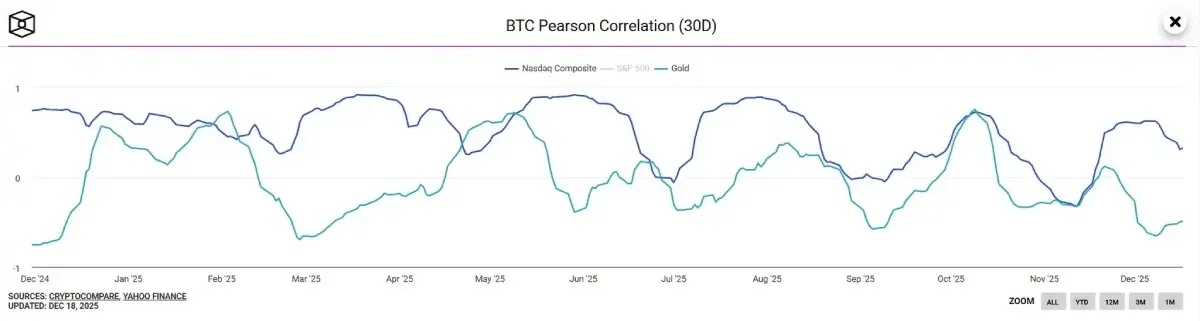
*Figure: 30-day correlation coefficient between BTC and Nasdaq/Gold*
1.1 Bitcoin: The "Digital Mirror" of US Tech Stocks
In the market performance of 2025, the correlation between Bitcoin and the Nasdaq 100 Index reached a historical high of 0.75-0.85, while its correlation with gold—a traditional safe-haven asset—dropped below 0.2. This implies that in the eyes of Wall Street, Bitcoin is no longer a simple "hedging tool," but rather a high-elasticity "digital tech stock." This shift in pricing power means that Bitcoin's volatility logic is now driven more by macro liquidity and the performance of the US stock market than by internal crypto developments.
1.2 The "Targeted Siphoning" Effect of Institutional Buying
The incremental capital introduced by giants such as BlackRock and Fidelity exhibits a strong sense of "exclusivity." These pension funds and family offices, operating based on regulatory compliance, liquidity depth, and brand recognition, allocate almost exclusively to Bitcoin. For global investors using fiat on-ramps, whether through SEPA transfers in the Eurozone or SWIFT for international wires, the path to Bitcoin has never been more streamlined, yet this path rarely leads to other assets.
- Structural Solidification: Of the tens of billions of dollars flowing into ETFs in 2025, over 95% of the capital is locked within the Bitcoin ecosystem. Only a tiny fraction (less than 5%) manages to penetrate Ethereum or altcoins through bridges or over-the-counter (OTC) trades.
- The MSTR Leverage Effect: MicroStrategy (MSTR) continues to increase its holdings by issuing convertible bonds, currently holding approximately 670,000 BTC (accounting for 3.2% of the circulating supply). This "corporate hoarding" model creates a self-reinforcing positive feedback loop, further siphoning liquidity that might have otherwise flowed into the altcoin market.
This "institutionalization" has built an invisible wall between Bitcoin and the rest of the asset class. The historical logic of "capital overflow"—where Bitcoin's gains eventually trickle down to smaller coins—has been completely rewritten in 2025.

II. Phenomenon Observation: The "Never-Setting Sun" of Bitcoin vs. the "Great Divergence" of Altcoins
Data reveals a harsh reality: the traditional "Four-Year Cycle" script—characterized by the rotation pattern of "BTC surges, then ETH follows, then Altcoins fly together"—has effectively failed in 2025.
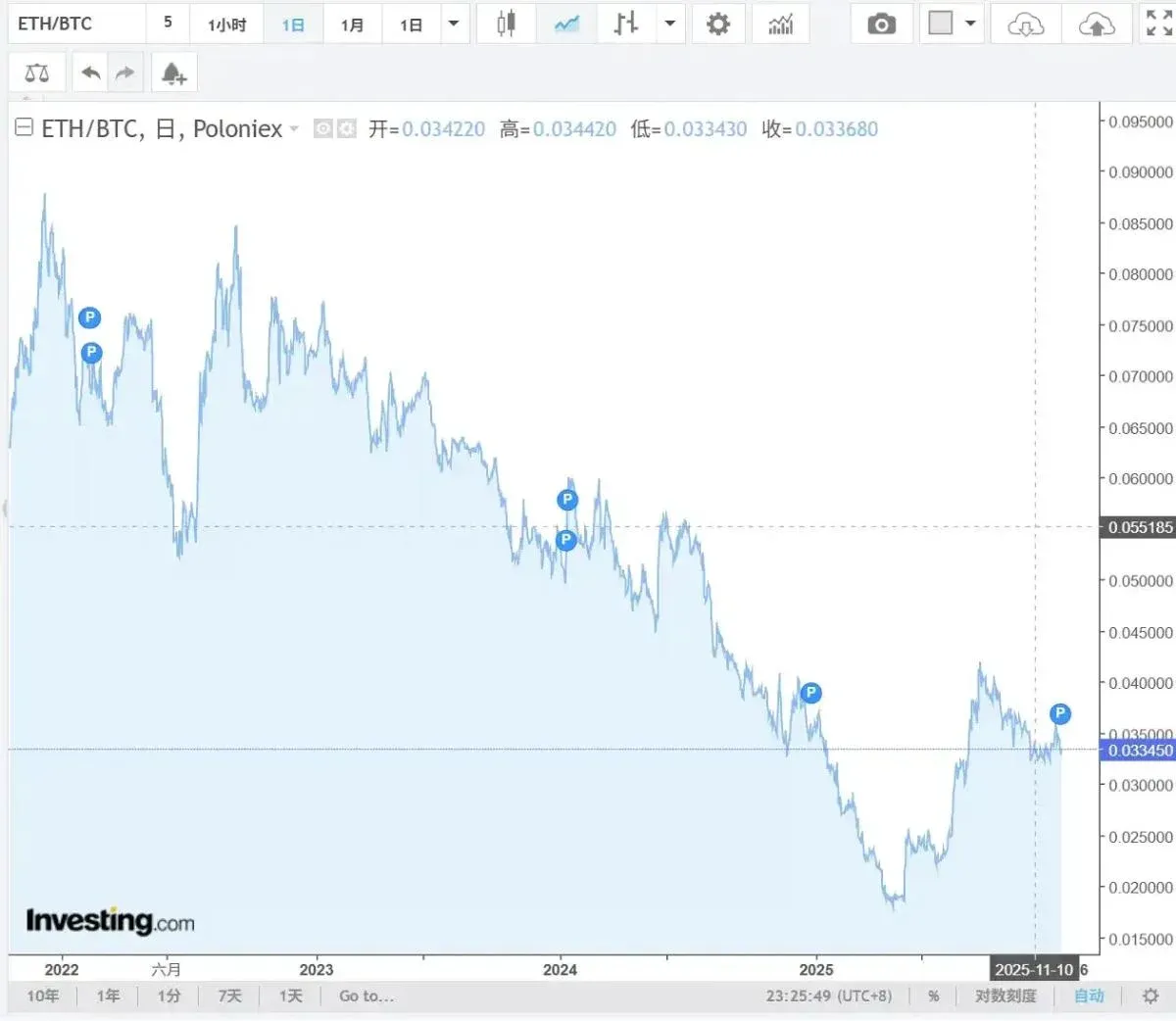
*Figure: ETH/BTC Exchange Rate Chart*
2.1 "Fire and Ice" in the Statistical Data
Bitcoin’s Dominance:
- Price Performance: Starting the year at $70,000, Bitcoin once touched $125,000 (a +78% gain), and even during market corrections, it remained stable within the $86,000-$88,000 range.
- Market Share: Bitcoin’s Market Dominance climbed from 50% at the start of 2024 to 59-60% in 2025, reaching new highs for recent years. It is important for users in the United States to note that they should utilize Binance.US for their trading activities, as the global Binance platform remains restricted for US residents. Furthermore, investors must keep in mind that cryptocurrency gains are generally taxable events under local jurisdictions, such as capital gains tax in the US or UK.
Ethereum’s "Identity Crisis":
- Exchange Rate Collapse: The ETH/BTC exchange rate fell to a multi-year trough, shrinking by more than 60% from its historical highs.
- Valuation Dilemma: Despite having ETF support, Ethereum hovered around the $2,800 mark with little momentum, as institutional interest remained significantly lower than that for Bitcoin.
The "Twilight" of Altcoins:
- Activity Depletion: The Altcoin Season Index has remained consistently below 20. Most projects in the top 100 by market cap have plummeted 80-95% from their 2021 peaks.
- The Liquidity Trap: "VC Coins" (tokens backed by venture capital) launched in 2025 generally exhibit characteristics of "high valuation, low initial circulation." It has become the norm for these tokens to break below their listing price almost immediately upon launch.
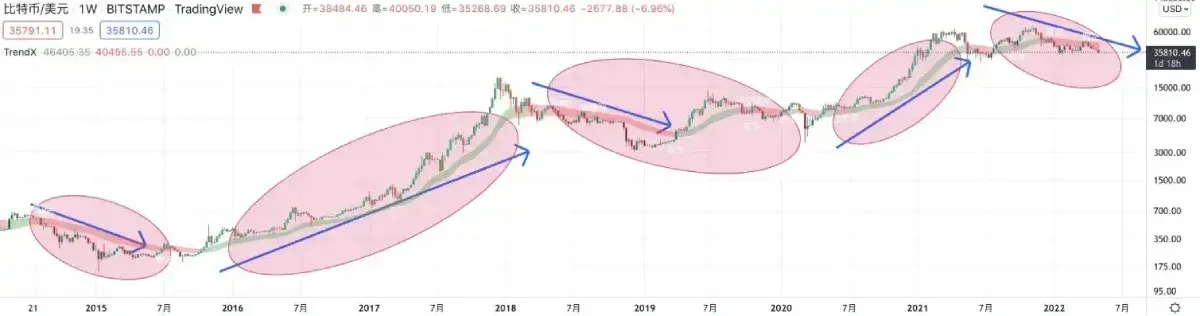
2.2 Profound Deviations from Historical Dimensions
Compared to the previous two bull markets, the transmission mechanism in 2025 has experienced a clear "disconnection":
- 2017: The ICO craze drove ETH gains (+17,400%) far beyond those of BTC (+1,900%).
- 2021: The DeFi and NFT summer allowed altcoins to achieve near-universal 10x to 100x leaps.
- 2025: When Bitcoin hit new all-time highs, altcoins not only failed to follow suit but instead fell into a slow, grinding decline due to liquidity exhaustion.
III. In-Depth Analysis: Why Have Ethereum and Altcoins Collectively "Fallen Behind"?
3.1 Ethereum’s Internal Consumption: The "Vampire" Effect of Layer 2
Ethereum’s weakness stems not only from external competition but also from internal contradictions within its ecosystem structure.
- Liquidity Fragmentation: While Layer 2 networks like Arbitrum and Base have locked in tens of billions of dollars in Total Value Locked (TVL), their native tokens have not effectively funneled value back to ETH. Instead, they have dispersed the mainnet’s Gas consumption and diluted user attention.
- The Yield Paradox: After the transition to Proof of Stake (PoS), ETH’s 3-4% staking yield lacks competitiveness when compared to the 4.5% yield of US Treasuries. This makes it difficult to attract crypto-native capital that is seeking higher risk-adjusted returns.
3.2 The "Death Spiral" of Altcoins
- The Bankruptcy of the VC Coin Model: A large number of projects launched with Fully Diluted Valuations (FDV) in the billions of dollars, but with extremely low initial circulating supplies. As VCs and teams continue to unlock their tokens, the selling pressure far exceeds the market's absorption capacity, leading to long-term price erosion.
- Meme Coin Game Fatigue: Although Meme coins on Solana (such as WIF and BONK) brought localized heat, they are essentially zero-sum games. After experiencing multiple "rug pulls" or being "exit liquidity," retail capital's risk-aversion has intensified significantly.
- Shrinking Trading Depth: The average daily trading volume of altcoins on top-tier exchanges has shrunk by over 70% compared to 2021. Extremely low liquidity means that even small sell orders can trigger a violent collapse in price.
IV. Institutional Perspective: Grayscale and CoinShares’ 2026 Outlook
Regarding future evolution, two major asset management giants have provided clear path predictions in their latest reports.

4.1 Grayscale’s Prediction: Asset Stratification and "Separating the Wheat from the Chaff"
In its "2026 Digital Asset Outlook," Grayscale argues that the market is entering a new phase dominated by compliance and fundamentals:
- BTC’s Scarcity Narrative: March 2026 will mark the mining of the 20 millionth Bitcoin. Grayscale predicts that, driven by increased allocation from pension funds and sovereign wealth funds, Bitcoin has the potential to break through the $150,000 mark.
- ETH’s Painful Transition: Ethereum will need 1-2 years to prove that its Layer 2 strategy can truly feed value back to the mainnet. 2026 may be a period of "sideways consolidation and momentum building."
- The Stratified Fate of Altcoins: Only projects with real users and a clear regulatory path (such as Solana or Avalanche) will survive. Speculative tokens lacking utility are highly likely to be marginalized.
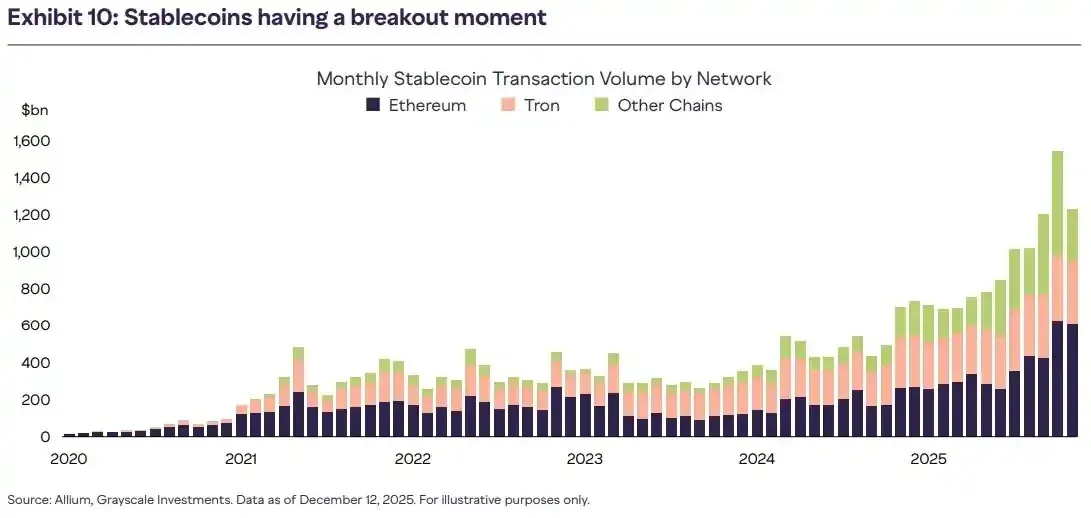
4.2 CoinShares: Moving Toward the "Hybrid Finance" Era
CoinShares introduced the concept of "Convergence" in its report, suggesting that 2026 will be the year where utility prevails:
- Real-World Asset Tokenization (RWA): Institutions like BlackRock and Franklin Templeton are issuing tokenized funds and treasuries on public chains. It is expected that the market value of RWA will exceed $50 billion by 2026.
- Reshaping Payment Rails: As regulatory frameworks like MiCA (Markets in Crypto-Assets) in the EU mature, the market cap of stablecoins is expected to approach $500 billion, becoming a vital component of global payments.
- The Return of Fundamentals: Token valuations will shift from "pure narrative" to "cash flow" and "real revenue." Approximately 90% of existing altcoins will likely be eliminated by the market during this process.

V. Conclusion: Has the Four-Year Cycle Really Ended?
The core of past cycles was "Supply-Driven": the halving led to a supply squeeze, which in turn triggered retail FOMO and capital overflow into smaller assets.
However, 2025 has inaugurated a "Demand-Driven" mode:
- Targeted Inflow: Institutional capital only buys compliant Bitcoin, cutting off the traditional path for capital to flow toward altcoins.
- Collapse of Confidence: After being "burned" by multiple VC coins and Meme coin cycles, retail investors are no longer easily enticed to buy the top, leading to a solidified stratification of liquidity.
In summary: The halving logic of the four-year cycle still exists in terms of Bitcoin's scarcity, but its "universal rise" transmission mechanism has failed.
Bitcoin’s "Never-Setting Sun" symbolizes the successful "domestication" of crypto assets by the mainstream financial system. It has gained unprecedented liquidity, but it has also lost some of its decentralized purity. Meanwhile, the "Twilight" of altcoins is not the end of the industry, but rather a necessary process of de-bubbling.
The future crypto market will no longer be a carnival where "all coins rise together," but a brutal competition where "the strong get stronger." Only those projects that can integrate into the "hybrid finance" system, possess real revenue, and maintain a compliant path will be able to rise from the ashes. In this paradigm shift, traditional "copy-pasting" of historical patterns is meaningless; only investors who understand the new rules will survive the new cycle.
This concludes our introduction to the "Never-Setting Sun" of Bitcoin and the "Twilight" of Altcoins. Has the four-year cycle truly ended? For more in-depth analysis on Bitcoin cycle judgments and market trends, please search for previous articles on Bitaigen or continue browsing related content. We hope you will continue to support Bitaigen in the future!
Related Reading
- Crypto Pricing Power: Liquidity, Spot ETFs & Market Trends
- Bitcoin Halving Impact on Post‑Halving Prices Amid Spot ETFs
- Bitcoin Manipulation Allegations & Spot ETF Inflow Surge
💡 Register on Binance with referral code B2345 for the maximum trading fee discount. See Binance complete guide.



