
 Bitaigen Research
 What Is AR.IO Token? Is AR.IO a Good Investment? What Could Its Future Price Be? How AR.IO Works and Why It Is the Key to Decentralized, Permanent Network Access Built on Arweave
Below, Bitaigen’s editor explains the concept of the ARIO token, its investment potential, and price forecasts in detail.
In this article we will dissect the technical foundations of the AR.IO project and its synergy with Arweave, evaluate the ecological role of its token, and objectively analyze its potential investment value against industry trends. By systematically explaining core functions, incentive mechanisms, and the competitive landscape, we aim to give readers a comprehensive view of whether ARIO deserves attention.
Introduction
The Internet was never designed for the permanent preservation of information. When a website shuts down or changes ownership, its content often disappears. Link rot, data loss, and censorship affect news, scientific research, financial records, and countless other domains. This instability creates headaches for users, developers, and enterprises that rely on continuous access to information.
The permaweb, built on the Arweave blockchain, addresses this problem by offering a permanent, tamper‑proof storage layer. Once data is published, it stays online forever and can always be retrieved.
However, permanence alone is not enough. Accessing that data must be fast, reliable, and user‑friendly—this is where AR.IO comes in. AR.IO is the access layer of the permaweb, providing decentralized gateways, human‑readable domain names, and a token‑based incentive system that enables the permaweb to be used and built at scale. In short, it turns permanent storage into a usable network.
What Is AR.IO
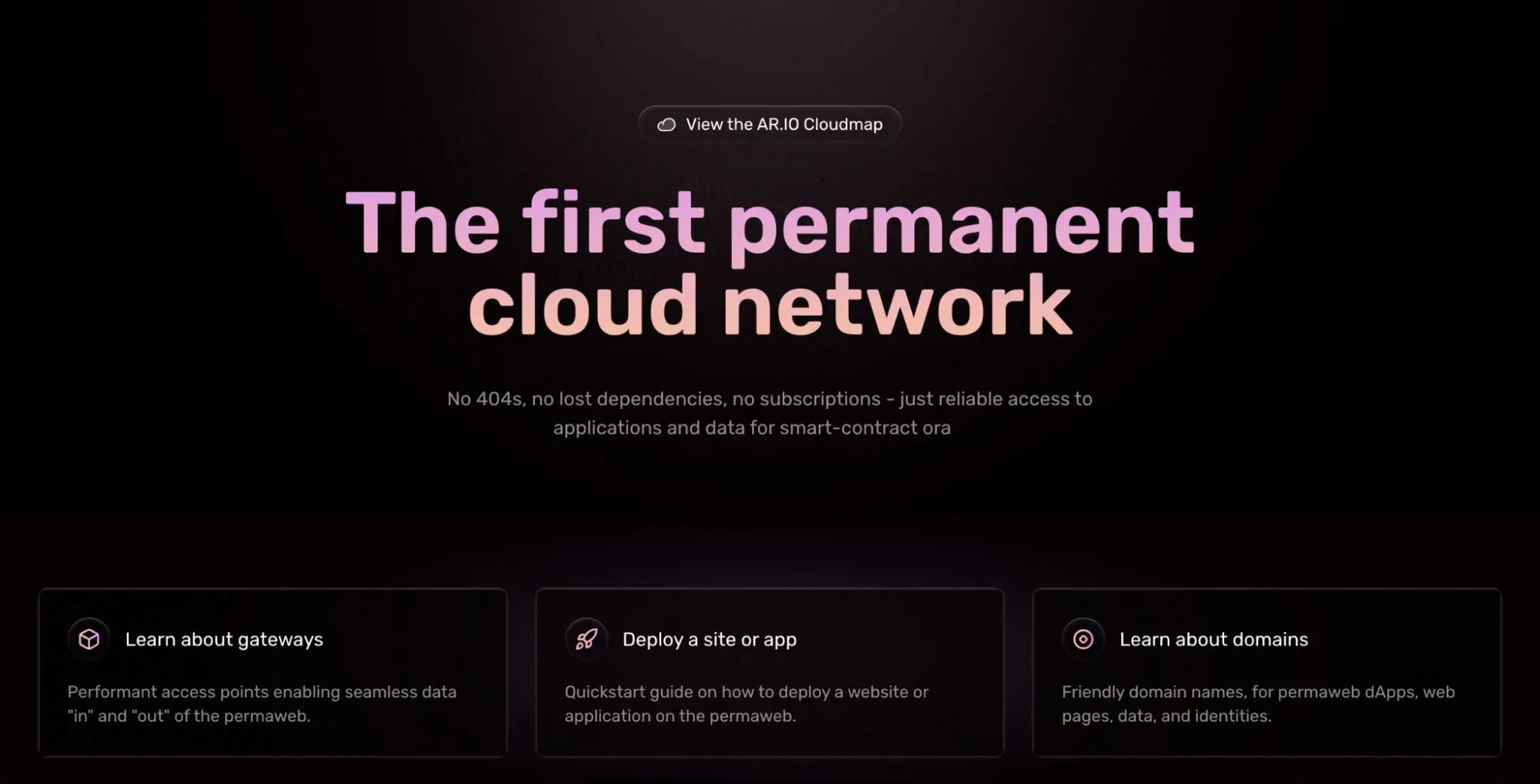
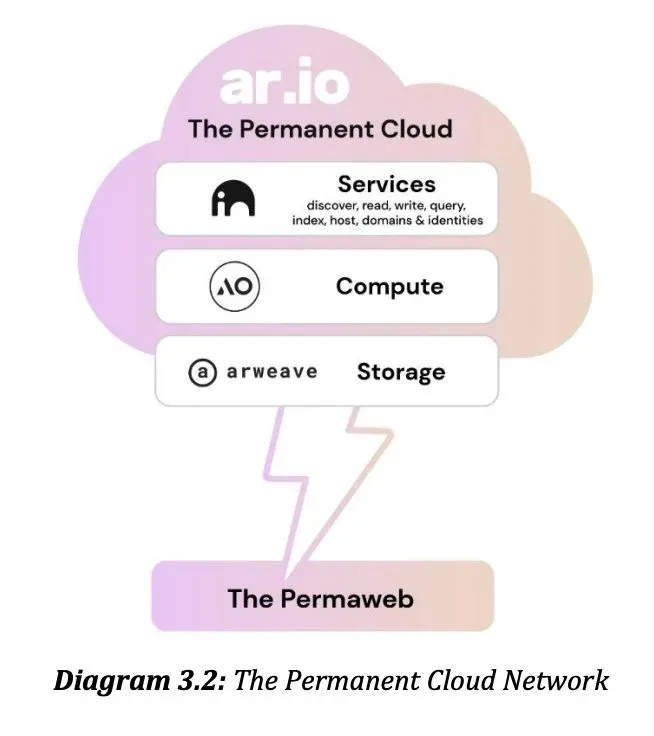
AR.IO is the access layer of the permaweb. It runs a decentralized network of gateways and tools that let users interact with data stored on Arweave. Arweave handles the permanent network storage; AR.IO supplies the usable interface.
Think of Arweave as the backend storage engine where everything lives forever, while AR.IO is the frontend that makes that content reachable. Just as DNS translates IP addresses into human‑readable domain names, AR.IO’s Arweave Name System (ArNS) translates long content hashes into readable web addresses. Similar to a CDN, AR.IO’s distributed gateways ensure that content loads quickly and reliably, without a single point of failure.
The AR.IO network primarily performs three functions (see [ar.io][1]):
Access: Decentralized Gateways
AR.IO operates an independent gateway network—servers that retrieve and deliver content from Arweave. The gateways work like a global content‑delivery network (CDN) but are not centrally controlled; users are automatically routed to the fastest, most reliable node.
Identity: Arweave Name System (ArNS)
ArNS lets users assign human‑readable names to permanent content. Instead of using a long hash, a user can access a file via a web‑style name such as `example.arweave.dev`.
Incentive: $ARIO Token
The network uses the $ARIO token to reward gateway operators, allocate names, and ensure fair participation. It is a utility token that underpins the economic operation of the AR.IO ecosystem.
In summary, AR.IO bridges the gap between permanent storage and a usable web experience, helping developers build permanently‑running applications and websites while providing readable names and higher reliability.
History, Origin, and Key Figures Behind AR.IO
AR.IO was founded in 2020 by Philip Mataras. Mataras previously worked at KPMG and Parsons Brinckerhoff as an enterprise IT architect. After discovering Arweave’s permanent storage layer, he created ArDrive, one of the first decentralized applications that uploaded files to the permaweb.
As ArDrive grew, a larger problem became apparent: although Arweave can store data forever, the way to access that data remained centralized and fragile. The permaweb heavily relied on a single gateway (arweave.net), lacked a readable naming system, and offered no guarantee of fast, reliable access. The absence of a decentralized access layer limited the permaweb’s usability and reach.
To fill this gap, AR.IO was launched. Its mission is to provide the infrastructure layer that improves how people and applications interact with Arweave data. AR.IO introduced decentralized gateways, a naming system (ArNS), and an incentive model that coordinates network participation and service quality.
“AR.IO” stands for Arweave Input/Output, emphasizing its role as the gateway between Arweave’s storage layer and a usable network.
In early 2022, AR.IO took over the management of arweave.net, converting it into a decentralized resource and eliminating the single point of failure. In the same year, the company secured $17.2 million in funding from Forward Research (the core Arweave team), Blockchain Capital, and Ryze Labs.
Leadership Team
- Philip Mataras – Founder & Chief Executive Officer
- Ariel Melendez – Chief Technology Officer
- Lucas Porter‑Bakker – Head of Product & Design
AR.IO employs between 11 and 50 staff members and continues to develop infrastructure that supports a decentralized, permanent web.
How AR.IO Works
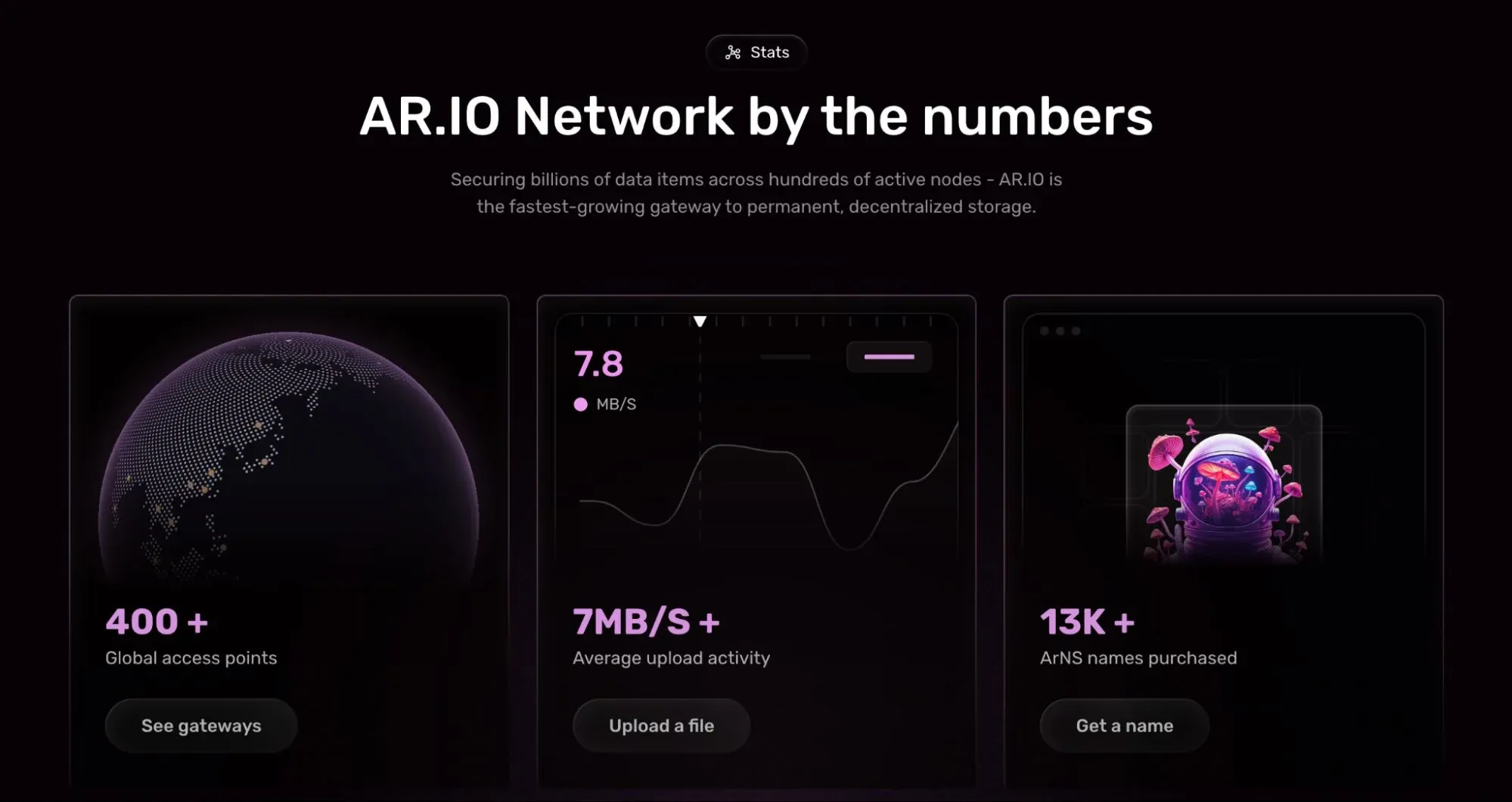
AR.IO operates a decentralized gateway network that lets users connect to data stored on the Arweave blockchain, delivering a high‑performance, user‑friendly access layer.
Decentralized Gateways
Gateways are servers that retrieve and serve data from Arweave. Without gateways, users would need to interact directly with the blockchain, which is complex and inefficient. AR.IO allows anyone to run a gateway node, decentralizing the service, removing single points of failure, and increasing resilience. Gateways can serve websites, dApps, and other data much like traditional web servers, except the content originates from a decentralized network.
Gateway Operators
Anyone can become a gateway operator by running the AR.IO software and staking ARIO tokens. Operators must lock up ARIO to be discoverable by the network. Competition is based on speed and reliability: the better a node performs, the more likely it is selected to serve traffic.
Arweave Name System (ArNS)
AR.IO supports ArNS, which lets users assign readable domain names to permaweb content, such as `example.arweave.dev`, eliminating the need to remember long transaction hashes. Names are managed and resolved by AR.IO gateways, lowering the technical barrier for building and using websites on the permaweb.
Token Incentives
The $ARIO token is central to AR.IO’s operation and is used for:
- Staking – required for gateway participation and visibility;
- ArNS registration and renewal – paying for human‑readable names;
- Coordinating reputation and service quality (see [ario.arweave.dev][2]).
These incentives align network performance with user demand, creating a sustainable system for permanent content access.
Gateway Routing & Load Balancing
AR.IO employs algorithms that route traffic to the most suitable gateway based on availability and performance, improving the user experience while guaranteeing content accessibility even when some nodes go offline.
Key Features of AR.IO
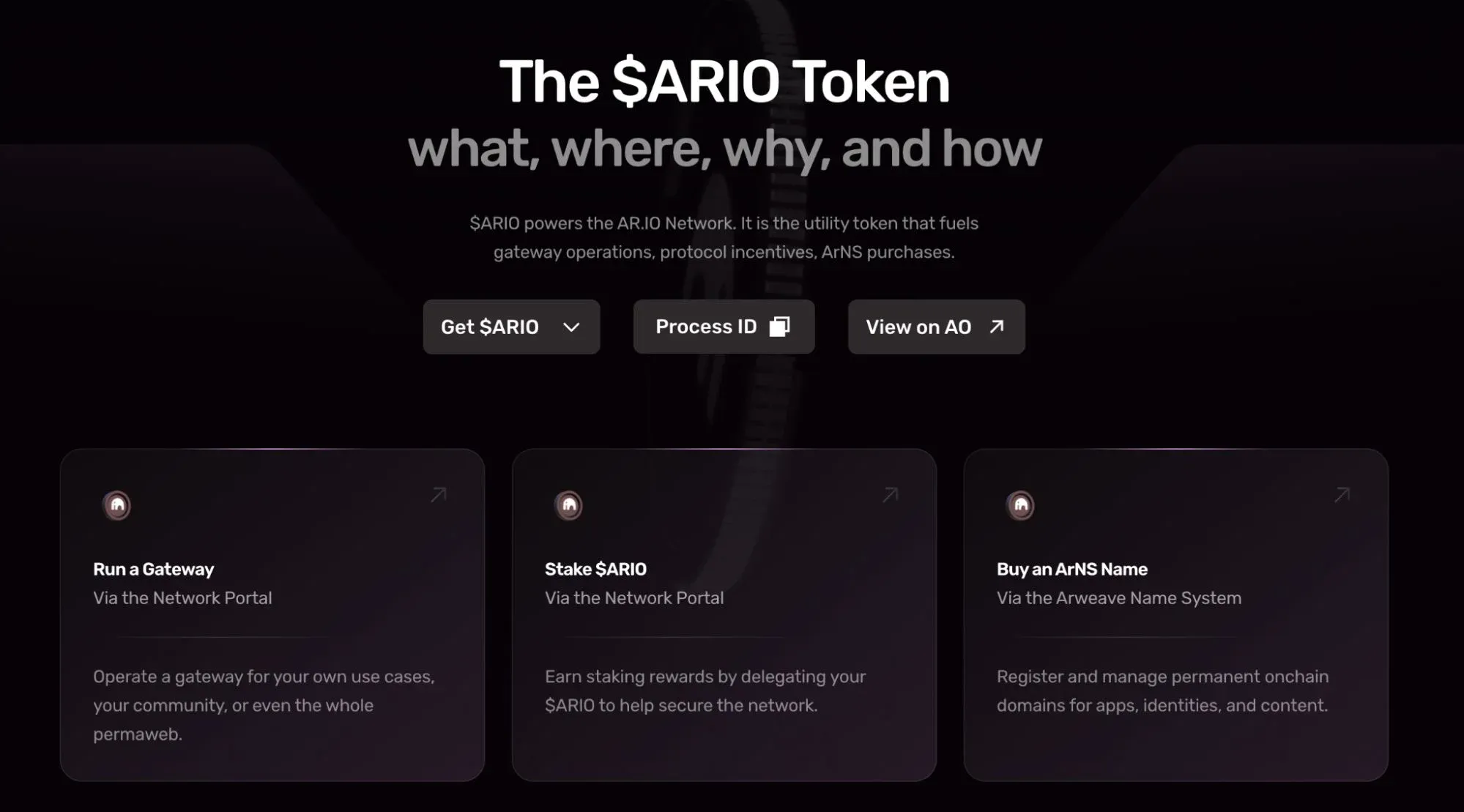
AR.IO provides the infrastructure that connects users and developers to an Arweave‑based permaweb, with design emphasis on accessibility, decentralization, and reliability.
Decentralized Gateway Network
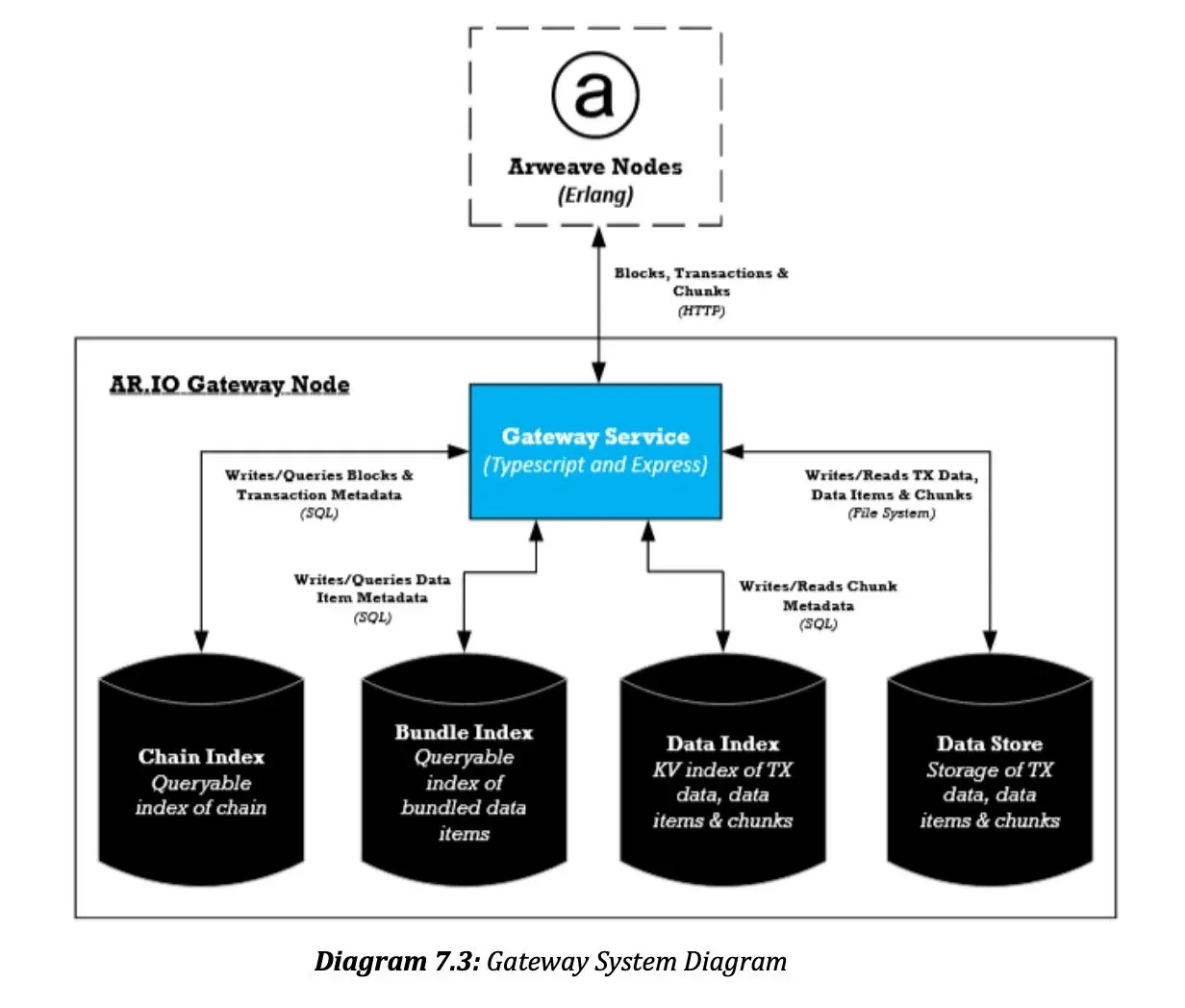
Anyone can run a gateway node that pulls content from Arweave and serves it, much like a traditional web server. Because there is no central authority, the network is resistant to downtime, censorship, and manipulation. Users are automatically routed to the fastest node.
Arweave Name System (ArNS)
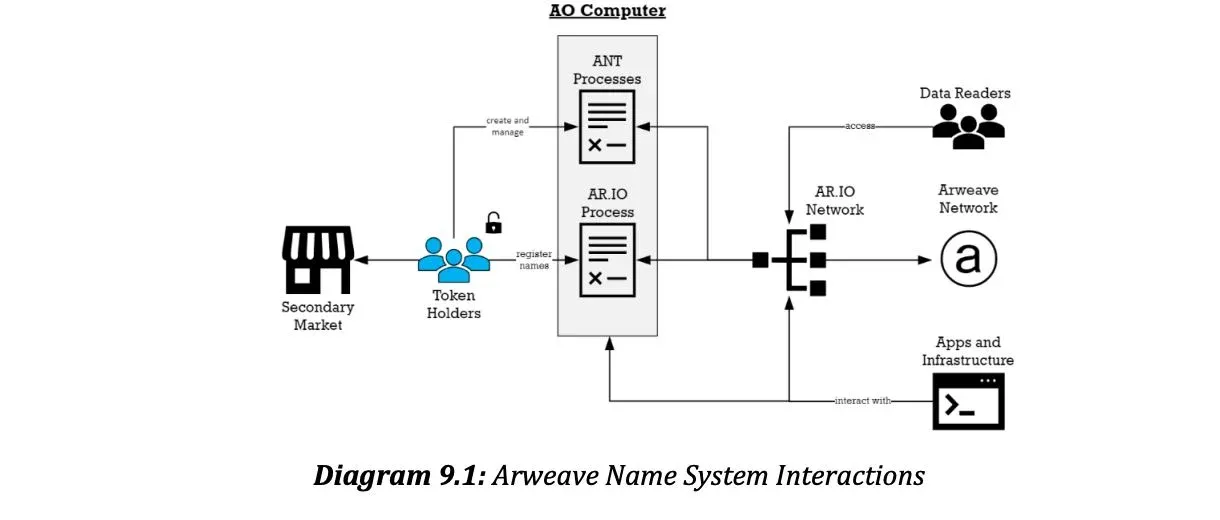
ArNS is AR.IO’s human‑readable naming scheme, allowing users to assign memorable, web‑friendly names (e.g., `blog.arweave.dev`) to data stored on Arweave, replacing unwieldy transaction IDs. This lowers the technical threshold for building websites, blogs, and dApps on the permaweb.
$ARIO Token Incentive Model
The AR.IO network runs on the $ARIO token, which fulfills three core roles:
- Staking – gateway operators lock tokens to increase visibility and reputation;
- Payments – used to register and renew ArNS domains;
- Rewards – distributed based on uptime, performance, and other service metrics.
A token‑driven model ensures participants have economic motivation to maintain efficient, reliable infrastructure.
Routing & Load Balancing
When a user requests permaweb content, the network automatically selects the best‑performing gateway, speeding up load times and preserving availability even if some nodes fail.
Open‑Source & Developer‑Friendly
All AR.IO gateway software is open source. Developers can deploy their own gateways, integrate ArNS, or build tools and applications on top of the AR.IO stack, fostering continued growth of the permaweb ecosystem.
Content Discovery & Indexing
Gateways include indexing and discovery capabilities, helping users browse and search permaweb resources more easily, turning permanent storage into an explorably usable web layer.
Is AR.IO a Good Investment Target?
Assessing whether AR.IO is worth investing in requires understanding its technical foundation, token utility, market positioning, and associated risks. The project has solid fundamentals, but investors should weigh opportunities against limitations.
AR.IO addresses a critical Web3 pain point: making permanent storage accessible and usable. It builds essential infrastructure on top of Arweave, a blockchain purpose‑built for immutable data. As demand for decentralized applications and storage rises, tools like AR.IO that provide stable access are likely to see increased usage, offering a base for long‑term value.
The $ARIO token is not merely a speculative asset; it performs several functional roles:
- Staking for gateway operation;
- Paying for human‑readable domain names (ArNS);
- Distributing rewards based on node performance.
Thus, $ARIO has real utility within the ecosystem rather than being a pure “hold‑only” token. As the number of gateway operators and end‑users grows, demand for the token could increase correspondingly.
In an environment of tightening content‑moderation, rising disputes over data ownership, and growing cloud‑service monopolies, the decentralization trend is accelerating. AR.IO aligns with that trend by offering a decentralized alternative for permanent web access. Investors who believe in the potential of a decentralized internet may find AR.IO appealing.
Nevertheless, it is important to note that AR.IO is still in an early stage and faces technical challenges, user‑adoption hurdles, and regulatory uncertainty. $ARIO, as a newly issued token, experiences high price volatility. Its market liquidity, exchange listings, and long‑term user adoption are still maturing, and any investment should fully acknowledge these risks.
In 2022, AR.IO secured $17.2 million from investors including Blockchain Capital, Forward Research (the Arweave core team), and Ryze Labs, providing strong financial backing and credibility for network development and ecosystem expansion.
As with all crypto assets, $ARIO does not guarantee a return on investment; its value depends on the success of the AR.IO network, real‑world usage, and broader market dynamics. It functions more like a utility token with intrinsic use within its ecosystem.
How to Acquire $ARIO
One of the most straightforward ways to obtain $ARIO is through the centralized exchange Gate.com, which lists the ARIO/USDT trading pair. To start:
- Visit Gate.com and register an account using an email address.
- Complete the KYC process (identity verification and facial recognition).
- Deposit USDT or another supported token. Gate.com accepts credit/debit cards, SEPA/SWIFT bank transfers, and various third‑party payment methods for fiat‑to‑crypto top‑ups.
- Navigate to the ARIO/USDT market, choose a market order (instant purchase) or limit order (set your price), enter the amount you wish to buy, and execute the trade.
After purchase, you can keep the tokens in the exchange’s wallet or withdraw them to a self‑custody wallet that supports $ARIO for added security.
Note for U.S. residents: Use Binance.US or another U.S.-compliant platform, as the global Binance platform is not available to U.S. customers.
Tax reminder: Crypto gains may be taxable in your jurisdiction. Consult a tax professional to understand your obligations.
$ARIO Tokenomics
$ARIO is the core utility and incentive token for the AR.IO network, designed to support a decentralized gateway ecosystem, provide naming services, and maintain network performance and security.
Total Supply & Distribution
- Total Supply: 1,000,000,000 $ARIO (one billion tokens)
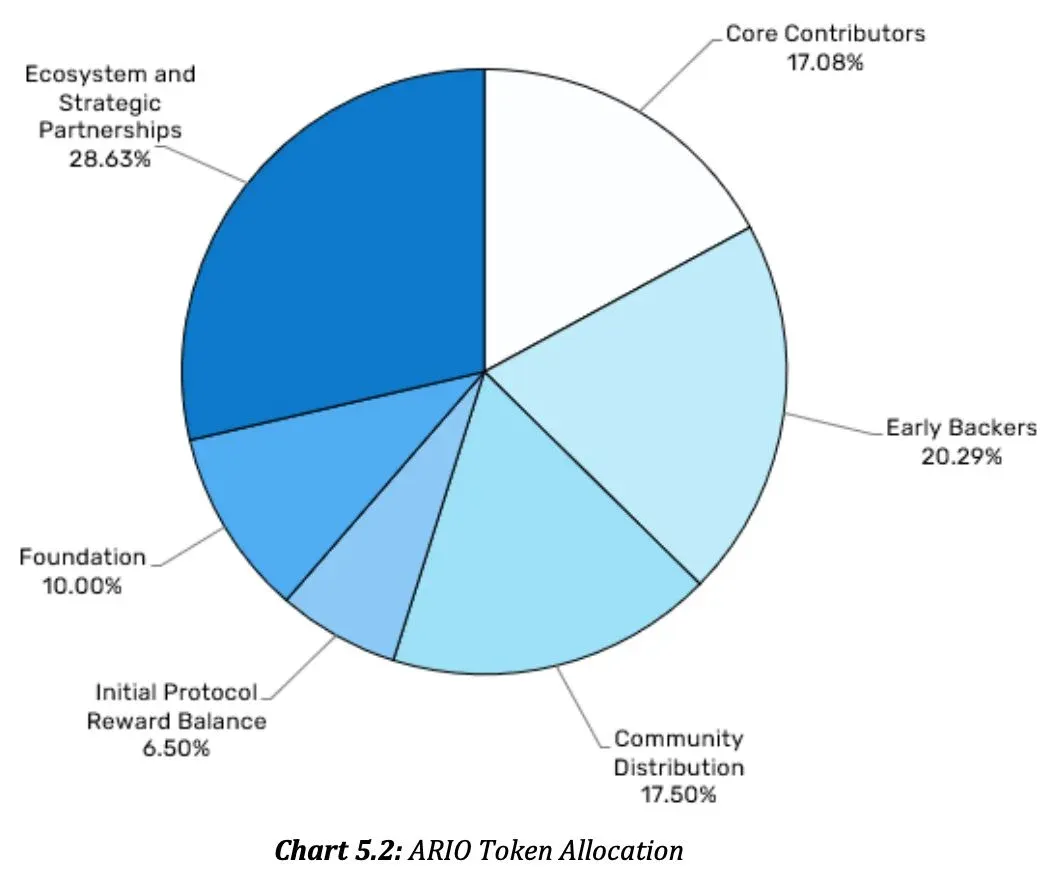
The supply is fixed; there is no inflationary minting after launch. The allocation strategy is intended to fund network development, reward early participants, and sustain long‑term ecosystem growth.
Utility of $ARIO
- Staking: Gateway operators must stake $ARIO to join the network; the amount staked can affect routing algorithms and node visibility.
- ArNS Payments: Used to register and renew domain names within the Arweave Name System.
- Reward Distribution: Tokens are awarded based on gateway uptime, stability, and service quality.
- Governance (future): Token holders may eventually gain voting rights on protocol upgrades and network parameters.
Release & Vesting Schedule
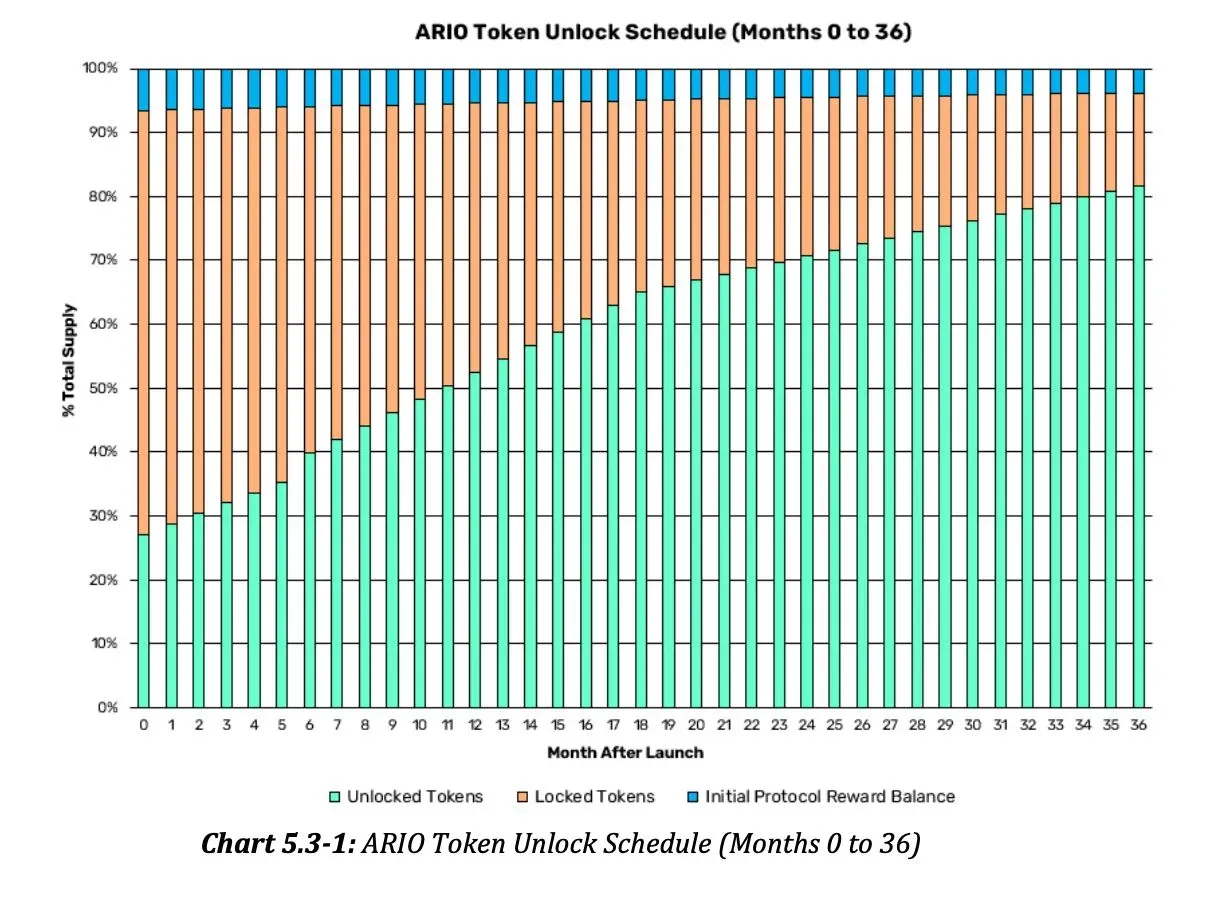
- Tokens allocated to the team, advisors, and strategic partners are subject to vesting periods to mitigate sudden sell‑offs.
- Ecosystem incentive tokens will be released gradually to support network growth, reward mechanisms, and community initiatives.
- The emission rate for rewards is not fixed; it adjusts dynamically based on network demand and sustainability considerations.
Network Sustainability
By requiring staking and issuing rewards only for demonstrable service, AR.IO’s token model avoids wasteful or unnecessary token inflation. Participants are incentivized to maintain high‑quality infrastructure rather than merely “mining” tokens. In essence, the system operates as a Proof‑of‑Service model, where tokens are earned through measurable contributions.
Economic Alignment
The tokenomics aim to achieve several objectives:
- Encourage long‑term participation through staking and vesting;
- Fixed supply eliminates inflation pressure;
- Real‑world utility supports developers and end‑users;
- Align incentives across infrastructure, governance, and availability layers.
AR.IO Development Roadmap
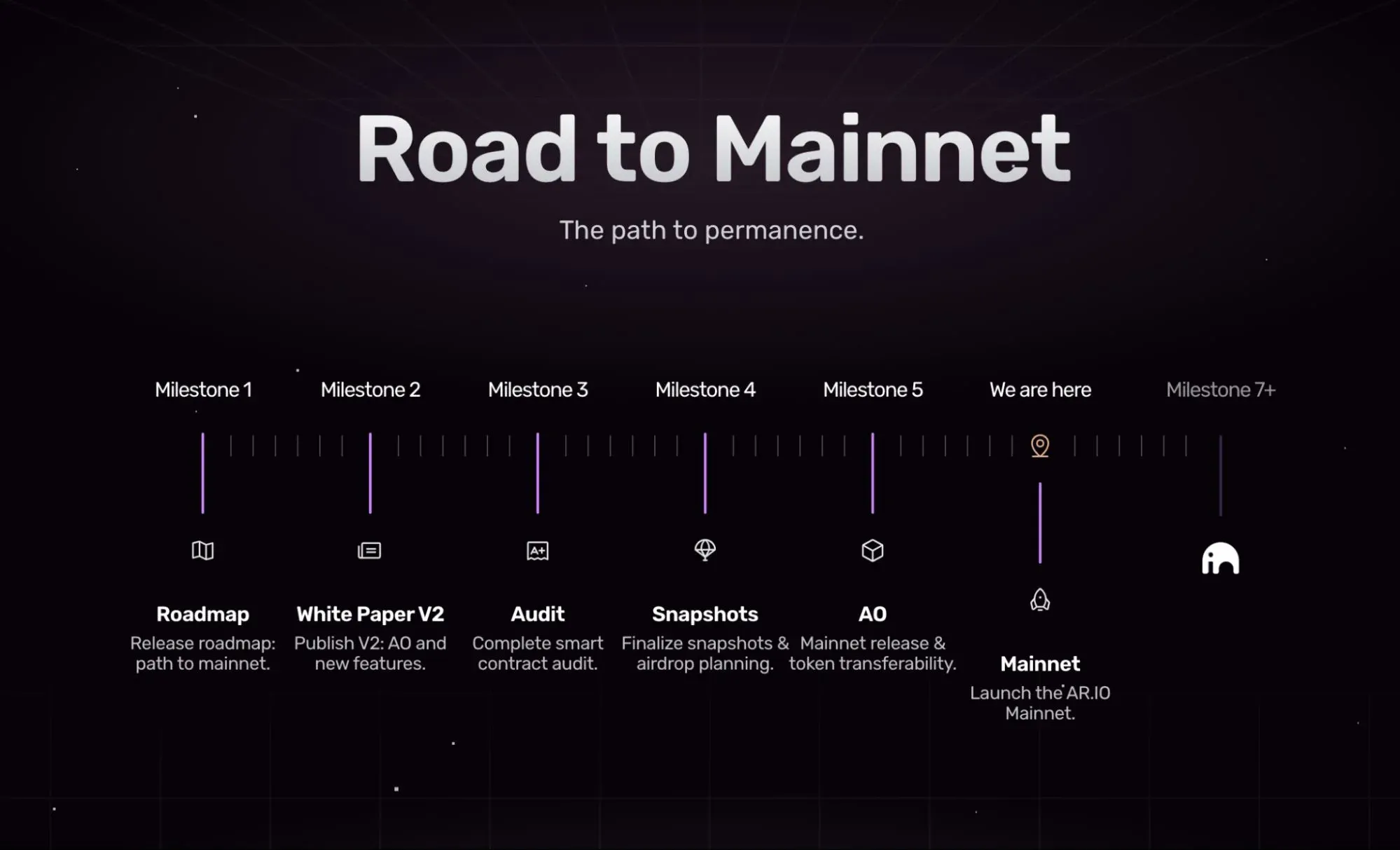
After launching its mainnet, AR.IO is concentrating
💡 Register on Binance with referral code B2345 for the maximum trading fee discount. See Binance complete guide.



