
 Bitaigen Research
 We provide a comprehensive panorama of Fabric Protocol (ROBO) from the perspectives of project positioning, technical implementation, airdrop mechanics, and token‑economic model, helping readers understand its potential value within the robotics and AI ecosystem and offering a rational outlook on its future trajectory. The detailed analysis follows.
Latest Updates on Fabric Protocol (ROBO)
Binance HODLer (Official Registration Official Download) has launched its 62nd airdrop campaign – Fabric Protocol (ROBO). The protocol aims to provide a decentralized coordination layer for robot and AI workloads across devices, services, and human‑machine interactions.
Key Points of the ROBO HODLer Airdrop
- Token Name: Fabric Protocol (ROBO)
- Initial Total Supply: 10,000,000,000 ROBO
- Maximum Supply: 10,000,000,000 ROBO
- Total HODLer Airdrop Allocation: 100,000,000 ROBO (an additional 200,000,000 ROBO is reserved for future market‑making activities; specific rules will be announced later)
- Circulating Supply at Binance Listing: 2,231,000,000 ROBO (22.31 % of the initial total)
- Smart‑Contract Addresses:
- BNB Smart Chain: `0x475cbf5919608e0c6Af00e7bf87FaB83bF3Ef6e2`
- Ethereum: `0x32b4d049fe4c888d2b92eecaf729f44df6b1f36e`
- Listing Fee: 0 USDT
- Research Report: “Fabric Protocol (ROBO)” – the report will be published within 48 hours after this announcement
- BNB Holding Cap: A single user’s BNB holdings may not exceed 4 % of the total; any amount above 4 % will be counted as 4 %
How to Claim the HODLer Airdrop Rewards
- Open the Finance page and search for BNB.
- Use your BNB holdings to subscribe to a principal‑protected earning product (either flexible or fixed‑term) or an on‑chain earning product.
- Binance will take random snapshots of users’ BNB balances during a period after this announcement and calculate the hourly average holdings to determine the airdrop amount.
- Example: If the reward calculation occurs on 2024‑06‑11, the system may reference balance snapshots taken between 2024‑06‑01 and 2024‑06‑07.
- Eligible users will receive the corresponding ROBO tokens in their spot wallet within 5 hours after the airdrop is announced.
What Is Fabric Protocol?
Fabric Protocol is a blockchain‑based infrastructure specifically designed for robotic and artificial‑intelligence agents. Its goal is to break free from the constraints of centralized platforms, allowing machines to possess identities, accept tasks, and earn economic rewards. Today, most data generated by robots remains trapped inside proprietary, closed‑loop corporate systems. Fabric’s mission is to open that data and value to a public network, turning robots from pure executors into economically active participants.
Within this ecosystem, all economic interactions rely on the ROBO token – the sole native utility token that handles payments, governance, and security functions.
Roles and Attributes of the ROBO Token
- Task Compensation: Robots are paid in ROBO upon completing work.
- Network Access: Holding ROBO grants operators eligibility to join the network.
- Security Layer: The token plays a critical role in the network’s security mechanisms.
- Governance: A veROBO model enables decentralized decision‑making.
- Contribution Rewards: Incentives are distributed to ecosystem contributors.
It is important to note that ROBO is not a traditional equity share or dividend certificate; it does not provide profit‑sharing or ownership rights. Its value is entirely derived from actual usage within the network.
Issuance and Valuation of the ROBO Token
The public sale concluded on January 2026 via the Kaito Launchpad, targeting a raise of US $2 million. Allocation results were announced in early February; participants could opt for a short‑term refund, but the majority retained their tokens, indicating solid support despite market volatility.
- Pre‑sale Valuation: US $200 million
- Post‑Auction Valuation: US $400 million
To date, ROBO has not entered the circulation phase.
Token Economics and Supply Plan
- Maximum Supply: 10 billion ROBO
- Current Circulating Supply: 0 (Token Generation Event [TGE] not yet started)
- Projected TGE Timing: Multiple sources point to Q1 2026
To curb extreme early‑price swings, Fabric employs an adaptive issuance model that dynamically adjusts supply based on actual network utilization.
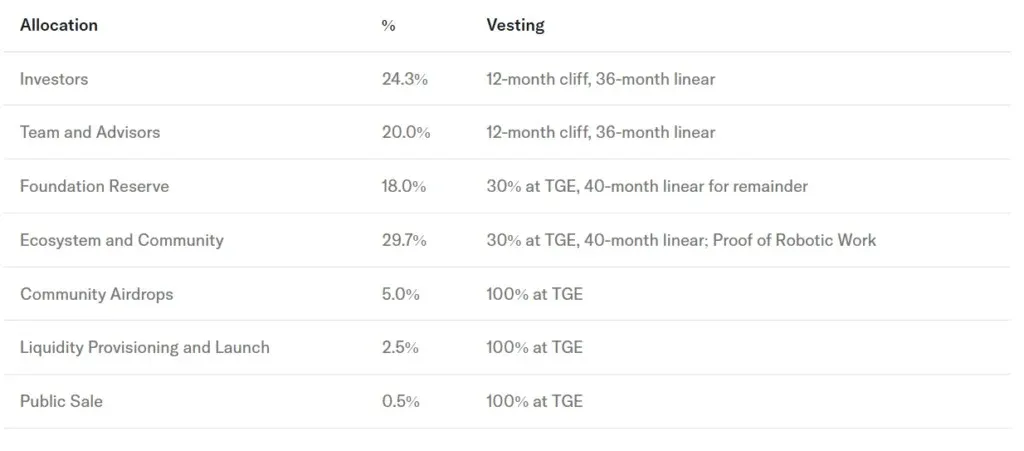
Allocation and Vesting Schedule
| Category | Percentage | Unlock Mechanism |
|---|---|---|
| Ecosystem & Community | 29.7 % | 30 % released at TGE, the remaining 70 % linearly over 40 months |
| Investors | 24.3 % | 12‑month cliff, then linear over 36 months |
| Team & Advisors | 20 % | Same as investors: 12‑month lock‑up, 36‑month linear release |
| Trust Reserve | 18 % | 30 % can be drawn early, the rest linearly over 40 months |
| Community Airdrop | 5 % | Fully released at TGE |
| Liquidity & Launch | 2.5 % | Immediately unlocked at TGE |
| Public Sale | 0.5 % | 100 % unlocked at TGE |
During the first 12 months, neither investors nor the team face sell‑pressure, but because the TGE simultaneously releases airdrop, liquidity, and public‑sale tokens, some initial volatility may still occur.
ROBO Airdrop Verification Process
The airdrop verification portal remained open until 2026‑02‑24 03:00 UTC. Users could only complete eligibility verification; the exact allocation amounts will be announced later through a lottery or claim notice. Evaluation criteria include:
- Activity on the Fabric dashboard
- Community contribution records
- Developer participation
- Interaction with partner ecosystems
This step is considered a crucial component of the token’s initial distribution.
Price Forecast (2026‑2037)
| Year | Minimum (USD) | Average (USD) | Maximum (USD) |
|---|---|---|---|
| 2026 | 0.010439 | — | 0.044999 |
| 2027 | 0.010021 | 0.02062 | 0.031219 |
| 2028 | 0.018296 | 0.03846 | 0.058623 |
| 2029 | 0.050634 | 0.162086 | 0.273538 |
| 2030 | 0.032927 | 0.109259 | 0.185592 |
| 2031 | 0.040984 | 0.071781 | 0.102577 |
| 2032 | 0.060116 | 0.138267 | 0.216418 |
| 2033 | 0.183537 | 0.541148 | 0.898758 |
| 2034 | 0.108188 | 0.2730099 | 0.437831 |
| 2035 | 0.137789 | 0.237413 | 0.337037 |
| 2036 | 0.2119048 | 0.523236 | 0.834567 |
| 2037 | 0.77740093 | 1.86 | 2.95 |
The figures above are for reference only and should not be interpreted as investment advice. Note: In many jurisdictions, gains from cryptocurrency transactions may be subject to taxation; users should consult local tax regulations or professional advisors.
Step‑by‑Step Guide to Buying ROBO on Binance
- If you have not yet downloaded or registered on the Binance app, refer to this tutorial for registration instructions.
- Launch the Binance app (Official Registration Official Download). In the Markets tab’s search bar, type ROBO. When the spot pair ROBO/USDT appears, tap it to open the trading page.
- For U.S. residents: Use Binance.US instead of the global Binance platform to comply with regional regulations.
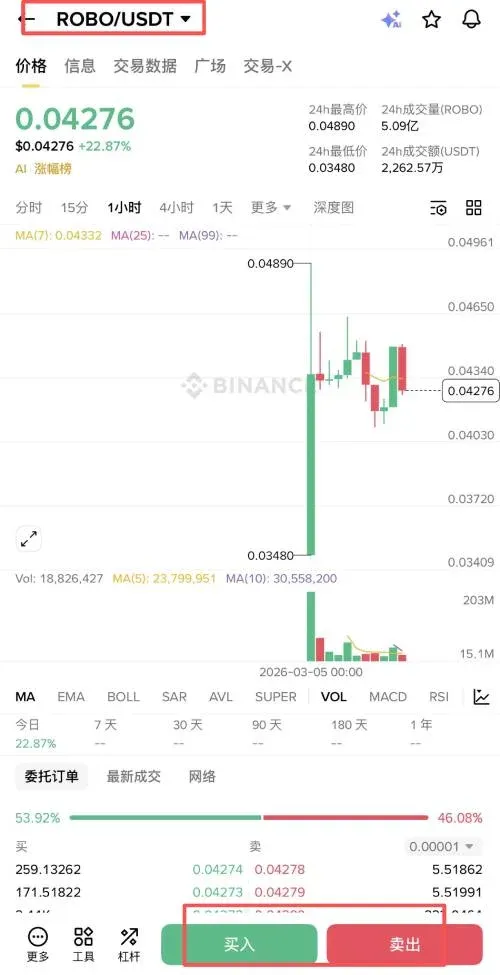
- On the trading interface, click Buy, select Limit Order, enter your desired price and amount, then confirm by clicking Buy ROBO to complete the transaction.
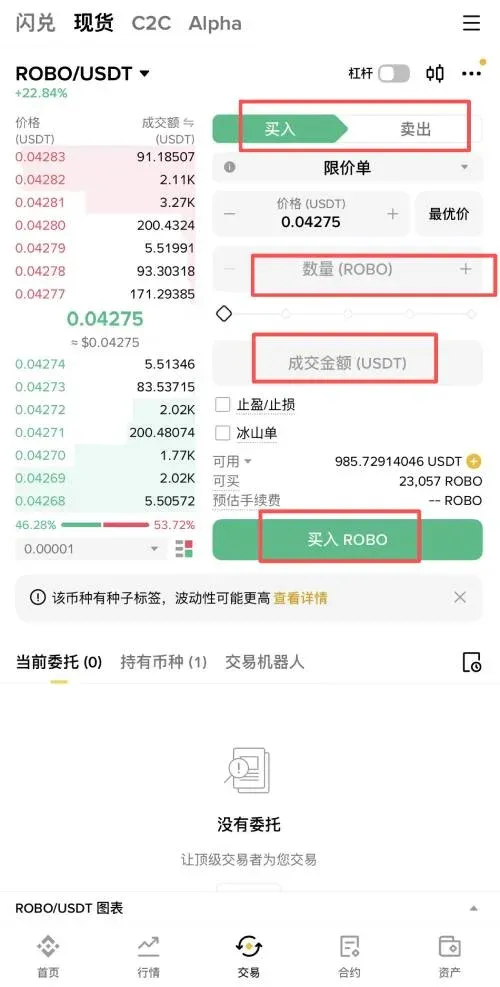
The purchase flow is now complete.
Governance and Network Mechanics
Fabric Protocol utilizes a governance model called veROBO. Users who lock ROBO receive veROBO; the longer the lock‑up period, the greater the voting power, encouraging long‑term commitment over short‑term speculation. The network also comprises several essential components:
- Robot Identity Verification System
- Skill‑Chip Modules
- Task Delegation Platform
- Security Assurance Layer
Together, these modules ensure that robots can operate securely and economically within the network.
Team and Organizational Structure
The project is overseen by the non‑profit Fabric Foundation, which handles long‑term governance and resource coordination. Technical development is carried out by OpenMind Labs, whose team members are seasoned engineers in AI and robotics. Token‑issuance matters are managed by Fabric Protocol Ltd.. Founding member identities have not been disclosed—a common practice for next‑generation infrastructure projects.
Outlook
ROBO has not yet been listed for public trading, so technical analysis data are unavailable. However, the project has been added to Coinbase’s roadmap, and the airdrop campaign is actively progressing, indicating a certain level of ecosystem preparation. Post‑launch, the token may experience notable volatility; the unlock schedule and potential early‑seller pressure are risk factors to monitor.
Overall, Fabric Protocol sits at the forefront of the emerging robot‑economy landscape. Its success will largely depend on real‑world application adoption and the extent of ecosystem participation.
---
This concludes the article. For more information on ROBO, you may search Bitaigen’s archive of previous articles or continue exploring the related links below. Thank you for following Bitaigen, and we look forward to your continued interest and support!
💡 Register on Binance with referral code B2345 for the maximum trading fee discount. See Binance complete guide.



