
 Bitaigen Research
 PYUSD (PayPal USD) is a dollar‑pegged stablecoin jointly issued by global payments giant PayPal and blockchain infrastructure provider Paxos, and it is one of the few dollar‑stablecoins launched directly to the general public by a large traditional payment institution.
PYUSD is a fiat‑backed stablecoin issued by PayPal in partnership with Paxos, pegged 1:1 to the U.S. dollar; compared with USDT, it uses a 100 % full‑reserve model, offers higher regulatory transparency and asset segregation, but its liquidity and ecosystem size are currently lower than USDT.
In this article we dive deep into the PayPal‑Paxos dollar‑stablecoin PYUSD, focusing on its core differences from the market‑dominant USDT, and walk you through how to acquire and use it. If you want to understand why this digital asset backed by a traditional payments titan is generating so much buzz, keep reading!
What is PYUSD?
PYUSD (PayPal USD) is a stablecoin pegged 1:1 to the U.S. dollar, issued by PayPal through the blockchain‑focused Paxos Trust Company. Unlike highly volatile cryptocurrencies such as Bitcoin or Ethereum, PYUSD’s design goal is “stability”. It runs on a blockchain (initially on Ethereum, later expanded to Solana), allowing the U.S. dollar from the traditional banking system to circulate freely as a digital token.
In short, PYUSD is essentially “PayPal’s version of digital cash”, combining the fast settlement of crypto with the price stability of fiat. It is important to note that PYUSD is not the dollar balance held inside a PayPal account; that balance remains part of the traditional financial system, whereas PYUSD exists independently on a blockchain, with PayPal and Paxos jointly guaranteeing the 1:1 backing.
How PYUSD Works
PYUSD can maintain its 1:1 peg thanks to transparent issuance and reserve rules, not merely marketing hype.
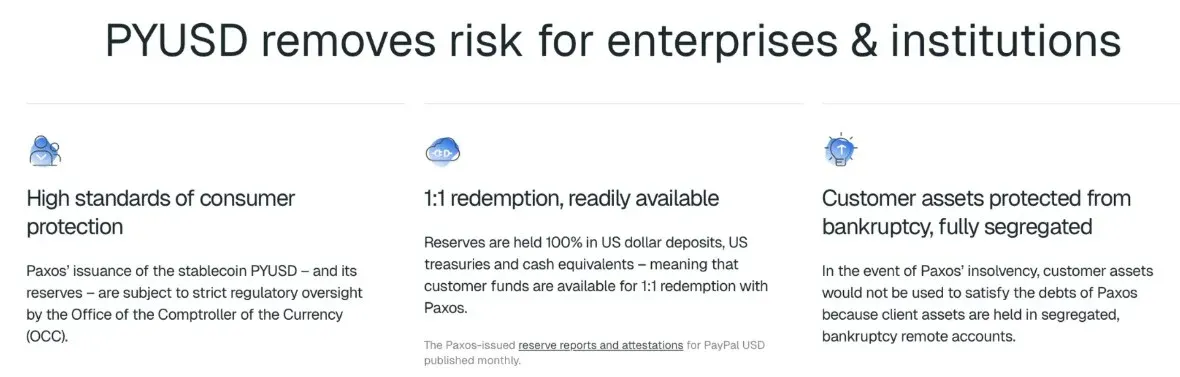
100 % Full Reserve, Safety First
Every circulating PYUSD token is backed by an equivalent amount of U.S. dollar assets held by PayPal and Paxos. The reserve assets prioritize liquidity and safety, and mainly consist of:
- U.S. dollar cash deposits
- U.S. short‑term Treasury securities
- Cash equivalents
Consequently, if 100 million PYUSD are in circulation, there must theoretically be at least USD 100 million of high‑liquidity assets locked in a custodial system to satisfy users’ redemption requests at any time.
1:1 Mint & Burn
- Minting: Qualified participants (such as institutions or exchanges) deposit USD 1 with Paxos, after which the system mints 1 new PYUSD.
- Burning: When a user redeems 1 PYUSD for USD, the token is destroyed and the equivalent dollars are returned to the user.
This mechanism ensures that total supply dynamically follows actual inflows and outflows of cash, eliminating the risk of issuing tokens before securing the underlying assets.
Asset Segregation & Regulatory Compliance
PYUSD user assets are fully segregated. Even if Paxos were to experience a financial crisis or bankruptcy, the reserve assets stored in an independent, bankruptcy‑remote account would not be used to satisfy corporate debts.
Moreover, the issuance and reserves of PYUSD are overseen by U.S. regulators (including banking‑related agencies). Paxos publishes regular reserve reports and undergoes third‑party audits, allowing anyone to verify the composition and size of the backing assets at any time.
Note: PYUSD is not a decentralized issuance; it relies on a regulated institution. Users must trust the “asset reserve + issuance rules” rather than solely the smart‑contract code.
PYUSD vs. USDT vs. USDC: Dollar Stablecoin Comparison
| Feature | **PYUSD** | **USDT** | **USDC** |
|---|---|---|---|
| **Issuing entity** | PayPal (partner Paxos) | Tether | Circle + Coinbase |
| **Launch year** | 2023 | 2014 | 2018 |
| **Reserve assets** | USD cash, short‑term U.S. Treasuries, cash equivalents | USD cash, Treasuries, Bitcoin, gold, etc. (some controversy) | USD cash, U.S. Treasuries |
| **Reserve transparency** | High (regular public reports) | Medium (regular disclosures, but disputes) | High (regular audited reports) |
| **Issuance model** | Centralized | Centralized | Centralized |
| **Compliance orientation** | High, leaning toward traditional finance & payments | Market‑oriented | High, oriented to institutions & regulators |
| **Asset segregation** | Bankruptcy‑remote protection | No explicit legal segregation | Separate segregated accounts |
| **Market liquidity** | Early stage | Largest (top market share) | High |
| **Target user group** | Users who value brand, compliance, and payment experience | Active traders, crypto veterans | Institutions, DeFi participants |
| **Main advantage** | Asset segregation, strong regulatory oversight, integration with PayPal’s payment ecosystem | Best liquidity, lowest slippage | Strong compliance, wide DeFi adoption |
| **Main drawback** | Centralized control, limited liquidity | Centralized freeze authority, historic credibility questions | Brief de‑peg during Silicon Valley Bank collapse |
- If you only need fast entry/exit on exchanges and high‑frequency trading, USDT remains the most liquid option.
- If you prioritize compliance and audit transparency, USDC is more suitable for institutions and DeFi.
- PYUSD is positioned as a dollar‑stablecoin for “payment and everyday‑user” scenarios, emphasizing regulatory safety and a bridge to traditional finance.
Real‑World Use Cases for PYUSD
1. Capital preservation
During periods of extreme crypto market turbulence or when other stablecoins face de‑pegging risk, holding PYUSD can serve as a relatively safe haven. Its regulatory framework and asset structure reduce the risk of loss due to issuer insolvency.
2. U.S. equity investment (IBKR funding)
Interactive Brokers (IBKR) now accepts PYUSD deposits. Unlike USDT, which may be blocked due to regulatory constraints, PYUSD enables you to move crypto‑derived earnings directly into a U.S. brokerage account, bypassing cumbersome bank conversions and SWIFT wires.
3. Ultra‑low‑cost cross‑border transfers (Solana)
PYUSD is deployed on Solana, and the network’s high throughput allows cross‑border transfers to settle in seconds with fees often below $0.01, dramatically cheaper than traditional bank wire transfers.
4. DeFi yield generation
Depositing PYUSD into on‑chain DeFi protocols such as Kamino, Drift, Marginfi lets you participate in lending or liquidity mining, earning annualised yields (APY) that exceed conventional bank deposits. These returns stem from protocol incentives rather than token price appreciation.
How to Purchase PYUSD
1. Via Centralized Exchanges (CEX)
Best for users who prefer familiar trading interfaces. Major exchanges—Bybit, OKX, Gate.io—have listed PYUSD.
Step‑by‑step:
- On a Taiwan‑based exchange (e.g., MAX, BitoPro) purchase USDT using TWD.
- Withdraw the USDT to an overseas exchange that supports PYUSD.
- In the spot market locate the PYUSD/USDT pair and execute the purchase.
Important for U.S. residents: Use Binance.US or other U.S.‑compliant platforms rather than the global Binance site.
2. Via Decentralized Exchanges (DEX)
If your goal is to go straight to on‑chain DeFi, you can use Binance Web3 Wallet or similar tools to swap directly on‑chain.
Buying PYUSD with Binance Web3 Wallet
Preparations
- Create a Binance Web3 non‑custodial wallet and fund it.
- Ensure the wallet holds the following assets:
- USDT (to swap for PYUSD; Solana network is recommended)
- SOL (to cover gas fees; keep roughly $5‑$10 worth of SOL on hand)
Purchase Steps
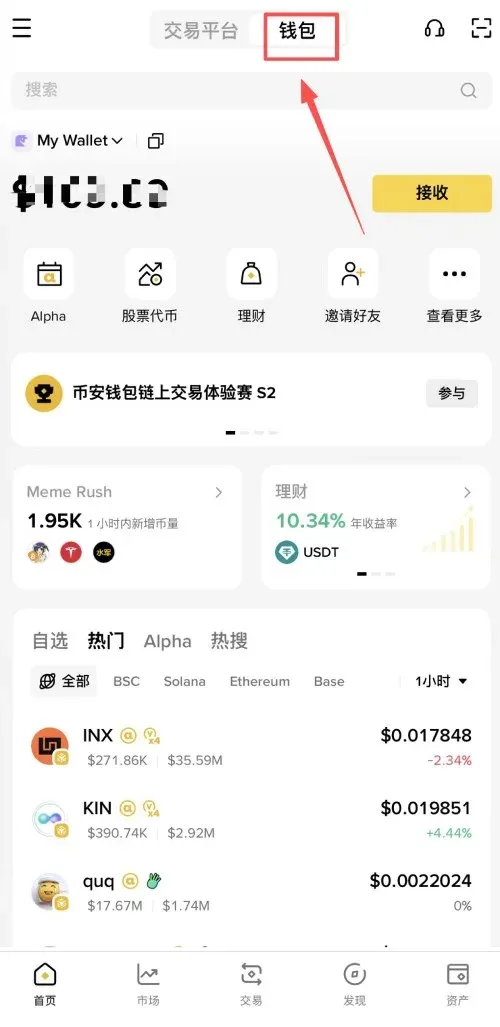
- Open Binance Web3 Wallet: Launch the Binance app and switch to the “Binance Wallet” section.
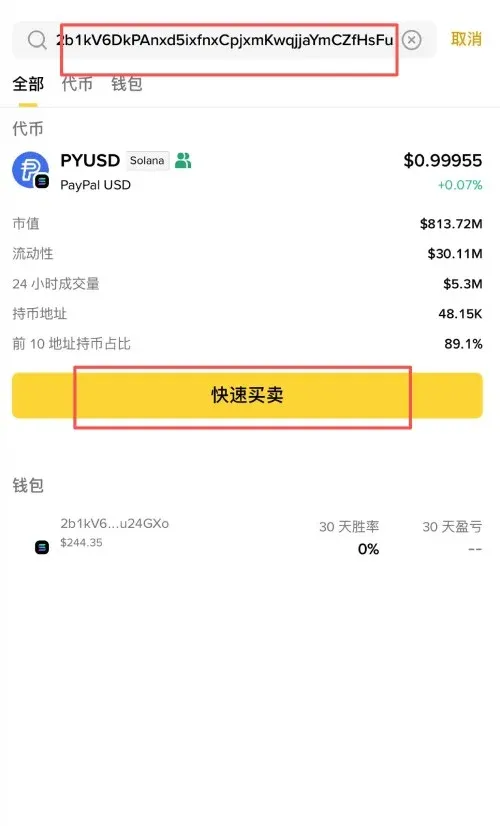
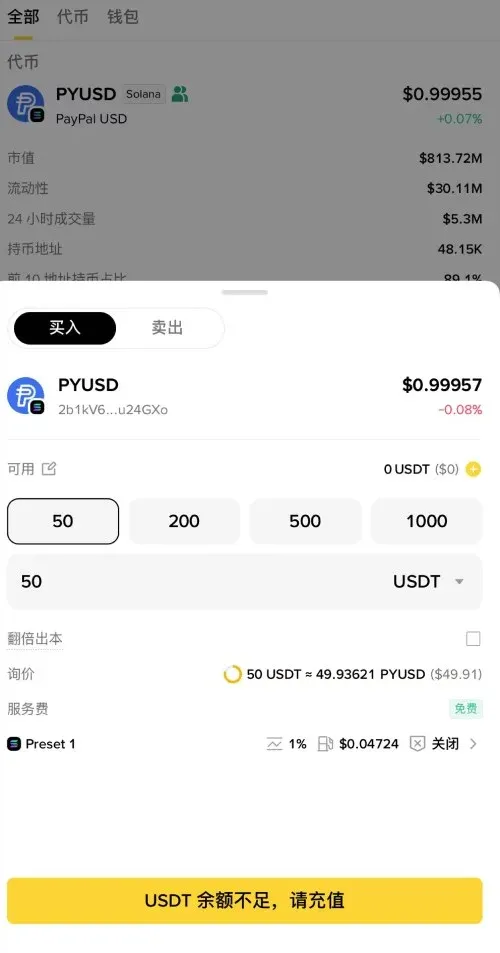
- Enter the PYUSD contract address: Paste the Solana contract `2b1kV6DkPAnxd5ixfnxCpjxmKwqjjaYmCZfHsFu24GXo` into the search bar on the home page. Once PayPal USD (PYUSD) appears, click “Quick Buy”.
- Complete the purchase: Input the amount you wish to spend; the interface will display the estimated PYUSD you will receive. After confirming the rate and fees, click “Buy” and pass the security verification. Within minutes the PYUSD will appear in your wallet’s asset list.
Engaging in DeFi Yield
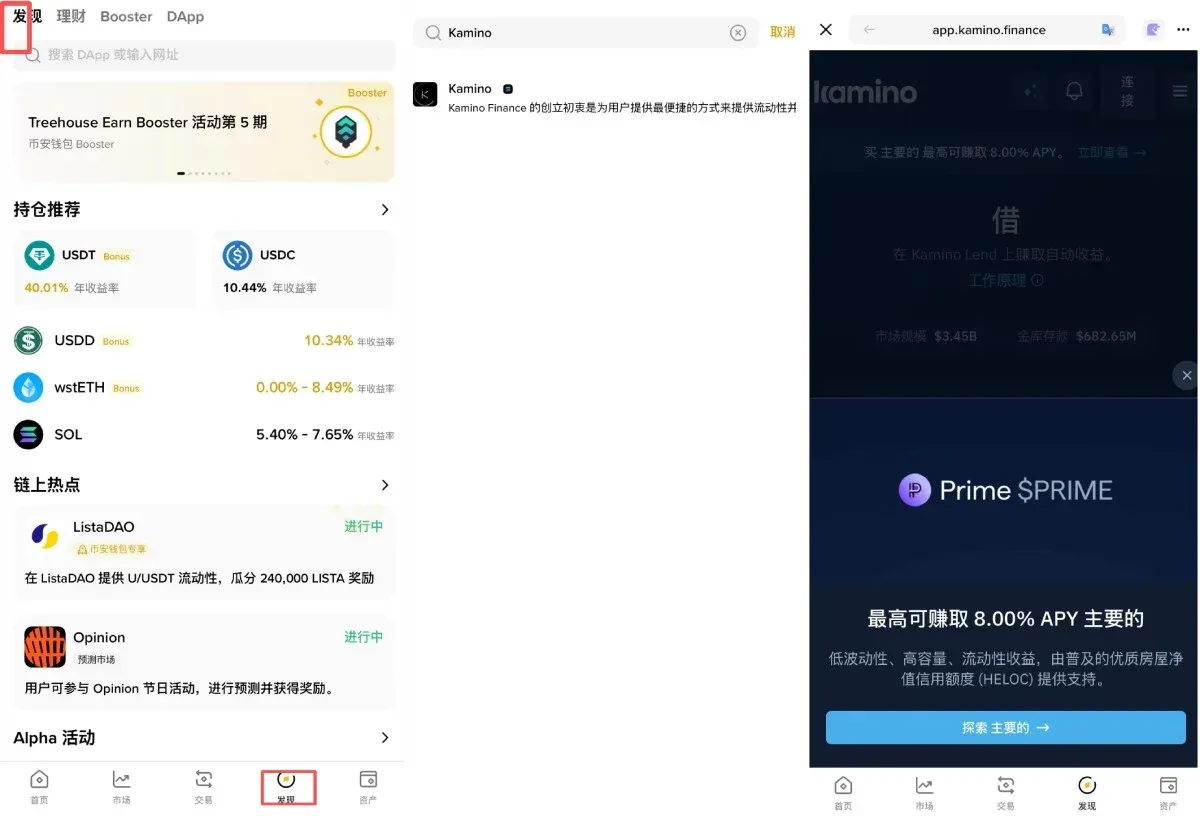
After acquisition, go to the “Explore” tab at the bottom of the Binance Web3 wallet, search for a target DeFi protocol such as Kamino, select PYUSD, and start lending or providing liquidity to begin earning yields.
Potential Risks and Drawbacks of PYUSD
Centralized control
To satisfy U.S. regulations, the PYUSD smart contract includes freeze and wipeFrozenAddress functions. If a regulatory authority determines that a particular address is linked to illicit activity, Paxos (the issuer) can freeze or even destroy the assets in that address. While this serves compliance purposes, it runs counter to the decentralization and censorship‑resistance ethos of many crypto projects.
Limited market liquidity
PYUSD is still in its early adoption phase, with relatively few supporting platforms and on‑chain applications. Liquidity has not yet reached the scale of USDT or USDC, which may inconvenience users who need deep order books.
PayPal services in Taiwan are restricted
PayPal’s in‑app crypto‑buy‑sell feature is currently only available to U.S. residents. Taiwanese users must rely on exchanges or Web3 wallets, which raises the entry barrier.
Tax reminder: Gains from trading or earning yields on PYUSD may be subject to tax in your jurisdiction. Consult a local tax professional to ensure compliance.
Frequently Asked Questions
Is PYUSD really safe? Could it collapse like UST?
UST was an algorithmic stablecoin without full‑reserve backing; a loss of confidence caused its price to plummet to zero. PYUSD is a fiat‑collateralized stablecoin, with each token backed 100 % by USD cash or Treasury assets and regulated by the New York State Department of Financial Services, making it considerably safer.
Will PYUSD replace USDT or USDC?
Unlikely in the short term. USDT maintains the top market‑share liquidity, while USDC has entrenched itself in institutional and compliance‑driven use cases. PYUSD targets the “payment and mainstream‑user” niche, focusing on regulatory assurance and a bridge to traditional finance.
Can I use PYUSD to make a profit?
PYUSD’s purpose is to stay 1:1 with the dollar and does not provide capital appreciation. However, you can earn yields by supplying PYUSD to DeFi protocols that offer lending or liquidity‑mining rewards.
Bottom Line: Should You Hold PYUSD?
PYUSD (PayPal USD) does not aim to dethrone USDT’s market dominance; rather, it fills a niche that demands high regulatory standards + integration with the traditional financial system. Choosing the right dollar‑stablecoin boils down to your primary use case:
- For trading efficiency and deep liquidity, USDT remains the most convenient choice.
- For auditability and institution‑grade safeguards, USDC is preferable.
- If you favor payment‑centric scenarios, asset security, and the PayPal ecosystem, PYUSD is worth considering.
Reminder: Even with the PayPal brand attached, Taiwanese users cannot purchase PYUSD directly within the PayPal app. You must obtain it via an exchange or a Web3 wallet to unlock its on‑chain functionalities and capital‑allocation benefits.
This concludes the comprehensive analysis and step‑by‑step guide on what PYUSD is and how it differs from USDT. For more PYUSD‑related insights, search the Bitaigen (比特根) archive or continue browsing the articles below. Thank you for staying informed and engaged!
Related Reading
- USAT Stablecoin: Mechanism, Regulation & USDT/USDC Comparison
- SEC's 2% Stablecoin Discount Aligns With Money‑Market Funds
- South Korea's Central Bank Pushes Bank‑Led KRW Stablecoin Amid Legislative Delay
💡 Register on Binance with referral code B2345 for the maximum trading fee discount. See Binance complete guide.



