
 Bitaigen Research
 SatLayer (SLAY token) is a Bitcoin‑based second‑layer protocol that offers programmable DeFi, real‑world asset (RWA) and insurance functionalities. Whether it is worth investing in depends on an individual’s risk tolerance and assessment of its technical outlook.
SatLayer aims to turn Bitcoin (BTC) into the gold‑standard for programmable DeFi, risk‑weighted assets (RWA) and insurance economies. The platform aggregates roughly 200 million BTC worth of staked funds through a Bitcoin Virtual Staking (BVS) model and mints a safe, reusable vBTC token. The first SlayDrop airdrop has already launched, allowing users to lock BTC in exchange for SLAY tokens. This article systematically analyses SatLayer’s positioning, core architecture, SlayDrop mechanism, SLAY token economics, and future ecosystem outlook.
Abstract – By means of BVS‑based re‑staking and a programmable asset layer, SatLayer enables BTC to serve as collateral, insurance capital, and liquidity within smart contracts. SLAY has a total supply of 2.1 billion, with 10 % earmarked for community airdrops. Ecosystem incentives and cross‑chain integrations are continuously advancing.
From the perspectives of technology, economic model, and ecosystem design, we outline how SatLayer implements programmable DeFi and insurance on top of Bitcoin and evaluate the potential value of its governance token SLAY. This paper will help you quickly grasp the project’s core and decide whether it fits your personal risk profile. Please continue reading.
What Is SatLayer?
SatLayer is an economic protocol built on top of Bitcoin’s base layer. Users deposit BTC or Liquid Staking Tokens (LST) into a BVS pool, earn conventional staking rewards, and receive a 1:1 representative token vBTC, which can be employed in on‑chain DeFi and RWA scenarios. The SLAY token handles protocol governance and incentives, bridging Bitcoin’s security with programmable capabilities to provide a novel solution for the crypto economy.
Core Architectural Features
Bitcoin Virtual Staking (BVS)
BVS is the foundation of the platform: after locking BTC, users obtain vBTC. This token can act as collateral, insurance capital, or liquidity within smart contracts, thereby enabling the safe, repeated use of BTC.
Programmable Asset Layer
An open library of contracts lets developers wrap vBTC into insurance pools, yield aggregators, or RWA securitisation tools. Each module is supported by incentives paid in SLAY.
Security and Isolation
SatLayer isolates Bitcoin’s native network security from its smart‑contract layer. All vBTC minting and redemption are performed via multi‑signature custodianship and on‑chain proofs, reducing the risk of smart‑contract vulnerabilities.
SlayDrop Airdrop Mechanism
Registration and Lock‑up
Starting August 3, 2025, SatLayer will open the SlayDrop to the first 20,000 registered users. Participants must register on the official website using a Bitcoin wallet (e.g., Bitcoin Core, MetaMask + Torus) and lock at least 0.01 BTC into the BVS pool. The system records each user’s locked amount and start date.
SlayPoints Calculation
Every day at 00:00 UTC the platform takes a snapshot of participants and computes SlayPoints using the formula Locked BTC × Number of lock‑up days. The higher the amount and the longer the duration, the more points a user accrues, ensuring a fair ranking.
Leaderboard and Eligibility
SlayPoints are displayed in real time on the airdrop page leaderboard. The top 20,000 users at the cut‑off will receive SLAY rewards; users can continuously check their rank and estimated allocation.
Claim Process
The airdrop ends on August 9, 2025 at 13:00 UTC. Afterwards, participants must log in again with the same wallet, the system will calculate their SLAY entitlement, and a simple “Claim” button will transfer the tokens to the user’s wallet. This design balances lock‑up depth with duration, employing a transparent scoring system and live leaderboard to achieve a predictable and equitable distribution.
Token Economic Model
SatLayer converts idle BTC into productive, programmable assets that can be used in DeFi, RWA, stablecoins, and even traditional finance (TradFi). The protocol can provide users with six distinct sources of yield:
- BTC staking yield
- BTC LST yield
- Layer‑1 / Layer‑2 ecosystem rewards
- SLAY rewards
- BVS use‑case revenue
- Downstream DeFi integration earnings
As a leading project in Bitcoin re‑collateralisation, SatLayer raises the utilisation of BTC as a premium collateral asset and, through BVS (Bitcoin Validation Service), enables real‑world profit‑generating scenarios such as insurance, RWA, stablecoins, and AI infrastructure.
Recent metrics show continuous ecosystem growth, with partnership numbers, active users, and on‑chain transaction volume all hitting all‑time highs.
SLAY Token Overview
| Parameter | Details |
|---|---|
| **Token Symbol** | SLAY |
| **Standard** | ERC‑20 (Ethereum Mainnet) |
| **Decimals** | 6 |
| **Maximum Supply** | 2,100,000,000 SLAY |
| **Initial Circulation** | 21.0 % |
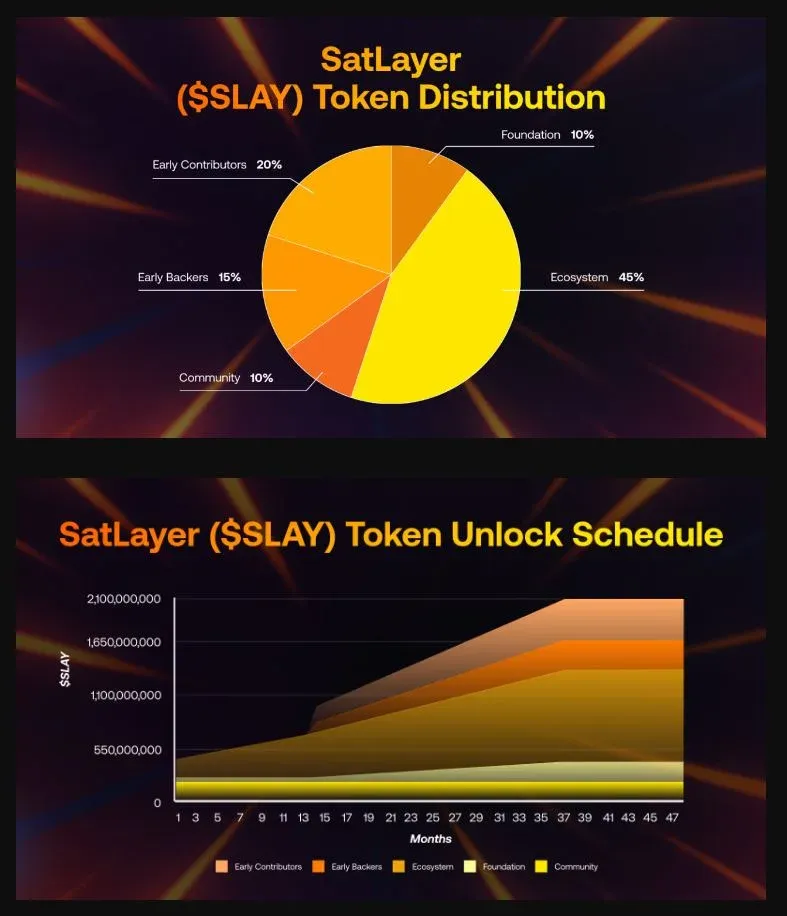
Allocation Structure
- Community (10 %) – Distributed to community members via SlayDrop and other token‑generation‑event (TGE) activities.
- Ecosystem (45 %) – Reserved for ecosystem incentives, investments, and grants that support projects built on SatLayer.
- Foundation (10 %) – Belongs to the SatLayer Foundation for protocol development, marketing, and public‑affairs expenses.
- Early Supporters (15 %) – Rewards for entities that provided financial or strategic backing during the early stages.
- Early Contributors (20 %) – Compensation for individuals who contributed to product, engineering, business development, or ecosystem construction.
Token Utility
- Governance & Decentralisation – Community members holding SLAY can submit and vote on governance proposals that decide incentive parameters, fund allocation, and new ecosystem projects.
- Value Accumulation – A portion of protocol fees is funneled into the Foundation treasury; token holders can vote on treasury usage. As the treasury grows, it may enhance SLAY’s intrinsic value.
- Staking & Security – BTC stakers may also stake SLAY to provide economic security for BVS and earn additional rewards.
- Slashing Mechanism – If operators fail to deliver the agreed‑upon security guarantees, the locked BTC and/or SLAY can be slashed, incentivising honest behaviour.
Tax Note: Crypto‑related gains, including any SLAY received from the airdrop or staking rewards, may be taxable in your jurisdiction. Users should consult local tax regulations and consider reporting obligations, especially when converting to fiat via USD, SEPA, or SWIFT transfers.
Ecosystem Partners & Future Outlook
Cross‑Chain Interoperability
Collaborations are underway with projects such as Stargate and Allbridge to enable vBTC bridges across Ethereum, BNB Chain, Polygon, and other major networks.
DeFi & RWA Partnerships
Discussions with Aavegotchi explore using vBTC for lending and insurance; plans are in place to leverage vBTC collateral to launch on‑chain short‑term bond and other RWA initiatives.
Institutional Use Cases
The Foundation is working with custodial firms and banks to design large‑scale BTC re‑collateralisation services, offering traditional finance institutions on‑chain collateral solutions and distributing SLAY incentives.
Community & Developer Enablement
An upcoming SDK will simplify the integration of vBTC and SLAY into third‑party applications. A hackathon series will award 1,000,000 SLAY to stimulate the creation of new protocols and tooling.
Frequently Asked Questions
What is SatLayer?
SatLayer is a Bitcoin‑anchored economic protocol that aggregates BTC via BVS and mints the representative token vBTC for use in DeFi, RWA, and insurance contexts.
How can I participate in SlayDrop?
Register on the official website and lock at least 0.01 BTC. After the airdrop ends, claim your SLAY on the airdrop page.
What is the total supply of SLAY?
2.1 billion tokens, allocated as follows: 10 % community airdrop, 45 % ecosystem incentives, 15 % early supporters, 20 % early contributors, and 10 % foundation reserve.
How do I stake BTC?
Use the official application to deposit BTC or LST into the BVS pool; the system automatically mints vBTC, allowing you to participate in re‑staking yields and earn SLAY rewards.
Key Takeaways
- Programmable BTC Layer – SatLayer enables BTC to be used for insurance, lending, and smart‑contract liquidity.
- SlayDrop Airdrop – The first 20,000 BTC lock‑up participants will receive SLAY.
- SLAY Economics – 2.1 billion total supply; 10 % earmarked for airdrop, 45 % for ecosystem incentives.
- Ecosystem Expansion – Multi‑chain bridges, DeFi/RWA collaborations, and institutional partnerships are in progress.
- Community Governance – The SLAY DAO and upcoming SDK will further motivate developer collaboration.
This completes a comprehensive analysis of SatLayer (SLAY token). For further updates, follow Bitaigen (比特根)’s subsequent coverage.
Related Reading
- Lombard (BARD) DeFi Token: Bitcoin Liquidity & Governance
- RWA Token Review 2026: 6 Core Projects & Investment Logic
- 黄金资产上链全指南:RWA 实体黄金代币与监管解析
💡 Register on Binance with referral code B2345 for the maximum trading fee discount. See Binance complete guide.



