
 Bitaigen Research
 What is a DEX? DEX vs. CEX Differences: A Comprehensive Guide for Beginners
Cryptocurrency trading platforms are primarily categorized into two major types: Centralized Exchanges (CEX) and Decentralized Exchanges (DEX). These two categories differ significantly in terms of asset control, security mechanisms, trading efficiency, and entry barriers. This article provides an in-depth analysis of the core differences between these platforms, helping novice investors choose the most suitable trading method based on their specific needs and risk tolerance.
When entering the crypto market, understanding the underlying logic of different trading platforms is vital. Facing the choice between the convenience of a CEX and the sovereignty of a DEX, our editorial team has deconstructed the operating mechanisms, security dimensions, and application scenarios of both. Our goal is to help you clarify the balance between asset control and trading efficiency, clearing the fog of technical jargon so you can make more rational choices based on your personal requirements.
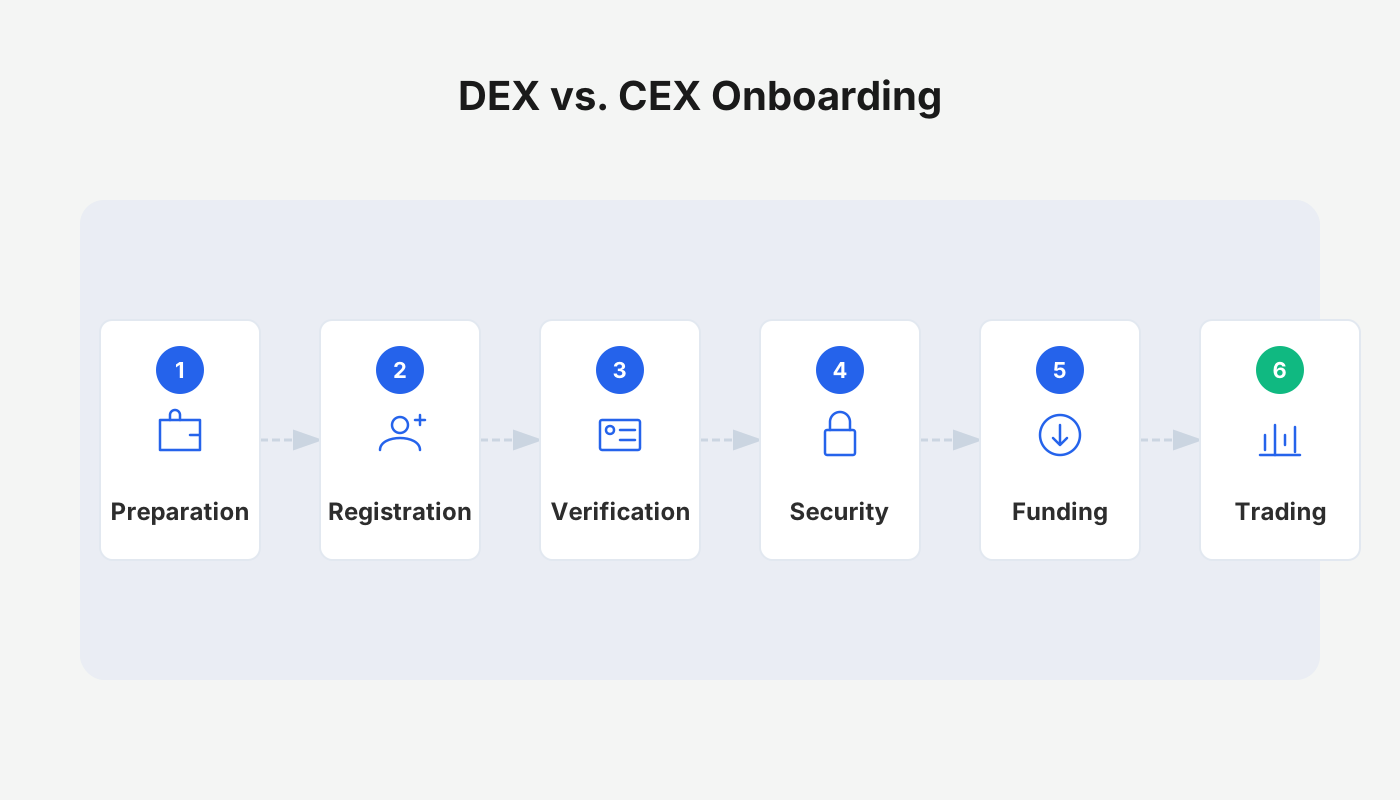
What is a DEX? What are its Core Differences from a CEX?
A DEX (Decentralized Exchange) is a trading platform that operates based on blockchain smart contracts. Users trade directly through their personal wallets without the need for real-name registration, maintaining full control over their private keys at all times. In contrast, a CEX (Centralized Exchange) is a platform operated by a centralized organization, functioning similarly to a digital currency bank. Users must complete Identity Verification (KYC), and their assets are held in custody by the platform. CEXs are characterized by high transaction speeds and support for fiat currency on-ramps and off-ramps.
---
What is a CEX (Centralized Exchange)?
A Centralized Exchange (CEX) is the most common first stop for beginners entering the crypto market. Its operational model is similar to traditional stock exchanges or banks, where a centralized company is responsible for matching trades, safeguarding funds, and providing customer support.
Core Features of a CEX
- Account System and KYC: Users need to register using an email address or phone number and typically must complete Know Your Customer (KYC) verification to comply with global regulatory requirements.
- Asset Custody: Funds deposited by users are stored in wallets managed by the exchange. Users hold the right to withdraw their account balance, but they do not possess the underlying private keys to the wallet addresses.
- Efficient Matching: Transactions are completed on the platform’s centralized servers, resulting in extremely fast execution speeds and excellent market Liquidity.
- Fiat Gateways: CEXs support direct buying and selling of cryptocurrencies using USD, EUR, and other fiat currencies via bank transfers (such as SEPA or SWIFT), credit/debit cards, and third-party payment processors.
- Common Platforms: Binance, OKX, Bybit, Bitget, and Coinbase.
- *Note for US Users: Due to specific regulatory environments, residents of the United States are generally required to use localized platforms such as Binance.US rather than the global Binance platform.*
Advantages and Disadvantages of a CEX
- Pros: Low entry barrier with a user-friendly interface; deep trading liquidity and minimal slippage; account recovery options via customer service if a password is forgotten.
- Cons: Risks of centralization, such as the platform being hacked or the operator disappearing (exit scams); assets may be frozen due to internal risk control policies; lower level of privacy.
- Tax Note: It is important to remember that in many jurisdictions, capital gains from cryptocurrency trading are taxable. CEXs often provide transaction history exports to assist with local tax reporting.
---
What is a DEX (Decentralized Exchange)?
A Decentralized Exchange (DEX) is a trading protocol that operates without the involvement of a central intermediary. It automatically executes trading logic through Smart Contracts deployed directly on a blockchain.
Core Features of a DEX
- No Registration Required: Users do not need to create an account. They can use the platform simply by connecting a decentralized wallet (such as MetaMask, OKX Wallet, or Trust Wallet).
- Self-Custody: All assets remain in the user's own wallet address throughout the process. The platform cannot touch, move, or freeze the user's funds.
- On-Chain Execution: All transaction records and matching logic are public, transparent, and immutable on the blockchain.
- Common Platforms: Uniswap (Ethereum/Polygon), PancakeSwap (BNB Chain), dYdX (Perpetuals), and SushiSwap.
Advantages and Disadvantages of a DEX
- Pros: Users have total control over their assets; security depends on the user's own private key management; no KYC required, which protects privacy; provides access to a wider range of emerging tokens (often referred to as "meme coins" or "altcoins") before they hit major exchanges.
- Cons: Higher barrier to entry requiring technical knowledge; users bear the full risk of losing their private keys; transaction costs are influenced by network Gas fees (miner fees); generally does not support direct fiat-to-crypto exchanges.
---
CEX vs. DEX: Key Dimensional Comparison Table
| Comparison Dimension | CEX (Centralized Exchange) | DEX (Decentralized Exchange) |
|---|---|---|
| **Asset Management** | Custodial (Platform managed) | Non-custodial (User managed) |
| **Identity Verification** | Mandatory KYC / Real-name | Anonymous; Wallet connection only |
| **Trade Matching** | Centralized server matching | Smart Contracts / Automated Market Makers (AMM) |
| **Fiat Support** | Supports USD/EUR via SEPA/SWIFT | Generally no; Crypto-to-crypto only |
| **Security Risk** | Platform management & hacker attacks | Private key loss or contract vulnerabilities |
| **Transaction Speed** | Extremely high (millisecond response) | Depends on blockchain network confirmation |
| **Privacy Protection** | Low; Data held by the platform | High; On-chain address interactions |
| **Difficulty Level** | Simple; Suitable for beginners | High; Requires on-chain knowledge |
---
Target Audience and Selection Recommendations
Who is better suited for a CEX?
- Crypto Novices: Those who need a simple, intuitive interface and reliable channels to deposit fiat currency like USD.
- High-Frequency Traders: Those seeking lightning-fast execution and low latency to utilize tools like leverage, futures, and advanced charting.
- Mainstream Coin Holders: Investors primarily buying and selling large-cap assets like Bitcoin (BTC) and Ethereum (ETH).
Who is better suited for a DEX?
- Experienced Players: Those proficient in managing seed phrases and seeking absolute control over their digital assets.
- Primary Market Hunters: Investors looking for new projects and early-stage tokens that have not yet been listed on mainstream centralized exchanges.
- Privacy-Conscious Users: Individuals who prefer to trade without disclosing personal identity information.
---
Common Operational Mistakes and Security Risks for Beginners
In the world of cryptocurrency, security awareness is often more important than technical skill. Here are the most common pitfalls for beginners:
- Improper Private Key Management: Taking a screenshot of a Seed Phrase and saving it in a phone gallery or uploading it to cloud storage. If the phone is compromised or the cloud account is leaked, assets will be stolen instantly.
- Phishing Website Attacks: Clicking on fake links found on social media (like X/Twitter) or community groups and authorizing a wallet on a fraudulent DEX page, leading to the wallet being drained.
- Incorrect Network Selection: Choosing the wrong blockchain during a deposit or withdrawal (e.g., sending an ERC20 asset to a TRC20 address). This often results in the permanent loss of assets.
- Blindly Chasing High Returns: DEXs host many un-audited "meme" or "shitcoin" projects that carry a high risk of a Rug Pull (where developers abandon the project and run away with investors' funds).
- Ignoring Gas Fees: Performing small transactions on a congested network like Ethereum Mainnet, where the transaction fee (Gas) might actually exceed the principal amount being traded.
---
Deep Comparison: Fund Flow and Privacy Protection
Fund Logic in a CEX
In a CEX, every buy or sell order you place is merely a numerical update in a private database. Assets only truly move from the exchange's wallet to your personal wallet when you initiate a "Withdrawal" request. This means the platform has the absolute final say over your funds and can freeze them if they suspect suspicious activity.
Fund Logic in a DEX
A DEX enables true "Peer-to-Peer" (P2P) trading. Through Liquidity Pools, users swap assets directly with a smart contract. While this method is transparent, it is important to realize that because all records are on the blockchain, if your wallet address is ever linked to your real-world identity, your entire financial history on that chain becomes transparent to the public.
---
Asset Protection: Security Operating Procedures
- Backup Your Seed Phrase: Use a pen and paper to write down your seed phrase manually. Store it in a waterproof and fireproof safe place, and never store it on any device connected to the internet.
- Enable Two-Factor Authentication (2FA): Always enable Google Authenticator or a similar hardware-based 2FA on your CEX accounts to provide an extra layer of defense beyond a password.
- Separate Cold and Hot Wallets: Keep large amounts of long-term assets in a Cold Wallet (Hardware Wallet), while using a "Hot Wallet" with smaller amounts for daily trading and DeFi interactions.
- Verify Official Channels: Always obtain the correct contract addresses and official website links for DEXs through authoritative sites like CoinMarketCap or CoinGecko to avoid phishing sites.
---
Future Trends: The Convergence of DEX and CEX
In the future, the relationship between these two is not necessarily a zero-sum game. We are seeing the rise of Hybrid Exchanges (HEX), which aim to retain the trading speed of a CEX while introducing on-chain settlement and self-custody features. Simultaneously, with the widespread adoption of Layer 2 scaling technologies, the transaction costs and speeds of DEXs are gradually approaching the levels of CEXs, providing users with a more seamless trading experience.
Summary: For beginners, it is recommended to start with a CEX to become familiar with basic operations and market logic. As your experience and technical understanding grow, you can gradually explore the DEX ecosystem to discover the broader Web3 world. Regardless of which method you choose, protecting your private keys and account security remains the absolute highest priority.
---
Frequently Asked Questions (FAQ)
Q: Do DEX trades require transaction fees?
A: Yes. In addition to any small protocol fee charged by the platform, you must pay a Gas fee to the blockchain network (e.g., Ethereum or BNB Chain) to process the transaction.
Q: If a CEX goes bankrupt, can I get my coins back?
A: It is extremely difficult. Since CEXs are custodial, if a platform goes bankrupt, user assets are often treated as part of the estate during liquidation. This is why many experienced users prefer to keep large holdings in personal wallets.
Q: Why can't I find the token I want to buy on a DEX?
A: This may be because the token has not yet had a liquidity pool created for it on that specific DEX, or you may need to manually search for it by pasting the token's Contract Address.
Q: Are DEXs regulated?
A: Currently, DEXs exist in a regulatory gray area. Due to their decentralized nature, it is difficult for regulators to impose direct restrictions on them. However, this also means users have very little legal recourse if they fall victim to a scam or a smart contract exploit.
Related Reading
- What is a DEX? Best Decentralized Exchanges Guide 2026
- Centralized vs Decentralized Exchanges (CEX vs DEX) Explained
- What Is a DEX? Complete Guide to Decentralized Exchanges
💡 Register on Binance with referral code B2345 for the maximum trading fee discount. See Binance complete guide.



