
 Bitaigen Research
 The Crypto Trading Landscape: A Comprehensive Guide to the Top 10 Reliable Exchange Apps
Cryptocurrency trading is one of the hottest sectors today. Because security and stability are paramount, the choice of exchange software becomes especially critical. In this article we will introduce the ten most reliable and reputable crypto‑trading apps that are widely used worldwide.
We have examined platforms from three core dimensions—security, regulatory compliance, and user experience—to systematically compare the features and differences of mainstream Bitcoin trading platforms both domestically and internationally. We also contrast centralized exchanges (CEX) with decentralized exchanges (DEX) so that beginners and more experienced users can quickly pinpoint the app that best fits their needs. For detailed rankings and selection recommendations, keep reading.
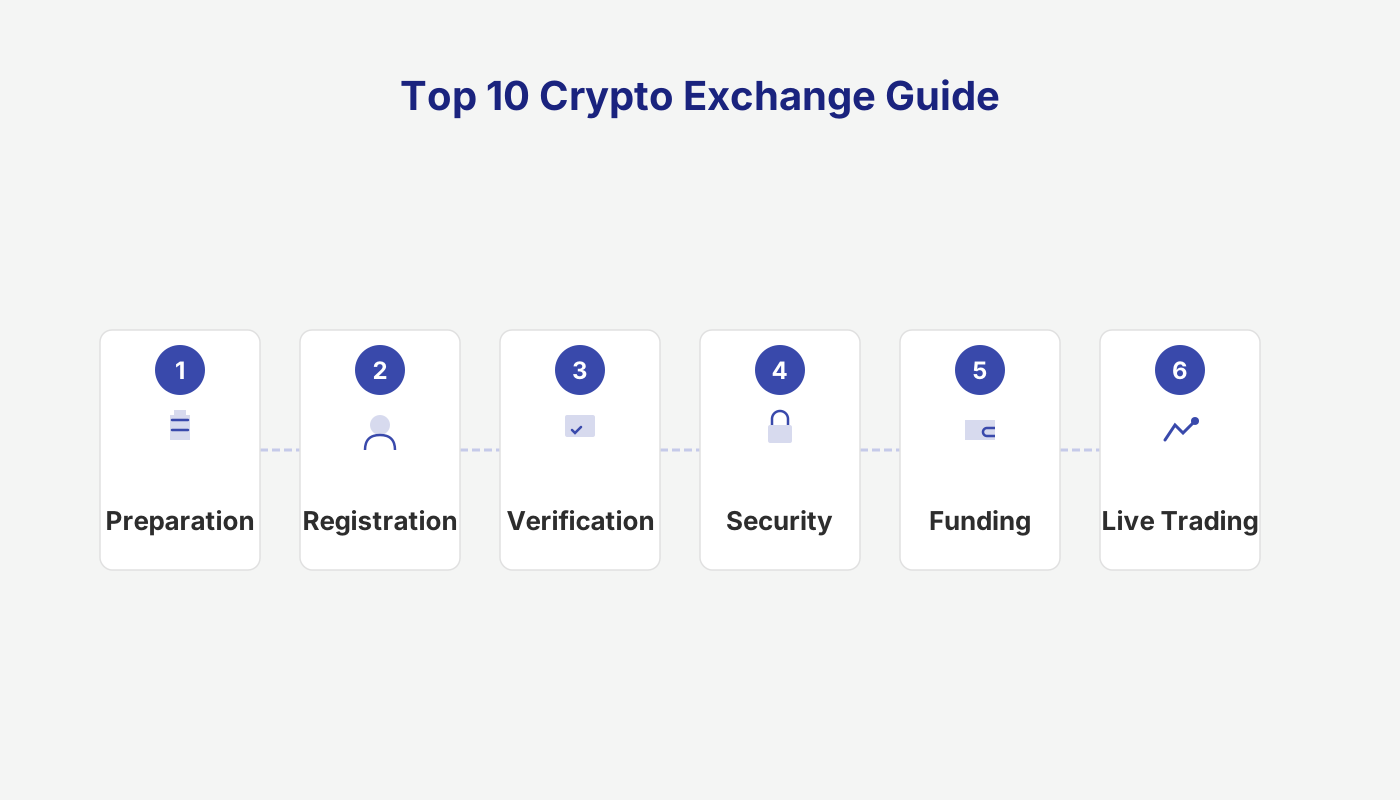
What Is a Cryptocurrency Exchange?
Cryptocurrency exchanges (sometimes called virtual‑currency exchanges) provide services for buying, selling, swapping, and fiat‑on‑ramp of digital assets such as Bitcoin (BTC), Ethereum (ETH), Ripple (XRP), and many others. Well‑known platforms include Binance, OKX, Kraken, and others.
In the Chinese market, the most commonly used centralized platforms are Binance, OKX, Bitget, Gate.io, Huobi, and Bybit. These six services can satisfy the majority of traders’ everyday needs.
Exchange Types: Centralized vs. Decentralized
In the crypto world, centralized exchanges (CEX) and decentralized exchanges (DEX) represent the two dominant models. The table below summarizes their key differences, helping you quickly decide which type aligns with your preferences.
| Dimension | **Centralized Exchange (CEX)** | **Decentralized Exchange (DEX)** |
|---|---|---|
| Asset control | Funds are deposited into the platform; the exchange holds custody | Users keep assets in their own wallets; private keys remain with the user |
| Trade speed | High‑speed order matching, deep liquidity | Dependent on blockchain block times, generally slower |
| User experience | Friendly UI, supports fiat deposits/withdrawals | UI can be more complex, limited fiat support |
| Compliance | Must complete KYC/AML and other regulatory checks | Most do not require KYC, offering higher anonymity |
| Security risk | Exposure to hacking attempts or platform insolvency | Smart‑contract bugs may lead to loss of funds |
1. Centralized Exchanges (CEX)
- Definition: Operated by a company or organization; users must register and transfer funds to the platform, which then manages assets and matches orders.
- Advantages: Fast execution, high liquidity, intuitive interfaces, and well‑developed fiat on‑ramps. Ideal for newcomers and traders who prioritize speed and convenience.
- Risks: Users must trust the platform’s security measures; there is a possibility of hacks or the exchange shutting down.
2. Decentralized Exchanges (DEX)
- Definition: Built on smart‑contract technology, allowing peer‑to‑peer trades without a central authority.
- Advantages: Users retain full control of their assets, enjoy greater privacy, and avoid regulatory constraints placed on centralized providers.
- Risks: Longer confirmation times, often lower liquidity, and the responsibility of safeguarding private keys falls entirely on the user—loss of a key means permanent loss of assets.
Choosing Between Them
- Prefer CEX: If you want rapid trades, easy fiat entry points, and a straightforward user experience.
- Prefer DEX: If you value self‑custody, wish to sidestep centralized regulation, and possess a moderate level of technical competence.
Comparative Strengths of Centralized and Decentralized Exchanges
Advantages of CEX
- Efficient Matching: Order‑book algorithms enable massive trades to be executed almost instantly.
- Robust Customer Support: Most platforms offer 24/7 help desks and two‑factor authentication (2FA), reducing the risk of accidental loss.
- Fiat Channels: Support for multiple fiat deposit and withdrawal methods (e.g., USD via SEPA or SWIFT) enhances convenience.
Advantages of DEX
- Asset Sovereignty: Private keys never leave the user’s wallet, preventing the exchange from freezing funds.
- Anonymous Trading: Many DEXs do not require KYC, offering a higher degree of privacy.
- Contract‑Driven Innovation: Features such as liquidity mining, yield farming, and tokenized derivatives are often first launched on DEXs.
Global Landscape
Globally, cryptocurrency trading is still dominated by CEXs—platforms like Binance, Huobi, and OKX account for the majority of total volume. However, as regulators tighten oversight and high‑profile security incidents occur, a growing segment of users—particularly privacy‑focused professionals—are migrating toward DEXs.
Note on Taxation: In many jurisdictions, profits derived from cryptocurrency trading are subject to capital‑gains tax or other fiscal obligations. Users should consult local tax advisors to ensure compliance with applicable laws.
Ranking of the Top 10 Crypto‑Exchange Apps
The following list features only centralized exchanges, which are generally more suitable for beginners and for storing modest amounts of capital securely. If you are handling large sums, consider moving the majority of your holdings to a hardware wallet for long‑term storage.
1. Binance
- Official site: Register here | Download the app
- Key features: Over 270 million global users, more than 600 trading pairs, and a matching engine capable of processing 1.4 million orders per second—placing it among the fastest in the industry.
- Regulatory status: Holds licenses in Japan, France, the United States, and several other jurisdictions. Fiat on‑ramps support USD via SEPA, SWIFT, and local bank transfers.
- U.S. users: Residents of the United States must use Binance.US, which operates under a separate regulatory framework.
2. Bybit
- Official site: Register here | Download the app
- Strengths: Focuses on derivatives, with taker fees as low as 0.05 % for maker orders and 0.075 % for taker orders. 24/7 live chat support ensures rapid issue resolution.
- Team background: Founders have experience in investment banking and foreign‑exchange markets; CEO Ben Zhou maintains an active presence on social media.
3. Coinbase Pro
- Headquarters: United States
- Core functionalities: Two‑factor authentication, 98 % of assets stored offline, and a clean charting and order‑management UI.
- Geographic coverage: Available in over 100 countries, primarily serving North American and European customers. Offers credit‑card fiat purchases in USD, EUR, and GBP.
4. OKX
- Official site: Register here | Download the app
- Highlights: Supports spot, futures, OTC, and fiat trading; its Web3 infrastructure is built with a focus on security and scalability.
- User base: Operates in hundreds of countries, boasting high reputation scores and strong security protocols.

5. Upbit
- Founded: 2017 (South Korea)
- Highlights: Integrated with KakaoTalk for instant trading, supports more than 200 trading pairs, and once recorded a daily turnover of USD 4.5 billion.
- Partnerships: Collaborates with U.S. exchange Bittrex to accelerate global expansion.
6. Bitget
- Headquarters: Singapore, founded in 2018
- Advantages: Consistently ranks among the top five global futures exchanges; holds a top‑three position for USDT‑based contract liquidity.
- Regional presence: Offices in Japan, South Korea, Vietnam, and Canada.
7. Kraken
- Founded: 2011 (United States)
- Security pedigree: First crypto firm to secure a banking license, has undergone multiple regulatory reviews, and was valued at roughly USD 3 billion in 2024.
- Services: Offers spot, futures, fiat on‑ramps, and a full suite of institutional tools; regularly placed in the global top ten by volume.
8. KuCoin
- Headquarters: Seychelles, serving 207 countries and regions
- Product suite: Spot, futures, staking, lending, token launchpad, and other one‑stop financial services.
- Scale: Over 20 million registered users; 2024 trading volume placed it among the top five worldwide.

9. HTX (formerly Huobi)
- Official site: Register here | Download the app
- Target audience: Professional traders worldwide, offering more than 40 asset classes for trading and investment.
- Geographic footprint: Independent operating centers in Singapore, Hong Kong, South Korea, Japan, and other key markets.

10. MEXC (formerly MXC)
- Founded: 2018 (global centralized exchange)
- Technology: Capable of processing 1.4 million transactions per second, serving roughly 10 million users across 170 countries.
- Security: Multi‑region server architecture, dual‑factor authentication, and IP monitoring protect user assets.
11. Bitfinex
- Headquarters: Hong Kong (iFinex Inc.)
- Specialty: Tailored for institutions and professional traders; offers margin trading, lending, OTC, and other advanced products.
- Security: 2FA + IP monitoring, plus support for the LEO ecosystem token.
12. Gate.io (rebranded as “Gate.io – Open Sesame”)
- Brand refresh: Renamed “Open Sesame” in July 2020.
- Coverage: Services more than 224 countries, offering close to 500 digital assets for trade.
- Security: SSL encryption, cold‑wallet storage, multi‑factor verification, and relatively low trading and withdrawal fees.
All of the platforms listed above are mainstream, reputable exchanges that operate in multiple jurisdictions. Whether you are a newcomer or a seasoned investor, you can select the app that best matches your trading style and security requirements.
Crypto‑Exchange Safety Checklist
When evaluating an exchange, pay close attention to the following criteria:
- Regulatory compliance – The platform should hold the necessary licenses from local financial authorities and complete KYC/AML verification.
- Security measures – Look for cold‑wallet storage, two‑factor authentication, IP‑address monitoring, and regular security audits.
- Operational stability – Verify that the exchange’s server infrastructure offers high availability and that there is no history of prolonged outages.
- Fee transparency – Understand deposit, withdrawal, and trading fees to avoid hidden costs.
In the Chinese market, reliable choices include Binance and OKX, both of which rank highly in global volume and security. If a specific coin is unavailable on those platforms, you may consider Bitget, Gate.io, or HTX as supplementary options. Small balances can be kept on an exchange for convenience, but for larger holdings it is advisable to move assets to a hardware wallet (e.g., Ledger Nano X or Trezor Model T) for offline custody.
Popular Web3 Wallets
- OKX Web3 0 Wallet
- Binance Web3 Wallet
- Trust Wallet
- MetaMask
- TokenPocket (multi‑chain support)
Always download wallets from official websites or reputable app stores to avoid counterfeit software that could compromise your funds.
Friendly reminder: For substantial sums, use a hardware wallet for cold storage. Chip‑level hardware wallets provide a higher security tier than software‑only solutions.
Is Bitcoin Anonymous?
Bitcoin offers a degree of privacy, but it is not completely anonymous. Every transaction is recorded on a public ledger, and blockchain‑analysis tools can trace activity back to wallet addresses. Although mixing services and privacy‑enhancing technologies such as CoinJoin are under development, ordinary users should employ dedicated privacy tools if anonymity is a priority.
What Happens If Bitcoin Is Lost?
If a user misplaces their private key, the corresponding bitcoins remain on the blockchain but become permanently inaccessible—effectively frozen forever. The reduced circulating supply can, in theory, increase demand for the remaining coins, exerting upward pressure on price, although market dynamics are influenced by many other factors.
---
*This concludes the comprehensive overview titled “What Are the Leading Bitcoin Trading Platforms? A Top‑10 Exchange App Ranking”. For deeper analyses of cryptocurrency exchanges and related topics, follow Bitaigen and stay tuned for future articles.*
Related Reading
- 2026 Top Cryptocurrency Exchanges Ranked: Binance, OKX & More
- Top 10 Crypto Exchanges for Beginners 2026 Secure & Low‑Fee
- Download Latest Official Versions of Top Crypto Exchange Apps
💡 Register on Binance with referral code B2345 for the maximum trading fee discount. See Binance complete guide.



