
 Bitaigen Research
 From a technical and ecosystem perspective, we systematically outline Aztec’s implementation of private smart contracts on Ethereum. The article first dissects the collaborative architecture of zkRollup, PXE, and the AVM, explaining how locally generated zero‑knowledge proofs are safely posted on‑chain, and compares the limitations of conventional privacy coins to help readers identify the innovative aspects. Subsequent sections will present use‑case scenarios—continue reading.
Aztec Project Overview
Aztec sits atop Ethereum and delivers a layer‑2 network in the form of a zkRollup that combines privacy with programmability. Unlike a pure anonymous‑transfer token or a scaling solution that only boosts throughput, Aztec embeds privacy directly into its smart‑contract system from the ground up, allowing developers to handle encrypted state and public state within the same contract. Its goal is to replicate the full Ethereum smart‑contract experience while preventing sensitive information from being exposed to external observers.
Core Architecture of AZTEC: Collaboration Between PXE and AVM
Aztec separates the execution environment into two non‑overlapping zones.
- Private Execution Environment (PXE), pronounced “pixie,” is a suite of libraries that run locally on a user’s device. When a user invokes a private function of a contract, all computation occurs locally; PXE manages keys, updates the private state, and generates a zero‑knowledge proof. Sensitive data never leaves the user’s side; only a proof is posted on‑chain, attesting that a specific event occurred without revealing its details.
- Aztec Virtual Machine (AVM) lives on‑chain, analogous to the Ethereum Virtual Machine (EVM), and handles public functions. When a contract contains logic that must be visible on the public ledger, the AVM executes the corresponding operations.
Data can flow only in one direction: a transaction originates in PXE and may subsequently enqueue a public call into the AVM; public functions cannot invoke private functions in reverse. This design safeguards privacy while still permitting private applications to interact with public decentralized‑finance (DeFi) protocols, distinguishing Aztec from projects such as Monero or Zcash that only offer confidential transfers and lack composable smart contracts.
Dual‑Mode Model of Private and Public State
Aztec adopts two distinct state‑management schemes based on the privacy attribute of the data.
- Private state follows a UTXO (Unspent Transaction Output) model, similar to Bitcoin’s implementation. Confidential information is stored as encrypted “notes” inside an append‑only Merkle tree. When a note is spent, the original note is not deleted; instead, a corresponding nullifier is written to a separate nullifier tree, indicating that the note has been consumed without revealing which note it was. External observers can see that “a note was nullified” but cannot link it to any specific content.
- Public state adheres to the traditional account‑based ledger model, akin to Ethereum, where balances and contract storage are openly read and written.
This hybrid approach gives DeFi developers flexibility: within a single contract they can keep user assets and transaction details private using the UTXO model, while simultaneously exposing aggregated information such as liquidity‑pool balances via the account model.
Native Account Abstraction and Multi‑Key Mechanism
Aztec implements every account as a smart contract, discarding Ethereum’s external owned account (EOA) concept. Validation and authorization logic are fully customizable, with common implementations including:
- Signing transactions with biometric data such as fingerprints or Face ID;
- Logging in through Google OAuth or other Web 2 identity providers;
- Enforcing daily transfer caps, multi‑signature requirements, or time‑locked spending rules.
In addition, Aztec introduces a richer multi‑key system that goes beyond a single key pair:
- Nullifier Key – used to consume private‑state notes;
- Incoming Viewing Key – allows the recipient to decrypt received notes;
- Signing Key – managed by the account contract to sign transactions.
To mitigate cross‑application linking attacks, Aztec employs app‑siloing: a Nullifier Key can be used only within the contract for which it was generated, so even if a key is compromised in one application it does not jeopardize the user’s safety in other apps. Note, however, that these protocol‑level keys are immutable after the account is deployed; a breach necessitates deploying a brand‑new account.
Origins and Technological Evolution
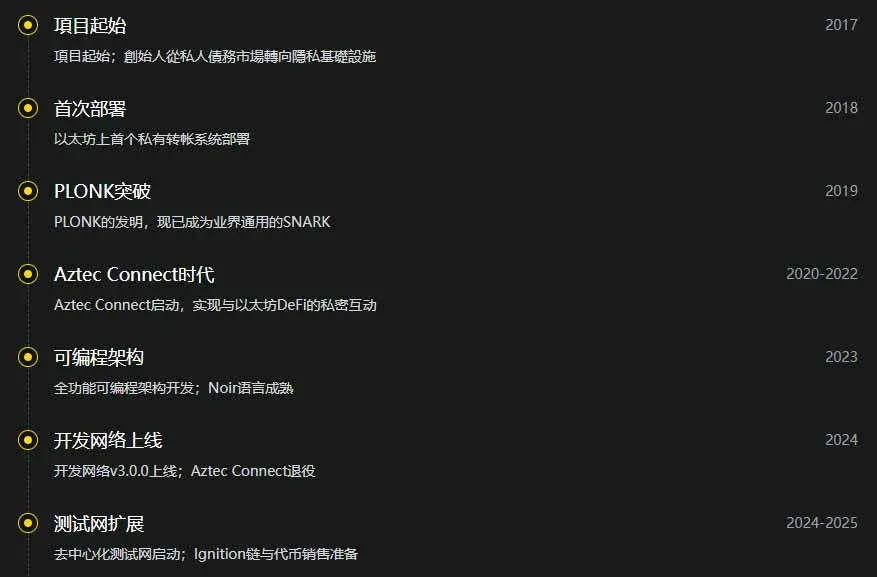
Aztec was not originally conceived as a privacy project. In 2017 the founding team aimed to build traditional financial products for the private‑debt market, but they hit a roadblock when the transparent nature of public blockchains proved incompatible with confidentiality requirements. This prompted a pivot toward developing privacy‑preserving technology that could underpin those financial instruments.
That shift led Aztec to invent PLONK, a universal zero‑knowledge proof system that has since become one of the most widely adopted SNARK frameworks in the blockchain industry, with numerous projects building their privacy layers on PLONK or its derivatives. Concurrently, the team released Noir, a high‑level language specifically designed for writing zero‑knowledge circuits and smart contracts.
From concept to mainnet, Aztec spent almost eight years in research and development, overcoming many technical hurdles associated with blending private computation and public computation within a single environment.
Project Timeline

Functional Comparison: Ethereum L1 vs. Aztec L2

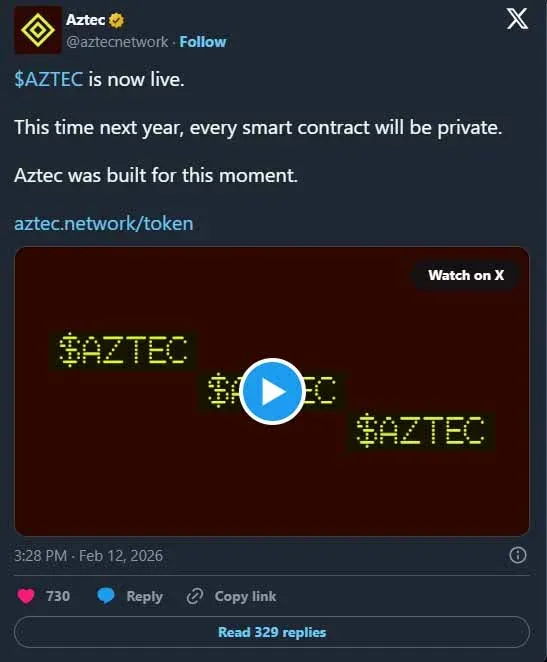
$AZTEC Token Overview
$AZTEC is an ERC‑20 token issued on the Ethereum mainnet that serves three primary functions:
- Staking – provides collateral for running Sequencer nodes;
- Governance – token holders can vote on network‑level decisions;
- Fee Payment – network fees are denominated in Mana, which is periodically converted to $AZTEC at a rate published by the Sequencer.
The total supply is 10,350,000,000 tokens. A public auction will sell up to 14.95 % of the supply, with a floor price based on a $350 million fully‑diluted valuation (FDV), roughly a 75 % discount to the most recent equity‑financing round.
Token allocation (percentage of total supply) is as follows:
The minimum stake required to run a Sequencer node is 200,000 $AZTEC. Sequencers are responsible for ordering transactions and producing blocks, collecting fees in Mana, and converting those fees into $AZTEC revenue. The fee structure includes an inherent deflationary mechanism: during periods of network congestion or heightened privacy demand, an additional “privacy premium” or congestion multiplier is applied. That extra fee is subsequently burned, offsetting inflation caused by staking rewards.
How Aztec Differs From Other Privacy Projects
Existing privacy solutions generally fall into two categories: those that only provide anonymous transfers but lack programmability, and those that focus on scaling without incorporating privacy. Aztec combines both advantages: it is a fully programmable smart‑contract platform where privacy is baked into the architecture rather than added as an afterthought.
The separation of PXE and AVM, the UTXO‑based private‑state model, the unidirectional execution flow, native account abstraction, and the multi‑key system together form a solution with few direct competitors in the market. The team’s contributions to PLONK and Noir further bolster its technical credibility.
Whether Aztec can achieve end‑to‑end privacy while maintaining composability remains to be seen. After eight years of development, the project has moved from testnets to a mainnet that already hosts real users and capital. The next 12‑18 months will be critical for validating its sustainability in production environments.
Frequently Asked Questions (FAQ)
What is the Aztec network?
Aztec is a zkRollup layer‑2 built on Ethereum that prioritizes privacy, delivering a smart‑contract platform capable of executing both private and public logic via zero‑knowledge proofs.
How does Aztec achieve on‑chain privacy?
It splits computation between a local PXE (private) and an on‑chain AVM (public). Sensitive data stays on the user’s device; only a zero‑knowledge proof is recorded on the blockchain.
What are the main uses of the $AZTEC token?
Staking Sequencer nodes, participating in on‑chain governance, and paying network fees.
What is the total supply of $AZTEC?
The initial supply is 10,350,000,000 tokens.
What does PXE stand for?
PXE (pronounced “pixie”) is a client‑side library that performs private computations and generates zero‑knowledge proofs.
Who invented PLONK?
The PLONK protocol was developed by the team led by Aztec Labs co‑founder and CEO Zac Williamson.
How many $AZTEC are required to run a Sequencer node?
The minimum stake is 200,000 $AZTEC.
Is the Aztec network decentralized?
From the outset, the project has planned a decentralized block‑production mechanism, unlike many Layer‑2 solutions that initially rely on a centralized Sequencer.
How is the floor price for the public token sale determined?
It is based on a $350 million fully‑diluted valuation, representing roughly a 75 % discount to the most recent equity‑financing round.
When is the Aztec mainnet expected to launch?
The roadmap targets a full‑stack launch during 2025‑2026, beginning with the Ignition Chain phase followed by open user transactions.
---
Additional Notes for Global Readers
- When converting fiat to $AZTEC or vice‑versa, users in most jurisdictions can use standard banking channels such as SEPA (for Euro) or SWIFT (for USD and other currencies).
- U.S. residents must use Binance.US or another U.S.-licensed exchange; the global Binance platform is not available to them.
- Cryptocurrency gains may be subject to taxation in the holder’s local jurisdiction. Participants should consult a qualified tax professional to understand reporting obligations.
This article has systematically covered the core aspects of the Aztec (AZTEC) token and its private smart‑contract platform. For deeper technical details, readers can refer to previous Bitaigen (比特根) special reports or follow the linked resources below. Happy exploring the frontier of blockchain privacy technology!
💡 Register on Binance with referral code B2345 for the maximum trading fee discount. See Binance complete guide.



