
 Bitaigen Research
 Binance copy‑trading is a feature offered by the Binance platform that lets users automatically replicate the trades of top traders in the spot or futures markets. Users can select outstanding signal providers and set parameters to enable automatic copying.

In this article we systematically outline the core mechanics of Binance copy‑trading and the key criteria for selecting signal providers, helping newcomers get started quickly while mastering risk control. By dissecting the fee structure and the differences between spot and futures settings, you can fine‑tune your parameters for more effective copy‑trading. If you want to learn the practical steps and how to screen high‑quality signal providers, keep reading for the complete guide.
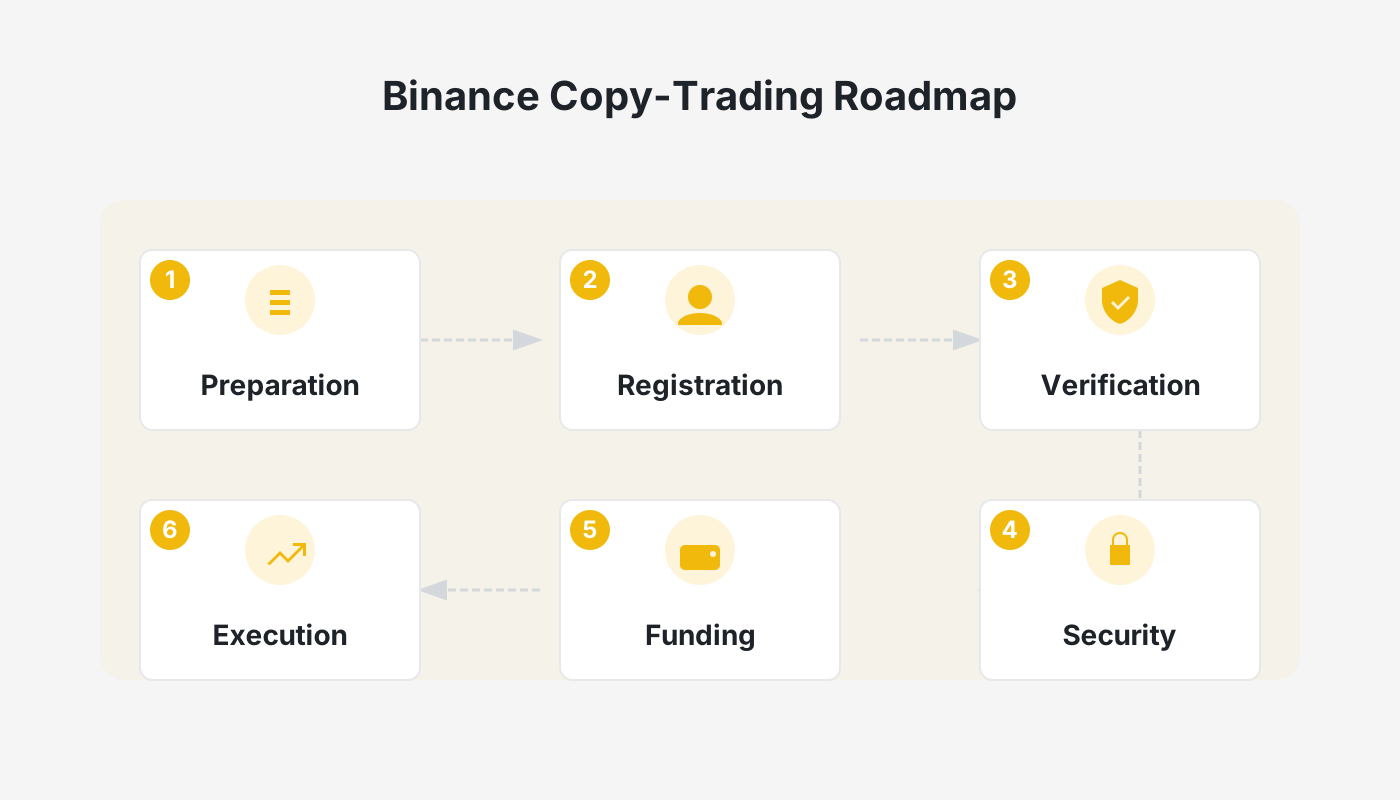
What is Binance copy‑trading?
Binance copy‑trading allows investors on Binance’s copy‑trading platform to pick traders and mirror their buy‑sell actions in real time. When a signal provider makes a profit, they take a pre‑agreed share of that profit as a performance fee; no fee is charged when the trade is unprofitable. The model resembles a managed fund but only collects a share of gains, avoiding extra charges on losses.
The platform supports both spot copy‑trading and futures copy‑trading. Users can adjust the trading pair, leverage, stop‑loss levels, and other parameters according to their risk tolerance, thereby reducing exposure. *(U.S. users should access these features through Binance.US rather than the global Binance platform.)*
Binance copy‑trading fees
Fees for Binance copy‑trading fall into three main categories:
| Fee type | Description | Fee range |
|---|---|---|
| **Trading fee** | Charged based on the instrument (spot/futures) and order type (limit/market) | Futures copy‑trading 0.02% ~ 0.05%<br>Spot copy‑trading 0.1% |
| **Profit share** | The percentage of profit set by the signal provider, commonly 10% | Charged only on profitable trades |
| **Funding rate** | The financing cost or rebate for holding futures positions | Varies according to the specific futures contract |
*Note: All fees are expressed in USD (or the equivalent fiat currency via SEPA/SWIFT transfers). Crypto gains may be taxable under your local jurisdiction, so consider consulting a tax professional.*
Binance copy‑trading risk analysis
Advantages
- Automatic replication: No need to monitor the market yourself; you simply follow a professional trader’s actions.
- Transparency & security: Performance data are publicly displayed on the platform and can be tracked, reducing the risk of fund misappropriation.
Tip: Copy‑trading is not a “set‑and‑forget” profit machine. You still need to conduct your own due diligence (DYOR) to survive in highly volatile markets.
Risks & drawbacks
| Risk / drawback | Explanation |
|---|---|
| **Performance fraud** | Some signal providers may use multiple accounts to inflate their results, misleading copiers. |
| **Agency issues** | If a provider hedges on another exchange, the copier’s capital could suffer losses. |
| **Future uncertainty** | Past performance does not guarantee future results; the timing of copying and parameter choices both affect actual returns. |
Three tips to improve copy‑trading success rate
- Select traders with strong risk‑control habits – give priority to providers who consistently use stop‑loss orders and demonstrate solid money‑management.
- Watch market trends – when the market shows a clear downtrend or heightened volatility, consider pausing copy‑trading to limit potential losses.
- Control the proportion of capital allocated to copying – diversify the amount you commit based on your personal risk tolerance; avoid allocating all assets to copy‑trading.
How to screen high‑quality signal providers on Binance?
Binance offers a wealth of performance metrics that help investors evaluate providers from multiple angles. When screening, consider the following points:
1. Long‑term performance
- Look at cumulative returns over at least 90 days; avoid judging a provider’s skill solely on short‑term spikes.
- Pay attention to whether the provider hides their join date or position details—missing information warrants caution.
2. Avoid “negative‑position” tendencies
- Check for large unrealized losses; consistently holding losing positions may indicate a tendency to lock in negative returns.
- If a provider disables position data, think twice before deciding to copy them.
3. Risk‑control ability
- Maximum Drawdown (MDD): Measures the largest historical loss percentage; a lower MDD signals steadier risk management.
- Sharpe Ratio: Excess return per unit of risk. For spot trading, aim for a Sharpe ≥ 3; for futures, aim for a Sharpe ≥ 8.
4. Provider profit‑to‑asset‑under‑management ratio
- Pure profit percentages can be misleading. Calculate Provider profit ÷ Assets under management to obtain an average profitability figure for a more objective assessment.
5. Example analysis
- Days active: 61 days, Return on Investment (ROI) 7,491.48% (very high short‑term return; requires longer‑term observation).
- Maximum drawdown: 34% (moderate), Sharpe ratio 7.43 (excellent risk‑adjusted performance).
- Average copy‑trader return: roughly 51% (non‑annualized), indicating most providers in the sample were profitable.
Binance spot copy‑trading tutorial
Step 1: Open the copy‑trading page
Trade → Copy‑Trading → select “Spot Copy‑Trading”
Step 2: Choose a signal provider
Pick a trader that matches your risk preferences using the screening method described above.
Step 3: Set copy parameters and confirm
Enter the amount to allocate, set a stop‑loss cap, etc. → Confirm to complete the operation.
Recommendation: Keep the trading pairs aligned with the provider’s and always set a total stop‑loss limit to protect against the provider’s failure to close positions in time.
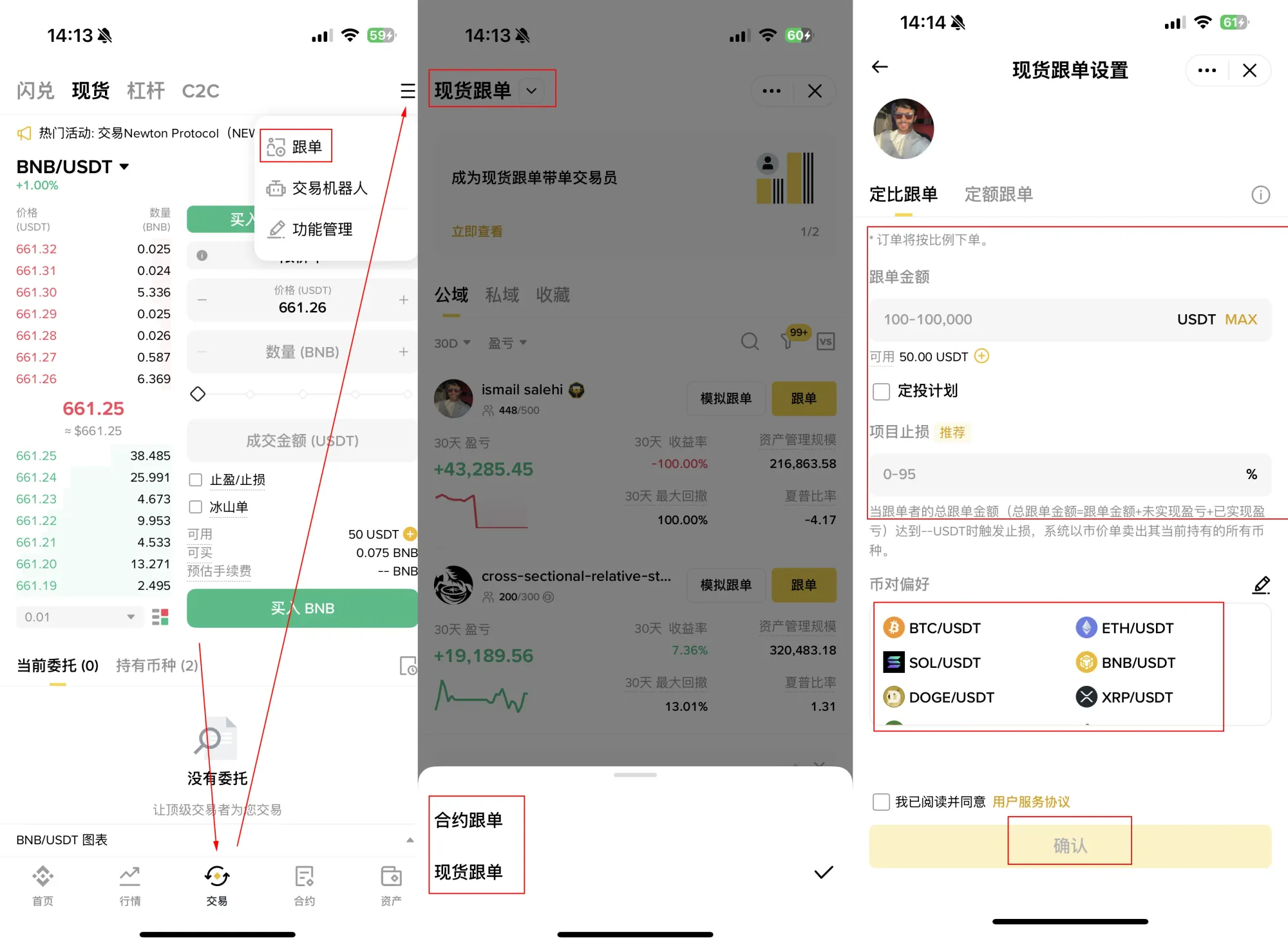
Binance futures copy‑trading tutorial
Step 1: Open the copy‑trading page
Trade → Copy‑Trading → select “Futures Copy‑Trading”
Step 2: Choose a signal provider
Apply the same screening criteria outlined earlier.
Step 3: Set futures copy parameters and confirm
Choose the allocation method (fixed‑ratio or fixed‑amount) → Confirm to finish.
Explanation of copy‑margin modes
| Mode | Description |
|---|---|
| **Fixed‑ratio** | Replicates the provider’s position size as a proportion of your allocated capital, keeping the capital ratio consistent. |
| **Fixed‑amount** | Invests a constant amount per order, which may result in position sizes that differ from the provider’s. |
Best practice: Use the fixed‑ratio mode, keep advanced settings unchanged, and always set a stop‑loss ceiling to prevent losses from provider errors.
Closing remarks
Binance copy‑trading gives investors an easy way to mirror top traders, offering a form of diversified exposure in the highly volatile cryptocurrency market. However, even the most impressive historical performance does not guarantee continued high returns. Investors should continuously monitor provider performance, stay aware of market conditions, and persist with DYOR to enhance returns while keeping risk under control.
This article covered “What is Binance copy‑trading?”, “How to pick a trader?” and a complete “Binance copy‑trading tutorial”. For more Binance copy‑trading guides, search for past articles by Bitaigen (比特根) or browse the recommended content below. Happy trading!
Related Reading
- How to Start Binance Copy‑Trading: Spot & Futures Guide
- Binance Copy Trading 2025: Benefits, Risks & Top Picks
- Binance Copy‑Trading Guide: Mirror Top Traders & Cut Fees
💡 Register on Binance with referral code B2345 for the maximum trading fee discount. See Binance complete guide.



