
 Bitaigen Research
 In the landscape of global cryptocurrency exchanges, Binance stands out as a market‑leading platform. This article will guide you from start to finish through Binance’s fee structure, helping you become a prudent cryptocurrency investor.
In this article we systematically break down Binance’s fee architecture, covering contracts, deposits, and withdrawals, and explain how holding BNB, attaining a higher VIP tier, or participating in promotions can optimize your costs. Read on to save unnecessary expenses when you trade.
Note: Users residing in the United States should use Binance.US rather than the global Binance platform.
Binance Fee Calculation: Discounts, BNB Reductions
On Binance, spot trading, futures contracts, deposits, and withdrawals all follow a Maker‑Taker fee model. Holding BNB grants a 25 % discount, and raising your VIP level or joining promotional events can further lower fees.
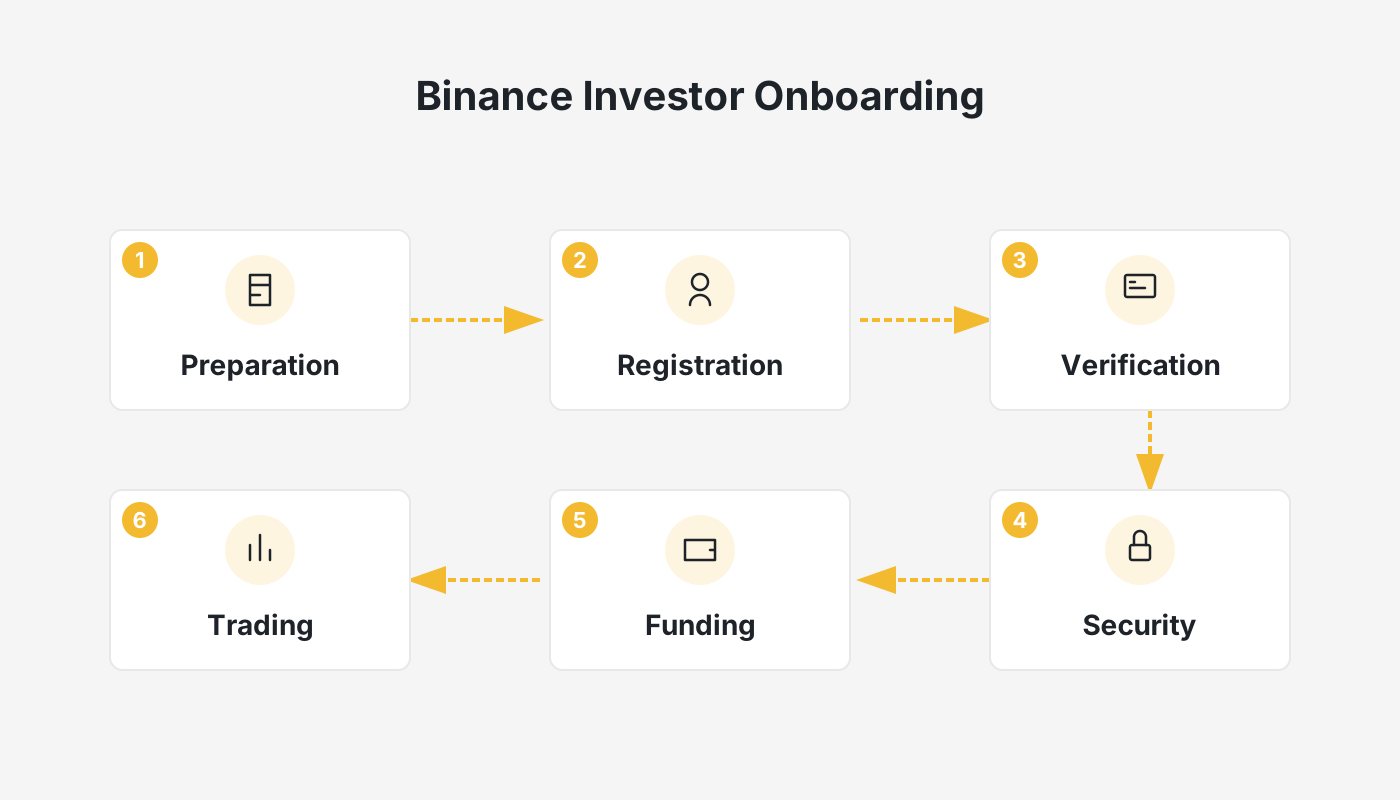
If you have not yet downloaded the app or created a Binance account, you can start with the instructions in this guide.
In Binance’s spot market, fees are applied using the Maker‑Taker model.
- Maker (order‑placer): Provides market liquidity, usually incurs a lower fee, and can receive additional reductions through discounts.
- Taker (order‑taker): Consumes market liquidity, incurs a relatively higher fee, leaving less room for cost control.
Spot Fee Rate Example
A regular user (VIP 0) trading the BTC/USDT pair faces a standard fee of 0.1 %.
- Buy BTC (market order, Taker): Trade size of 10,000 USDT → fee of 10 USDT.
- Sell BTC (limit order, Maker): Same trade size of 10,000 USDT → fee also 10 USDT.
Ways to Reduce Fees
- Pay with BNB: Using BNB to settle spot fees gives a 25 % discount, turning a 10 USDT fee into 7.5 USDT.
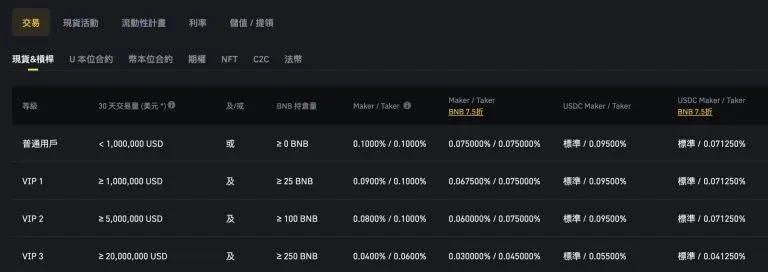
- Upgrade VIP Level: 30‑day trading volume and BNB holdings determine your VIP tier; the higher the tier, the lower the fee rates.
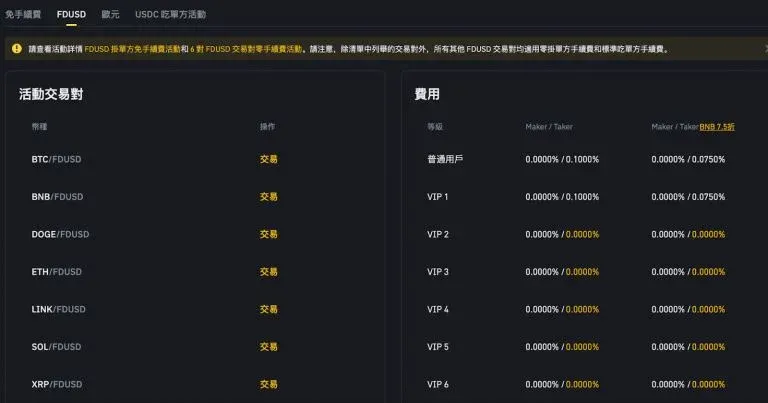
- Participate in FDUSD Zero‑Fee Promotions: Binance periodically offers 0‑fee trading for specific pairs (e.g., FDUSD/BTC, FDUSD/ETH).
- Use a Referral Code: Register with the Bitaigen referral code to receive fee rebates.
- FDUSD Zero‑Fee Promotion: Binance intermittently launches zero‑fee campaigns for certain trading pairs. For example, trading major coins like BTC or ETH against the stablecoin FDUSD incurs a 0 % maker fee. If you frequently trade these assets, this is a significant cost saver.
- Referral Code: When creating a Binance account, use the Bitaigen referral link to obtain fee cashback.
Binance Futures Fee Calculation: Leverage Is High, Costs Still Matter
Futures trading’s main attraction is leverage, but its fee structure differs from spot trading and requires careful calculation.
Binance futures are divided into USDT‑Margined (U‑margin) and Coin‑Margined contracts:
- U‑margin contracts: Margin is denominated in USDT or USDC, suitable for users who prefer fiat‑pegged collateral.
- Coin‑margin contracts: Margin is denominated in cryptocurrencies such as BTC or ETH, ideal for holders of those assets.
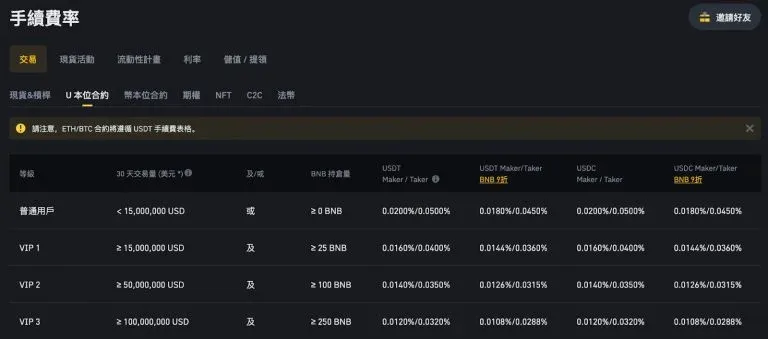
Base Fee Rates
- U‑margin perpetual futures: Maker fee 0.02 %, Taker fee 0.05 %. Holding BNB gives an additional 10 % discount.
- Coin‑margin perpetual futures: Slightly higher rates; refer to Binance’s official fee schedule for exact numbers.
Example (U‑margin perpetual)
- Open position (market order, Taker): A BTC contract valued at 50,000 USDT → fee 0.05 % = 25 USDT.
- Close position (limit order, Maker): Same notional value → fee 0.02 % = 10 USDT.
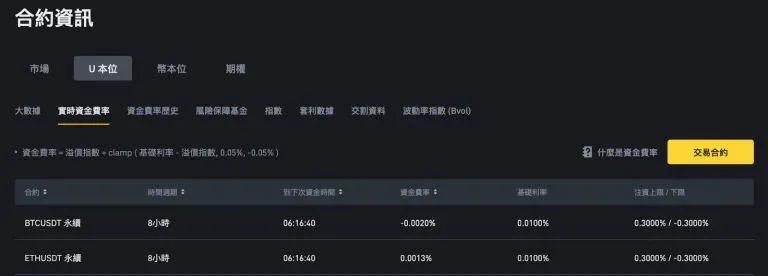
Hidden Cost – Funding Rate
- Funding Rate: Binance settles this every 8 hours to balance long and short positions. When longs dominate, the rate is positive and longs pay shorts; when shorts dominate, the opposite occurs. Futures traders must monitor this rate closely to avoid unexpected losses from funding payments.
Binance Deposit Fees: Credit Card, Transfer, Wire – Which Is Most Cost‑Effective?
Depositing funds is the first step toward trading, and choosing the right channel can significantly cut costs.
- Credit / Debit Card: Fast and convenient, with a fee of roughly 3.5 % (e.g., depositing 1,000 USDT costs about 35 USDT). Suitable for small, urgent entries.
- Cryptocurrency Transfer: Moving assets from another exchange or wallet usually incurs a low fee; USDT deposits can be kept within 0.33 %–1.5 % (e.g., sending 1 USDT via the TRC‑20 network costs about 0.001 USDT).
- Wire Transfer (temporarily unavailable): Typically used for large deposits, with a fixed cost of about 300–800 TWD. Binance has currently paused wire‑transfer deposit/withdrawal routes.
- P2P (Peer‑to‑Peer) Trading: Buying crypto directly from other users on Binance’s P2P platform can yield more competitive exchange rates, but you must ensure transaction safety.
Binance Withdrawal Fees: Choose the Right Network to Save Money and Time!
Withdrawal costs also depend heavily on the blockchain network you select; fees vary widely across coins and chains.
| Coin | Recommended Network | Fee | Arrival Time | Cost‑Saving Ratio |
|---|---|---|---|---|
| USDT | TRC‑20 | $1 USDT | ~13 minutes | 83 % |
| BTC | Lightning | 0.0002 BTC | Instant | 79 % |
| ETH | Arbitrum | 0.00004 ETH | ~5 minutes | 97 % |
| BNB | BEP‑20 | 0.0005 BNB | ~1 minute | 95 % |
| XRP | XRP Ledger | 0.25 XRP | ~4 minutes | 88 % |
Key Point: Fee differences across blockchain networks are substantial.
- USDT (TRC‑20): Withdrawing 1,000 USDT costs about 1 USDT.
- BTC (Lightning): Withdrawing 0.1 BTC costs about 0.0002 BTC.
- ETH (Arbitrum): Withdrawing 1 ETH costs about 0.00004 ETH.
Always verify the selected network before initiating a withdrawal to avoid unnecessary expenses.
In addition, Binance’s C2C platform allows you to sell crypto directly to other users for fiat (e.g., USD, EUR via SEPA, or SWIFT). Exchange rates are generally favorable, but be sure the counterparty has confirmed payment before releasing the coins to mitigate fraud risk.
Full Guide to Binance Fee Reductions: Combine Strategies for Maximum Savings
Summarizing the points above, you can maximize fee savings on Binance by employing the following tactics:
- Hold BNB long‑term: Use it to offset fees and participate in Launchpool, on‑chain mining, and other reward programs.
- Raise Your VIP Tier: Trading volume and BNB holdings determine your tier; higher tiers directly lower fee rates and unlock exclusive perks.
- Take Advantage of FDUSD Zero‑Fee Events: Monitor Binance announcements and join these promotions to eliminate fees on designated pairs.
- Select the Optimal Deposit/Withdrawal Method: Compare credit‑card fees, crypto transfers, and P2P options to choose the most cost‑effective route.
- Stay Updated on Binance Promotions: The exchange regularly releases fee‑discount or cashback campaigns; keeping an eye on them prevents missed savings.
Reminder: As regulatory scrutiny intensifies worldwide, it is advisable to complete KYC 2.0 verification to avoid account restrictions when withdrawing funds.
Tax Note: Cryptocurrency gains may be subject to tax in your local jurisdiction. Consult a qualified tax professional to understand your reporting obligations.
This completes the “Comprehensive Binance Fee Reduction Guide: Spot, Futures, Deposit, and Withdrawal Fee Calculations.” For more Binance‑related fee information, please explore other articles on Bitaigen (比特根).
Related Reading
- Binance Review 2024: Features, Security, Fees & BNB Discounts
- Binance Fees: Spot Trading, BNB Discounts & VIP Levels
- Binance Copy Trading Guide: How to Replicate Top Traders
💡 Register on Binance with referral code B2345 for the maximum trading fee discount. See Binance complete guide.



