
 Bitaigen Research
 Binance is a globally leading cryptocurrency exchange that offers spot trading, derivatives, wealth‑management products and more. Its security framework includes the SAFU fund, KYC verification, 2FA and other safeguards, while its fee structure is competitive within the industry and can be reduced further by holding BNB.
In this article we systematically outline Binance’s core functionalities and security architecture, and combine hands‑on testing to evaluate its fee model. By deeply analysing the platform’s products, risk‑control mechanisms and BNB‑discount system, readers can quickly decide whether the exchange meets their personal requirements. More details await you in the sections that follow.
---
1. What is the Binance exchange?
Binance (official registration link | official download link) is currently the world’s largest crypto‑trading venue by volume, supporting 500+ digital assets and offering spot, futures, options, grid trading and a suite of wealth‑management services.
- Founded in 2017 by Changpeng Zhao (CZ). It started with simple coin‑to‑coin trading and later introduced its native token BNB.
- Beyond the centralized exchange, Binance operates a decentralized exchange (DEX), a peer‑to‑peer lending platform, staking services and other blockchain‑focused solutions.
Overall, Binance positions itself as an all‑in‑one crypto‑finance platform whose competitive edge lies in high liquidity, low fees and a broad product catalogue.
1.1 Basic exchange information
| Item | Details |
|---|---|
| **Cryptocurrencies listed** | 500+ |
| **Maximum leverage** | 125× (BTC/USDT); new users limited to 20× |
| **Spot BTC slippage** | Market order: 0; Limit order: 0 |
| **Futures BTC slippage** | Market order: 0; Limit order: 0 |
| **BTC spot fee (tested)** | Market order: 0.1 %; Limit order: 0.1 % (tiered by trading volume or BNB holdings) |
| **BTC futures fee (tested)** | Market order: 0.1 %; Limit order: 0.1 % (tiered by trading volume or BNB holdings) |
| **Security rating** | ★★★★★ |
| **KYC** | Mandatory for deposits, withdrawals and trading |
| **Deposit methods for TWD** | Credit/debit cards, wallet transfers, C2C |
| **Withdrawal methods for TWD** | Wallet transfers, C2C |
| **Crypto withdrawal fees** | BTC: 0.000001 ~ 0.00039 BTC; ETH: 0.00015 ~ 0.001 ETH; USDT: 0.19 ~ 15 USDT; USDC: 0.001 ~ 15 USDC; BNB: 0.00012 ~ 0.0006 BNB |
| **Customer support** | 24/7 live chat with rapid response |
*For users in the United States, Binance.US is the legally compliant platform to access these services; the global Binance site is not available to US residents.*
*When dealing with fiat, Binance accepts USD via bank transfers (SEPA for Europe, SWIFT for other regions) and other local currencies where supported.*
1.2 Pros and cons of Binance
Advantages
- Excellent liquidity and fast order execution
- Clean UI with a full set of features
- Competitive fees with no hidden spreads
- User‑protection fund SAFU
- Transparent asset reserves verified through Merkle‑tree proofs
- Regulatory approval in 18 jurisdictions
- Prompt, professional customer service
Disadvantages
- Has suffered hacking incidents (compensated users afterwards)
- Reserve composition could be healthier; stable‑coin proportion is relatively low
- Merkle‑tree verification is technically complex and currently only validates on‑chain balances
Further reading
- 2026 latest guide for mainland Chinese users to register on Binance
- How to download the Binance app? Mainland China download and installation guide (Android/iOS)
- Detailed Binance account‑security checklist (including app download steps)
---
2. How secure is Binance? Are there scams or bankruptcy risks?
As the industry‑leading exchange, Binance’s security enjoys broad market confidence and attracts substantial institutional and retail capital. Below we evaluate security from several angles.
2.1 User‑protection fund SAFU
- Launched in July 2018, SAFU (Secure Asset Fund for Users) is earmarked to compensate users in the event of extraordinary losses such as a hack.
- A fixed percentage of every trading fee is automatically transferred to the fund. Binance has publicly pledged that SAFU will remain at US$1 billion in size.
- By 2022 the fund reached US$1 billion, and by the end of last year it had grown to over US$1.2 billion.
- In March 2023, after Paxos halted BUSD issuance, Binance swapped its BUSD holdings in SAFU for TUSD and USDT.
- Following the 2018 hack that stole 7,000 BTC, Binance fully reimbursed affected users through SAFU, reinforcing trust.
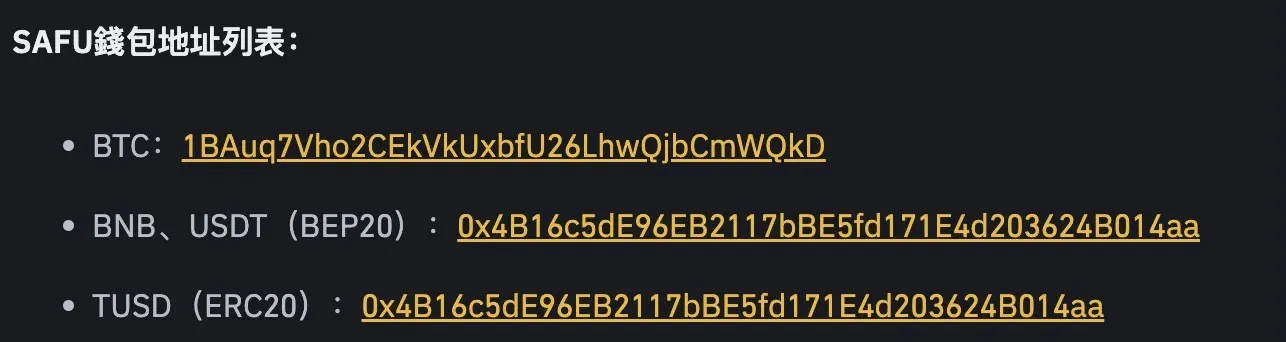
The fund’s wallet addresses are publicly viewable; currently they hold 16,277 BTC (≈ US$11.5 billion), 1.36 million BNB (≈ US$7.3 billion) and other assets.
2.2 Regulatory stance and licensing
- Binance holds operating licences in 18 jurisdictions worldwide and publishes registration numbers and verification links on its website.
- It has not obtained a “major‑financial‑institution” license that many regulators consider authoritative; certain regions (e.g., the United States) have ongoing AML investigations by the SEC, resulting in hefty fines and leadership changes.
- In Taiwan the platform is usable, but because Binance has not established a local legal entity, it lacks formal regulatory approval.
2.3 Public asset reserves and health
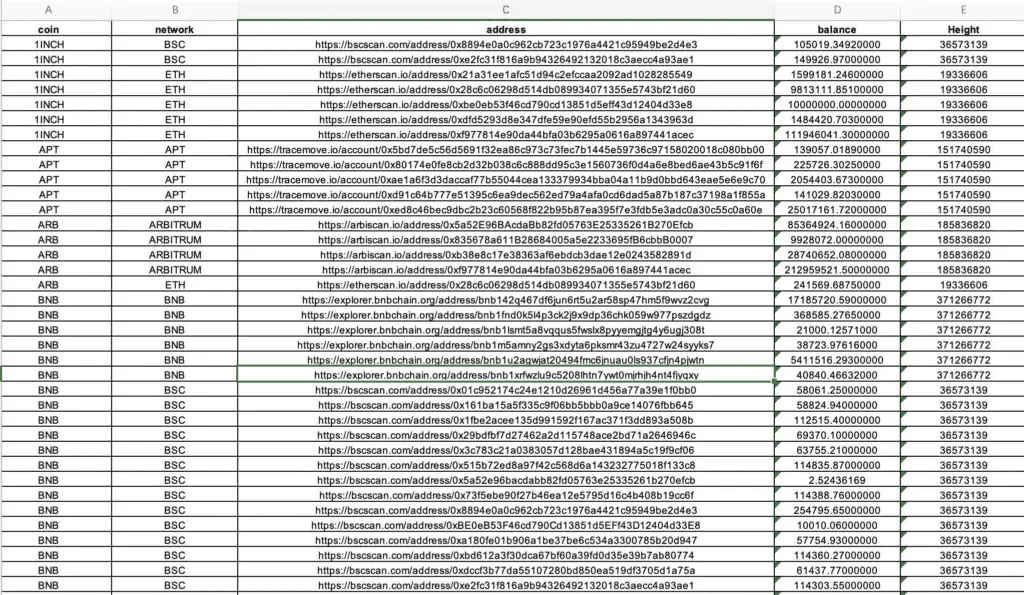
- In November 2022 Binance launched a Reserve‑Proof system, completing sixteen public audits up to January 2024 (though no third‑party audit reports have been released).
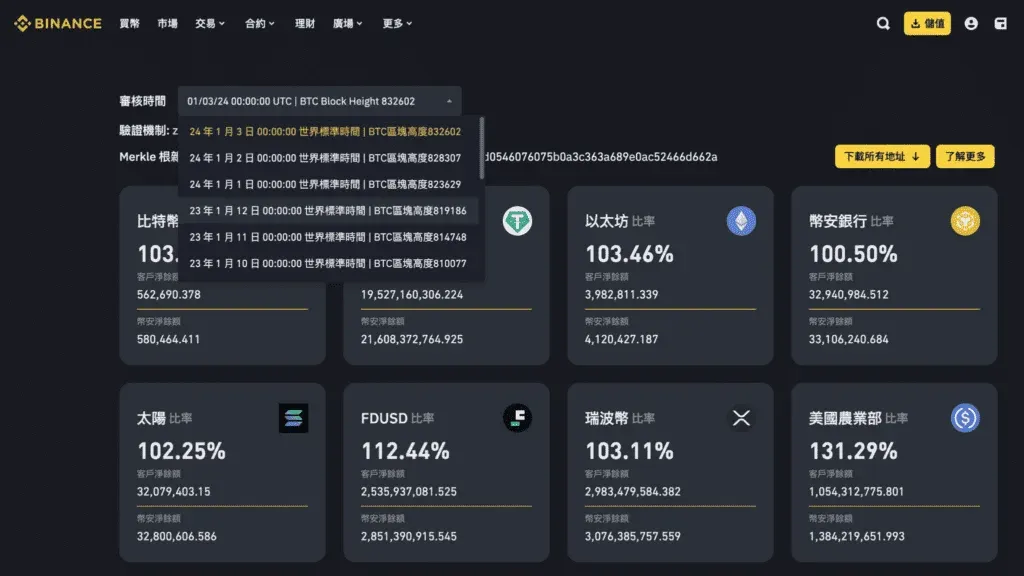
- The disclosed balance ratios show that each listed coin’s on‑chain balance fully covers user holdings; wallet addresses are downloadable for independent verification.
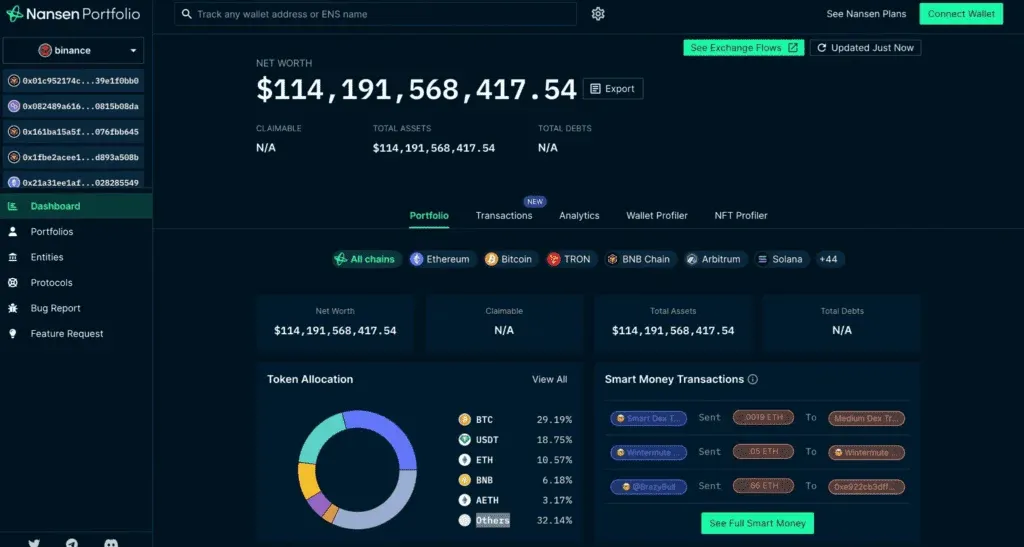
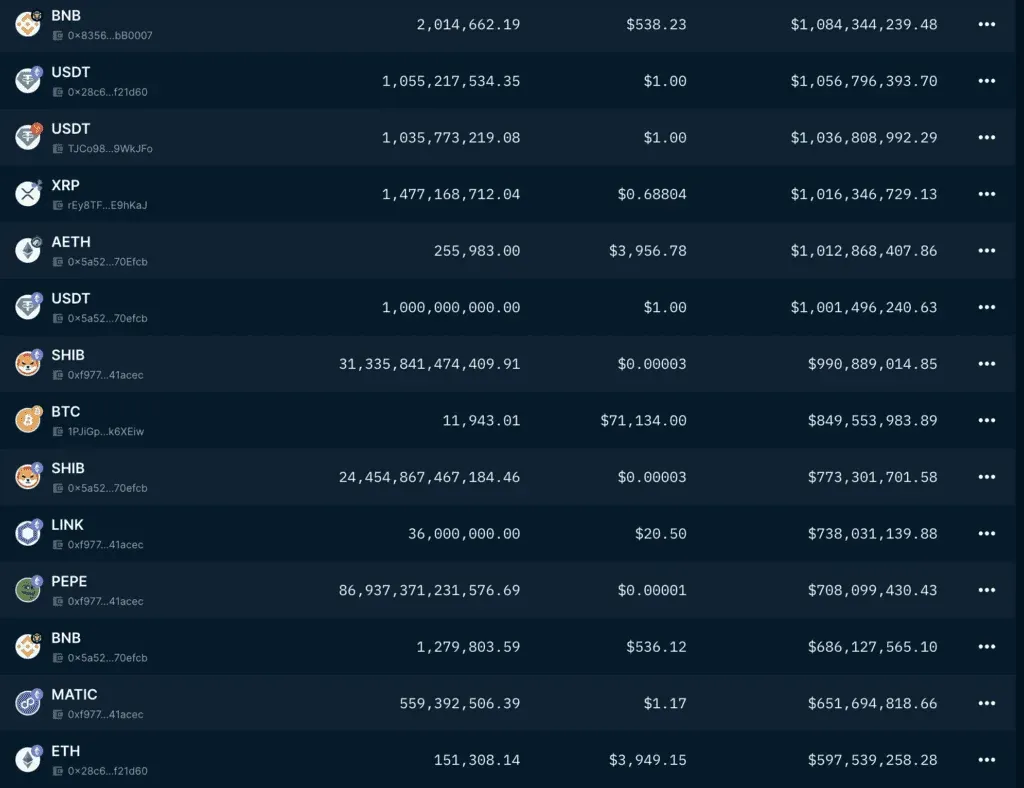
- According to Nansen data, the reserve composition is roughly 18 % stablecoins, 29 % Bitcoin, with the remainder spread across “Others” (e.g., OP, SOL, PEPE, XRP) – indicating a diversified but still volatile asset mix.
2.4 Online balance verification and Merkle‑tree
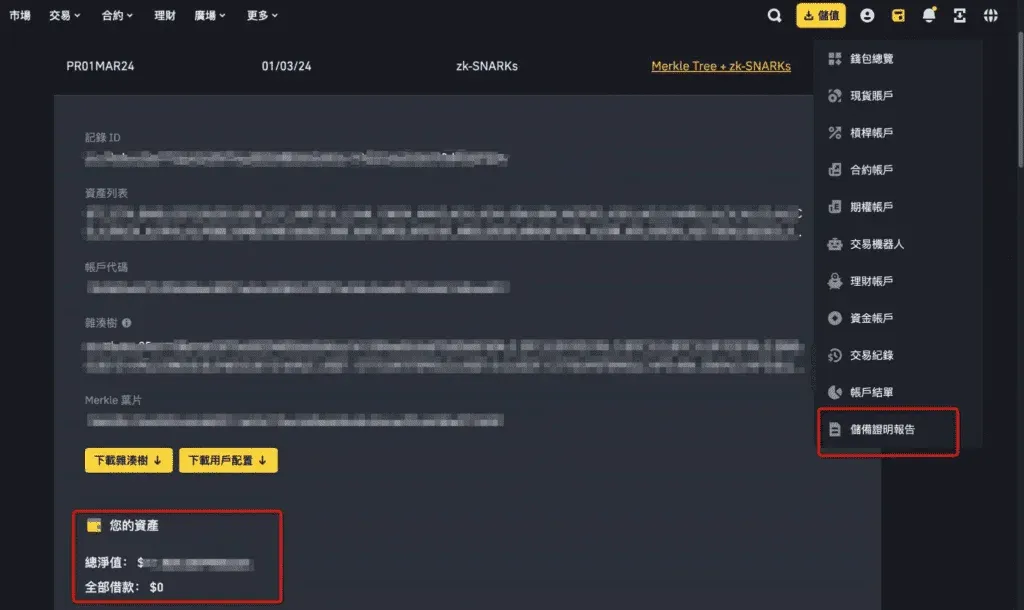
- The Assets → Reserve Proof page shows real‑time balances.
- Binance provides an offline verification tool that users can download and run via command line; the macOS version currently suffers from extraction issues, but the online balance view remains functional.
2.5 Historical security incidents and compensation
- 2019: Hackers stole 7,000 BTC; Binance reimbursed roughly US$40 million in full.
- 2022: A vulnerability in the BNB Chain affected about US$100 million of assets, but the incident did not impact Binance’s exchange; the founder publicly reaffirmed the safety of user funds.
2.6 Multi‑layer account‑security settings
| Security feature | Available? |
|---|---|
| KYC identity verification | Yes (required before trading) |
| Two‑factor authentication (2FA) | Yes (Google Authenticator, SMS, etc.) |
| Withdrawal password | No |
| Withdrawal whitelist | Yes |
| Anti‑phishing code | Yes |
| Device management | Yes |
| Account activity monitoring | Yes |
Binance’s security page highlights 2FA, identity verification, anti‑phishing code and withdrawal whitelist as the most critical safeguards for asset protection.

---
3. What is the user experience on Binance like?
3.1 Client overview
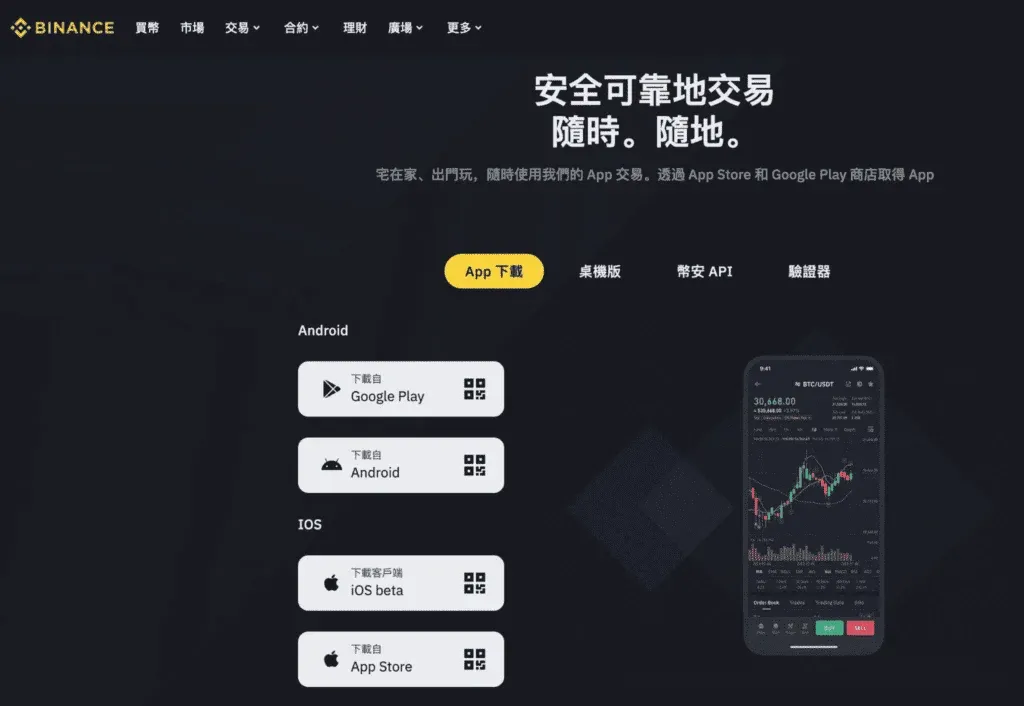
- Binance offers a web portal, iOS/Android apps, and a desktop client. The desktop version is the most feature‑rich and presents information in a clear layout.
- The mobile app supports technical indicators, drawing tools, candlestick rulers and other advanced charting functions, making it one of the most comprehensive trading clients on the market.
3.2 Spot‑trading experience
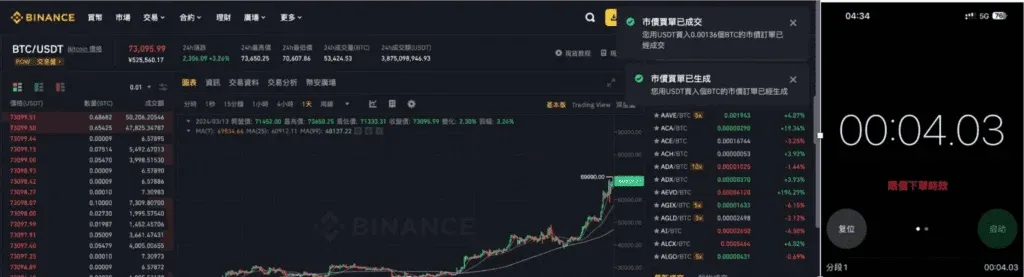
- Over 400 mainstream cryptocurrencies are available, with liquidity that consistently ranks first in the industry.
- Market orders are filled almost instantly; limit orders can be matched within seconds even during bullish periods. In our tests a limit order was executed in 2 seconds.
- Fees for both market and limit orders are 0.1 %, with no noticeable spread.
3.3 Futures‑trading experience
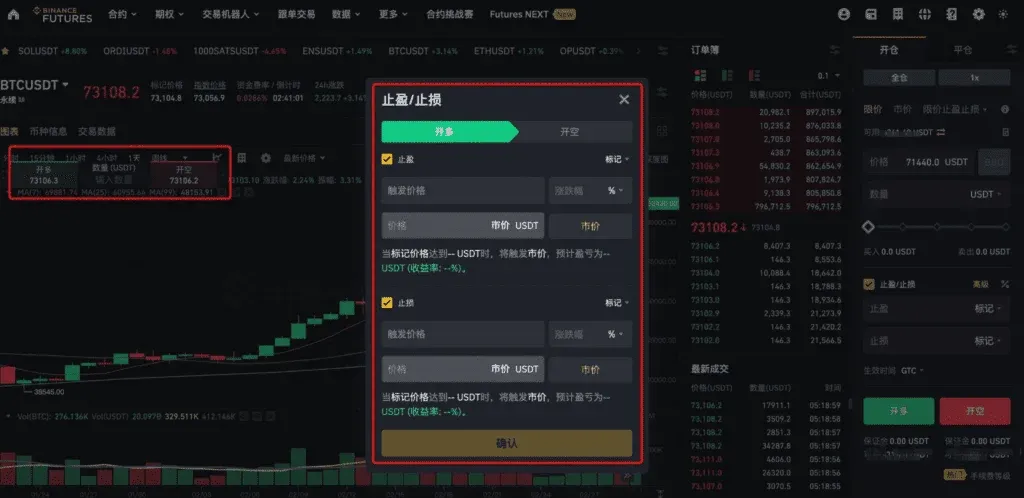
- Binance lists 317 perpetual contracts and 22 delivery contracts, offering up to 125× leverage (new accounts capped at 20×).
- Execution speed and liquidity are comparable to spot trading.
- When a stop‑loss order triggers, slippage may occur; users are advised to factor a slippage buffer into position management.
3.4 Binance wealth‑management products
| Product type | Estimated APR |
|---|---|
| Principal‑protected earn | 0.32 % ~ 21.44 % |
| High‑yield dual‑currency investment | 3.65 % ~ 177.1 % |
- Offerings include dual‑currency investments, flexible savings, recurring purchases, etc., with returns that fluctuate with market conditions.
- Subscription is straightforward and the yield calculation is transparent.
---
4. Binance fee performance and spread in practice
- Spot fees are a flat 0.1 % for takers and makers; holding BNB and paying fees with it grants a 25 % discount.
- Futures fees differentiate taker and maker rates, topping out at 0.05 % and 0.02 % respectively, with a further 10 % discount for large BNB holdings.
- Some newly launched trading pairs temporarily enjoy zero‑fee promotions—check the Binance Announcements Center for the latest.
- Funding rates for futures sit around the industry median: higher than OKX but lower than several other major venues.
4.1 Spot BTC purchase – real‑world test
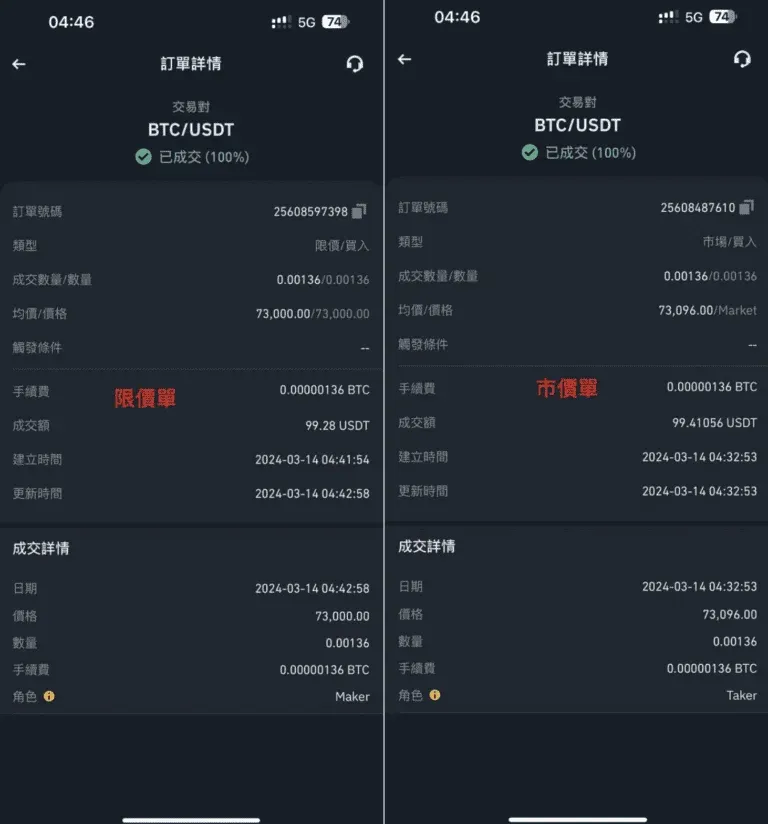
| Pair | Order type | Total bought (USDT) | Avg. price | Fee | Slippage |
|---|---|---|---|---|---|
| BTC/USDT | Market | 99.417309673 | 0.0994 | 0.1 % | 0 |
| BTC/USDT | Limit | 99.287300073 | 0.09928 | 0.1 % | 0 |
4.2 Futures BTC purchase – 5× leverage test
| Pair | Order type | Total bought (USDT) | Execution price | Fee | Slippage |
|---|---|---|---|---|---|
| BTC/USDT Long | Limit | 145.9729 | 0.029 | 0.02 % | 0 |
| BTC/USDT Long | Market | 145.9729 | 0.044 | 0.05 % | 0 |
| Pair | Holding days | Funding fee (%) |
|---|---|---|
| BTC/USDT Limit | Day 1 | 0.2465 % |
| Day 2 | 0.2519 % | |
| Day 3 | 0.3484 % | |
| Day 4 | 0.2764 % | |
| Day 5 | 0.1747 % | |
| BTC/USDT Market | Day 1 | 0.2446 % |
| Day 2 | 0.2500 % | |
| Day 3 | 0.3457 % | |
| Day 4 | 0.2742 % | |
| Day 5 | 0.1733 % |
*Positive numbers denote costs; negative numbers would indicate a net funding‑rate income.*


