
 Bitaigen Research
In the historical volatility of Bitcoin, the Dollar‑Cost Averaging (DCA) method is regarded as an effective way to reduce the timing risk of purchases. The core of this strategy is to invest the same amount of capital at fixed intervals regardless of market conditions, thereby buying fewer units when prices are high and more units when prices are low. The back‑test and forward‑looking model below demonstrate that a disciplined, long‑term DCA approach can deliver steady returns across multiple bull markets.
In this article we systematically back‑test DCA on Bitcoin using its long‑term power‑law growth curve combined with a forward‑looking model. The results show that a robust time horizon together with fixed‑interval contributions can significantly lower entry‑point risk across several bull‑bear cycles, enhancing the safety of long‑term returns. For a deeper dive into model construction, scenario settings, and practical implementation, please continue reading.
Long‑Term Model Emphasizes Time Horizon
To assess the potential future performance of DCA, we employed a forward‑looking simulation built on Bitcoin’s long‑term power‑law growth curve. On a logarithmic chart this curve reproduces the price‑time relationship of Bitcoin since its inception and generates an upward support band and a median trend line that closely match the past several complete market cycles.
Starting in January 2026, we invest USD 250 each week until March 2030, totaling approximately USD 54,250 in contributions. The model forecasts:
- If Bitcoin follows the median upward trend, the average price by March 2030 would be about USD 430,278;
- In a lower‑bound scenario (≈ USD 274,000) and an extremely optimistic scenario (≈ USD 900,000), the price range is also taken into account.
Based on these three paths, the four‑year DCA is expected to accumulate roughly 0.30 BTC, whose corresponding asset values would be:
- USD 274,000/BTC → about USD 82,200;
- USD 430,278/BTC → about USD 129,000;
- USD 900,000/BTC → about USD 270,000.
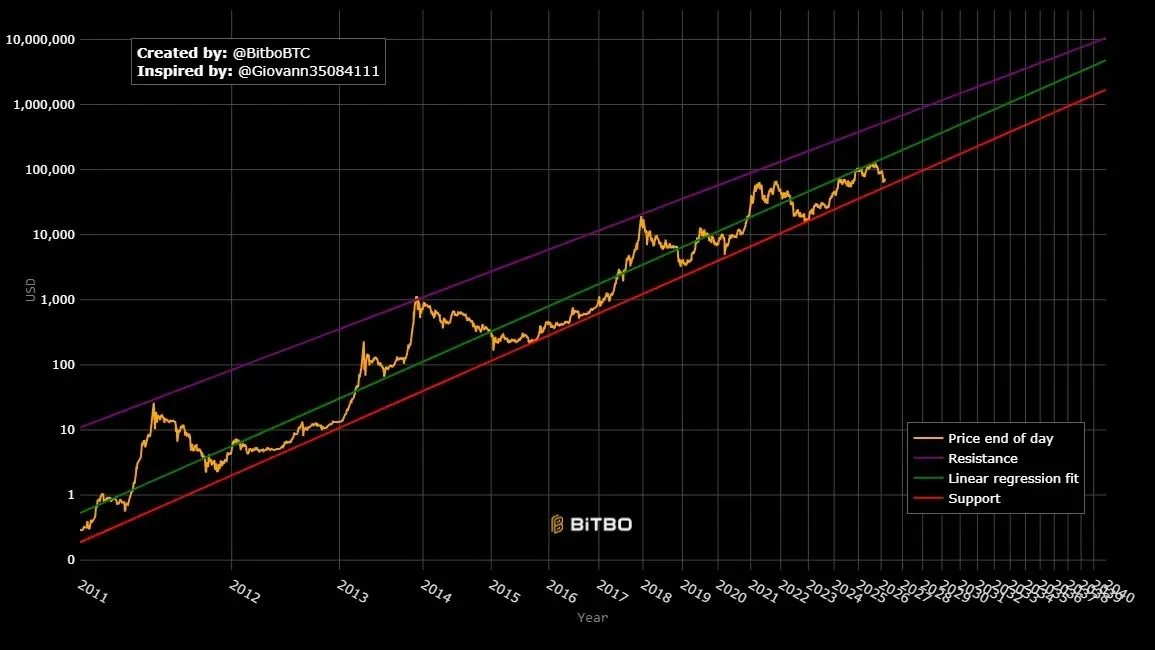
Bitcoin power‑law growth curve. Source: Bitbo.io
Further research (Sminston With, November 2025) indicates that even if the purchase price is 20 % above the then‑current USD 94,000 and the position is exited 20 % below the median band in 2035, the remaining holdings can still achieve an almost 300 % increase after ten years, delivering a total return of roughly 7.7 × the initial capital. This result highlights that while entry timing influences the range of possible returns, the length of the holding period is the decisive factor for overall performance.
Five‑Year Bitcoin DCA Stack Shows Strong Net Gains
Looking back at empirical data, consider a weekly contribution of USD 250 starting in January 2021. Over five years the total contribution amounts to USD 67,500, resulting in a cumulative holding of 1.65097905 BTC with an average purchase cost of approximately USD 40,884 per Bitcoin. At the current market price of roughly USD 71,000, this Bitcoin allocation is worth about USD 120,518, delivering a capital gain of USD 53,018 (≈ 76 %). If Bitcoin’s price rises to USD 100,000, the portfolio value would approach USD 165,098; at the cycle peak of USD 126,000 observed in October 2025, the value would be around USD 208,023.
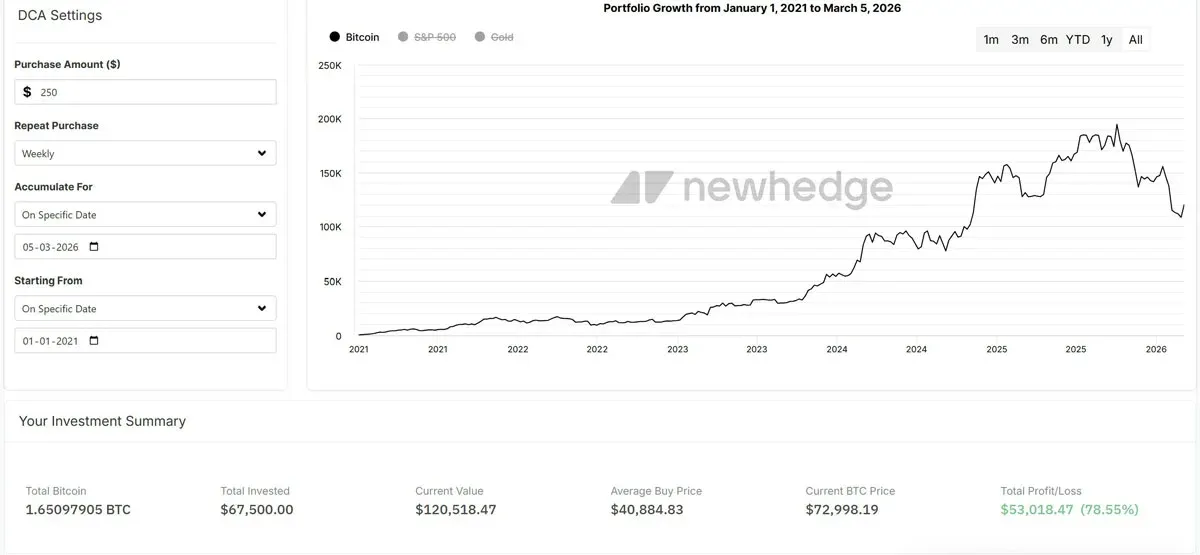
Bitcoin DCA cycle 2021‑2026. Source: NewHedge
In contrast, a shorter accumulation window also illustrates how entry timing affects early returns. Using a weekly USD 250 contribution beginning in January 2024, the total invested to date is USD 28,500, yielding 0.36863166 BTC with an average purchase price of roughly USD 77,312. At the current price of USD 71,000, the market value is about USD 26,909, representing an unrealized loss of approximately ‑6 % relative to cost. Should Bitcoin climb to USD 100,000, the holding would be worth USD 36,863; at the high of USD 126,000, the value would be about USD 46,448.
Comparison with Traditional Assets
In an analysis published in February 2022, Bitcoin analyst Adam Livingston of the Swan Institute compared DCA results for Bitcoin with those for the S&P 500 (SPX). Both strategies used a weekly contribution of USD 100. After five years, the Bitcoin holding was valued at roughly USD 42,508, whereas the SPX investment was worth about USD 37,470, corresponding to cumulative returns of 62.9 % and 43.6 %, respectively. Livingston concluded that despite Bitcoin’s higher volatility, continuous buying during drawdown periods can still generate more attractive cumulative gains.
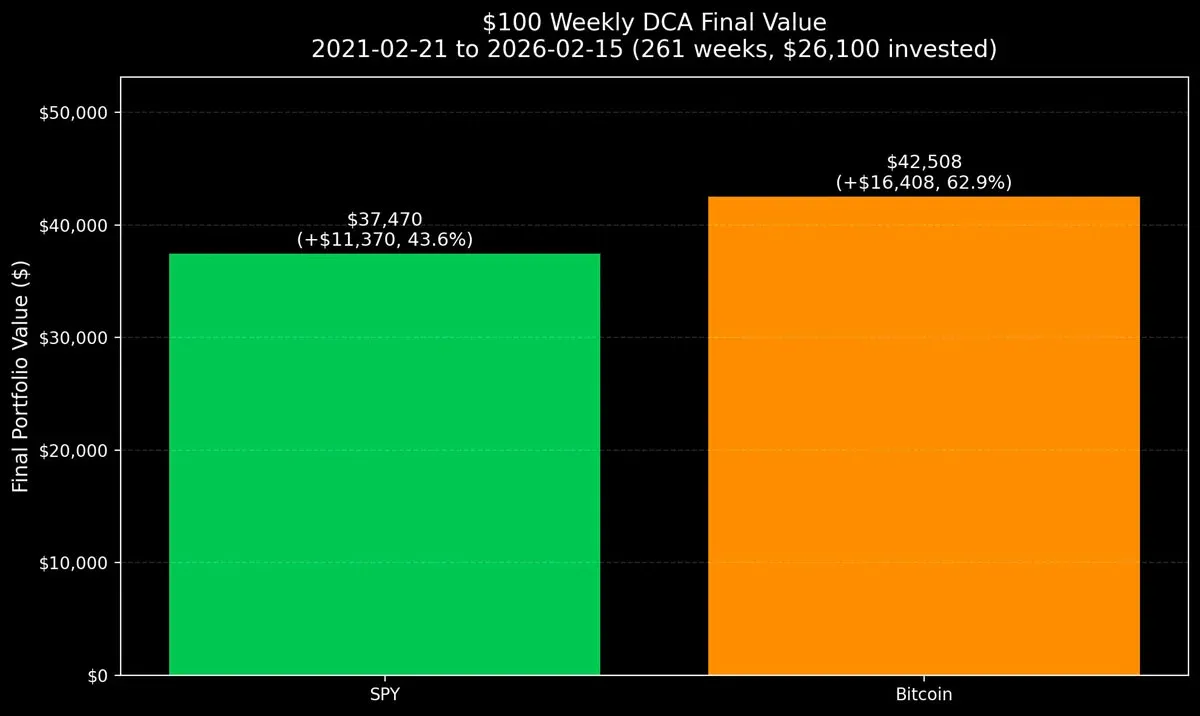
$100 weekly DCA shifted into BTC and SPX. Source: Adam Livingston/X
Conclusion
Synthesizing historical back‑tests, current performance, and forward‑looking models based on power‑law growth, Dollar‑Cost Averaging Bitcoin exhibits strong return potential across various time horizons. The key take‑aways are:
- Maintain a long‑term holding period – Time is the primary driver of returns; short‑term fluctuations have a relatively limited impact on overall performance.
- Stick to a fixed contribution amount – Avoid adjusting the investment size based on market sentiment; this naturally smooths the average cost when prices dip.
- Employ a realistic expectation model – Combining historical trends with power‑law growth forecasts can provide investors with a more robust range of expected outcomes.
These points capture the essence of “Dollar‑Cost Averaging Bitcoin (BTC): A Safe Strategy for Long‑Term Returns Backed by Data.” For further empirical analysis of Bitcoin DCA, please follow subsequent articles from Bitaigen (比特根).
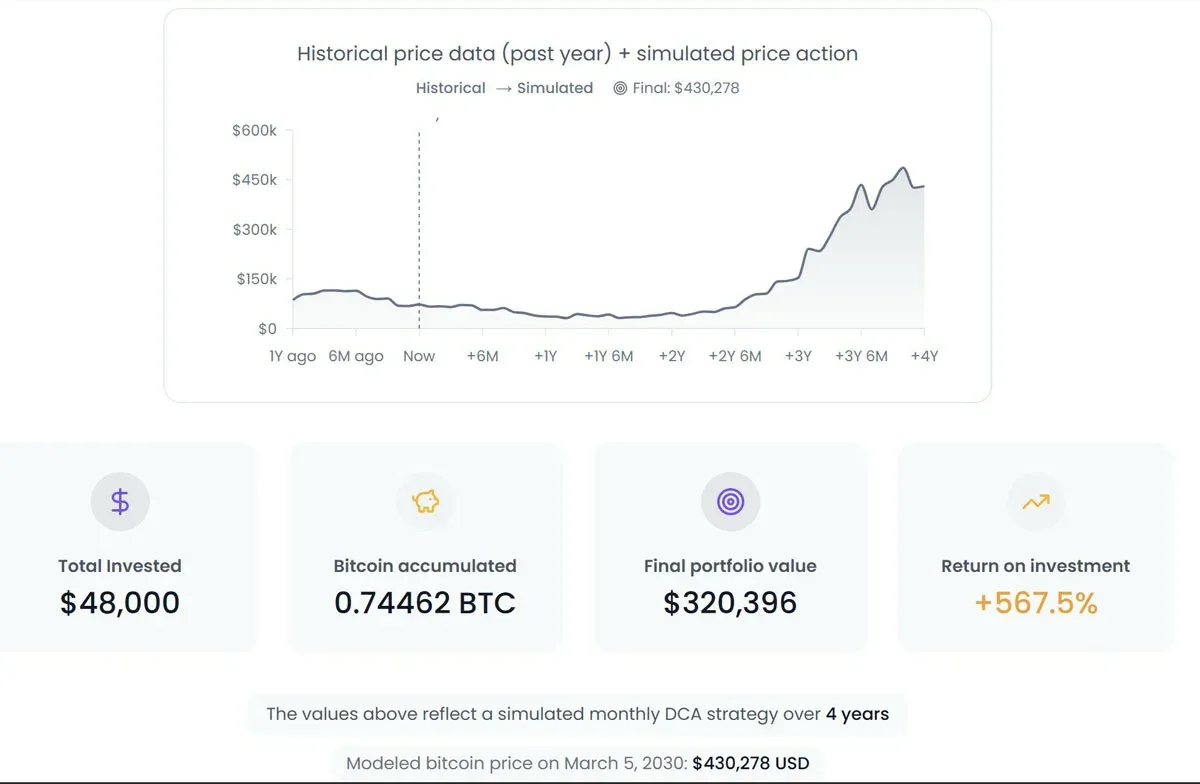
DCA investment results should be completed by March 2030. Source: Bitcoin Well (比特币井)
Additional notes for a global audience:
- All fiat amounts are quoted in USD. For transfers outside the United States, SEPA (Euro) or SWIFT (other currencies) can be used according to the platform’s supported methods.
- U.S. residents should conduct trades on Binance.US rather than the global Binance platform to remain compliant with local regulations.
- Cryptocurrency gains may be taxable in your jurisdiction; consult a tax professional to understand your obligations.
💡 Register on Binance with referral code B2345 for the maximum trading fee discount. See Binance complete guide.



