
 Bitaigen Research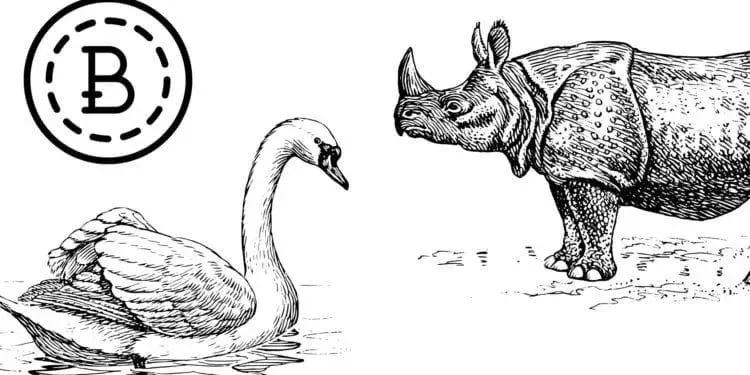
Whether in the cryptocurrency market or in traditional finance, the terms “black swan” and “grey rhino” frequently appear in articles and news reports. What do they mean for investors? How do they differ from each other?
In this article we outline the origins of the “black swan” and “grey rhino” concepts, highlight their core differences, and provide actionable risk‑alert thinking. By dissecting real‑world cases, we help investors spot potential shocks early in the highly volatile crypto market and improve the foresight of their risk management.
What does a Black Swan signify?
The term “black swan” was introduced by Nassim Nicholas Taleb in his eponymous book and refers to an event that is extremely rare and difficult to predict. Such events typically have massive impact, and after they occur people often rationalize them as if they were expected. Taleb stresses that conventional statistical and risk models, which rely on historical data, cannot capture extreme scenarios that have never happened before, and therefore cannot forecast black swans.
In our culture, predicting a black swan is impossible, but confirming a black swan after the fact is inevitable.
He warns us not to assume that because past experience was safe, the future will be safe as well; when facing the unknown and uncertainty, people often fall into logical traps, constructing fantasies and explanations that make them believe they understand and control the situation. In the real world, most changes are non‑linear and far from smooth.
If you hear a “renowned” economist using terms like “equilibrium” or “normal distribution,” don’t argue with him; you can even slip a mouse into his shirt and walk away.

Taleb’s “Grey Rhino”
Why the name “Black Swan”
In ancient Europe people believed all swans were white, so a black swan was taken as an impossible example. The later discovery of black swans in Australia shattered that belief and turned the animal into a symbol of unpredictable events. At the same time, the phrase “black swan” carries strong visual impact, instantly evoking rarity, suddenness, and unforeseeability—exactly the notion Taleb wanted to convey, which is why the term has become widely remembered.

Source: Bournemouth News
Black Swan events that have occurred in the crypto space
The cryptocurrency market is highly volatile, regulatory approaches differ across jurisdictions, and it is constantly influenced by technology, legislation, and market sentiment. For example, a new government regulation or a massive hacker attack can deliver an unforeseen shock.
On March 12 2020, amid the COVID‑19 outbreak in Wuhan, the crypto market suffered two sharp drops within 13 hours. The first fall was about 25 %; later, around midnight US time, Bitcoin fell below $4,000 in a matter of minutes, marking the biggest single‑day decline in seven years. Post‑mortem analysis could only label it a systemic crash.
More than a year later, on May 18 2021, three major Chinese financial industry associations jointly issued a statement banning any business involving cryptocurrencies and warning investors that the market is speculative. After the announcement, Bitcoin plunged $13,591 in a single day, creating a record‑high actual loss of roughly $2.56 billion, with liquidations exceeding $9 billion and a 50 %+ drop within seven days.
Taleb’s stance on the crypto world
In 2018 Taleb suggested that Bitcoin could be viewed as a form of “insurance,” reminding governments that they no longer have a monopoly over monetary control. However, by 2021 his position had flipped 180 degrees—he moved from an enthusiastic supporter to a critic, arguing that Bitcoin does not hedge inflation and calling it an “open‑ended Ponzi scheme.”
What does a Grey Rhino signify?
The phrase “grey rhino” was coined by writer and risk analyst Michele Wucker in her book *The Grey Rhino*. It refers to high‑probability, highly visible risks that are often ignored or postponed.
These risks can inflict severe damage on individuals, organizations, or societies, yet they are frequently overlooked because people focus on other matters or stall decision‑making. The grey rhino concept stresses that early identification and appropriate action can dramatically reduce future losses.
The longer the procrastination, the more opportunity the grey rhino has to gather momentum, eventually striking with greater destructive power.
Unlike black swans, grey rhinos are more predictable and occur more frequently—they are risks we can see, but inertia, decision‑making difficulty, or attention shifts cause us to neglect them.
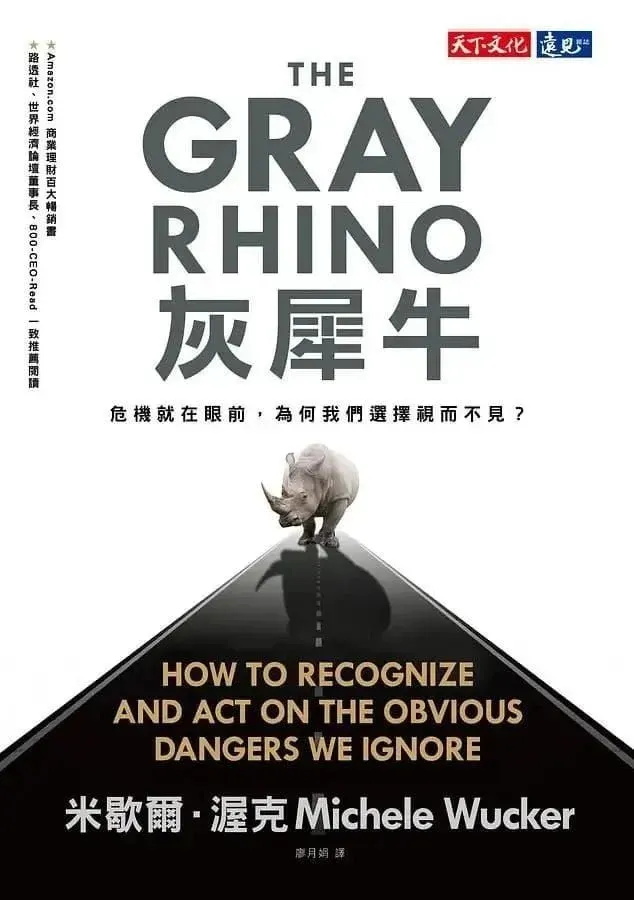
Michele Wucker, *The Grey Rhino*
Why the name “Grey Rhino”
Wucker chose the image of a grey rhino because it symbolizes a large, obvious, and threatening presence—mirroring the characteristics of these risks. While “black swan” focuses on unpredictable extreme events, “grey rhino” emphasizes risks that are plainly visible yet remain unaddressed for various reasons.

Source: AFP
Author’s view: The grey rhino fits crypto well
In a 2022 interview, Wucker noted that the grey rhino metaphor is highly applicable to the cryptocurrency boom. She argued that whether crypto is seen as a “grey rhino” depends on the perspective of different stakeholders.
From the standpoint of industry builders, delegating monetary policy to traditional financial institutions could pose greater risk than embracing decentralized finance. For central banks, widespread crypto adoption threatens their control over the financial system. Investors or private individuals may view continued market growth as a positive, believing that not participating is the risk; conversely, if they regard crypto as a bubble, allocating capital becomes the greater risk.
Grey Rhino events that have occurred in the crypto space
In the early hours of May 10 2022, the algorithmic stablecoin UST issued by Terra (LUNA) suddenly de‑pegged and entered a death spiral. Panic‑driven users burned UST to mint LUNA, driving LUNA’s price close to zero and wiping out the equity of many retail participants and whales, and even causing severe losses for several top crypto venture‑capital firms.
Analysts pointed out that the LUNA crisis showed clear warning signs. At the start of 2022, the LUNA‑UST dual‑token mechanism was already under heavy criticism. While the mechanism helped UST gain rapid market traction and boosted LUNA’s price and market cap, the Anchor Protocol that underpinned UST was widely denounced as an unsustainable “Ponzi scheme.”
MakerDAO co‑founder and CEO Rune Christensen publicly warned in January of the same year:
“Please note that UST and MIM are indeed Ponzi schemes, and I respect that. You can certainly make money from them, but they are not designed for supply elasticity; once the market pulls out capital, they will go to zero.”
He further argued that continuously deceiving users is detrimental to long‑term stability and that those seeking lasting stability should be allowed to exit liquidity provision.
Another example is Ethereum. On September 15 2022, Ethereum completed its transition from Proof‑of‑Work (PoW) to Proof‑of‑Stake (PoS) and merged its execution and consensus layers. GPU mining ended, leaving miners who still owned graphics cards with depreciating equipment. Although the transition was foreseeable, many miners believed the change was far off or clung to a last‑ditch hope, illustrating a classic “mining investment” grey rhino risk.
That concludes the overview of “What are Black Swan and Grey Rhino events? How to anticipate them?” For a more comprehensive look at black swans and grey rhinos, you can search Bitaigen’s previous articles or continue reading the related posts below. We hope you keep following Bitaigen!
Note on taxation: Cryptocurrency gains may be subject to tax in your jurisdiction. Be sure to consult local tax regulations or a qualified professional to determine your obligations.
Regional note: Users in the United States should use Binance.US rather than the global Binance platform for fiat on‑ramps and withdrawals (USD, SEPA/SWIFT).
💡 Register on Binance with referral code B2345 for the maximum trading fee discount. See Binance complete guide.



