
 Bitaigen Research
 In this article we dissect the extreme panic sentiment surrounding Ethereum during the Chinese New Year period, analyze the structural evolution from retail to institutional capital flows, and combine on‑chain data with historical experience to explore how technical narratives and fundamentals influence its short‑term price action. We will later clarify the key tests Ethereum faces, helping readers spot signals of structural re‑shaping.
What Does Extreme Panic Mean?
The current sentiment index has slipped into an extreme‑panic zone, and overall market mood is leaning toward pessimism. Past experience shows that such extreme sentiment is usually accompanied by a redistribution of token holdings.
During price pull‑backs, short‑term capital tends to exit more readily, while long‑term holders are more inclined to keep their positions. On‑chain metrics indicate that, in deep corrections, exchange balances can temporarily decline, whereas the share of ETH held in long‑term addresses rises. This phenomenon does not directly predict an immediate rebound, but it does signal that the market is undergoing an internal structural re‑balancing.
It is important to stress that panic alone does not automatically trigger a recovery. True turning points typically arise from the emergence of new narratives, improvements in liquidity, or technical breakthroughs.
From Retail‑Driven to Institution‑Led: Shifts in Market Structure
Between 2016 and 2021, the primary engine of the crypto market remained retail capital. The holiday‑season home‑coming gatherings, social sharing, and brief liquidity releases during Chinese New Year indeed amplified price swings in the then‑smaller market.
In the past two years, traditional finance channels such as ETFs have started to pour money into crypto assets, tightening the link between crypto volatility and macro‑economic dynamics. Holidays are no longer merely sentiment windows; they are now influenced by global liquidity conditions, the timing of macro‑data releases, and even the schedule of U.S. equity markets.
When the market transitions from a “narrative‑driven” to a “fundamentals‑and‑liquidity‑driven” regime, the so‑called Chinese New Year effect naturally weakens. The holiday itself cannot automatically generate buying pressure, especially in the absence of a fresh narrative catalyst.
Narrative Transitions: The Real Challenges Facing Ethereum
Over the past several years, Ethereum has undergone multiple technical upgrades, including the shift to Proof‑of‑Stake and ongoing scaling initiatives. The “ultrasonic money” narrative built a long‑term value expectation around these upgrades. However, as scaling solutions gradually roll out, transaction costs drop, main‑net fees decline, and the scale of token burning fluctuates, discussions about the token’s value‑capture mechanism have intensified.
The rapid growth of the Layer 2 ecosystem has, on one hand, improved network usage efficiency, but on the other hand, it has fragmented liquidity. The relationship between main‑net revenue and activity has become more intricate, and ETH’s value logic is shifting from “high gas‑fee‑driven” to “settlement‑layer security and trust‑infrastructure‑driven.”
Technical positives are being realized, yet a new, overarching narrative has not fully crystallized; consequently, the market often enters a valuation‑digestion phase. This temporary cooling is not unusual; it simply amplifies sentiment swings.
Variables in 2026: Where Could the Next Catalyst Emerge?
Looking ahead, Ethereum’s core discussion may move from “scaling speed” to “efficiency of value settlement.” Market attention is transitioning from pure TVL figures to on‑chain real revenue, protocol sustainability, and resistance to censorship.
If more mature chain‑abstraction solutions, intent‑driven transaction models, and other novel application paradigms can re‑aggregate the dispersed liquidity structure, the value‑flow logic between Layer 1 and Layer 2 will become clearer, potentially prompting a staged sentiment recovery.
Until such developments materialize, volatility will remain the norm.
A Historical View of Chinese New Year Market Moves
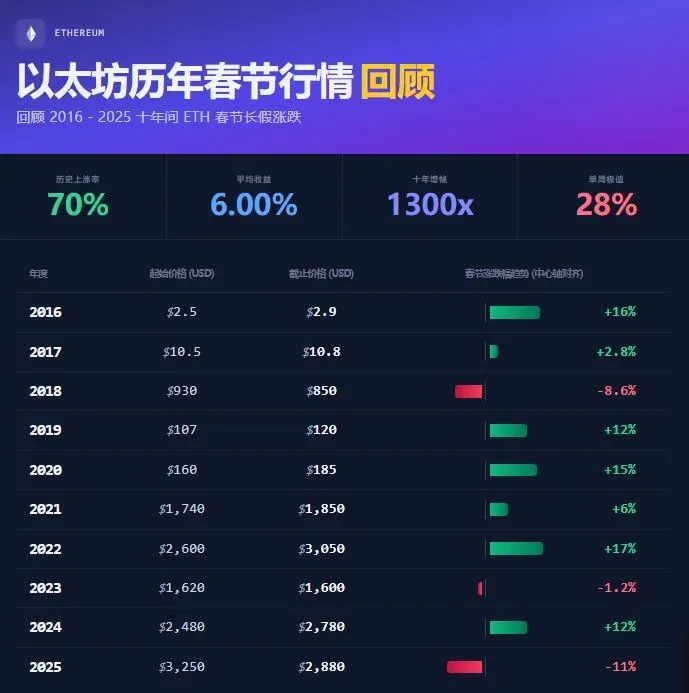
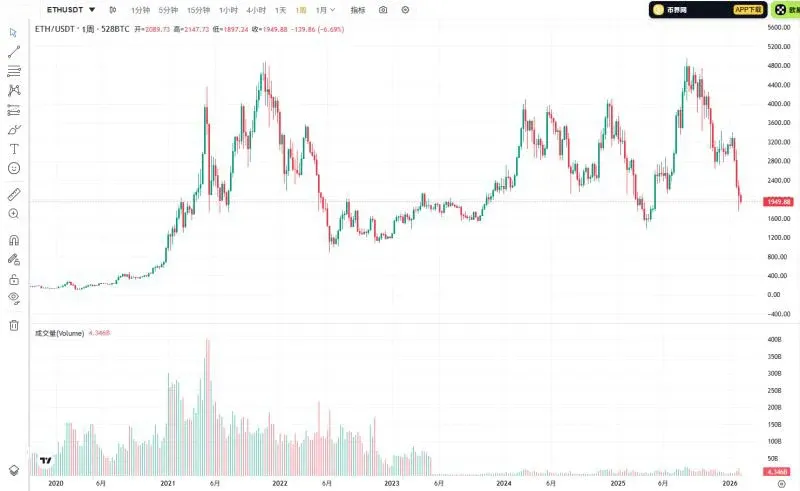
Since the Ethereum mainnet launched on July 30 2015, it has gone through multiple full price cycles. Reviewing the price action before and after each Chinese New Year from 2016 to 2025 (see chart below), most years show an upward bias, but not every year delivered a bounce.
Reducing the holiday effect to a “must‑rise” rule is clearly an oversimplification. Assuming a fixed calendar effect based solely on candle‑chart appearances loses validity as market structure evolves and historical samples become less predictive.
Social Media’s Unvarnished Snapshot
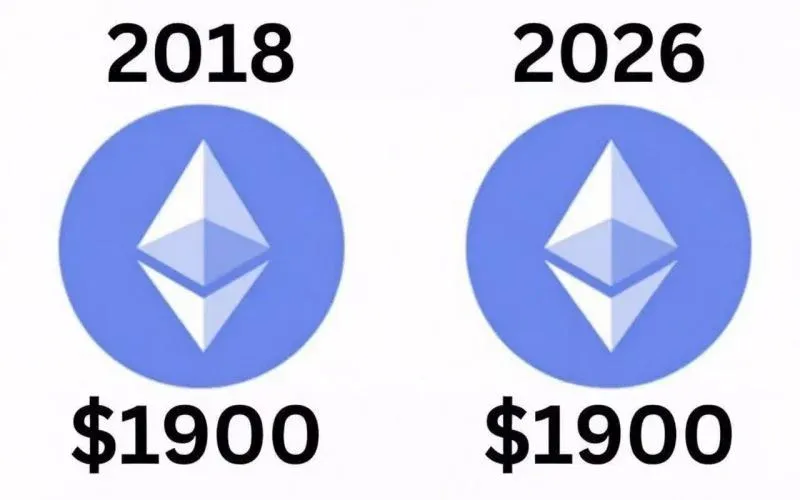
During periods of extreme sentiment, the chatter on social platforms often offers more insight than the price chart itself. Recently, an investor posted a tongue‑in‑cheek poem that mocks years of holding experience; this self‑deprecating humor is itself part of the market cycle.
A light‑hearted verse from social media:
Eight years of holding, a blur of uncertainty,
No calculations, yet memories linger.
Thousands of upgrades, no words for the melancholy.
Even if we meet, recognition may fail—tears on a face, hair turned white.
A night’s dream returns home, opening trades, watching candles in panic.
Four‑thousand‑eight‑hundred, when will the light return?
One can foresee the annual gut‑wrench, 1900, lying still where it started.
Closing Thoughts: Patience Within the Cycle
Ethereum is no longer a test‑net that rode the ICO hype wave, nor is it merely a product of the DeFi boom. It is moving toward a more mature infrastructure stage and is now subject to scrutiny from traditional finance and regulatory bodies alike.
The price movements during Chinese New Year are not just raw data points; they reflect broader industry evolution. Market structure, participant composition, and driving logic are all shifting.
In an environment of extreme panic, sentiment amplifies uncertainty. Yet in the crypto space, scarcity is rarely about opportunities; it is about the patience to endure through cycles. Being able to stay the course across multiple cycles is itself a competitive edge.
The above constitutes the full analysis titled “How Does ETH Perform Around Chinese New Year? The Challenges Ethereum Faces in Extreme Panic.” For more content on ETH’s holiday market behavior, follow additional articles by Bitaigen (比特根).
*Note for U.S. readers: when accessing spot markets, use Binance.US or other U.S.-compliant platforms. Fiat deposits and withdrawals should be processed via SEPA, SWIFT, or local USD‑based methods where applicable.*
Related Reading
- Ethereum Investment: Is It Safe, Profitable & Future Outlook
- Succinct (PROVE): Decentralized ZKP Network on Ethereum
- Top 10 Cryptocurrencies to Invest in Jan 2026
💡 Register on Binance with referral code B2345 for the maximum trading fee discount. See Binance complete guide.
⚠️ Risk Disclaimer: Crypto prices are highly volatile. This is not investment advice.



