
 Bitaigen Research
 Ethereum (ETH) price performance this week remained constrained by macro factors, even though the market briefly spiked to $2,200 before retreating about 6%. At the same time, the Iran conflict entered its sixth day, U.S. equities weakened, and disruptions to oil and gas supplies added multiple uncertainties, prompting investors to broadly adopt a risk‑off stance.
In this broader environment, institutional investors’ willingness to hedge downside risk via the derivatives market has become markedly stronger.
---
We analyze why Ethereum is being held back when sprinting toward critical price levels from three angles—macroeconomic environment, institutional derivatives positioning, and network activity. Gaining insight into the underlying shift in risk appetite and technical demand can help gauge future market direction; we recommend reading the full analysis.
Ethereum Derivatives and Options Sentiment
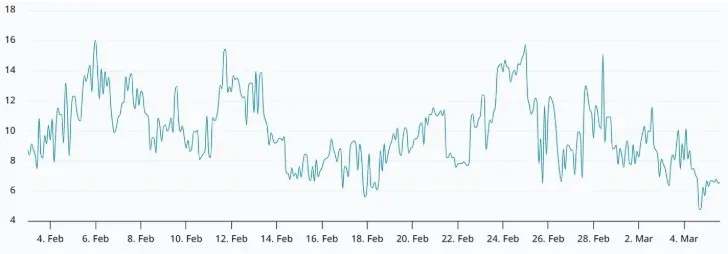
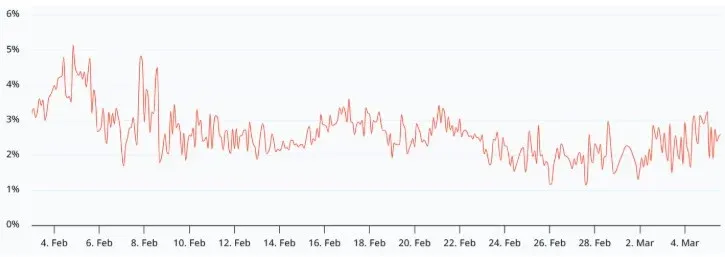
The annualized premium on ETH 30‑day futures has slipped below the neutral 5% threshold, indicating insufficient demand for bullish leverage. This premium decline is directly tied to the fact that Ethereum’s current price remains 58% below its August 2025 all‑time high of $4,956.
From the options market perspective, when large players and market makers seek downside protection, ETH’s put‑call skew typically climbs above 6% and can even exceed 15% under extreme pressure. Deribit data show that the skew rose to 7% on Thursday, after briefly returning to a neutral range the day before, indicating that professional traders remain cautious, further amplifying the potential impact of bearish forces.
---
Network Activity and DApp Demand
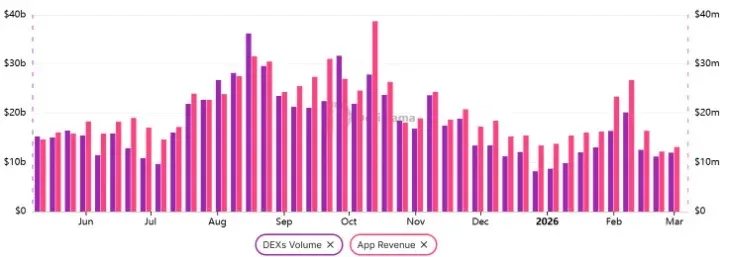
After a modest rebound in early February, activity on the ETH network has stalled. Changes in decentralized exchange (DEX) volume and DApp revenue directly affect Ethereum’s fee‑burn mechanism and inflation pressure. Last week, on‑chain DEX trading on Ethereum fell to $12.6 billion, a clear decline from $20.2 billion a month earlier; at the same time, DApp revenue over the past seven days dropped to $14.1 million, a 47% month‑over‑month decrease. During the same period, DEX volume on the Solana chain also slipped by roughly 50%.
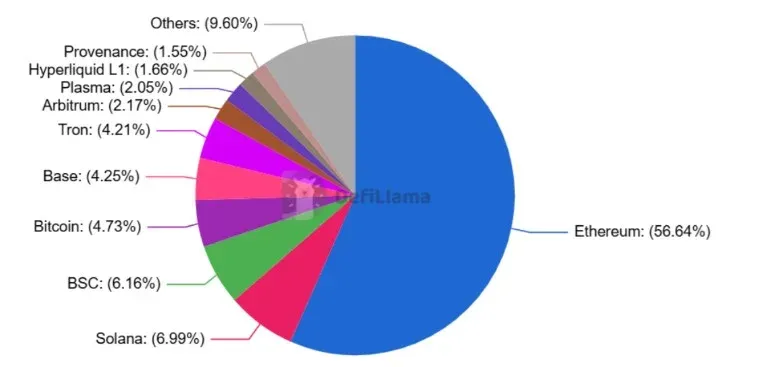
Despite the weak on‑chain metrics, ETH still enjoys an absolute lead in total value locked (TVL), positioning it to regain momentum when DApp activity revives. The Ethereum ecosystem—including its Layer‑2 solutions—accounts for roughly 65% of the total locked market value across all blockchains.
---
On‑Chain Locked Value Comparison
To date, the total value locked on Ethereum’s main chain stands at about $55.4 billion, ranking first; the runner‑up, Solana, holds only $6.8 billion. This gap indicates that institutions preferentially allocate capital to decentralized assets rather than public chains such as Solana or BNB Chain that tout low fees and high throughput.
---
Key Takeaways
- The Ethereum derivatives market shows that institutions are leaning toward downside risk avoidance and hedging against global political‑economic uncertainty.
- Demand for decentralized finance remains the core support for ETH’s value; despite recent declines in network activity, the TVL advantage still provides room for a subsequent recovery.
Overall, although ETH’s price continues to track risk‑off sentiment, breaking back above $2,500 in the short term faces notable resistance. If a solid support level can be established around $2,400, market sentiment may shift toward a more bullish outlook.
This concludes the article. For more in‑depth Ethereum analysis, please search for previous Bitaigen articles or continue reading the related reports below. Thank you for your interest and support of Bitaigen!
💡 Register on Binance with referral code B2345 for the maximum trading fee discount. See Binance complete guide.
⚠️ Risk Disclaimer: Crypto prices are highly volatile. This is not investment advice.



