
 Bitaigen Research
 We systematically review the concept, purpose, and calculation mechanism of funding rates for perpetual contracts in this article, helping you understand how long and short side participants balance prices through fees, and providing practical methods for checking rates and related risk considerations. After mastering these points, you can manage positions more rationally, reduce unexpected risks caused by funding fees, and continue reading to explore the details.
The Nature and Function of Funding Rates
In perpetual contract trading, the Funding Rate is a balancing mechanism designed to bring the contract price closer to the underlying spot price. At regular intervals the system compares the total open interest of long and short positions; the side that holds the dominant position is required to pay a “funding fee” to the opposite side. If too many traders are long and the contract price drifts above the spot price, the system forces longs to pay shorts, encouraging some longs to close or flip to short positions, which in turn pulls the contract price back toward the spot level. Conversely, when shorts dominate, the short side pays the long side.
During a rapid bull market or when market sentiment is strongly bullish, the funding rate is typically positive and relatively large; when the market cools down or sentiment turns bearish, the rate often turns negative and its magnitude tends to be smaller.
---
Billing Cycle and Collection Method
- Settlement frequency: Most exchanges calculate the funding rate every 8 hours, with common settlement timestamps at 00:00, 08:00, 16:00 UTC. A few tokens may have a shortened cycle under special circumstances.
- Automatic deduction: The fee is transferred automatically within the contract account; traders do not need to take any extra action. If you close your position before the settlement moment, no fee is generated for that interval.
- Impact on margin: Because the fee is deducted from your margin, it is advisable to leave a buffer when opening a position so that a sudden funding charge does not deplete your margin and trigger a liquidation.
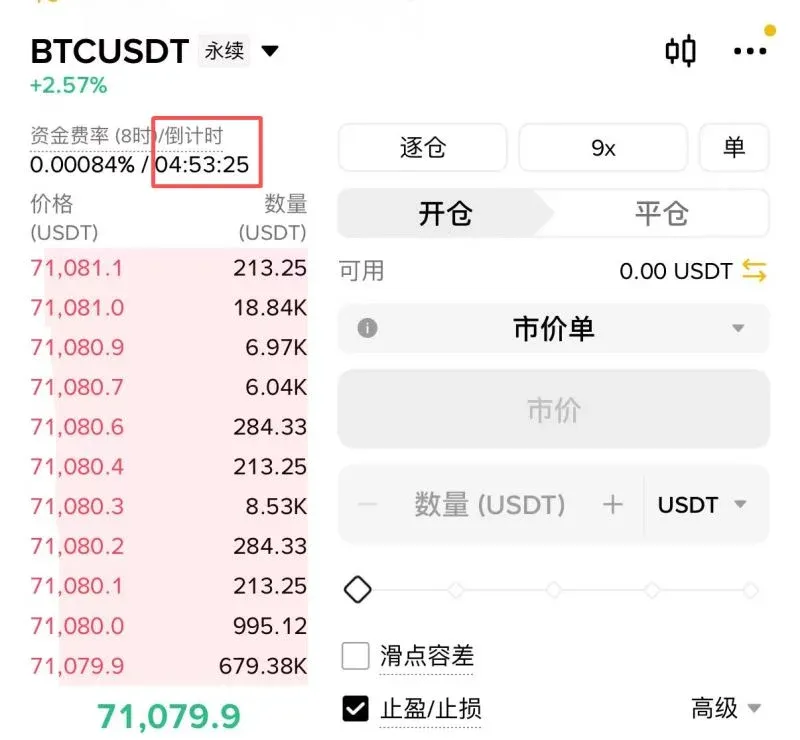
On the trading interface you will usually see a countdown to the next settlement, for example “6 h 34 m 35 s until settlement,” together with the current funding rate.
---
Funding Rate Calculation Formula
- Funding fee = Funding rate × Position value
- Position value = Contract quantity × Mark price
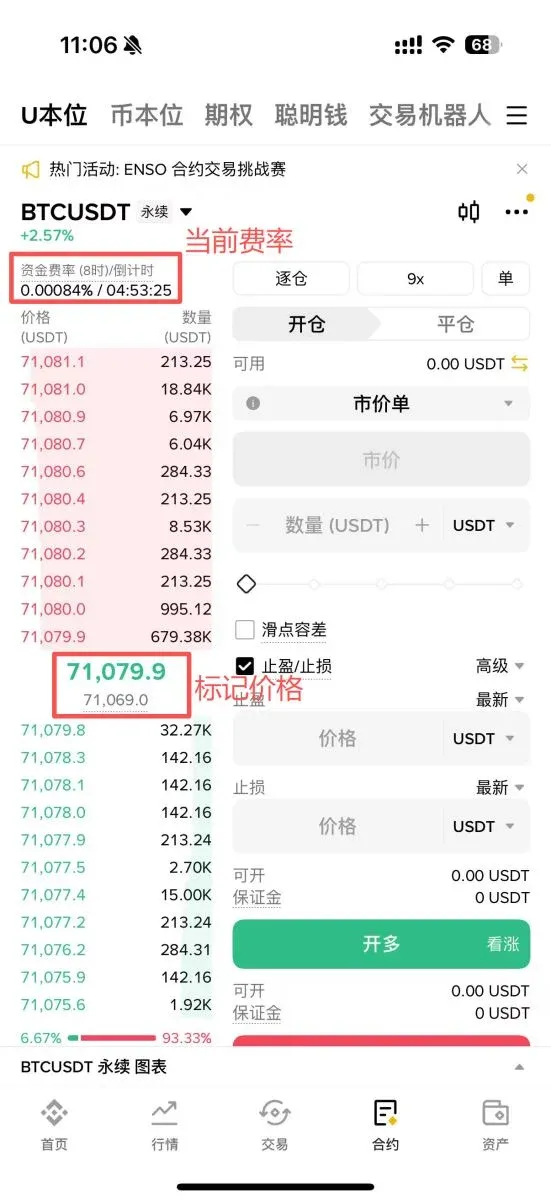
Example: Suppose you hold 10 lots of a Bitcoin perpetual contract, the mark price is 69,883.6 USDT, and the funding rate is 0.00858 %. The fee you would owe is
\(10 × 69,883.6 × 0.00858\% = 59.96 USDT\).
The actual fee is determined by the exact rate at the moment of settlement; any estimate made before settlement is only a reference.
Positive vs. Negative
- Positive value: Long positions must pay short positions.
- Negative value: Short positions must pay long positions.
A handy mnemonic: positive = long, negative = short.
Sign‑agnostic magnitude
Regardless of sign, a larger absolute number means a larger fee for that settlement interval. Typical funding rates hover around 0.01 %, which annualizes to roughly 10.95 % when extrapolated over a year.
Upper and lower bounds
Different platforms impose caps and floors on a given token’s funding rate to prevent runaway fees during extreme market moves. For Binance’s BTCUSDT perpetual contract, the limits are +0.3 % and ‑0.3 % respectively.
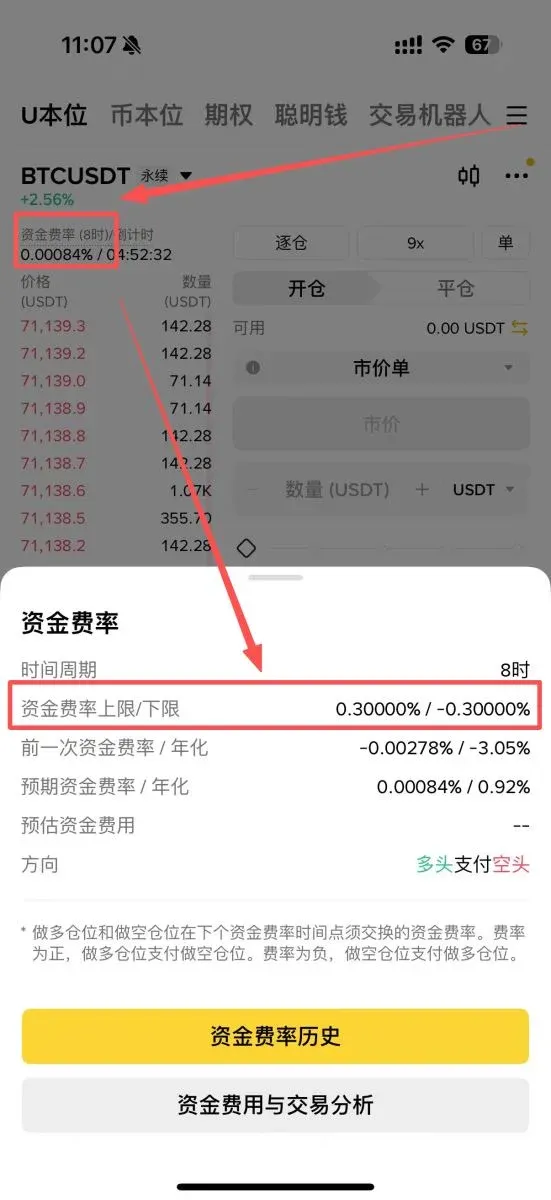
You can view these limits by clicking the “Funding Rate” tab on the contract’s trading page.
---
How to Check Bitcoin’s Funding Rate (Using Binance as an Example)
- Open the exchange’s homepage and switch to the “Derivatives” (or “Futures”) section.
- In the cryptocurrency list at the top‑left, select BTCUSDT.
- The top‑right corner will display the current funding rate together with a countdown timer; the number shown is the rate that will apply at the next settlement.
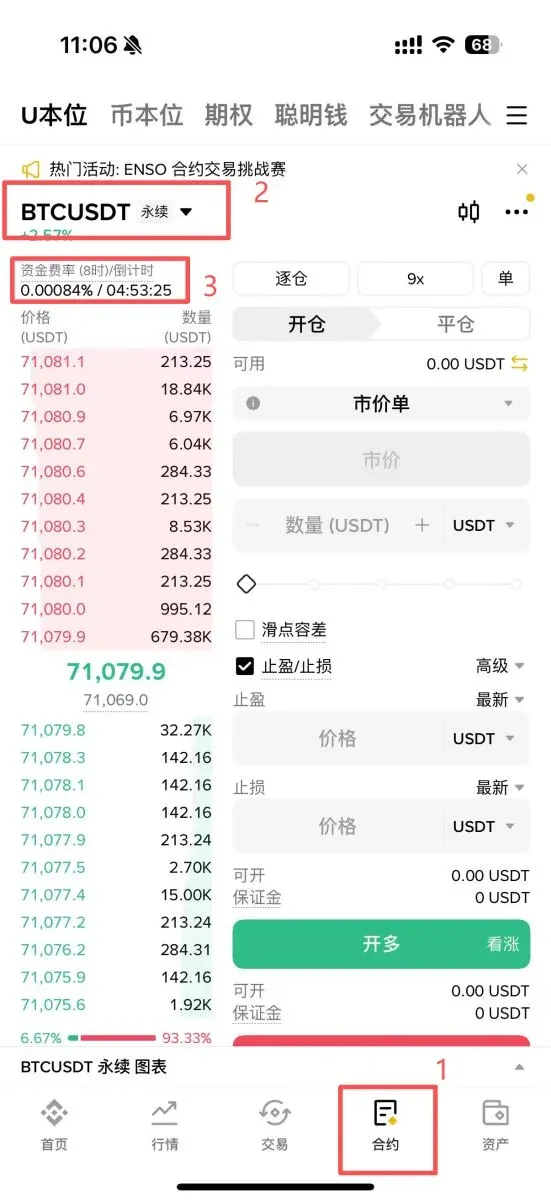
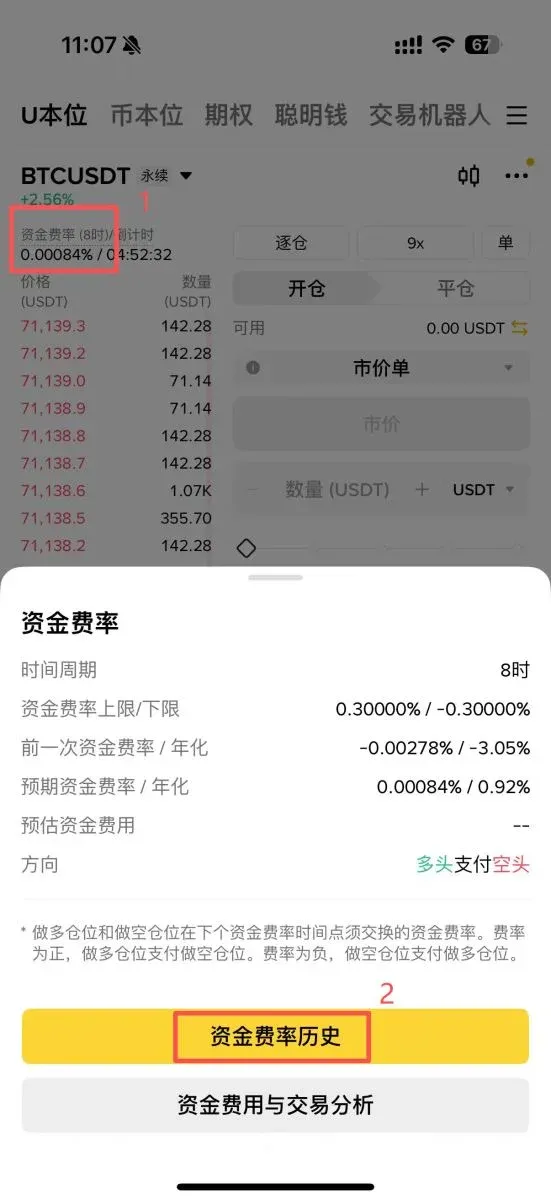
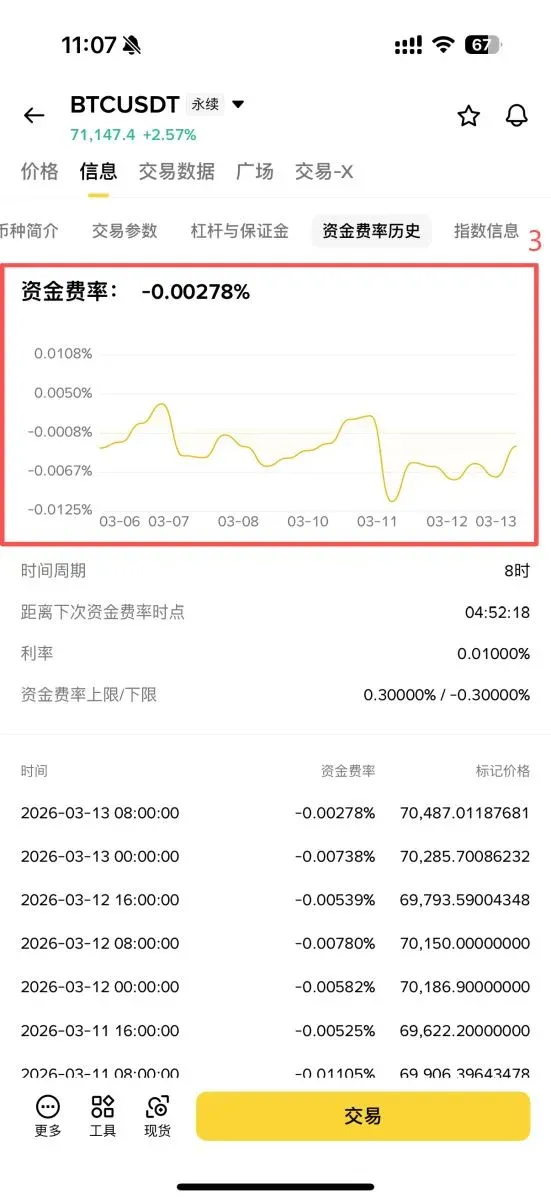
If you want to review historical trends, click “Funding Rate” → “Funding Rate History.” The platform will list the rate changes over the past seven days. In addition to the Binance mobile app, the same information is available on Binance’s website under the funding‑rate section.
Note for U.S. residents: Use Binance.US (or another U.S.-compliant exchange) instead of the global Binance platform to access these features.
---
Cross‑Platform Comparison and Arbitrage Opportunities
Comparing Funding Rates Across Exchanges
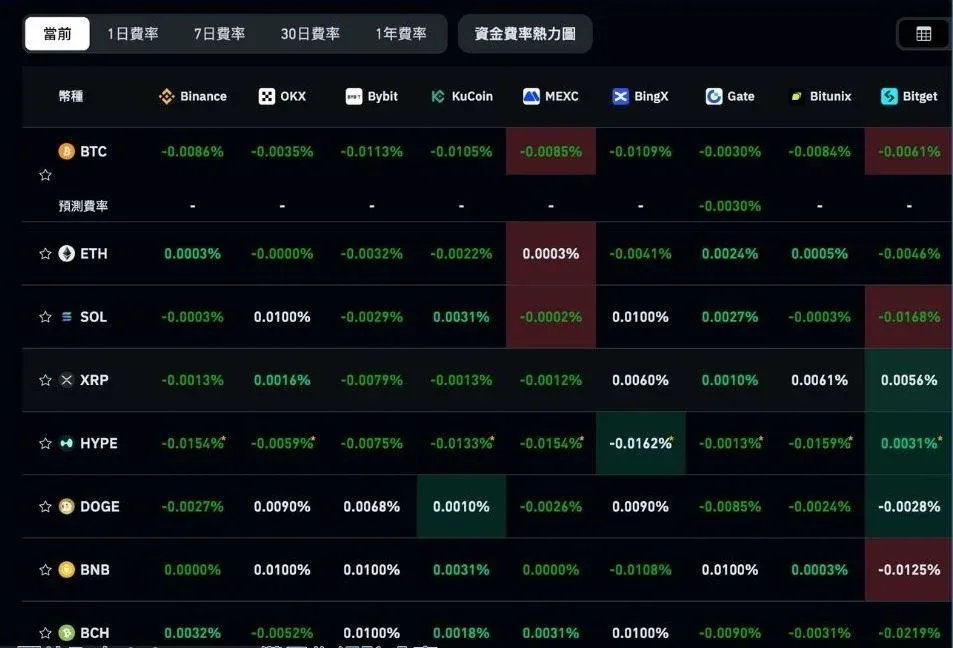
Aggregators such as Coinglass let you view real‑time funding rates for multiple exchanges and many assets on a single screen. The page refreshes every few seconds, helping traders spot rate discrepancies between platforms quickly.
Funding‑Rate Arbitrage Methods
1. Cash‑and‑Carry (Spot‑Futures) Arbitrage
- When the funding rate is positive, buy the spot Bitcoin and simultaneously short an equal notional amount of the perpetual contract.
- Every 8 hours the short side receives a funding payment, offsetting any potential loss on the futures side.
- If Bitcoin’s price moves, the profit/loss on the spot position largely cancels the opposite exposure on the contract, leaving the net gain primarily from the funding payment.
Some exchanges (e.g., Binance) offer built‑in arbitrage bots that execute this strategy automatically once you allocate capital. Keep in mind that if the rate flips to negative, the direction of cash flow reverses, turning what was once a profit into a cost. Moreover, slight price differences between the spot purchase and the futures sell can introduce a small additional expense.
2. Cross‑Exchange Rate Arbitrage
- Observe the same asset on two different exchanges, for example Exchange A showing +0.01 % and Exchange B showing ‑0.005 %.
- Go short on Exchange A and long on Exchange B; each settlement cycle yields a net 0.015 % profit after accounting for the opposite signs.
Because arbitrageurs act quickly, the rate gap usually narrows within a short time frame, and the achievable profit may be comparable to or even lower than the transaction fees charged by the exchanges.
---
Frequently Asked Questions (FAQ)
- What is the core purpose of the funding rate?
It aligns perpetual contract prices with the underlying spot price, preventing large divergences between the two markets.
- How does it affect the cost of holding a position?
With a positive rate, longs pay the fee and shorts receive it; with a negative rate the opposite occurs, directly altering the daily cost of maintaining the position.
- Where can I check Bitcoin’s funding rate in real time?
On the perpetual‑contract pages of exchanges such as Binance, OKX, Bybit, or via data platforms like Coinglass, CryptoCompare, etc.
Tax reminder: Crypto‑related gains, including those derived from funding‑rate arbitrage, may be taxable in your jurisdiction. Consult a local tax professional to ensure compliance.
---
Key Takeaways
- The funding rate is a mechanism that narrows the gap between perpetual contract prices and spot prices.
- The sign indicates who pays whom: positive = longs pay, negative = shorts pay.
- Fees settle every 8 hours, and the exchange automatically debits or credits the appropriate accounts.
- Current rates and the countdown to the next settlement are displayed on the contract page of each exchange.
- When employing cash‑and‑carry or cross‑exchange arbitrage, monitor rate changes closely and account for any price‑difference costs.
Having understood the concept, calculation method, and where to retrieve funding‑rate data, you can manage contract positions more deliberately or explore appropriate arbitrage ideas. For deeper analysis of funding rates, stay tuned to future Bitaigen (比特根)专题 (special topics).
💡 Register on Binance with referral code B2345 for the maximum trading fee discount. See Binance complete guide.



