
 Bitaigen Research
 How high can Polkadot (DOT) rise by 2030? The price of DOT has experienced significant fluctuations throughout its history, with its trajectory closely tied to major technical upgrades, ecosystem parachain auctions, and overall sentiment within the global cryptocurrency market. Looking ahead, the project's development will depend heavily on the successful implementation of the JAM Chain architecture and the ability of Polkadot 2.0 to attract a new wave of developers. Below, the editorial team at Bitaigen provides a comprehensive price prediction and analysis of Polkadot’s future trends.
As the era of Polkadot 2.0 approaches, Polkadot (DOT) finds itself at a critical juncture of technical transformation. This article, based on current market data, explores the long-term impact of the JAM Chain architecture and ecosystem auctions on token value. We will not only analyze today’s market volatility but also provide multi-dimensional forecasts for the trends spanning 2026 to 2030. Through in-depth research by the Bitaigen editorial team, we aim to offer insights into Polkadot’s core competitiveness and potential risks within the cross-chain interoperability race.
Polkadot (DOT) Price Today
DOT Market Capitalization Information
- Market Cap: $18.64B (Estimated equivalent based on global liquidity)
- Fully Diluted Valuation (FDV): $18.56B
- Market Cap/FDV Ratio: 79.49%
- Market Sentiment: Currently trending toward caution as the broader market consolidates.
DOT Supply Data
- Circulating Supply: 1.66B DOT
- Total Supply: 1.66B DOT
- Maximum Supply: 2.1B DOT (Note: Polkadot utilizes an inflationary model for network security).
What is Polkadot (DOT)?
Polkadot is an open-source, decentralized blockchain platform designed to facilitate cross-chain interoperability and high-performance scalability. Launched in 2020, its primary objective is to connect disparate blockchains into a single, unified network, allowing them to process transactions in parallel and exchange data securely without intermediaries. The native cryptocurrency of the platform is "DOT," which is used for transaction fees, network governance, and supporting the network overhead required for building decentralized applications (dApps).
Polkadot was initiated by the Web3 Foundation and developed by a team led by Gavin Wood (a co-founder of Ethereum), Robert Habermeier, and Peter Czaban. The three founders aimed to build Polkadot into a superior platform capable of overcoming the limitations of existing blockchain networks, such as insufficient scalability and a lack of interoperability. Polkadot provides a framework for blockchains to interconnect, share information, and collaborate seamlessly. Since its release, DOT has consistently ranked as one of the highest-market-cap cryptocurrencies, maintaining a top 15-25 position on platforms like CoinMarketCap as of late 2024.
Key Components of the Polkadot Ecosystem include:
- Relay Chain: The central pillar of the Polkadot network, responsible for maintaining global consensus, shared security, and cross-chain interoperability across the entire ecosystem.
- Parachains: Independent blockchains that run in parallel with the Relay Chain. Each parachain can have its own tokens, governance models, and specific use cases, ranging from Decentralized Finance (DeFi) and gaming to identity verification.
- Bridges: Specialized communication modules that allow Polkadot to connect with external blockchains (such as Ethereum and Bitcoin), enabling the transfer of tokens and data across different network architectures.
- Governance: Polkadot utilizes an on-chain governance system where DOT holders can vote on critical decisions, including protocol upgrades, treasury expenditures, and the allocation of parachain slots.
Functions of the DOT Token in the Ecosystem:
- Governance: Holders have voting rights on network proposals, ensuring the community directs the project's evolution.
- Staking: Validators and nominators stake DOT to secure the network and are rewarded with newly minted DOT, offsetting the network's built-in inflation.
- Bonding: During the "Parachain Slot Auction" process, DOT is used to bond or "lock up" tokens to connect new parachains to the Relay Chain.
Polkadot’s ultimate vision is to serve as the foundational infrastructure for Web3 (the decentralized internet), providing a scalable and interoperable underlying architecture.
DOT (Polkadot) Basic Information Table
| Project Information | Details |
| :--- | :--- |
| Name | Polkadot |
| Ticker | $DOT |
| Market Cap | Approx. $6.14 Billion (US$6.14B) |
| Fully Diluted Valuation (FDV) | Approx. $6.14 Billion (US$6.14B) |
| Market Cap Rank | #22 (Based on CoinMarketCap real-time data) |
| Category | Layer 0 Multi-chain Protocol, Blockchain Infrastructure |
| Native Blockchain | Polkadot Mainnet (Relay Chain) |
| Circulating Supply | Approx. 1.61 Billion (1.61B DOT) |
| Total Supply | Approx. 1.61 Billion (1.61B DOT) |
| Max Supply | Uncapped (Utilizes a dynamic inflation mechanism) |
*Data Source: CoinMarketCap (As of September 2025)*
DOT (Polkadot) Funding History
| Funding Round | Price per Token | Amount Raised | Valuation | Date |
| :--- | :--- | :--- | :--- | :--- |
| First Private Sale | $0.288 | $80 Million | $288 Million | October 2017 |
| Public Offering | $0.288 | $65 Million | $288 Million | October 2017 |
| Second Private Sale | $1.20 | $60 Million | $1.2 Billion | June 2019 |
| Third Private Sale | $1.25 | $42.76 Million | $1.25 Billion | July 2020 |
Polkadot vs. Ethereum: Key Differences
While Ethereum transitioned to a Proof of Stake (PoS) mechanism following "The Merge," Polkadot and Ethereum still maintain significantly different architectural philosophies.
| Dimension | Polkadot (DOT) | Ethereum (ETH) |
| :--- | :--- | :--- |
| Launch Year | 2020 | 2015 |
| Founders | Gavin Wood et al. | Vitalik Buterin et al. |
| Native Token | DOT | ETH |
| Consensus Mechanism | Nominated Proof of Stake (NPoS) | Proof of Stake (PoS) |
| Scalability | High (Parallel processing via Parachains) | Improving (Relies on Layer 2 Scaling) |
| Interoperability | Native support for cross-chain communication | Relatively limited, relies on external bridges |
| Governance | On-chain (DOT holder voting) | Combination of on-chain and off-chain |
| Network Speed | Theoretical 1,000+ TPS (scaling with cores) | Base layer ~20-30 TPS (L2s are much higher) |
| Supply Model | Inflationary (No hard cap) | Can become deflationary via EIP-1559 |
How Polkadot Works
At the heart of Polkadot is the Relay Chain, which serves as the security, consensus, and cross-chain hub for the entire ecosystem. Running alongside it are Parachains, which are independent blockchains optimized for specific purposes like DeFi, gaming, or supply chain management. By processing transactions across multiple chains in parallel, Polkadot significantly enhances scalability and avoids the congestion issues common in traditional single-chain networks.
The network employs a Nominated Proof of Stake (NPoS) mechanism. Validators participate in transaction verification and security maintenance by staking DOT. Nominators support reputable validators by staking their DOT behind them, thereby sharing in the rewards. Furthermore, through Bridge protocols, Polkadot can facilitate the cross-chain transfer of assets and data with external networks like Ethereum and Bitcoin.
Why Does DOT Have Value?
DOT plays an irreplaceable role in maintaining the operations of the Polkadot network:
- Governance Rights: DOT holders possess the right to vote on network upgrades. Voting weight is proportional to the amount of DOT staked.
- Staking Rewards: Users who participate in network consensus by staking DOT can receive newly minted DOT as a reward for their contribution to security.
- Inflation and Supply: Initially, the DOT supply was set at 10 million. However, following a community vote in 2020, a "re-denomination" occurred, changing the total supply to 1 billion (with a 1:100 split) accompanied by an annual inflation rate.
Why Use DOT?
For developers, the cross-chain interoperability provided by Polkadot is highly attractive. Currently, cloud platforms, browser wallets, and various block explorers are already operating within the ecosystem. For investors, DOT’s staking rewards are a major point of interest; some global exchanges have historically offered annual staking yields of approximately 12%. When moving funds from traditional finance, users often utilize SEPA or SWIFT transfers to fund their accounts on major exchanges.
Historical Price Performance of Polkadot (DOT)
- Early Volatility: The 2017 ICO raised approximately $145 million, though some funds were temporarily inaccessible due to a vulnerability in the Parity wallet.
- 2021 Breakout: Driven by the excitement surrounding parachain slot auctions, DOT surpassed $49.82 in May 2021 and reached an all-time high of $55.08 in November of the same year.
- 2022-2023 Correction: Impacted by macroeconomic shifts and regulatory scrutiny, the price of DOT gradually retracted, dropping near $4.31 in early 2023.
- 2024-2025 Status: In the first quarter of 2024, DOT saw a relief rally to $11.89. As of August 2025, the price of DOT has been consolidating around the $3.81 mark.
- February 2026 Reference: Influenced by broader market volatility, prices fluctuated between $1.101 and $1.753 during this period.
Summary: The price trajectory of DOT is deeply intertwined with technical milestones (such as Polkadot 2.0 and the JAM Chain) and overall market sentiment.
Key Factors Influencing Polkadot (DOT) Price
- Technical Upgrades: The launch of new parachains or the implementation of core architectures like the JAM Chain (Join-Accumulate Machine).
- Market Sentiment: High correlation with Bitcoin and other major "Blue Chip" cryptocurrencies.
- Regulatory Environment: Changes in global policies regarding blockchain infrastructure and decentralized protocols.
- Staking Dynamics: A high percentage of DOT locked in staking reduces the circulating supply available on exchanges.
- Ecosystem Adoption: The activity level of parachain auctions and the number of active developers building on the platform.
- Macroeconomics: Global inflation rates and central bank interest rate policies significantly impact risk assets like DOT.
Is Polkadot Entering a New Bull Market Phase? (Observation: Feb 26, 2026)
Recently, the level of discussion surrounding Polkadot within the crypto community has risen significantly. Its multi-chain protocol and interoperability features continue to attract institutional attention.
Key Drivers
- ETF Expectations: There is speculative anticipation in the market regarding a potential spot DOT ETF.
- Network Upgrades: The resource elasticity introduced by Polkadot 2.0 has bolstered market confidence.
- Technical Indicators: Recent trading volume and performance at key support levels indicate potential bullish momentum.
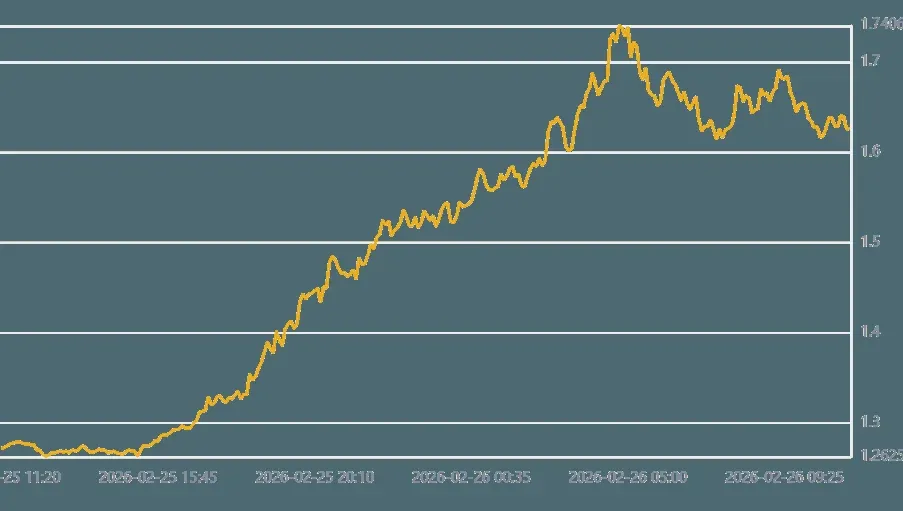
As of the observation date, DOT was trading at approximately $1.62 with a market capitalization of $2,115,447,303. The 24-hour trading volume has expanded significantly, signaling strong short-term market interest.
Technical Analysis: DOT Faces Critical Support Test (Observation: April 21, 2026)
- Bearish Structure: The price is currently trading below the EMA (Exponential Moving Average), with a pattern of lower highs.
- Critical Support: $1.25 is a vital line of defense that buyers must hold. A breakdown below this level could lead to a slide toward $1.00 or lower.
- Resistance Zones: Immediate resistance lies between $1.34 and $1.36. A breakout above $1.55 on high volume would be required to reverse the current downtrend.
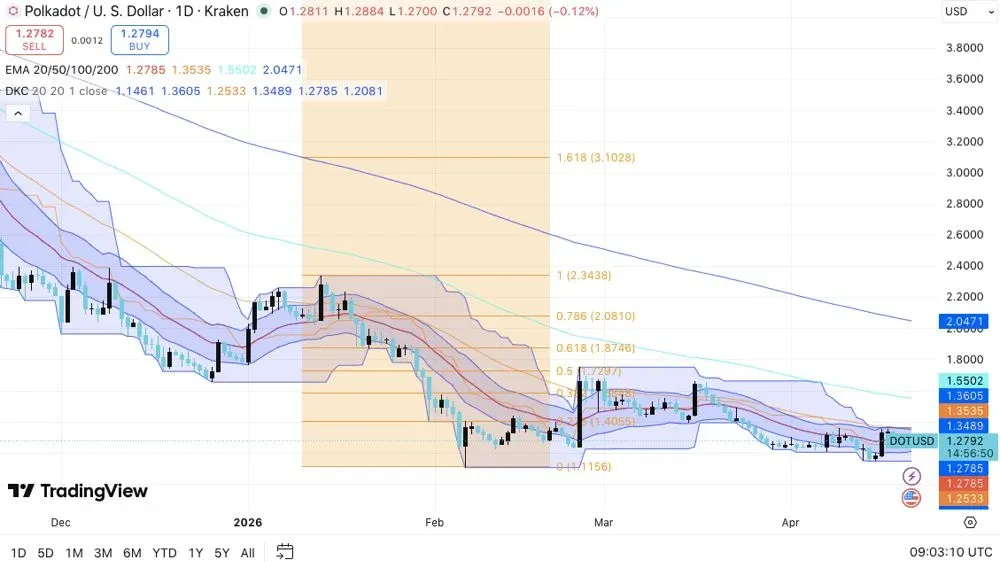
*Chart: Polkadot price dynamics (Source: TradingView)*
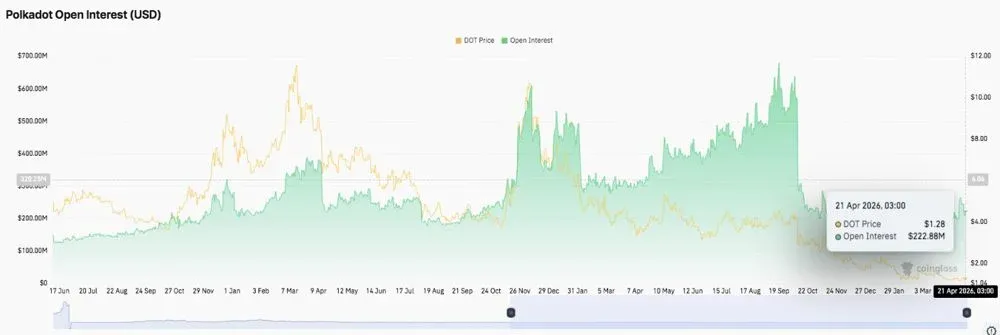
*Chart: Derivatives data (Source: Coinglass)*
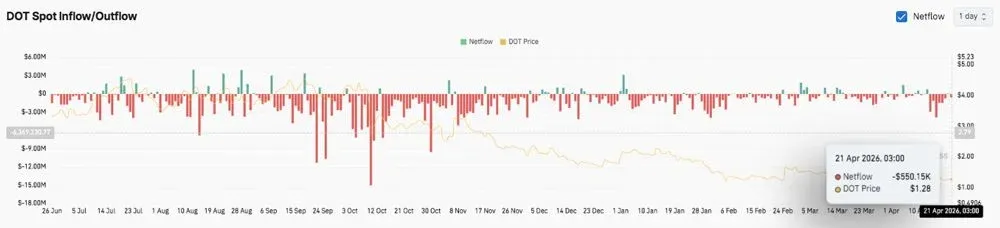
*Chart: Spot fund flows (Source: Coinglass)*
Currently, market sentiment remains cautious with a clear deleveraging trend. Investors should closely monitor the validity of the $1.25 support level.
Long-Term Polkadot (DOT) Price Forecast
Based on market model projections, the average price fluctuations for DOT over the coming years are estimated as follows (for reference only):
| Year | Minimum Price | Maximum Price | Average Price | Potential Change |
| :--- | :--- | :--- | :--- | :--- |
| 2026 | $0.81 | $1.73 | $1.56 | -- |
| 2027 | $0.94 | $2.12
💡 Register on Binance with referral code B2345 for the maximum trading fee discount. See Binance complete guide.



