
 Bitaigen Research
 We have examined how a handful of hidden whales on Polymarket generate consistent profits by employing high‑frequency quantitative market‑making strategies. By dissecting their trading behavior, strategic models, and risk‑control mechanisms, readers can gain a deep understanding of how this niche operates and evaluate whether it fits their own investment approach.
How Whales Achieve Six‑Figure‑Plus Returns on Polymarket Through Quantitative Market‑Making
Amid the debates surrounding prediction markets, a few accounts rely on ultra‑high‑frequency micro‑trades to turn this “emerging track” into a relatively stable source of profit.
Representative Account Examples
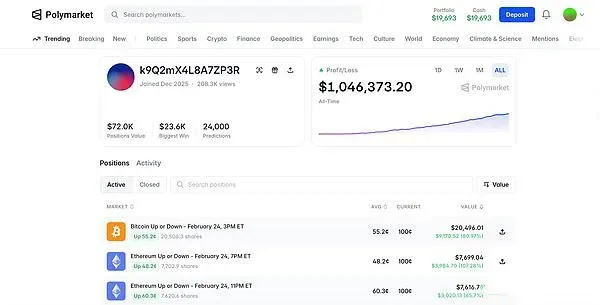
- Account k9Q2mX4L8A7ZP3R: Cumulative net profit $1,046,373.20 across 24,000 predictions.
https://polymarket.com/@k9Q2mX4L8A7ZP3R
- Account 0x8dxd: Total profit $1,680,017.40.
https://polymarket.com/@0x8dxd
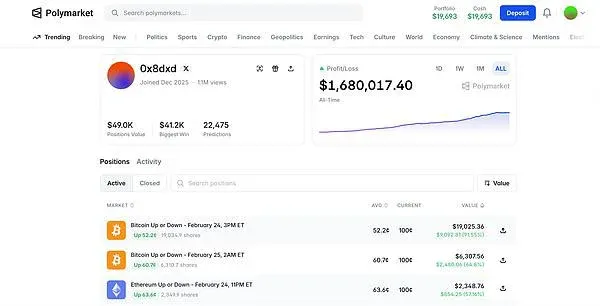
The equity curves of these two whales are almost straight lines sloping upward with virtually no drawdown. Their success does not stem from a “holy‑grail” forecast of a single event (e.g., an election) but from an institution‑grade market‑making strategy that systematically transfers profit to the order‑book side that provides liquidity (the Maker) at the micro‑order‑book level.

---
The Nature of Prediction Markets and the “Pick‑Up‑Money” Opportunity
Polymarket contracts function in the short term as binary options: if the event occurs, the contract settles at $1; if it does not, it settles at $0.
Among the 99 possible price ticks, the party that actively buys (the Taker) faces a negative return in roughly 80 % of them. In other words, the buyer’s funds are systematically transferred to the seller (the Maker) through the order book, creating a “pick‑up‑money” space that large participants can exploit.
---
Retail “Lottery” Mindset and Premium‑Risk
Many retail traders gravitate toward contracts priced at $0.01, mistakenly believing that a single win will yield a hundred‑fold return. Polyhub back‑testing shows that the true occurrence probability of such contracts is only 0.43 %, while their premium deviation reaches ‑57 %.
When retail participants pay a high premium for these low‑priced contracts, the majority of the eventual payoff is captured by market makers via their standing orders. The wealth flow in the order book therefore follows: active Taker → passive Maker.
---
The Mathematics Behind Pricing: Implied Volatility (IV)
Professional market makers do not quote by intuition; they treat each contract as a binary option and reverse‑engineer the Implied Volatility (IV). IV reflects the intensity of market sentiment: the more volatile the environment, the higher the IV.
If a model can estimate the true probability for the next minute more accurately than the market consensus, it can spot mis‑priced contracts on the order book and execute positive arbitrage.
---
Core Technical Implementations
1. HMM State Management – Smart Switcher
Polymarket’s quote latency operates at the second level, whereas Binance updates prices at the millisecond level. Whales equip their systems with a Hidden Markov Model (HMM) acting as a “smart switch.” When external market data is stable, the system trades normally; if Binance exhibits sharp volatility, the HMM instantly flips to an “active state,” freezes incoming data and cancels orders to avoid being out‑run by ultra‑fast snipers. (U.S. users should route Binance‑related data through Binance.US to comply with regional restrictions.)
2. Brent Method – Robust Root Solver
During extreme turbulence, conventional algorithms can collapse under computational load. Top‑tier market‑making engines adopt the Brent method, a numerical technique that finds the optimal price within nanoseconds, ensuring the trading engine stays online at critical moments.
3. OFI Order‑Flow Monitoring – Price Radar
Large participants continuously monitor the Order‑Flow Imbalance (OFI), effectively a radar that compares the intensity of buy‑side versus sell‑side placements, cancellations, and additions. By gauging OFI, they forecast price movement over the next few seconds, allowing pre‑emptive positioning or risk avoidance.
---
Capital Management: Controlling Tail Risk
In highly volatile prediction markets, the most lethal threat is not model error but Tail Risk—low‑probability events that can wipe out a position.
Polyhub’s research indicates that elite whales do not apply the traditional Kelly Criterion directly, as it often suggests overly aggressive sizing in this environment. Instead, they incorporate the Coefficient of Variation (CV) as a penalisation term:
- CV measures the ratio of profit volatility to expected return.
- When market noise rises and signals become fuzzy, CV spikes, prompting the system to shrink exposure to near‑zero.
- Only during windows where signals are crystal‑clear and expected returns are highly certain does the system allocate substantial capital.
This “automatic decelerator” ensures a smooth upward trajectory of the capital curve even during periods of extreme uncertainty.
---
Closing Remarks
The profit model on Polymarket is fundamentally an institutional‑grade algorithmic system that leverages HMM state switching, microsecond‑level pricing, and order‑flow monitoring to systematically capture the intuitive purchases of retail participants. Retail traders lacking comparable technology and risk‑control frameworks are likely to become the passive liquidity providers for these whales.
For a deeper dive into the specifics of quantitative market‑making on Polymarket, stay tuned to future reports from Bitaigen.
*Please note that gains from cryptocurrency activities may be taxable in your local jurisdiction; consult a tax professional for guidance.*
💡 Register on Binance with referral code B2345 for the maximum trading fee discount. See Binance complete guide.
⚠️ Risk Disclaimer: Crypto prices are highly volatile. This is not investment advice.



