
 Bitaigen Research
 In this article we outline silver’s dual nature as both a precious metal and an industrial metal, analyze its core differences from gold, and explain why its market‑cap size and volatility characteristics give it a unique edge in cryptocurrency trading. After grasping these underlying dynamics, you’ll have a clearer view of the buying timing and risk points for the XAG/USDT perpetual contract. Please continue reading.
Characteristics of Silver and How They Differ From Gold
When people first encounter silver they often mistake it for “cheaper gold.” In reality, silver is both a precious metal and an important industrial material, and the two attributes behave quite differently.
- High proportion of industrial demand: More than half of all silver is used in manufacturing. Its excellent electrical conductivity makes it a key ingredient in high‑tech products such as solar‑panel cells, electric‑vehicle electronics, and AI‑server circuitry. Consequently, silver’s price moves not only with safe‑haven sentiment but also with the demand cycles of the global hardware industry.
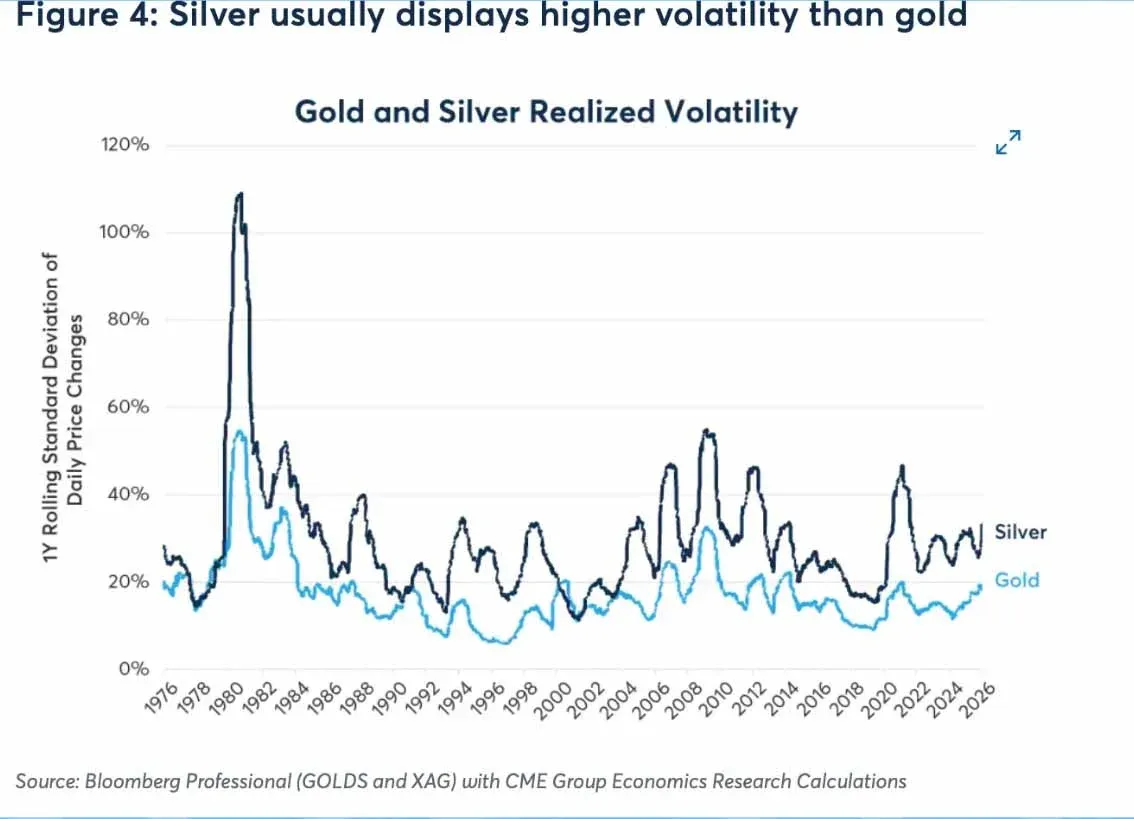
- Smaller market size: As of early 2026, the total market capitalization of gold is roughly USD 31 trillion, while silver’s is only about USD 4 trillion—a gap of nearly seven‑fold. The same amount of capital inflow therefore creates a more pronounced price impact on the smaller‑cap silver market, which is why silver’s volatility is typically 2–3 times that of gold.
- Volatility profile: In bullish periods silver often outperforms gold in terms of price gains; conversely, during market pull‑backs its declines tend to be sharper. Overall, gold behaves more like a pure safe‑haven asset driven by macro‑financial risks, inflation expectations, and interest‑rate outlooks, whereas silver is driven by a “safe‑haven + industrial demand” mix that makes its price prone to larger swings in both directions.
**
**
Gold vs Silver volatility image sourced from CME Group (Chicago Mercantile Exchange)
---
How Do Crypto Assets Access the Silver Market?
In traditional finance, there are three main ways to capture silver’s price movements: buying physical silver coins or bars, investing in silver ETFs (e.g., Taiwan’s 00738U or the U.S. SLV), and holding shares of silver‑mining companies. While these channels are well‑established, each comes with inconveniences—physical storage challenges, ETF trading hours restrictions, and, in Taiwan, the lack of any bank offering a silver passbook service.
Within the blockchain ecosystem, investors can participate in silver’s price through two pathways:
1. XAG/USDT Perpetual Contract
A perpetual contract is essentially a derivative; it does not involve the delivery of physical silver, but rather the price movement of silver. The contract is quoted in XAG (the ticker for silver) and uses USDT as both margin and settlement currency. When you open a position you only need to provide a certain amount of USDT as collateral, and the profit or loss of the contract is reflected directly in your USDT balance.
- How it works: When silver’s price rises, a long (buy) position increases the amount of USDT in your account; when the price falls, a short (sell) position does the same. No actual silver changes hands at any point.
- Who it suits: Traders who prefer swing or speculative strategies, want the ability to enter and exit at any time, and are comfortable with leverage‑amplified risk.
Key risk points to watch include the possibility of liquidation when leverage magnifies losses, and the funding rate cost that can accrue on positions held for an extended period.
2. Tokenized Silver
Tokenized silver wraps a physical or financial asset into a blockchain token (typically ERC‑20 or a token on another chain), giving the holder a claim to the underlying asset.
- Physical‑backed model: For example Kinesis Silver (KAG), where each token is backed by a vault of real silver, similar to the stable‑coin model used for precious metals. To understand its mechanics you can refer to previous analyses of the XAUT gold stablecoin, as the structures are comparable.
- ETF‑tracking model: For instance SLVON, which represents a on‑chain claim on the United States’ largest silver ETF – the iShares Silver Trust (ticker SLV). Holding SLVON means you own a share of the ETF, not a direct claim on physical silver stored in a vault.
Tokenized silver’s advantage lies in the ability to hold the asset long‑term with on‑chain proof of ownership, but it also faces challenges related to the issuer’s scale, liquidity, and the fidelity of price synchronization with the underlying market.
---
Tokenized Silver vs. Perpetual Contract: Which Should You Choose?
Both instruments move in line with silver’s market price, yet they serve very different use cases.
| Dimension | Tokenized Silver | XAG/USDT Perpetual Contract |
|---|---|---|
| **Ease of buying/selling** | Most tokens are listed only on niche exchanges or DEXs, resulting in a higher entry barrier | Major centralized exchanges (e.g., Binance, OKX) list the contract, allowing near‑instant execution |
| **Liquidity** | Limited by the issuer and the platforms that support the token; slippage or slow fills are common | Large‑exchange order books are deep, enabling rapid fills with minimal slippage |
| **Price fidelity** | Physical‑backed tokens depend on vault management; ETF‑tracking tokens are bound by the ETF’s trading hours, potentially causing gaps | The contract’s price is kept close to the spot through the funding‑rate mechanism, offering near‑real‑time reflection |
| **Holding cost** | Primarily custody fees; virtually no liquidation risk | Must monitor leverage‑related liquidation risk and cumulative funding‑rate expense |
| **Target audience** | Investors seeking a “silver asset certificate,” long‑term hedge, or portfolio allocation | Traders looking for high capital efficiency, short‑term arbitrage, or the ability to go both long and short quickly |
If your goal is a long‑term store of value and you wish to keep the ownership record on‑chain, a tokenized silver such as KAG is more appropriate. Conversely, if you prioritize rapid entry/exit, flexibility to flip long or short, and are comfortable with leverage‑induced volatility, the XAG/USDT perpetual contract is usually the more direct route.
---
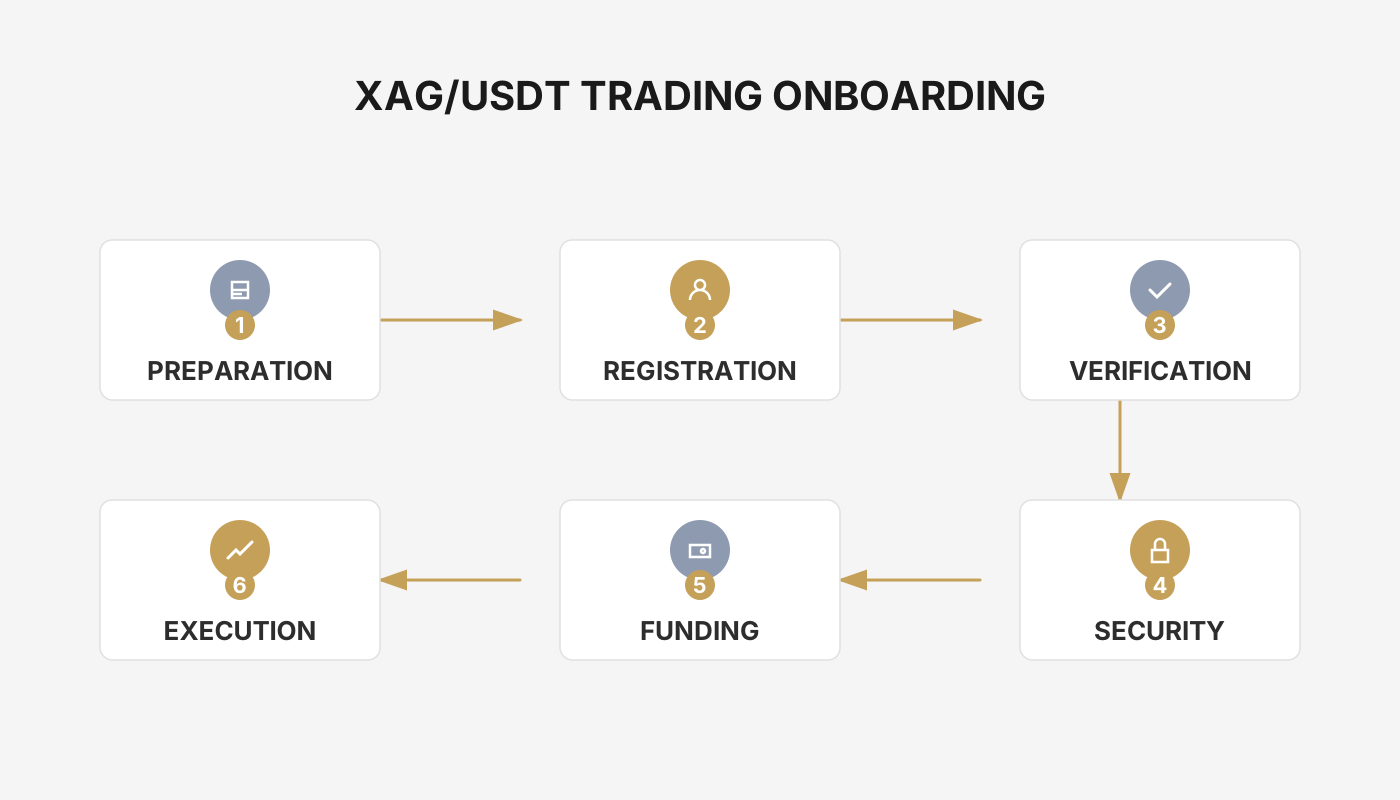
Step‑by‑Step Guide to Opening an XAG/USDT Perpetual Contract on Binance
Below we use Binance, the world’s largest derivatives exchange by volume, as an example to demonstrate how to trade silver with USDT. U.S. residents must use Binance.US (or another regulated U.S. platform) instead of the global Binance site.
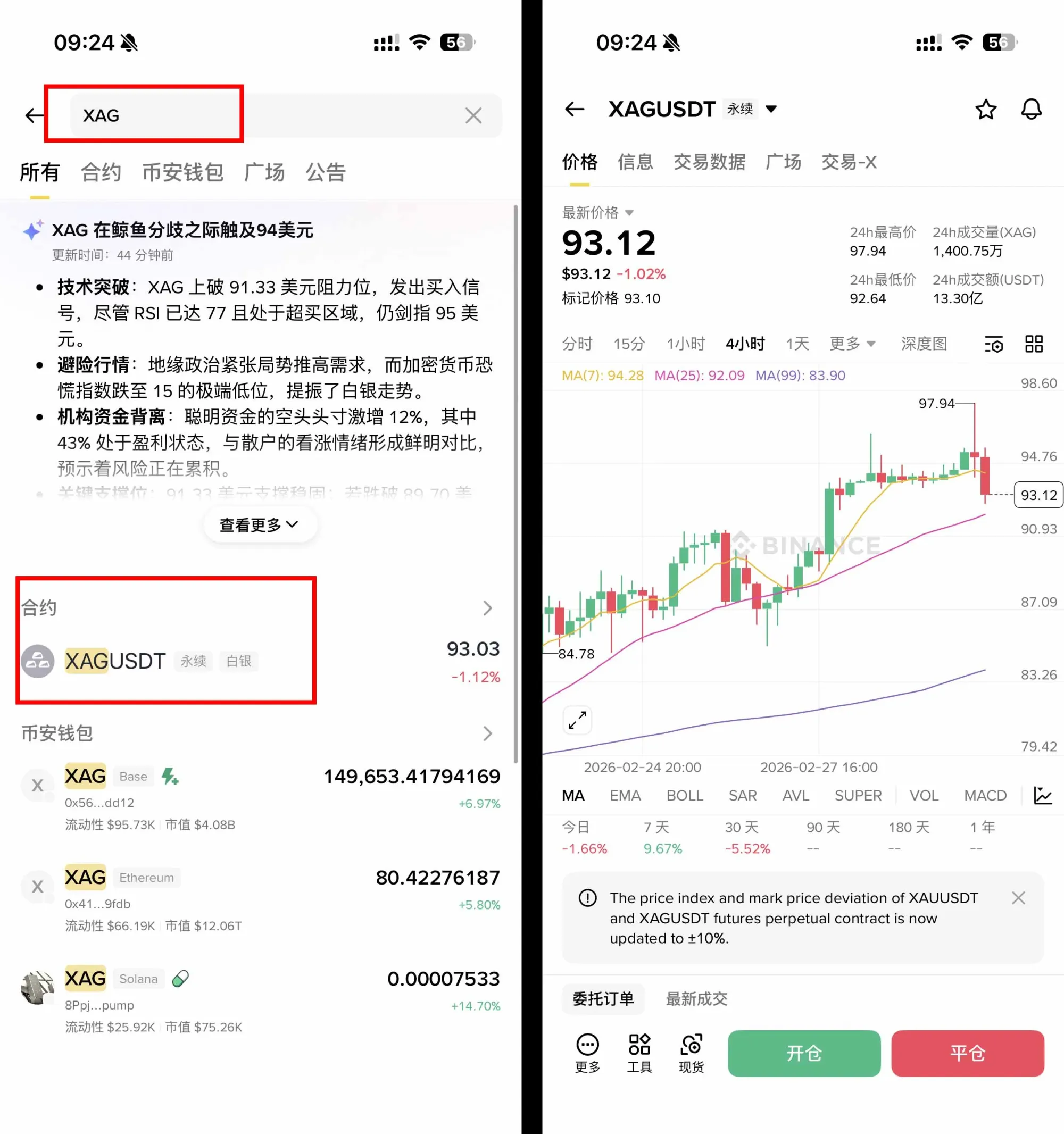
- Open the Binance app and type XAG into the top‑search bar.
- Select XAG/USDT Perpetual to open the trading interface.
- In the trading panel click Open Position and configure the desired parameters.
- For Margin Mode we recommend Isolated so that any loss is limited to the margin allocated to that specific position, protecting the rest of your account.
- Set an initial Leverage of 1–3×; once you are comfortable with concepts such as margin requirement and liquidation price you may consider adjusting it upward.
Choosing an Order Type
- Limit Order: Set a target execution price; the system will match your order when the market reaches that level. This is suitable for traders who want cost control.
- Market Order: Executes immediately at the best available price. It is fast but may suffer slippage during volatile moves, making it appropriate for urgent entries.
Placing the Order
- Input the USDT amount you wish to allocate.
- Choose the direction based on your market view:
- Long (Buy) → Expectation that silver will rise.
- Short (Sell) → Expectation that silver will fall.
Stop‑loss settings are crucial for protecting capital. For example, you might set an automatic liquidation at a 10‑15 % loss to prevent sudden adverse moves from eroding your account.
---
Frequently Asked Questions (Q&A)
Q1: Does buying an XAG/USDT perpetual contract mean I own physical silver?
A: No. The contract merely tracks silver’s price movement; your account always holds USDT, and profit/loss is settled in USDT. It is designed for capital‑efficient traders, not for collectors of physical metal.
Q2: Are perpetual contracts suitable for long‑term holding?
A: In theory, you can hold a low‑leverage position for an extended period if you accept the funding‑rate cost. Most participants, however, prefer swing trading because longer holdings expose you to larger price swings and accumulating funding fees.
Q3: Is the investment threshold high? Can I start with a small amount?
A: On platforms such as OKX, the minimum opening size for the XAG/USDT perpetual contract is 0.01 USDT (as of February 2026). A few dollars of margin are enough to open a position, making it very accessible.
Q4: Is trading available 24/7?
A: Yes. While the traditional COMEX market closes on weekends, crypto exchanges offer 24 hours × 365 days perpetual contracts, allowing you to capture price movements at any hour.
Q5: What is the funding rate and does it generate extra fees?
A: The funding rate is a periodic payment that aligns the perpetual contract price with the spot market. When longs dominate, they pay a fee to shorts, and vice‑versa. Settlements usually occur every 8 hours; individual payments are small, making the mechanism suitable for short‑ to medium‑term trades. For long‑term holders, the cumulative cost should be monitored.
---
Closing Thoughts
Silver combines the safe‑haven qualities of a precious metal with the demand‑driven engine of industrial usage, resulting in price swings that are generally more pronounced than gold’s. For blockchain‑based investors, you can access this market without visiting a bullion dealer or a bank by using either tokenized silver or the XAG/USDT perpetual contract.
- Tokenized silver aligns more closely with “owning the asset,” making it suitable for long‑term positioning, though it is constrained by issuer size, liquidity, and price‑tracking fidelity.
- Perpetual contracts provide efficient capital use, instant entry/exit, and the flexibility to go both long and short, serving as a powerful tool for capturing short‑term price differentials.
We hope this guide helps you navigate silver‑related opportunities in the crypto space. For deeper analyses of silver in the digital‑asset world, feel free to search for historical articles by Bitaigen or continue exploring the related links below. Wishing you successful investing, and stay tuned to Bitaigen for more updates.
*Disclaimer: Crypto‑related gains may be taxable in your jurisdiction; please consult a tax professional. All fiat references assume USD and SEPA/SWIFT transfer methods where applicable.*
💡 Register on Binance with referral code B2345 for the maximum trading fee discount. See Binance complete guide.



