
 Bitaigen Research
 We systematically review SOL’s latest developments and outlook from three major dimensions: technical upgrades, institutional positioning, and potential risks. By dissecting the upcoming core updates and their impact on network performance and decentralization, readers can grasp possible inflection points. Subsequent sections will further examine price ranges and risk factors, warranting a close read.
Solana (SOL) 2026 Outlook: Can Technical Upgrades and Institutional Positioning Move the Price?
In the past few months, SOL’s price has fallen by more than 30%, with a 17% dip recorded in February 2026 alone. Even so, extreme market panic has laid the groundwork for a potential rebound. Below we conduct a systematic review of SOL’s future across four dimensions: technical evolution, institutional activity, price‑range forecasts, and underlying risks.
1. Key Technical Upgrades: Alpenglow and Firedancer
Alpenglow – A Fundamental Leap in Network Performance
Solana is preparing to deploy the largest core‑software update in its history – Alpenglow. The upgrade has already received majority approval from validators and is slated to go live on‑chain in Q1 2026. Its primary goal is to shrink transaction finality from roughly 12 seconds to 150 milliseconds, while cutting validators’ monthly voting fees from about $5,000 to a small fraction of that amount. This improvement not only brings on‑chain transaction speed close to that of traditional financial infrastructure but also could significantly lower the operational barrier for validators, thereby enhancing decentralization and security.
Firedancer – Building a Multi‑Client Ecosystem
In December 2025, the brand‑new C/C++‑based validator client Firedancer was launched. It now runs on 207 validator nodes and processes over 600,000 transactions per second, with a target of 1 million TPS after full network migration. Previously, approximately 70 % of validator nodes ran the same Agave client, creating a single‑point‑failure risk. Firedancer adds redundancy, reducing the chance that a crash of a single client would halt the entire network. Moreover, Solana demonstrated zero downtime while withstanding a roughly 6 Tbps DDoS attack, further proving its resilience.
2. Institutional Positioning: ETFs, Cross‑Border Remittances, and Wall Street Interest
The Race for a Spot ETF
In January 2026, Morgan Stanley submitted a spot‑ETF application for Solana to the U.S. SEC – the first time a major American financial institution has sought to place SOL into a regulated investment product. At the same time, firms such as Bitwise, VanEck, and Fidelity have already issued SOL spot ETFs that, as of November 2025, have attracted about $476 million in assets, with a single‑day inflow peak of $58 million. Compared with Bitcoin ETFs, these products also offer roughly 6 %–7 % staking yields, further boosting institutional appeal.
Western Union’s On‑Chain Initiative
Western Union, the 174‑year‑old cross‑border remittance giant, plans to launch a USD‑pegged stablecoin (USDPT) on Solana in the first half of 2026. Even a modest migration of remittances onto the chain would inject substantial liquidity into Solana’s stablecoin ecosystem, which already exceeds $15.3 billion in supply and has locked over $1 billion in risk‑weighted assets (RWA).
3. Current Price Environment and Technical Analysis
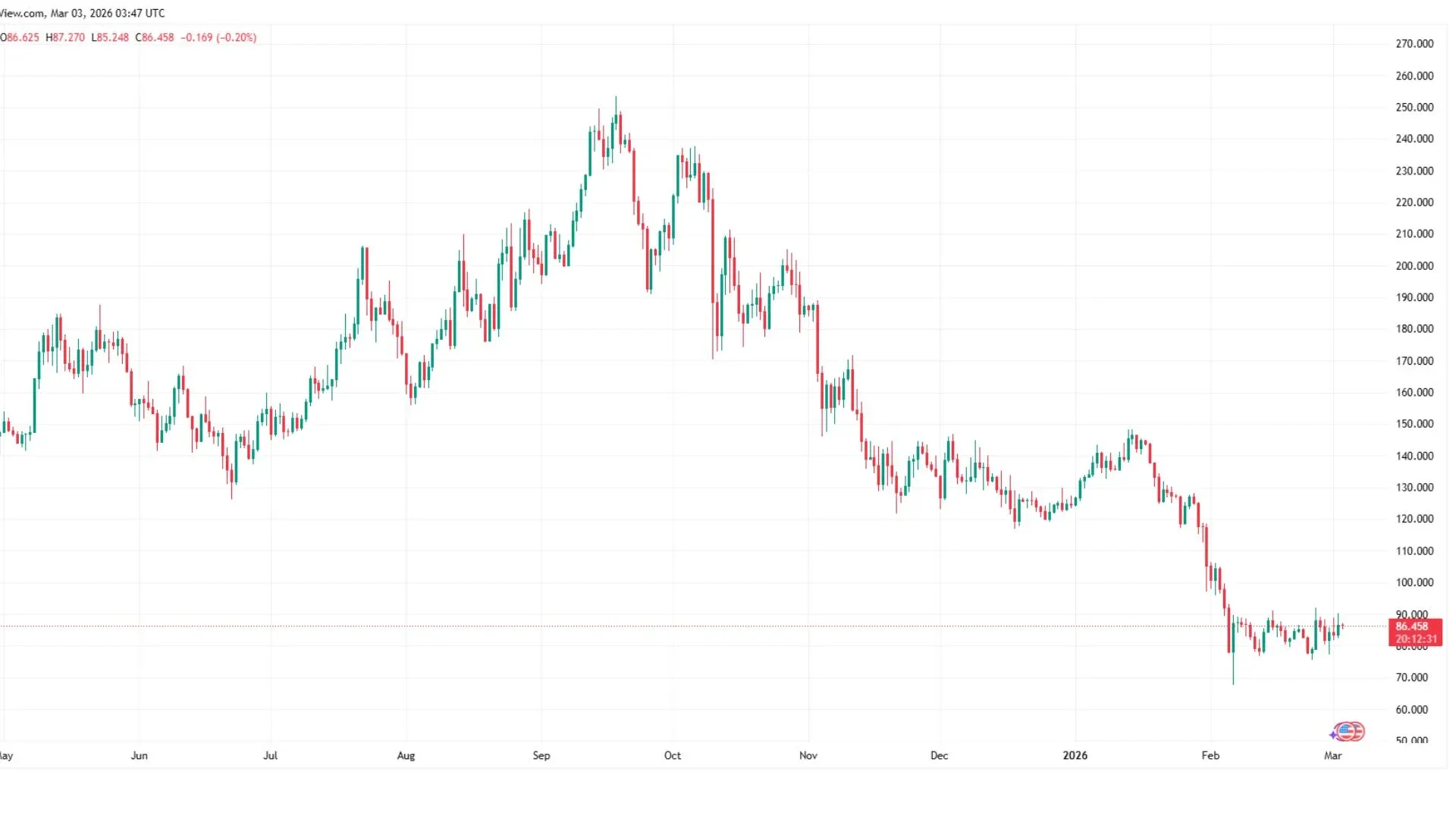
At the time of writing, SOL trades in the $84‑$87 range with a market cap of roughly $95 billion. Short‑term charts display a head‑and‑shoulders pattern, with the neckline around $107 and a break that occurred around January 31. If the break holds and the price continues downward, technical targets lie in the $59‑$64 corridor; if SOL can defend the critical $80 support, it may consolidate in that band and benefit from ETF‑related upside expectations.
It is also worth noting that the market‑fear index (CMV) stands at 11, and SOL’s financing rate is negative, indicating a large short‑position exposure. Any positive news could trigger short‑covering, potentially sparking a rapid bounce.
4. Analyst Expectations: From Conservative to Bullish Ranges
- Conservative: If the broader crypto market stays weak, models forecast an average 2026 price of about $105 for SOL, with an upper bound near $125.
- Mid‑range: Seven analysts surveyed by InvestingHaven quote an average target of $425, ranging from $111 to $450; a break above the $260 resistance could open the path toward $300.
- Bullish: Cosmo Jiang of Pantera Capital believes that mere approval of a Solana ETF could push SOL close to $1,000; independent analyst CryptoZachLA shares a similar view, conditional on both the ETF and Alpenglow delivering as expected.
- Scenario Modeling: CoinEdition outlines three possible scenarios – if only Alpenglow launches and validator migration exceeds 50 %, the base‑case price sits at $220‑$280; if all catalysts fire simultaneously, a bull‑case could reach $350‑$400.
5. Potential Downside Risks
- Ecosystem Revenue Decline: Between 2023 and 2024, DEX volume on Solana fell 62 % within a single week in February, with Pump.fun and Meteora each dropping over 70 %. Meteora, once a major revenue source, has virtually disappeared, and the lack of fresh ecosystem narratives weakens fundamental support.
- Competitive Landscape: Ethereum layer‑2 solutions continue to scale, while newer chains such as Sui are closing the performance gap with Solana. Although Standard Chartered remains optimistic about Solana, it cautions that an ecosystem still dominated by meme tokens will struggle to outpace Ethereum in the short term.
- Regulatory Uncertainty: Stagnation of the CLARITY Act or further SEC delays in approving a spot SOL ETF could push institutional catalysts out to 2027 or beyond.
6. Overall Assessment and Practical Notes
As of March 2026, SOL exhibits “unfavourable chart patterns but promising fundamentals.” The $80 support level is a short‑term pivot; losing it would create significant technical pressure. At the same time, the Alpenglow and Firedancer upgrades, together with institutional moves around ETFs and cross‑border remittances, are laying a sturdier infrastructure for Solana.
While precise 90‑day price forecasts are impossible, assuming Alpenglow launches on schedule, SOL’s risk‑adjusted return over a 12‑month horizon would likely improve relative to the current fear‑driven metrics. Investors should remain vigilant of volatility and avoid treating price movements as linear trends.
Tax reminder: Crypto gains may be taxable in your jurisdiction; consult a local tax professional to understand your obligations.
---
This concludes the comprehensive Solana (SOL) 2026 price outlook analysis. For deeper dives into SOL, follow additional articles from Bitaigen.
*When dealing with fiat on‑ramps, use USD transfers via SEPA or SWIFT where applicable. U.S. residents should access Binance.US rather than the global Binance platform.*
💡 Register on Binance with referral code B2345 for the maximum trading fee discount. See Binance complete guide.



