
 Bitaigen Research
 We delve deeply into the core architecture and operational logic of the UnifAI Network in this article, clarifying how its cross‑chain AI agents break through the limitations of traditional DeFi automation, and providing a systematic interpretation of the UAI token’s economic model. By offering a detailed walkthrough of the three‑layer modular design, readers can grasp the project’s innovative value and potential use cases—worth a careful read.
What Is UnifAI Network (UAI)? Overview of Core Mechanisms and How It Works
UnifAI Network aims to supply the underlying runtime support that AI agents need to operate across multiple blockchains, surpassing conventional DeFi automation tools. Through a three‑layer modular architecture, even users with no programming background can enable AI agents to discover, combine, and execute financial strategies in real time on chains such as Solana, BSC, Polygon, and others.
Functional Division of the Three‑Layer System
- Infrastructure Layer: Built on an open‑source protocol backbone, this layer creates a cross‑chain network where AI can run autonomously. It embeds a native AI protocol that automatically discovers and connects to newly launched DeFi primitives.
- Tool Layer: Offers developers an open SDK and “as‑a‑service” modules (TaaS, DaaS, AaaS), together with the Vibe Coding interactive interface that converts complex financial logic into visual code.
- Application Layer: Serves as the entry point for end‑users, encompassing agent wallets, AI financial advisors, and a strategy marketplace where users can browse, copy, or monetize automated trading bots.
Thanks to a dynamic tool‑discovery mechanism, UnifAI’s agents no longer rely on a predefined rule library; instead, they search for the optimal liquidity pool or yield opportunity at runtime, compressing what would normally take hours of on‑chain research into a matter of minutes.
---
How Autonomous Agents Operate
Within the UnifAI ecosystem, agents are considered sovereign financial executors rather than simple chatbots. They interact directly with smart contracts via large‑action models (LAMs) and follow a trigger‑logic‑action three‑step framework to carry out strategies:
- Trigger: Can be set as a time interval (e.g., every 4 hours) or a price threshold (e.g., SOL above $150).
- Logic: The agent scans key metrics such as FDV, TVL, 24 h fees, Jupiter organic scores, and others.
- Action: Once conditions are met, it initiates trades, adjusts slippage, and places real‑time take‑profit/stop‑loss orders.
Typical examples include Meteora DLMM automation on Solana and end‑game strategies on Polymarket on Polygon. In those cases, the agent identifies the high‑probability outcome of a prediction market before settlement and executes the corresponding operation.
---
Positioning and Functions of the UAI Token
UAI is the native token of the UnifAI economy, capped at a fixed supply of 1 billion tokens. It serves multiple roles within the platform:
- Service Fees: Users must pay UAI when accessing premium AI agents, advanced analytical tools, or the strategy marketplace.
- Staking & Rewards: Holders can stake UAI to help secure the network and receive a share of protocol revenue as well as fee discounts.
- Governance Rights: Token holders vote on protocol upgrades, new chain integrations (e.g., Hyperliquid expansion), and fund‑pool allocations.
- Strategy Incentives: Creators of strategies can claim 30 % of the fees generated by their bots, payable in UAI or a stablecoin.
*Note: Crypto gains may be taxable in your local jurisdiction; consult a tax professional to understand your obligations.*
---
Token Allocation Details
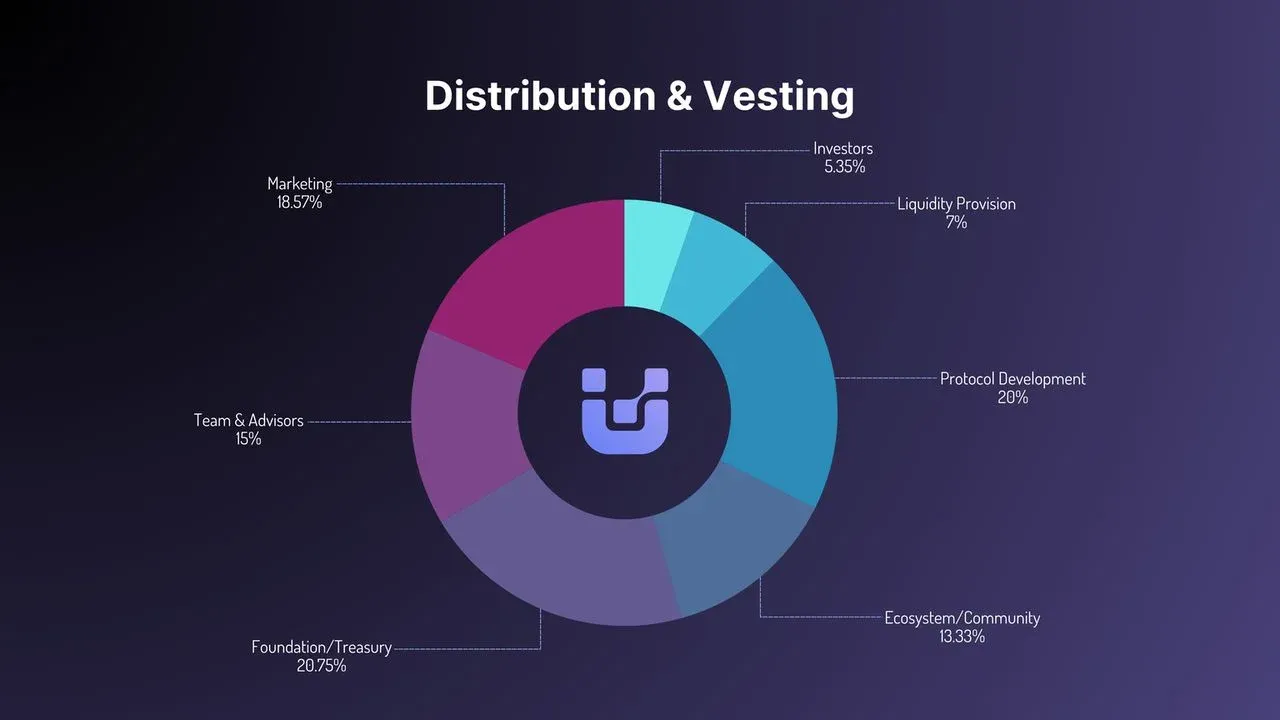
UAI is issued on the BNB Smart Chain (BSC) with a total supply of 1 000 000 000, establishing a hard ceiling against long‑term inflation. The distribution is as follows:
| Category | Percentage | Description |
|----------|------------|-------------|
| Foundation & Treasury | 20.75 % | Supports long‑term operations, strategy R&D, and ecosystem grants |
| Protocol Development | 20.00 % | Funds AI‑agent integration and infrastructure scaling |
| Marketing | 18.57 % | Promotion, education, and brand partnerships |
| Team & Advisors | 15.00 % | Linear vesting over 48 months to incentivize core contributors |
| Ecosystem & Community | 13.33 % | Airdrops, developer rewards, community incentives |
| Liquidity | 7.00 % | Ensures liquidity on centralized and decentralized exchanges |
| Investors | 5.35 % | Early partners, with a 24‑month vesting period |
---
Core Differences Compared With Traditional DeFi Automation
| Dimension | Traditional Bots | UnifAI (UAI) |
|-----------|------------------|--------------|
| Logic Type | Static IF‑THEN rules | Dynamic autonomous reasoning |
| Tool Acquisition | Hard‑coded APIs | Real‑time “instant” discovery |
| User Interaction | Script‑based, high technical barrier | Natural language + Vibe coding |
| Execution Model | Centralized scripts, deterministic | On‑chain agents, distributed |
| Ecosystem Compatibility | Single‑protocol isolation | Unified integration of > 100 protocols |
Traditional solutions typically depend on fixed IF‑THEN logic and hard‑coded APIs; a protocol upgrade or UI change can render the bot inoperable. By contrast, UnifAI’s dynamic tool‑discovery layer wraps hundreds of DeFi protocols into composable atomic blocks, allowing agents to reason at runtime and shrink multi‑step strategy deployment from several hours to under 20 minutes.
The gap widens further in execution efficiency and risk control. Conventional bots often ignore real‑time on‑chain data, whereas UnifAI agents continuously evaluate Jupiter organic scores (≥ 65), 24 h fee/TVL ratios (≥ 1 %), token age, and other metrics. For instance, in a Meteora DLMM strategy, the agent can autonomously adjust bid‑ask spreads and trigger a –8 % stop‑loss or +10 % take‑profit, eliminating the latency introduced by manual intervention. Leveraging LAMs, UnifAI now supports over 116 000 wallets, with cumulative transaction volume around US$123 million, markedly surpassing the scalability of traditional DeFi bots.
---
How UnifAI Differs From Other DeFAI Projects
Unlike Bittensor (TAO), which focuses on decentralized model training, or Artificial Superintelligence (FET), which targets generic autonomous economic agents, UnifAI concentrates on financial agents—closed‑loop, on‑chain execution without human mediation. The platform has integrated more than 100 mainstream DeFi protocols and over 45 specialized platforms (e.g., Polymarket, Hyperliquid), forming an AI → execution → optimization loop. Although its market cap is modest, UnifAI has already processed US$123 million in on‑chain trades and supports 116 000+ active wallets, demonstrating a higher user‑value density than many generic AI infrastructure projects.
---
Four Key Points to Consider Before Investing in UAI
- Sector Volatility & Narrative‑Driven Moves
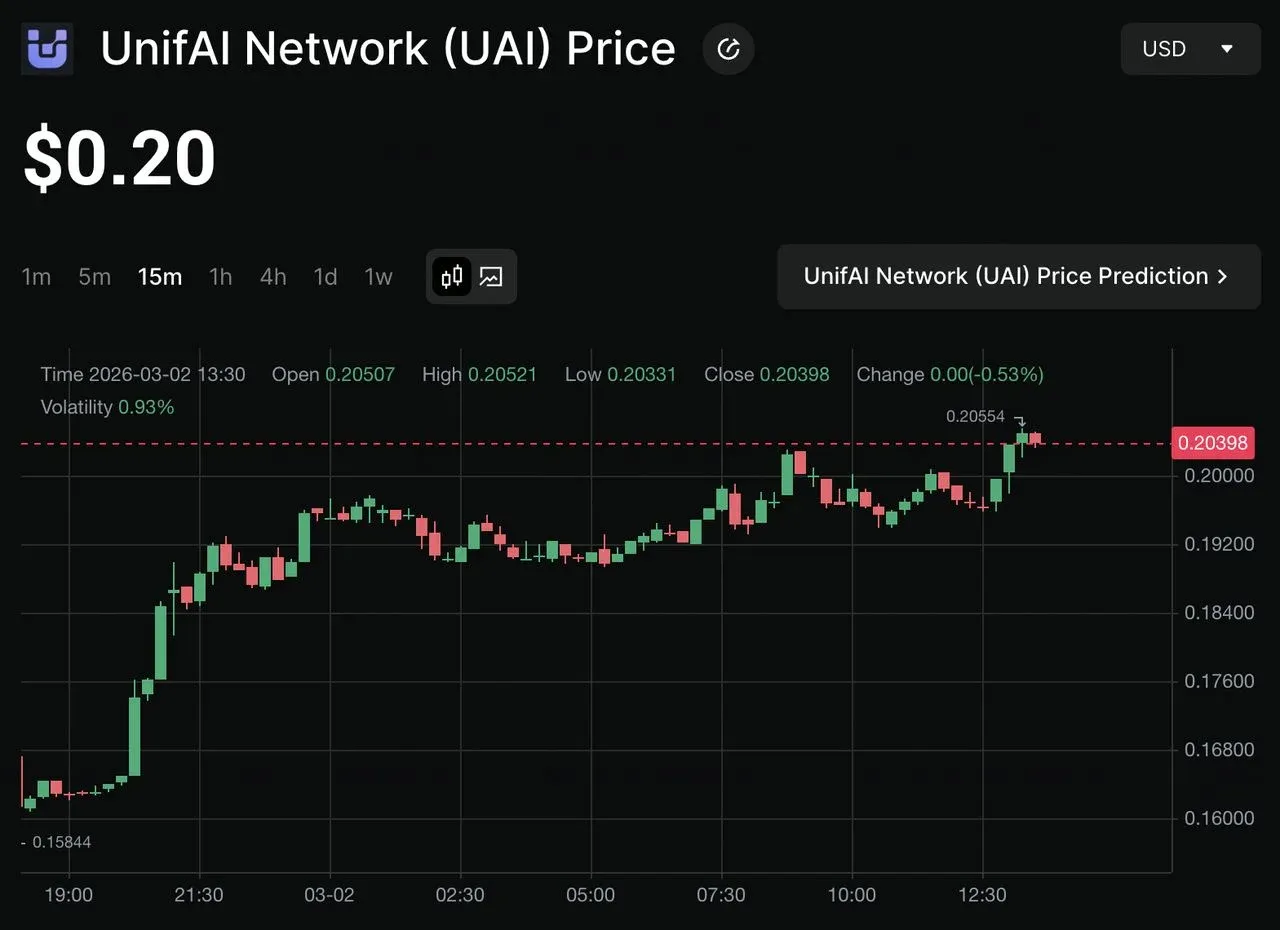
UAI belongs to the high‑beta AI sub‑sector. While the broader market fell 1.24 % recently, UAI posted an approximate 18.48 % gain. Its price is tightly linked to AI‑related news (e.g., OpenAI releases, NVIDIA earnings). Investors should monitor sentiment indicators such as the Fear & Greed Index (currently 15) and the Altcoin Season Index (as of March 2026, 34).
- Token Economics & Supply Pressure
Circulating supply stands at roughly 239 million tokens (23.9 % of total). Community allocations account for 13.33 %. Quarterly airdrops and ecosystem incentives will release about 33.3 million tokens; if demand does not keep pace, sell pressure could arise.
- Platform Adoption & TVL Stickiness
UAI’s intrinsic value ties to real‑world usage. Key metrics include wallet count (already > 116 000), cumulative transaction volume (> US$123 million), and active strategy count (over 3 600 as of March 2026). Should the 30 % fee share for strategy creators stagnate, the token’s fundamental value could be directly impacted.
- Smart‑Contract & Operational Risks
Agents act as proactive executors, requiring trust in the underlying model’s slippage handling and gas optimization. Any security flaw in the unified API or a failure of the dynamic tool‑discovery mechanism could trigger cascading liquidations across linked protocols (e.g., Meteora, Drift).
---
Conclusion: Is UnifAI the Next Step for DeFi Agent Networks?
UnifAI Network aggregates fragmented multi‑chain DeFi protocols into a single agent‑driven execution layer, showcasing the potential to shift from passive tooling to proactive financial intelligence. With more than US$123 million in transaction volume on platforms such as Polymarket and Meteora, and real‑world adoption across 116 000+ wallets, the project is gradually building the foundational infrastructure for the next generation of on‑chain interaction.
Nevertheless, as a nascent and highly speculative sector asset, UAI still faces uncertainties—including smart‑contract vulnerabilities, model mis‑predictions, and dilution pressure from the remaining 76 % of tokens yet to circulate. Its long‑term sustainability hinges on the team’s ability to stay ahead of the volatile AI‑crypto narrative, continuously deliver genuine on‑chain value, and navigate regulatory and market headwinds.
For more detailed information on the UnifAI Network (UAI), feel free to search for previous Bitaigen (比特根) articles or continue exploring the related links below. Thank you for following Bitaigen (比特根) and for your continued support!
💡 Register on Binance with referral code B2345 for the maximum trading fee discount. See Binance complete guide.



