
 Bitaigen Research
 Unitas aims to build an asset‑management platform centered on stable and sustainable returns, helping users earn profits that are independent of market price movements across a variety of digital assets. The platform offers several asset types that generate their own yield, including interest‑bearing stablecoins, Bitcoin, and gold‑backed metal assets. Its system employs a transparent and strict risk‑control mechanism, serving individual investors while also providing a unified yield and settlement infrastructure for on‑chain fund flows, payment scenarios, and traditional financial institutions.
From technical, economic, and application perspectives we deeply dissect Unitas (UP)’s innovative mechanisms, helping readers understand its yield model, risk controls, and future development potential. By reading this article you can quickly grasp how to participate and capture the platform’s earning opportunities, revealing its unique value proposition in digital‑asset management.
What is Unitas
Unitas has built a USSD + Yield infrastructure on blockchain, focusing on the development of a new generation of native crypto‑ecosystem stablecoins. Unlike traditional stablecoins that rely on banks or fiat reserves, Unitas issues USDu, a synthetic USSD supported by a delta‑neutral strategy that markedly reduces the price‑volatility risk of the collateral assets.
The project’s technical core is a delta‑neutral arbitrage model based on JLP (Jupiter Liquidity Provider). This model extracts roughly 75 % of the fees generated on the Jupiter Perps trading platform on Solana as profit, while holding JLP as the primary collateral and simultaneously opening a corresponding short perpetual‑contract position to hedge. Consequently, the actual returns stem from transaction fees and funding rates rather than overall market direction.
USDu is softly pegged to the U.S. dollar with an over‑collateralization ratio of about 105 %. Its staked version, sUSDu, can auto‑compound on‑chain, allowing holders to accrue value over time without any extra actions.
The system currently operates primarily on Solana and Binance Smart Chain (BSC), with plans to expand to additional EVM‑compatible chains. The project has secured investments from multiple institutions, including Amber Group, Blockchain Builders Fund (Stanford University), Bixin Capital, MEV Capital, Big Brain Holdings, and 57Blocks. A seed round completed in June 2025 raised USD 3 million.
What is the UP token
Token overview
- Name: Unitas
- Symbol: UP
- Total supply: 1,000,000,000 tokens
Primary functions
- Governance: UP serves as the governance token of the Unitas ecosystem; holders can vote on key protocol parameters, product direction, fee allocation, and other matters.
- Staking: Users may stake UP to receive sUP, which entitles them to rewards linked to the protocol’s long‑term growth.
- Fee sharing: Once the platform activates a revenue‑distribution mechanism, a portion of protocol earnings will be allocated to UP holders according to community‑governed rules.
UP tokenomics
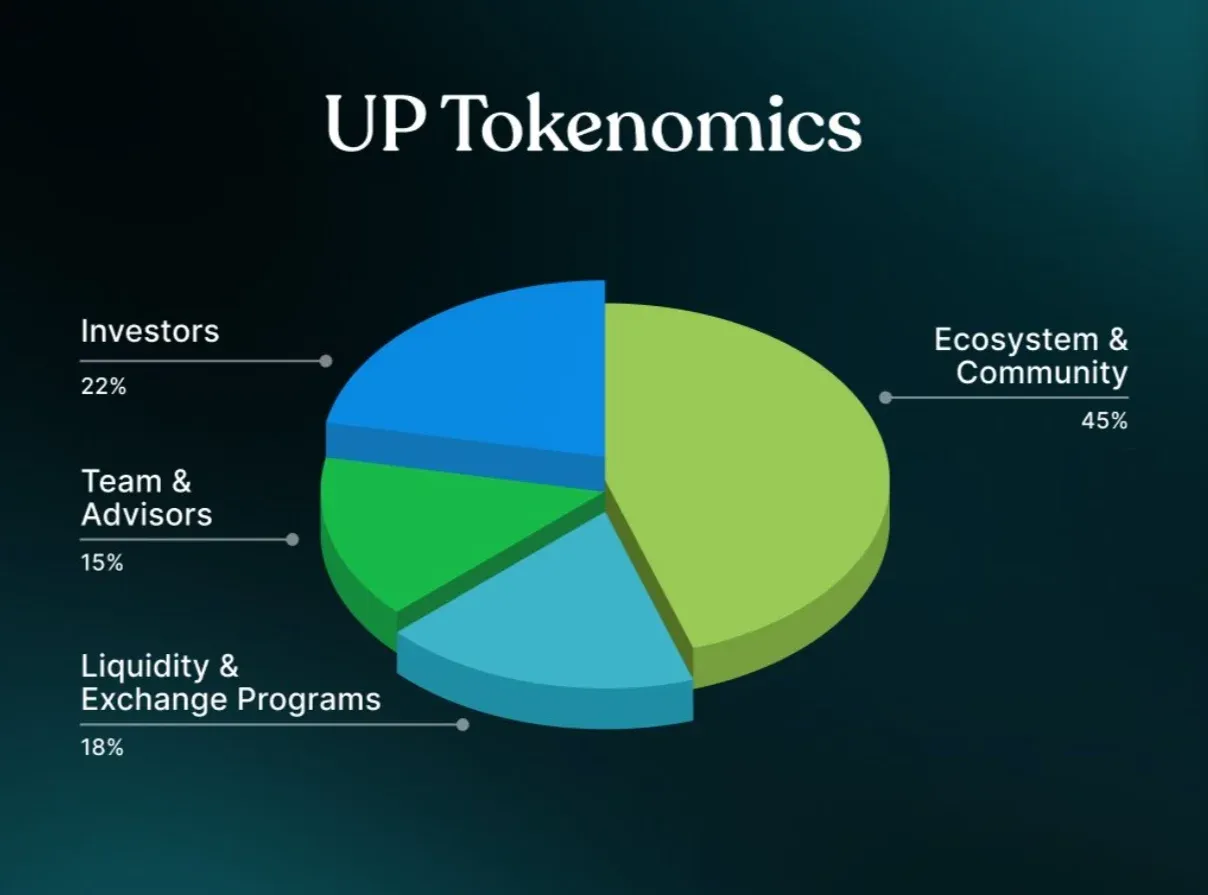
The issuance of UP is allocated as follows:
- Ecosystem & community: 45 %
- Liquidity & redemption program: 18 %
- Investors: 22 %
- Team & advisors: 15 %
Holders participate in the stUP mechanism, which confers the highest decision‑making authority and can:
- Set the community’s profit‑sharing ratio;
- Adjust risk caps and approve new yield strategies;
- Determine the allocation plan for the ecosystem budget.
Each stUP token equals one vote, ensuring that all system changes are executed in a democratic and transparent manner.
Value and yield‑generation mechanisms
- Market‑neutral strategy: Profits are generated from JLP‑derived trading fees and funding rates, making returns independent of the underlying asset price movements.
- Real‑World Asset (RWA) expansion: Future plans include tokenized equities, gold, and other precious‑metal income streams as additional sources of revenue.
- Exclusive yield rights: UP is the sole asset entitled to capture profits from the activities above; actual profits are injected into the staking pool as stUP, enhancing returns for token holders.
The Token Generation Event (TGE) marks the official launch of the UP governance system, after which the community will vote on risk and yield parameters. Unitas will continue deepening the integration of equities, precious metals, and other real‑world assets, positioning UP as the protocol’s exclusive governance and cash‑flow ownership token (without issuing corporate equity).
Core solutions of Unitas
Delta‑neutral hedging strategy
Delta measures the sensitivity of a derivative’s price to changes in its underlying asset. Unitas creates delta‑neutral positions between collateral assets (such as SOL, ETH, WBTC, USDC) and corresponding short perpetual contracts, enabling USDu to maintain a peg close to $1 even in highly volatile markets.
Advantages of this model include:
- Complete elimination of directional market risk;
- Higher capital efficiency compared with traditional CDPs, reducing the amount of locked collateral;
- High scalability achieved by aggregating liquidity from both decentralized exchanges (DEXs) and centralized exchanges (CEXs), without reliance on real‑world assets or banking systems.
Off‑chain settlement (OES)
Unitas partners with off‑chain custodians Ceffu and Copper to securely store collateral while accessing liquidity on centralized exchanges, eliminating the need to move assets onto the exchanges themselves.
Key benefits:
- Assets always remain owned by the user and are held in segregated accounts;
- Gas costs are reduced, accelerating minting and redemption processes;
- Connection to multiple exchanges and over‑the‑counter platforms diversifies counter‑party risk.
Continuous monitoring and backup procedures by the two custodians ensure that risk remains tightly controlled.
What is USDu
USDu is Unitas’s synthetic U.S. dollar, backed by a delta‑neutral strategy with JLP as the core collateral. JLP consists of a basket of assets such as SOL, ETH, BTC, and USDC, and its income derives from internal swap fees, trade execution fees, and liquidation fees. Because JLP directly records real trading activity, its earnings are insulated from market price fluctuations.
To offset the base‑asset risk inherent in JLP, Unitas simultaneously creates an equal‑sized perpetual short position, hedging directionally by shorting volatility‑exposed derivatives. The result is a market‑neutral stance whose returns come from fees and funding rates.
USDu’s minting process is tightly regulated; only whitelisted liquidity managers or protocol accounts may mint directly. Regular users can acquire USDu on secondary markets (e.g., through the Unitas app or decentralized exchanges).
Basic workflow
- A whitelisted address deposits USDC as collateral;
- 80 % of the USDC is used to purchase JLP, which is stored in an on‑chain multisig contract;
- The remaining 20 % is handed to custodian Ceffu as margin for the perpetual contracts.
Revenue distribution: 80 % flows into the staking contract to boost sUSDu value, while the remaining 20 % is allocated to the protocol treasury and insurance fund.
Advantages of the USDu strategy
- Revenue is sourced from genuine trading activity;
- Directional risk is neutralized through hedging;
- JLP provides diversified exposure to blue‑chip assets;
- The model scales naturally as derivatives trading volume grows;
- Users hold a stable asset while the protocol handles complex risk management in the background.
What is sUSDu
sUSDu is the staked version of USDu. Users lock USDu into a staking contract and receive the corresponding amount of sUSDu. Holding sUSDu continuously accrues the protocol’s actual earnings, allowing USDu to appreciate in value without the issuance of additional tokens.
Staking and unlocking workflow
- Staking: Users deposit USDu into the contract; the system automatically mints sUSDu. JLP earnings and funding rates are periodically transferred into the contract, raising the sUSDu/USDu exchange ratio.
- Unlocking: Users burn sUSDu; the underlying USDu moves to a withdrawal contract and enters a 7‑day cooldown period. After the cooldown, the USDu can be withdrawn to the user’s wallet.
Unitas Labs is redefining the concept of yield‑bearing stablecoins in DeFi. By combining a delta‑neutral model with off‑chain settlement, it achieves a rare balance among yield, stability, and decentralization. The UP token is expected to launch officially in 2026, at which point its functionality will expand further, attracting more participants.
Latest Unitas (UP) activity
Binance Wallet is reopening its TGE, featuring Unitas Labs (UP) in round 44.
- Subscription window: March 13 2026, 16:00 – 18:00 (UTC+8)
- Eligibility: Qualified users must use Binance Alpha points to participate
- Additional rewards: 10,000,000 UP will be reserved for future events; details will be posted on the TGE information page—stay tuned.
Looking ahead
Unitas’s long‑term goal is to popularize USDu and sUSDu across a broader DeFi landscape. The protocol is actively expanding to additional blockchain networks and deepening integration with systems that require stable collateral and market‑neutral yields. As these connections strengthen, USDu and sUSDu will become usable in a richer set of applications, offering users a transparent, predictable way to hold a dollar‑denominated asset along with an associated yield stream.
The platform strives to create a stablecoin framework that always keeps collateral transparent and generates revenue through real trading activity, aiming for predictable performance under any market condition. With ongoing technical iteration and ecosystem growth, USDu is poised to become a reliable, yield‑bearing dollar alternative, providing solid value support for protocols and end‑users that demand transparent mechanisms.
In summary, this article has provided a comprehensive overview of what the Unitas (UP) token is, how to participate and claim it, and its token economics and outlook. For more UP‑related information, you can search past Bitaigen articles or continue reading the recommended content below. We look forward to your continued interest and support for Bitaigen!
💡 Register on Binance with referral code B2345 for the maximum trading fee discount. See Binance complete guide.



