
 Bitaigen Research
In this article we systematically review the regulatory background, issuance process, and technical implementation of the USAT (USA₮) stablecoin, helping readers quickly discern its compliance differences and use‑cases compared with USDT and USDC. We then dive into the key components so you can gain a clearer understanding of the advantages and potential risks of this regulated, dollar‑backed on‑chain token—worth a thorough read.
What Is the USAT (USA₮) Stablecoin? Overview of Its Operating Mechanism
USAT (USA₮) is an on‑chain token that is fully backed 1:1 by U.S. dollars and issued under the United States regulatory framework. The token is endorsed by Tether and issued by Anchorage Digital Bank, N.A., a federally chartered digital‑asset bank supervised by the Office of the Comptroller of the Currency (OCC). USAT is designed in accordance with the federal stablecoin guidelines established by the GENIUS Act, passed in 2025, and features a regulated issuance qualification, a complete dollar reserve, and institution‑level audit oversight. Its purpose is to provide compliant on‑chain dollar liquidity for U.S.‑based institutions, regulated platforms, and users, rather than serving as a traditional offshore crypto liquidity tool.
Technical Implementation and Issuance Process of USAT
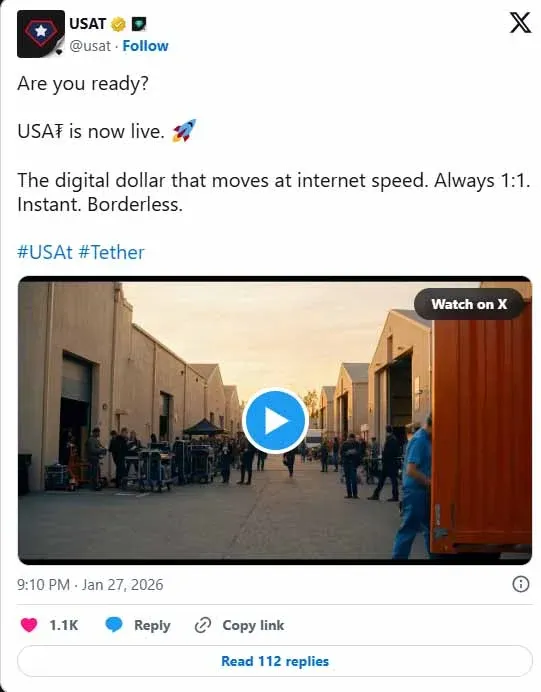
USAT is issued as an ERC‑20 token on the Ethereum network and went live on 27 January 2026, enabling direct integration with existing wallets, exchanges, and on‑chain settlement systems. Its core operating procedures are as follows:
- Minting and Burning: Anchorage Digital Bank is responsible for minting new USAT tokens or redeeming (burning) them on‑chain, with the entire process conducted within the United States.
- Reserve Management: All dollar reserves are held as highly liquid assets, with Cantor Fitzgerald acting as custodian and primary dealer, ensuring that the reserves are transparent and regulated.
- On‑Chain Circulation: Tokens can be transferred freely on Ethereum, with settlement times of a few seconds, eliminating the multi‑day delays typical of traditional cross‑border bank transfers.
This “on‑chain issuance → bank custody → regulatory compliance” model satisfies every requirement of the GENIUS Act concerning regulated issuance, transparency, and institutional suitability. Consequently, USAT can be used by U.S. broker‑dealers, fintech firms, custodians, and regulated exchanges without being subject to the compliance restrictions that may apply to offshore stablecoins.
USAT’s Position Within the Tether Ecosystem
USAT is not a replacement for USDT; rather, it is a version tailored specifically for the U.S. regulatory environment. USDT continues to dominate offshore markets, cross‑border payments, and emerging economies with its deep liquidity. USAT, by contrast, focuses on satisfying the demand for compliant dollars among U.S.‑based institutions. By maintaining this “dual‑track” arrangement, Tether can simultaneously serve offshore users through USDT and domestic users through USAT within the same ecosystem.
Overview of the GENIUS Act and Its Significance for USAT
The U.S. Stablecoin National Innovation Act (GENIUS Act) became effective on 18 July 2025, establishing the United States’ first federal regulatory framework for stablecoins. Key provisions of the act include:
- Issuers must be a federally chartered bank approved by the OCC or another qualified entity;
- Stablecoins must be fully backed 1:1 by high‑quality, liquid U.S. dollar assets;
- Issuers must disclose reserve information regularly and submit to independent audits;
- Anti‑money‑laundering (AML), sanctions compliance, and other controls must meet bank‑level standards.
For financial institutions, this means that banks, broker‑dealers, and fintech companies operating in the United States must use stablecoins that comply with this framework in order to settle on‑chain dollar transactions lawfully. USAT is built precisely to meet those requirements: it is issued by Anchorage Digital Bank (OCC‑regulated), its reserves are custodied by Cantor Fitzgerald, and it enables U.S. financial firms to obtain on‑chain dollar liquidity without stepping outside the federal regulatory regime.
Comparison of USAT, USDT, and USDC
As the GENIUS Act tightens stablecoin regulation within the United States, pure liquidity or brand considerations are no longer the primary differentiators. Issuance structure, regulatory coverage, and target user groups have become far more critical. The table below summarizes the main contrasts among the three tokens:
Differences Between USAT and USDT
USDT remains the world’s most liquid dollar stablecoin, with a market cap nearing $190 billion and deep integration into centralized exchanges, DeFi protocols, and payment systems in emerging markets. Its strength lies in its massive liquidity and broad acceptance.
USAT, on the other hand, competes on compliance rather than scale. Issued by an OCC‑regulated bank and adhering strictly to the GENIUS Act’s reserve and disclosure rules, it is designed for U.S. institutions, broker‑dealers, and payment providers that cannot directly use offshore stablecoins. It gives those entities access to on‑chain dollars while staying within the federal regulatory perimeter.
Differences Between USAT and USDC
USDC, issued by Circle, has long been the preferred stablecoin for U.S. institutions, with a market cap of roughly $71.5 billion and widespread adoption across fintech, banking, and regulated exchanges. Its success stems from highly transparent reserve disclosures and early alignment with regulators.
USAT represents Tether’s first regulated product for the U.S. market, blending a bank‑issuance model with the liquidity advantages of the broader Tether ecosystem. Analysts note that USAT’s potential competitive edge lies in its backing by Anchorage and Cantor Fitzgerald’s institutional networks, as well as possible future interoperability with USDT, allowing U.S. institutions to tap into global liquidity without leaving the domestic regulatory framework.
Three Major Risks to Consider Before Using USAT
Before holding or trading any stablecoin, it is crucial to understand its legal structure, reserve management, and technical implementation. The following three checkpoints are essential when evaluating USAT:
- Issuer and Redemption Mechanism: Even though a 1:1 backing is advertised, redemption rights may be limited to specific users or platforms, and redemptions could be delayed under market stress. Verify which channels allow direct redemption, the conditions attached, and the exact reserve management procedures.
- Regulatory and Platform Compliance: The regulatory landscape can change rapidly; new policies or jurisdictional restrictions may affect a token’s availability on exchanges or payment systems. Even a regulated stablecoin can be delisted if a particular country or platform imposes additional compliance requirements.
- Smart‑Contract and On‑Chain Risks: Always confirm that the contract address you interact with is the official one released by the issuer. Protect yourself against wallet vulnerabilities, bridge attacks, or mistaken transfers that could result in irreversible loss of assets.
Bottom line: Stablecoins aim to reduce price volatility, but they do not eliminate operational or systemic risk. As with any crypto asset, conducting thorough due diligence remains a necessary step.
Summary and Outlook
The launch of USAT marks a new phase for the U.S. stablecoin ecosystem, placing regulatory compliance at its core. By leveraging a federally chartered bank for issuance and adhering to the stringent reserve management dictated by the GENIUS Act, Tether positions USAT as an on‑chain dollar solution for regulated U.S. capital, while still benefiting from USDT’s global offshore liquidity.
Nevertheless, USAT is still a nascent product. Its real‑world adoption will depend on integration with trading platforms, the continued consistency of regulatory policy, and the genuine demand for on‑chain dollars among institutions. As with any stablecoin, prospective users should deeply understand the issuer’s structure, redemption workflow, and supported exchanges to ensure that they mitigate operational risk while enjoying reduced price volatility.
Frequently Asked Questions (FAQ)
1. Is USAT a U.S. legal tender?
USAT is not a legal tender issued or guaranteed by the U.S. government, nor is it covered by FDIC or SIPC insurance. Holders do not receive government deposit or investor protection.
2. What is the full name and ticker of USAT?
The token is commonly referenced as USA₮, a dollar‑pegged stablecoin supported by Tether and targeted at the U.S. market.
3. Who issues USAT?
USAT is issued by Anchorage Digital Bank, N.A., which operates under supervision from the OCC.
4. When did USAT go live?
USAT was publicly released on 27 January 2026.
5. Which legal framework governs USAT?
Its issuance and operation are fully based on the U.S. Stablecoin National Innovation Act (GENIUS Act), which mandates regulated issuance, full reserve backing, periodic disclosure, and compliance controls.
6. How does USAT differ from USDT?
USDT is Tether’s primary stablecoin for offshore and global crypto markets; USAT is issued through a U.S.‑regulated bank and is purpose‑built for compliant domestic use cases.
7. On which blockchain does USAT operate?
USAT is deployed as an ERC‑20 token on the Ethereum network. The contract address and transaction data can be inspected via public block explorers.
8. Does USAT maintain a 1:1 USD backing?
USAT pledges that each token is backed by one U.S. dollar held as liquid assets, with reserves audited and disclosed under a regulated custodial structure.
9. Could the dollar peg of USAT fail?
While the design aims to preserve a 1:1 value, any stablecoin’s peg can be affected by reserve quality, redemption pathways, and market conditions, introducing a degree of risk.
---
For a more comprehensive dossier on USAT, you can search for prior articles from Bitaigen (比特根) or continue reading the related content below. Thank you for your attention, and we look forward to your continued support!
Note for U.S. readers: When accessing cryptocurrency exchanges, use Binance.US or other U.S.-registered platforms rather than the global Binance site to remain compliant with local regulations.
Tax reminder: Crypto gains, including those from stablecoin transactions, may be taxable in your jurisdiction. Consult a tax professional to understand your obligations.
💡 Register on Binance with referral code B2345 for the maximum trading fee discount. See Binance complete guide.



