
 Bitaigen Research
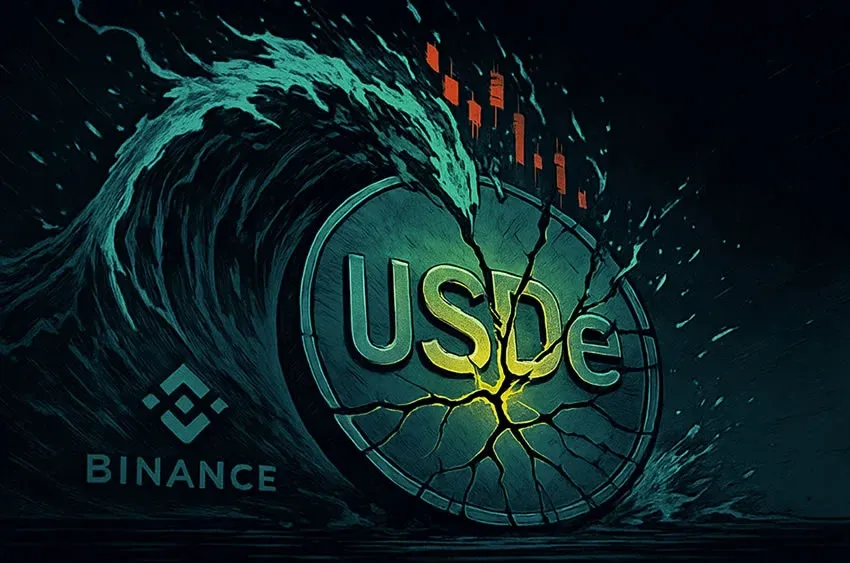
 USDe – an innovative synthetic‑dollar stablecoin launched by Ethena Labs – suffered a 35 % price de‑peg on the Binance exchange during a period of extreme market turbulence, prompting extensive discussion across communities and media outlets.
USDe is a decentralized synthetic stablecoin that aims for a 1:1 peg to the U.S. dollar by using crypto‑asset collateral and a short position in perpetual futures to hedge exposure. (50‑80 word direct answer)
In this article we outline the core mechanics, risk considerations, and step‑by‑step procedures for interacting with the USDe stablecoin on Binance, helping investors evaluate the feasibility of its decentralized peg mechanism, its potential returns, and the latest community feedback.
What Is USDe?
USDe (full name : Ethena USDe) is a synthetic U.S.‑dollar stablecoin issued on Ethereum. It employs crypto‑asset collateral together with short positions in perpetual futures contracts to counterbalance price movements, striving to keep its market price constantly aligned with the U.S. dollar at a 1:1 ratio.
Unlike the top‑three fiat‑backed stablecoins USDC (USD Coin), which maintain stability by holding an equivalent amount of bank‑issued dollars, USDe relies entirely on on‑chain assets and a derivatives‑based hedging mechanism.
Purpose and Background of USDe
- Launch date: 19 February 2024
- Issuer: Ethena Labs, a decentralized finance (DeFi) innovation company founded in 2023 by Guy Young.
- Core vision: Eliminate dependence on the traditional banking system and create a crypto‑native, scalable, censorship‑resistant “dollar‑denominated unit of account” that can serve as a higher‑yield reserve asset for the global crypto market.
- Conceptual inspiration: Mirrors the spot‑long + futures‑short support model described by BitMEX founder Arthur Hayes in his 2023 essay *Dust on Crust*, which Arthur publicly endorsed for USDe.
Main Differences Between USDe and USDC
| Feature | USDe (Ethena Labs) | USDC (Circle & Coinbase) |
|---|---|---|
| **Issuing platform** | Ethereum synthetic‑dollar protocol | Multi‑chain (Ethereum, Solana, etc.) |
| **Launch year** | 2024 | 2018 |
| **Market cap (Nov 2025, CoinMarketCap)** | ≈ $8.41 billion, rank #1,676 | ≈ $6.12 billion, rank #7 |
| **Stabilisation mechanism** | **Delta‑neutral hedging**: short perpetual contracts offset crypto‑collateral volatility | **Fiat reserve 1:1**: cash + short‑term U.S. Treasury securities |
| **Transparency** | Protocol openly publishes risks, mechanisms, and third‑party custody details; on‑chain real‑time queries | Weekly reserve disclosures, monthly third‑party audit reports |
Risk and Custody Information (see Ethena’s official documents)
- Risks of USDe as Synthetic Dollar
- Off‑Exchange Settlement in detail
Overview of the Ethena Protocol
Ethena refers to the synthetic‑dollar protocol whose primary goal is to issue and maintain the value stability of USDe.
How It Works
- Users deposit ETH, BTC, and other crypto assets into the Ethena smart contract as collateral.
- The protocol mints an equivalent amount of USDe.
- Simultaneously, it opens a matching short position in the perpetual‑futures market, achieving Delta‑neutral hedging—the gains and losses of the spot‑long and futures‑short offset each other.
ENA Governance Token
- ENA is Ethena’s native governance token; holders can propose and vote on key protocol parameters.
- Staking ENA earns protocol and ecosystem rewards, providing additional yield to participants.
- Governance topics include:
- Risk and asset parameters: whitelist of collateral assets, hedging and margin caps, oracle and liquidation settings, list of OES (Off‑Exchange Settlement) custodians, etc.
- Protocol treasury and ecosystem: treasury usage, partnerships (exchanges, wallets, DeFi protocols), and incentive programmes.
- Fee switches: whether to activate a mechanism that distributes a portion of protocol revenue to ENA stakers.
USDe’s Backing Mechanism
USDe achieves dollar‑level price stability through an automated, standardised process that incorporates Delta‑neutral hedging, margin management, and position adjustments during minting/redeeming.
Delta‑Neutral Hedging Strategy
- Hold a spot‑long position in crypto assets while simultaneously establishing an equal‑size short position in perpetual contracts.
- The two sides theoretically cancel each other out, reducing overall sensitivity to price swings to near 0.
Risk‑Management Hierarchy
- Reserve Fund – Acts as a “last buyer” when funding rates stay negative for an extended period or during extreme volatility, cushioning negative funding fees or supporting secondary‑market liquidity.
- Third‑Party Custody (OES) – Partnerships with global custodians such as Copper, Ceffu, and Fireblocks keep assets on‑chain under custodial control, granting only the necessary authorisations to exchanges for margin and settlement, thereby lowering counter‑party risk.
- Dynamic Allocation – When funding rates turn negative or volatility spikes, the protocol automatically rebalances the weightings of spot collateral, hedge positions, and liquid‑stablecoins to mitigate concentration risk.
Official Documentation
- How USDe Works
- How Ethena manages Funding Risk
- Liquid Stables: Dynamic Allocation
sUSDe: Yield‑Generating Derivative
USDe itself does not generate yield, but users can stake USDe in the Ethena protocol to receive sUSDe. Holding sUSDe automatically accrues a share of the protocol’s earnings derived from Delta‑neutral hedging and diversified asset allocation. Because the distribution occurs on‑chain, sUSDe is often described as an “Internet Bond”.
Rewards Mechanism Explanation: Rewards Mechanism Explanation
How to Invest in USDe on Binance
Binance is the world’s largest centralized exchange by trading volume, and USDe is listed on its platform. The following steps guide you through the full process from account creation to investment.
1. Register and Deposit Funds
- Registration link: <https://accounts.binance.com/register?ref=B2345> (copy into your browser)
- Android app download: <https://www.bitaigen.com/binance/download>
Related tutorials
- Binance app download, installation, registration, deposit/withdraw (funding with USD via SEPA/SWIFT)
- Binance app installation guide
- How to create an overseas Apple ID (iOS users)
Note for U.S. residents: Use Binance.US instead of the global Binance platform to remain compliant with local regulations.
2. Prepare to Trade USDe
After completing account creation and funding your wallet, navigate to the “Spot Trading” or “Futures Trading” page, search for USDe (or USDe/USDT, USDe/BUSD trading pairs), and you will see real‑time market data and be able to place orders.
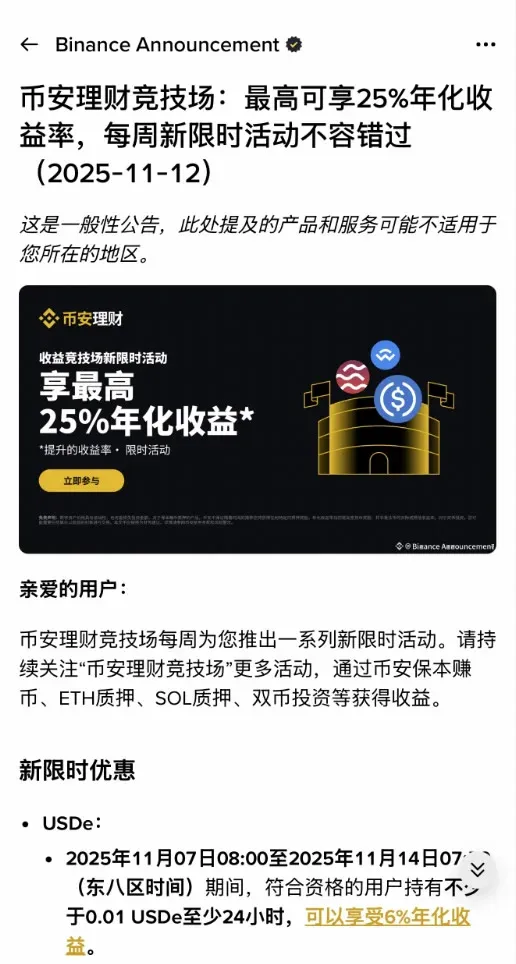
3. Participate in Binance Time‑Limited Reward Campaigns (as of November 2025)
- Eligibility: Purchase or hold at least 0.01 USDe for a continuous 24‑hour period.
- Reward: 7 % annualised yield, distributed daily.
- Detailed campaign information can be found at: Binance official campaign page.
4. Other Binance Financial Products
- Binance Earn – Principal‑Protected Savings: Differences between flexible and fixed‑term products, operation steps, and subscription procedures.
- Binance Dual‑Currency Investment: Underlying principle and subscription guide.
- Binance On‑Chain Yield: Mechanism, reward calculation, and usage instructions.
Analysis of the USDe De‑Peg Event
On 10‑11 October 2025, the U.S. President announced a 100 % tariff on Chinese goods, triggering a sharp sell‑off across global crypto markets. Bitcoin fell from roughly $121,300 to $105,000, while major layer‑1 assets such as ETH and SOL dropped 15 %–30 %. During a low‑liquidity weekend, automatic stop‑loss orders and leveraged liquidations cascaded, causing USDe on Binance to de‑peg to $0.65, a decline of about 35 %.
De‑Peg Recovery
- By midday on 11 October, USDe’s price had returned to the 1:1 peg.
- Ethena Labs clarified that the episode was a exchange‑level price dislocation, not a systemic protocol failure.
- Binance subsequently activated a compensation mechanism, offering affected liquidated users a reimbursement of the price difference and associated fees.
Summary of De‑Peg Causes
| Factor | Explanation |
|---|---|
| **Leveraged liquidations & liquidity drop** | Massive liquidation cascade contracted market depth, market makers tightened inventories, widening bid‑ask spreads and pushing the price down. |
| **USDe used as collateral** | In certain Binance products USDe can serve as cross‑margin collateral; when long positions were liquidated or collateral values fell, the system automatically sold USDe, adding sell pressure. |
| **Related asset anomalies** | Simultaneous stress on BNSOL (staked SOL) and wBETH (wrapped ETH) amplified margin strain. |
| **Arbitrage frictions** | Extreme market conditions, combined with deposit/withdrawal limits and risk‑control caps, hindered timely arbitrage, causing delayed price correction. |
Ethena’s Planned Improvements
- Proof‑of‑Reserve (PoR) mechanism: In partnership with Chaos Labs, Chainlink and other oracle providers, PoR will quickly differentiate between permanent collateral impairment and temporary price deviation, reducing the risk of erroneous liquidations.
- Open API keys: Any DeFi platform or exchange can request access to USDe reserve data, enabling on‑chain real‑time audits and greater transparency.
User‑Level Risk‑Mitigation Tips
- Diversify collateral and keep buffers – avoid relying on a single stablecoin as margin; maintain a safety margin.
- Cross‑check prices across venues – monitor USDe prices on both centralized exchanges and on‑chain DEXs; treat isolated anomalies as platform‑specific issues.
- Prioritise margin preservation in crashes – reduce leverage or add collateral promptly to avoid cascade liquidations.
- Stay informed on protocol metrics – long‑term holders should regularly review official documentation and dashboards to understand OES custody, hedging logic, funding‑rate risk, and reserve status, rather than focusing solely on price movements.
Risk Overview of USDe
| Risk Category | Primary Source | Potential Impact |
|---|---|---|
| **Funding‑rate risk** | Prolonged negative funding rates increase hedging costs | Erodes returns; mitigated by reserve fund and dynamic allocation |
| **Liquidity & margin risk** | Insufficient futures‑market depth or mass liquidations | Hedge may fail, leading to NAV volatility |
| **Custody & exchange risk** | Failure of third‑party custodians or centralized exchanges | Asset safety and hedge execution could be compromised |
| **Smart‑contract & governance risk** | Bugs in contracts or adverse governance decisions | May cause protocol malfunction or asset loss |
| **Market crowding risk** | Excess capital chasing the Delta‑neutral strategy | Funding spreads narrow, putting pressure on sustainable yields |
Conclusion
- USDe is a synthetic stablecoin that uses crypto collateral and a short perpetual‑futures hedge to maintain a dollar peg, issued by Ethena Labs.
- Its core architecture comprises Delta‑neutral hedging, a reserve fund, third‑party custody, and dynamic asset allocation, while sUSDe offers on‑chain yield to stakers.
- The October 2025 de‑peg stemmed mainly from Binance’s liquidity and margin structures, producing a brief price gap under extreme market stress. Ethena plans to improve transparency and risk identification through PoR oracles and an open API.
- To invest in USDe on Binance, complete registration, fund your account, purchase the token, and monitor any platform‑specific promotions. Diversifying collateral, comparing prices across multiple venues, and familiarising yourself with protocol‑level risk metrics can help lower potential losses.
Friendly reminder: When registering on Binance, use referral code B2345 to receive newcomer benefits. For a deeper dive into USDe (the synthetic dollar stablecoin), explore additional articles on Bitaigen.
*Tax note*: Crypto‑related gains, including those from USDe or sUSDe, may be subject to tax in your jurisdiction. Consult a qualified tax professional to understand your local obligations.
Related Reading
- Buy PERP on Binance: Complete Step‑by‑Step Guide
- Binance Alpha Launches Support for Block Street (BSB) Token
- XAUT Explained: Gold Backing, Pricing & Binance Buying Guide
💡 Register on Binance with referral code B2345 for the maximum trading fee discount. See Binance complete guide.



