
 Bitaigen Research
 From the perspective of the Bitaigen editorial team, we examine USOR's unique position within the Solana ecosystem, the regulatory and real‑asset implications behind its controversy, and how macro‑market fluctuations could affect its outlook. By dissecting the token design and community divisions, we aim to help readers clarify the project's risks and opportunities, with later sections offering deeper analytical basis.
USOR 2026 Price Outlook Overview
On January 21 2026, the broader cryptocurrency market suffered more than $1 billion in liquidations, yet a newly‑launched Solana token U.S. Oil (USOR) moved sharply upward, posting a single‑day gain of close to 300 % and closing at a historic high of $0.0839. The rally was largely driven by an unverified claim that the token was “backed by oil reserves” and by a heated trade‑war narrative that painted USOR as a proxy for geopolitical tension. The data cited originates from BingX.
However, the momentum reversed dramatically after early February. Around February 1, the project announced that its “token‑on‑boarding deadline” was approaching, and within a 24‑hour window USOR tumbled nearly 70 %, hitting a low of $0.00987. Independent investigators were unable to locate any evidence linking the token to actual oil inventories, prompting a wave of panic that also saw Bitcoin dip below $80,000. At the time of writing, USOR trades at only a fraction of its peak, and the community is split: a segment still treats it as a real‑world‑asset (RWA) token with physical‑asset attributes, while another faction dismisses it as a well‑packaged meme coin built on political satire.
This article will explore the token’s design, the core points of contention, and the contrasting macro‑environmental factors, providing a deep dive into how USOR’s transparency concerns may shape its future price trajectory.

Technical and Operational Foundations of USOR
U.S. Oil Reserve (USOR) was issued on the Solana blockchain in January 2026, positioning itself as a digital proxy for the United States Strategic Petroleum Reserve. The token follows the SPL standard, leveraging Solana’s high throughput and near‑instant finality to deliver extremely low transaction fees and rapid settlement. The project’s official website claims “federal custodianship” and “oil‑tokenization technology,” yet to date no U.S. government agency—including the Department of Energy—has validated any legal or financial relationship.
Core Features
- Native to Solana: Takes advantage of Solana’s efficient network, resulting in near‑zero transaction costs and lightning‑fast confirmations.
- RWA Narrative: Marketed as the first digital representation of the U.S. strategic energy reserve.
- Always Tradeable: Unlike traditional crude‑oil futures, USOR can be bought and sold 24/7 on decentralized venues such as Jupiter, Meteora, and other Solana‑based DEXs. (U.S. residents looking for fiat on‑ramps should use Binance.US or other SEPA/SWIFT‑compatible services.)
- Sentiment‑Sensitive: Prices react sharply to geopolitical headlines, especially U.S.–EU trade frictions and shifts in U.S. energy policy.
Tokenomics
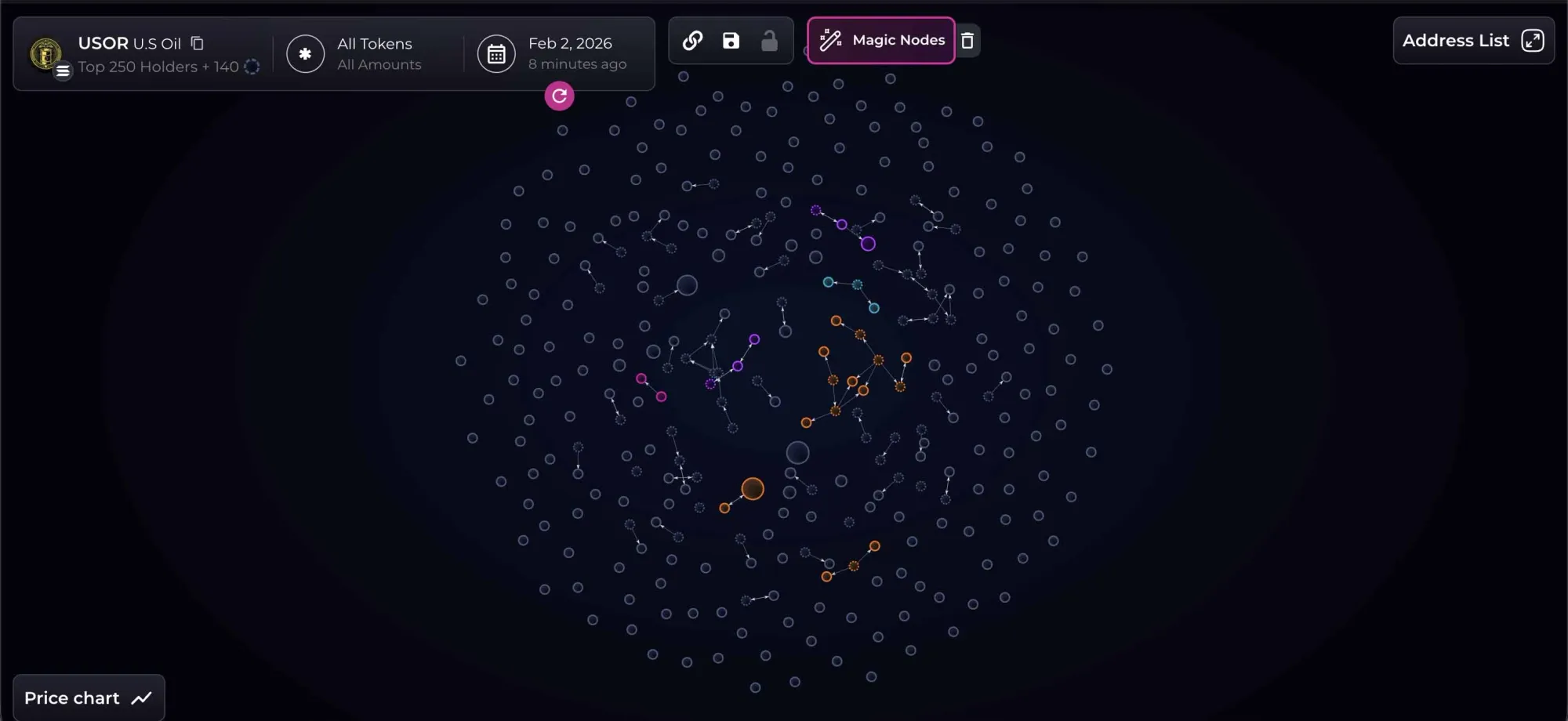
USOR employs a fixed‑supply model to create scarcity. The total issuance is 1,000,000,000 tokens (one billion), all minted at launch, with 100 % of the supply initially circulating. On‑chain analytics reveal that over 26 % of all tokens are held by addresses allegedly linked to the project team, and the top 100 addresses control a disproportionate share, creating a clear “whale” risk—large‑holder sell‑offs could instantly drain liquidity.
On‑Chain Distribution Visualisation
Data from Bubblemaps shows a highly concentrated ownership pattern: the top 20 addresses together hold more than 25 % of the total supply, forming a “bundle‑style” issuance structure. Although the number of unique token‑holding addresses exceeds 114,000, this concentration means that liquidity is vulnerable to stepwise exits by a few large actors. The current support level around $0.009 could be breached at any moment if those whales decide to sell.
Drivers Behind Price Volatility
USOR’s price action can be framed as a classic tug‑of‑war between “narrative‑driven speculation” and “fundamental validation.”
- Geopolitical Shockwaves: During the mid‑January escalation of U.S.–EU trade tensions, USOR’s price rose in lockstep with gold, prompting traders to label it a “political meme coin” betting on tariff disputes.
- Unverified “BlackRock‑Trump” Rumors: Social‑media chatter suggested a wallet linked to BlackRock was accumulating large USOR positions, while other addresses were flagged as belonging to a “Trump Team,” amplifying FOMO among retail participants.
- Token‑On‑Boarding Deadline: The project originally slated a “token‑on‑boarding” launch for February 1. Speculators rushed in during late January, but the actual product rollout proved limited, leading to a “good‑news‑exhaustion” sell‑off once the deadline passed.
- Lack of Empirical Evidence: Investigations by CCN and Yahoo Finance at the end of January found no legal, financial, or audited proof that USOR is tied to physical crude oil, eroding confidence among retail investors who had previously bought into the asset‑backed narrative.
*Note: Cryptocurrency gains may be taxable in your jurisdiction; consult a qualified tax professional to understand any obligations.*
Current Technical Analysis
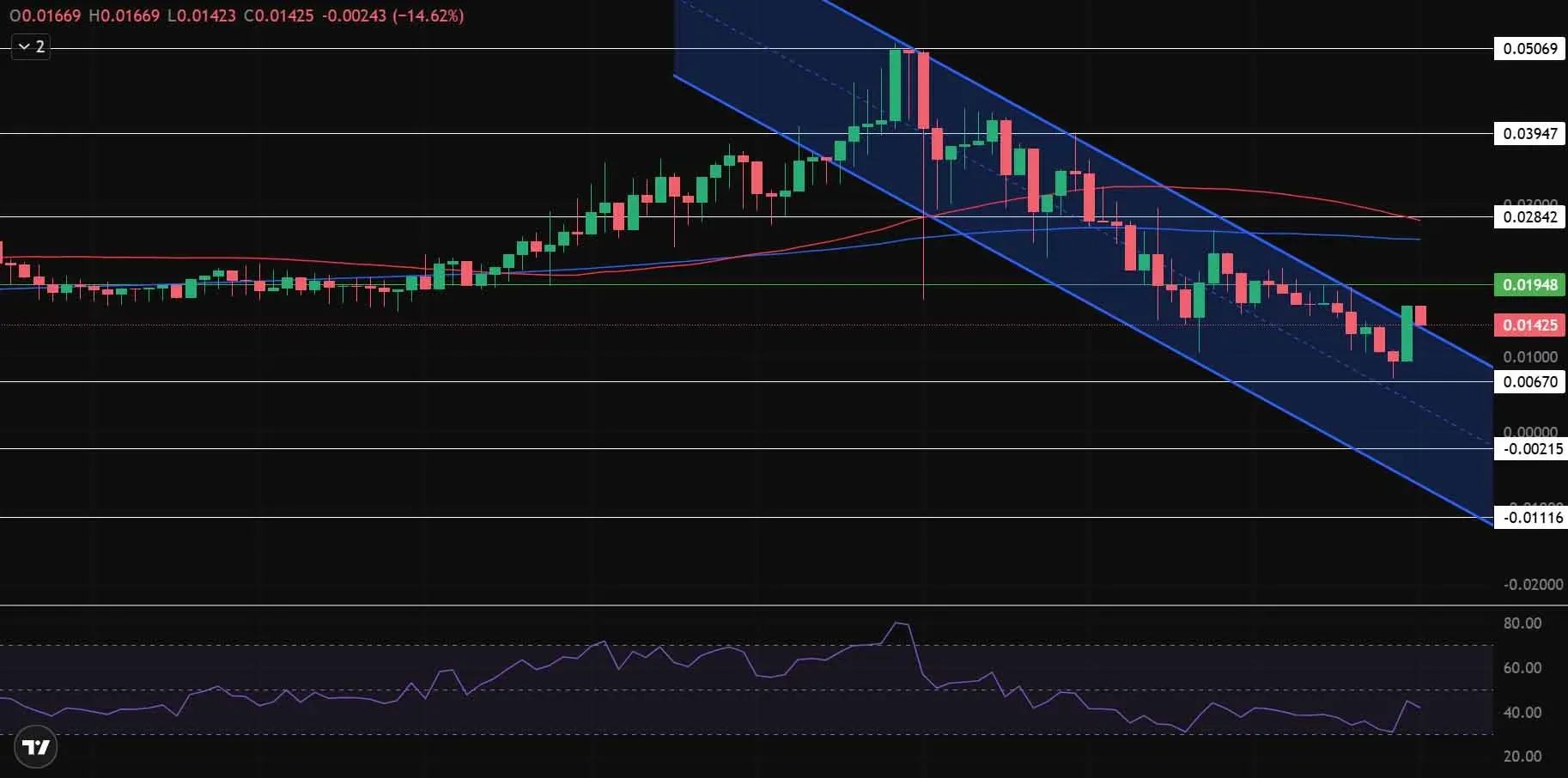
The USOR/USDT pair surged to the $0.083 historic high before retracing to a fragile $0.01 range. On the 1‑hour chart, the token is re‑testing the $0.01 psychological support level, which also served as a key pivot after the mid‑January breakout.
- RSI: The Relative Strength Index oscillates between 42 and 45, placing it in a neutral zone. This suggests that panic‑driven selling has eased, yet buying pressure remains thin.
- Pattern: Prices are compressed within a descending wedge. If the token can establish a stable sideways consolidation between $0.012–$0.015, a Fibonacci retracement target around $0.027 becomes plausible. Conversely, a breach of the $0.01 support could open the path toward the $0.0042 liquidity pocket.
Key Technical Levels
- Short‑Term Support ($0.010): Psychological floor and the brief consolidation zone preceding the January rally.
- Short‑Term Resistance ($0.013): Aligns with the current downtrend line and the 24‑hour high; a daily close above this level could relieve bearish pressure.
- Bullish Scenario ($0.050): Should the project secure third‑party audits or demonstrable links to a regulated commodity‑custody institution, the price could recover toward this milestone.
- Bearish Scenario ($0.0042): If the “oil‑reserve backing” narrative is completely discredited or if whales collectively liquidate, the token may tumble to this lower band.
2026 Price Range Forecast
As of February 2, USOR trades within a $0.014–$0.017 corridor. In mid‑January it briefly surged to ≈ $0.08 before undergoing a classic “pump‑and‑dump” cycle, after which volatility intensified.
- Bullish Outlook: Should speculative sentiment revive or the broader Solana ecosystem improve, USOR could re‑establish itself in the $0.03–$0.05 band.
- Conservative Expectation: The annual average may linger between $0.01 and $0.02; if market enthusiasm continues to wane, the downside corridor could tighten to $0.005–$0.01.
Can USOR Reclaim Its Historical Peak?
For USOR to revisit the $0.08 high, a strong catalyst would be required—such as a viral resurgence of the oil‑reserve narrative, a listing on a major exchange, or a broader risk‑on shift in the crypto market that lifts risk assets across the board. In the absence of fresh narrative fuel, the token is more likely to oscillate within a volatile range throughout 2026.
USOR’s trajectory underscores the double‑edged nature of narrative‑driven tokens: on one hand, it successfully harnessed macro‑energy headlines and Solana‑community meme culture to generate attention; on the other, the > 70 % price collapse serves as a stark reminder that, without audited asset backing, such projects carry exceptionally high risk.
To survive beyond 2026, USOR must narrow the gap between marketing hype and regulatory reality. Failing that, it will remain a high‑risk speculative instrument, with short‑term price movements dictated more by whale‑driven liquidity swings than by actual international crude‑oil prices.
---
This concludes the article. For further insights into USOR’s future prospects, you may search for prior Bitaigen reports or continue reading related pieces below. Thank you for following Bitaigen’s coverage and for your continued support!
💡 Register on Binance with referral code B2345 for the maximum trading fee discount. See Binance complete guide.
⚠️ Risk Disclaimer: Crypto prices are highly volatile. This is not investment advice.



