
 Bitaigen Research
Kevin Lepso of ETHGas points out that breakthroughs in transactions‑per‑second (TPS) excite engineers, but the traditional finance world’s attention remains on Ethereum because it offers the deepest liquidity.
Even as a wave of faster networks emerges, Ethereum continues to hold the highest concentration of stablecoins and decentralized finance (DeFi) capital.
Emerging blockchains promise higher throughput and lower costs, naturally raising the question: will institutional capital eventually migrate away from Ethereum?
Kevin Lepso—founder of ETHGas and former head of derivatives at Morgan Stanley Asia—believes Ethereum’s leading position will persist, because institutions value capital strength more than flashy performance metrics.
“‘Transactions per second’ is a metric that gets engineers excited, but is it really the key driver of capital flowing into a blockchain?” Lepso asked in a Cointelegraph interview.
“All the money is on Ethereum; stablecoins are there too. Traditional finance is closely watching where liquidity goes,” he added.
Institutional capital brings scale and stability to the blockchain ecosystem. Large asset‑management firms and tokenization‑fund issuers deepen liquidity with massive pools of cash and help anchor the supply of crypto assets. Their participation cements the network’s status, lifting it above a hype cycle driven solely by retail speculation—which spikes in bull markets and collapses in bear markets.
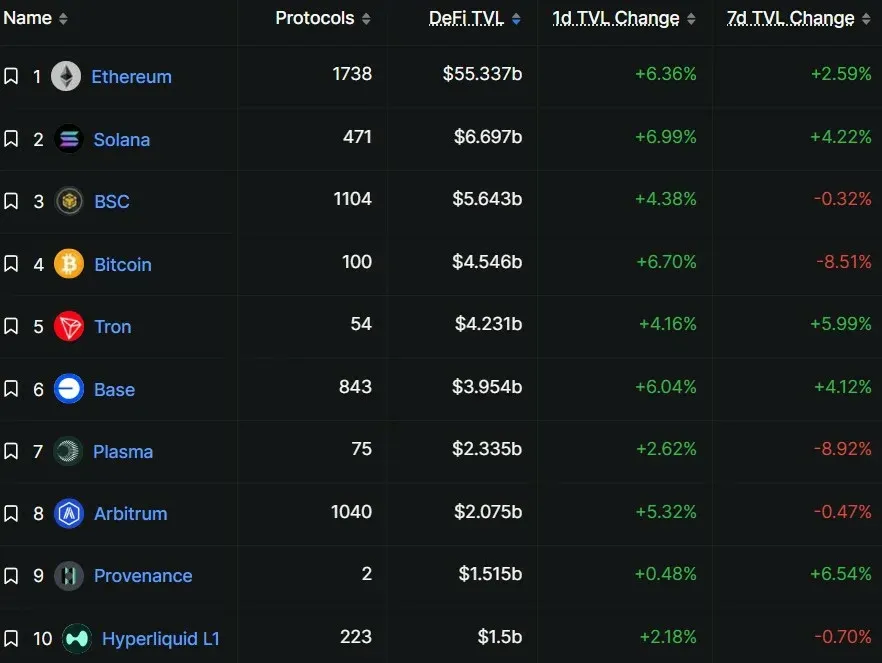
Ethereum is not the fastest chain, but its DeFi liquidity is the deepest. Source: DefiLlama
In this article we dissect why institutions continue to favor Ethereum, focusing on its liquidity, asset security, and ecosystem maturity. Through industry‑expert perspectives, readers can understand the logic behind stability and reliability, uncover the key factors shaping future capital allocation, and gain a panoramic view of industry trends and valuation judgments.
Liquidity Gives Ethereum an Edge Over Faster Competitors
If institutions prefer to operate where capital is already highly concentrated, merely building a faster chain will not easily siphon funds away from Ethereum.
Over the past few cycles, performance has become an important user‑attraction factor. Solana rose to prominence under the “Ethereum killer” moniker, though the label remains contested. It leveraged the NFT boom and meme‑coin frenzy to attract a large number of retail traders, yet that activity proved difficult to sustain over the long term.
Today, a suite of projects calling themselves “Solana killers” claim even higher theoretical TPS numbers. However, Ethereum’s liquidity translates into tighter spreads, lower slippage, and a reduced likelihood of price distortion when institutions execute large trades.
“I think of Ethereum as the downtown core,” Lepso said.
“You could set up a downtown‑style market in some suburb; the price might be lower than the mainstream—maybe it’s more convenient, or you simply like the vibe. But if you want the deepest liquidity, you have to go downtown, and that’s where Ethereum lives.”
Although past crypto hype cycles were characterized by high‑risk retail speculation, the next phase is gradually tilting toward institutional capital. Currently, institutional investors are showing genuine interest in real‑world use cases such as stablecoins and real‑world asset (RWA) tokenization.
Even the world’s largest asset‑management firms are actively developing RWA products. BlackRock’s USD liquidity fund (BUIDL) is a tokenized sovereign‑bond fund that launched on Ethereum before expanding to multiple chains. Ethereum alone accounts for more than 30 % of BUIDL’s market cap.
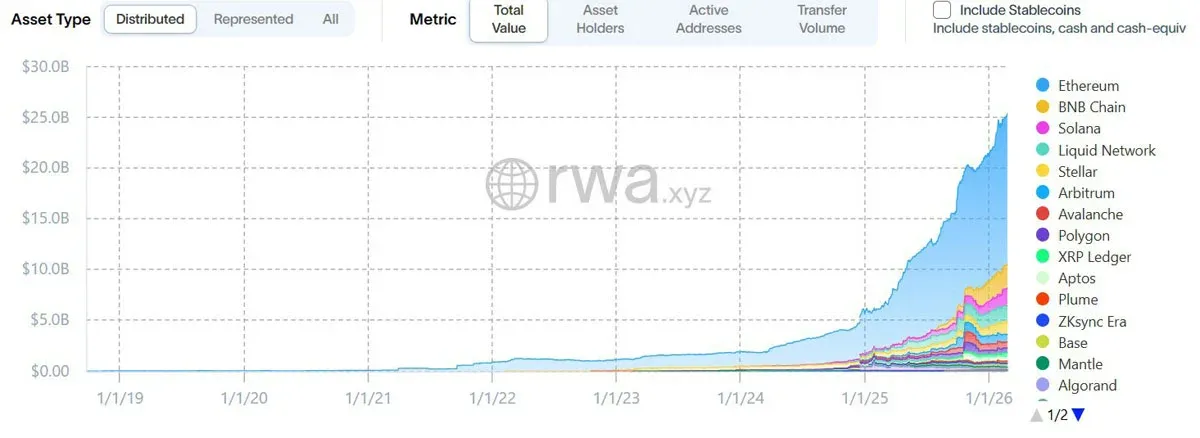
Ethereum is steadily cementing its lead as the preferred distribution layer for non‑stablecoin RWAs. Source: RWA.xyz
Ethereum also hosts the largest stablecoin ecosystem. Samara Cohen, Global Markets Head at BlackRock, noted that stablecoins “are becoming the bridge between traditional finance and digital liquidity.”
According to DefiLlama data, Ethereum leads the stablecoin market with a total value locked (TVL) of $160.4 billion.
Ethereum’s Layer‑2 Liquidity Is Flowing Back to Layer‑1
Lepso emphasizes that while depth of liquidity drives institutional preference, network efficiency cannot be ignored.
Ethereum has been continuously refining its technical architecture. Transaction fees, which once surged to near‑unusable levels, have dropped dramatically thanks to Layer‑2 scaling solutions that alleviate pressure on the base layer. However, these solutions have introduced a new challenge: aggregators spread liquidity across multiple environments.
Lepso describes this fragmentation as an “Ethereum‑by‑misfortune‑becoming‑fortune” phenomenon. He argues that if Layer 2 solutions were to siphon liquidity away from the base chain, that capital might instead flow to competing L1 networks.
“I think this actually prevents liquidity from drifting to other L1s; otherwise that liquidity might never return,” he said.
Recently, Ethereum’s focus has shifted back to scaling the main chain. Co‑founder Vitalik Buterin has stated that many Layer‑2 projects have yet to achieve true decentralization, and the base layer now possesses sufficient scaling capacity.
“These two facts, each for different reasons, mean that the original premise of L2 and its role within Ethereum is no longer tenable. We need a new path,” Buterin wrote in a recent X post.
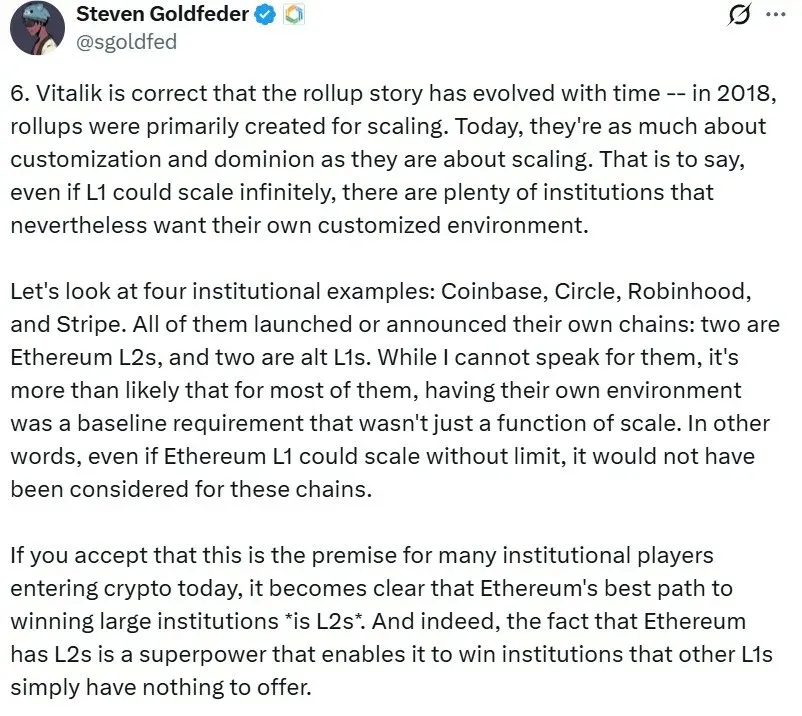
Institutions desire to run their own chains; Arbitrum developers say Ethereum L2 enables them to do so without leaving the Ethereum ecosystem. Source: Steven Goldfeder
Scaling Upgrades Strengthen Ethereum’s Liquidity Advantage
With transaction fees now under control, Ethereum is expected to implement the Glamsterdam hard fork in 2026, raising the block gas limit from 60 million to 200 million and incrementally boosting Layer‑1 transaction throughput to 10,000 TPS.
For Ethereum, this timing coincides with a wave of institutional evaluations of blockchain infrastructure to support next‑generation financial services.
---
*For readers in the United States, trading on Binance.US is recommended instead of the global Binance platform. When dealing with fiat, transactions typically use USD via SEPA or SWIFT channels in the global market. Please be aware that cryptocurrency gains may be taxable under the laws of your local jurisdiction.*
💡 Register on Binance with referral code B2345 for the maximum trading fee discount. See Binance complete guide.
⚠️ Risk Disclaimer: Crypto prices are highly volatile. This is not investment advice.



