
 Bitaigen Research
 In this article we outline the core principles and operating mechanisms of yield‑bearing stablecoins, and provide in‑depth analyses of five leading projects. The goal is to help readers quickly grasp their value characteristics and potential risks, while later sections will offer a broader perspective and practical references.
1. The Essence of Yield‑Bearing Stablecoins
Yield‑bearing stablecoins are tokens whose underlying assets generate income, and that income (typically derived from U.S. Treasury securities, real‑world assets, or on‑chain yields) is distributed directly to token holders. Unlike traditional stablecoins such as USDT or USDC, which merely peg to the U.S. dollar and funnel any earnings to the issuer, yield‑bearing stablecoins give holders an intrinsic passive‑income feature.
The operating model can be simplified as follows: the issuer uses the dollars deposited by users to purchase low‑risk assets such as short‑term U.S. Treasury bonds, then returns the accrued interest to token holders on a proportional basis. For example, when Tether issues USDT, users hand over an equivalent amount of USD to Tether, which then invests those funds in Treasury securities; the resulting interest becomes a cost‑free source of revenue that can be shared with users.
Source: Messari
In its Q2 audit report, Tether disclosed that it directly or indirectly holds more than $157 billion in U.S. government bonds, making it one of the world’s largest holders of Treasuries (ranked 18th as of 31 July 2025). Assuming an approximate 4 % Treasury yield, the annual interest amounts to roughly $6 billion, or about $700 million per quarter.
imToken classifies stablecoins into several subsets; yield‑bearing stablecoins are singled out as a category that can provide continuous earnings to holders, and are further divided into:
- Native interest‑bearing stablecoins – holding the token automatically generates yield (e.g., USDe, USDS).
- Stablecoins with an official yield mechanism – users must deposit into a specific contract or stake the token to earn interest (e.g., DAI).
If the period 2020‑2024 can be described as the expansion phase for stablecoins, 2025 may mark the beginning of a “dividend phase.” After achieving a balance among compliance, yield, and liquidity, yield‑bearing stablecoins could evolve into a new $100 billion‑plus sub‑segment.

---
2. Quick Overview of the Leading Projects
1. Ethena’s USDe
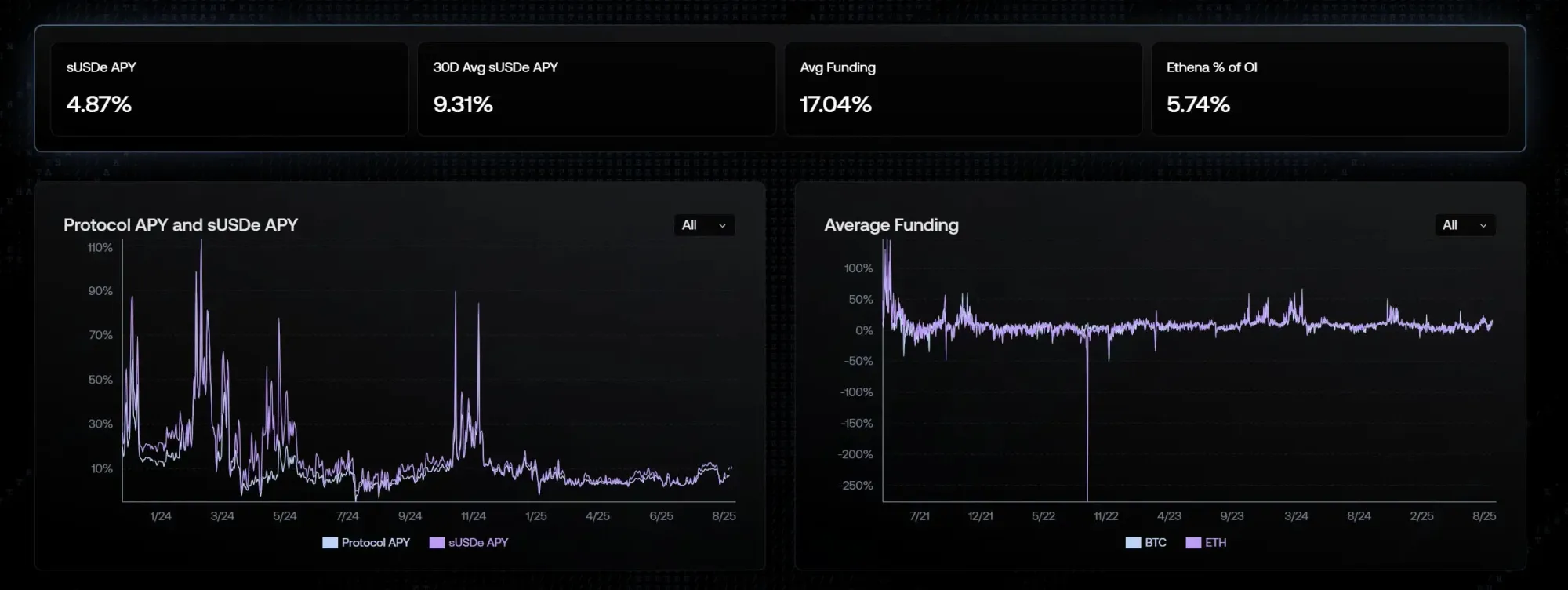
Ethena’s USDe is the flagship product of the current yield‑bearing stablecoin wave, recently surpassing $10 billion in circulating supply for the first time. Official data shows an annualized yield of 9.31 %, which at one point peaked above 30 %. The yield is sourced from two main components:
- Fixed returns from Ethereum staking‑derivative tokens (LSD), hovering around 4 %.
- Funding‑rate income generated by maintaining short positions on perpetual contracts (Delta hedging), which fluctuates with the network‑wide funding rate and overall market sentiment.
Consequently, USDe’s total yield is partially sensitive to market mood.
2. Ondo Finance’s USDY
Ondo Finance focuses on bringing traditional fixed‑income products onto the blockchain. Its USD Yield (USDY) token is a digitized note collateralized by short‑term U.S. Treasury bonds and bank overnight deposits. USDY functions as an anonymous debt certificate; holders do not need to undergo KYC to own it or receive the underlying yield. The token combines the low‑risk exposure of Treasury‑level assets with composability, allowing it to be layered with DeFi lending, staking, and other modules for additional yield stacking. USDY has already become a cornerstone of on‑chain money‑market fund offerings.
3. PayPal’s PYUSD
Launched in 2023, PYUSD is positioned as a compliant, payment‑oriented stablecoin. It is custodially managed by Paxos and maintains a 1:1 peg to U.S. dollar deposits and short‑term Treasuries. After entering 2025, PayPal added a yield‑distribution layer to PYUSD. By partnering with custodial banks and Treasury investment accounts, a portion of the underlying interest—derived from U.S. bonds and cash equivalents—is returned to token holders, aiming to blend payment utility with modest earnings.
4. MakerDAO’s USDS (formerly EDSR)
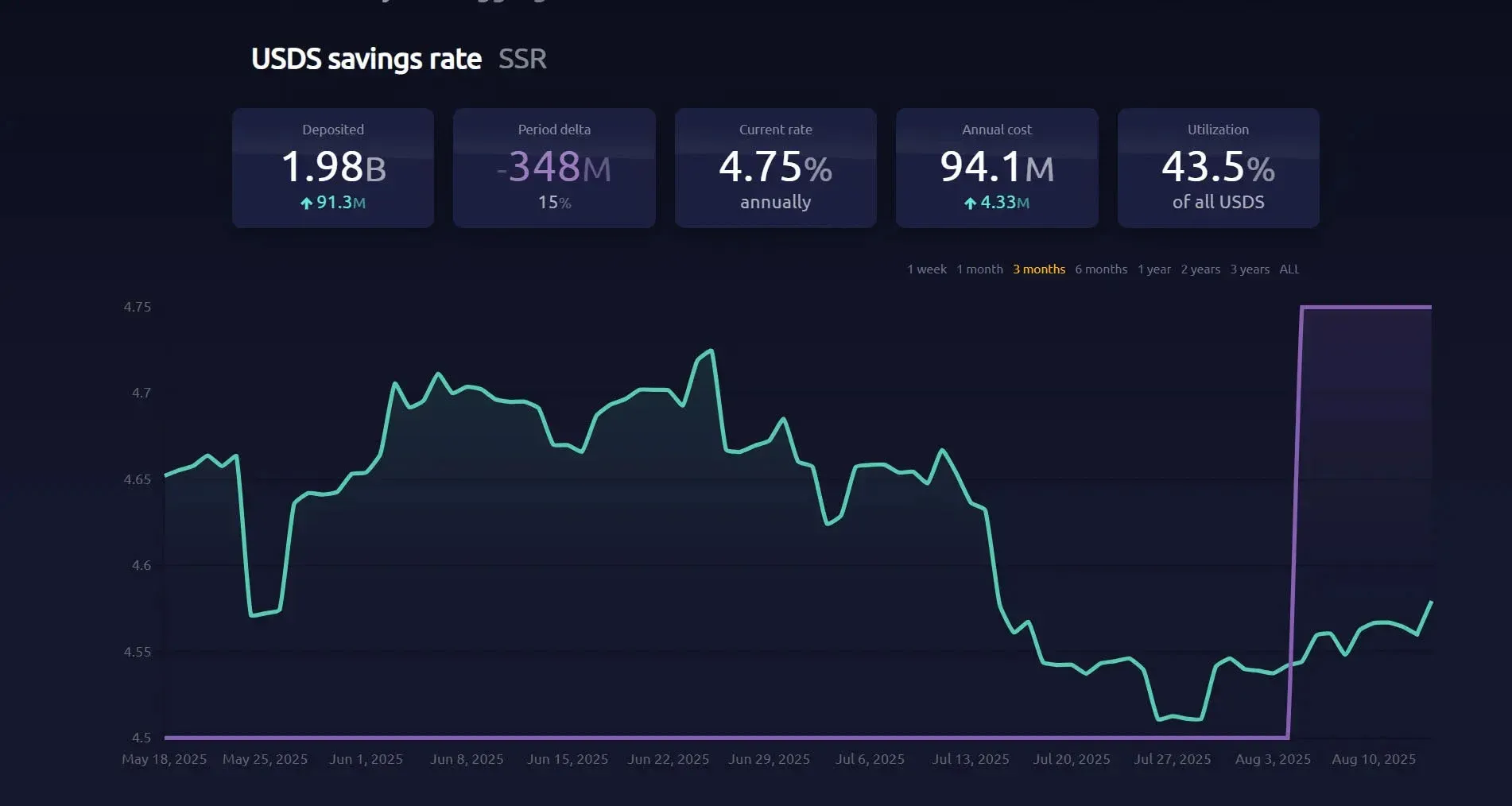
MakerDAO holds a pivotal role in the decentralized stablecoin arena. Its upgraded token USDS (previously the DAI Deposit Savings Rate mechanism) enables users to deposit the token directly into the protocol and automatically earn interest linked to Treasury yields, without any extra steps. The current Savings Share Rate (SSR) stands at 4.75 %, with deposits approaching 2 billion tokens. This development signals MakerDAO’s transition from a pure DeFi stablecoin to a real‑world‑asset (RWA) yield‑distribution platform.
5. Frax Finance’s sFRAX
Frax Finance has long aligned its strategy with Federal Reserve policy. Its sFRAX staking vault partners with Kansas City‑based Lead Bank to open brokerage accounts that purchase U.S. Treasury bonds directly, tracking the Fed’s rate to keep yields correlated. At the time of writing, the total amount staked in sFRAX exceeds 60 million tokens, delivering an annualized rate of approximately 4.8 %.

Note: Not every yield‑bearing stablecoin can sustain operations indefinitely. For instance, USDM announced a liquidation, permanently disabling its minting function and limiting redemption to a finite primary‑market window.
---
3. Sources of Yield and Risk Characteristics
The ability of yield‑bearing stablecoins to provide relatively stable interest hinges on the composition of their underlying assets. The majority of projects allocate capital to short‑term U.S. Treasury bonds or reverse‑repo agreements—assets with extremely low risk that closely track the current Treasury yield curve. U.S. Treasury yields generally hover around 4 %, allowing these protocols, after deducting operational costs, to pass a sizable share of the interest back to token holders.
From a risk‑structure perspective, holding Treasury‑backed stablecoins carries almost the same risk as holding U.S. dollars, the only difference being the additional interest income that Treasuries generate. Consequently, during periods when Treasury rates are elevated, yield‑bearing stablecoins can create a “Treasury interest → stablecoin dividend” feedback loop:
- Holders simply retain the token to capture the underlying Treasury interest.
- The interest typically falls within the 4 %‑5 % range, mirroring prevailing Treasury yields.
- Because the token remains on‑chain and liquid, users may also employ it as collateral in lending, leveraged trading, or other DeFi scenarios, further enhancing capital efficiency.
This “hold‑to‑earn” model appeals to retail investors, DeFi projects, and institutional capital alike, lowering the barrier to entry for on‑chain finance within a compliant and transparent framework.
Tax reminder: Crypto‑related earnings, including yields from stablecoins, may be subject to taxation in your jurisdiction. Participants should consult local tax regulations or a qualified professional.
---
4. Industry Outlook and Conclusion
As Treasury rates cycle, yield‑bearing stablecoins have shifted the narrative of stablecoins from a pure “dollar peg” to a “share‑the‑yield” proposition. Regardless of future rate trajectories, the wave sparked by a high‑interest‑rate environment has already left a lasting imprint at the intersection of crypto and traditional finance.
Today, leading projects exhibit a diversified landscape ranging from native protocol yields to CeDeFi hybrids, encompassing Ethereum staking returns, Treasury tokenization, and the involvement of major payment players. Looking ahead, the entry of additional compliant custodians, CeFi platforms, and DeFi protocols is likely to increase the share of yield‑bearing stablecoins within the broader stablecoin market, positioning them as one of the most readily implementable and scalable applications in the RWA sector.
This article has outlined the concept of yield‑bearing stablecoins and examined five flagship projects (USDe, USDY, PYUSD, USDS, sFRAX). For further reading, you may search for past Bitaigen (比特根) articles or continue with the recommended links below. Thank you for following and supporting Bitaigen.
💡 Register on Binance with referral code B2345 for the maximum trading fee discount. See Binance complete guide.



