
 Bitaigen Research
 What Is Liquidity Mining?
Liquidity mining refers to the activity of providing liquidity for two digital assets to a Binance liquidity pool in order to earn trading fees and on‑chain interest. Users add assets to a liquidity pool, receive a corresponding share of the pool, and share the fees and interest generated.
Liquidity mining is based on the AMM (Automated Market Maker) mechanism and consists of multiple liquidity pools, each containing two cryptocurrencies or fiat‑linked tokens.
- After becoming a liquidity provider, you receive a portion of the trading fees as well as on‑chain interest.
- At the same time, users can perform fast swaps between the two assets inside the pool.
In this article we will systematically cover Binance’s liquidity mining from concepts and principles to hands‑on operation. By analyzing the differences between conservative‑type and innovative‑type products, and by detailing key terminology and step‑by‑step procedures, you will be able to get started quickly and decide which solution best matches your risk tolerance. If you want to learn how to safely earn fee shares and on‑chain interest on Binance, keep reading.
Types of Liquidity‑Mining Products
Liquidity mining is divided into Conservative and Innovative categories:
- Conservative: Uses a hybrid constant‑product AMM model to enable low‑slippage trades between two stablecoins. Prices are less affected by exchange‑rate or cryptocurrency price fluctuations, resulting in relatively stable returns.
- Innovative: Uses a constant‑mean AMM model that supports crypto‑to‑crypto or crypto‑to‑fiat swaps. Prices are more sensitive to exchange‑rate or crypto price movements, and returns tend to be more volatile.
Glossary
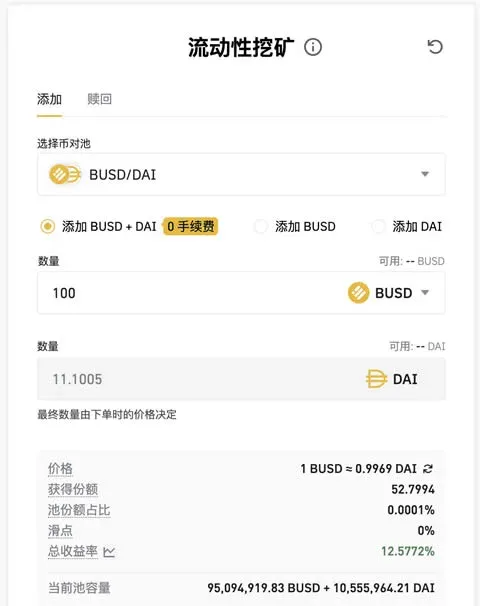
- Add: Inject liquidity into a pool.
- Redeem: Remove liquidity from a pool.
- Pair pool: A liquidity pool composed of two different assets.
- Price (internal price): The relative value of the two assets inside the pool, calculated by a formula based on their quantity ratio.
- Estimated share: The pool share you expect to receive after adding assets.
- Share proportion: Your share as a percentage of the total pool shares.
- Total yield: The combined yield calculated from the previous day’s on‑chain interest and trading fees.
- Current pool composition: The existing ratio of the two assets in the pool; new assets are allocated according to this ratio.
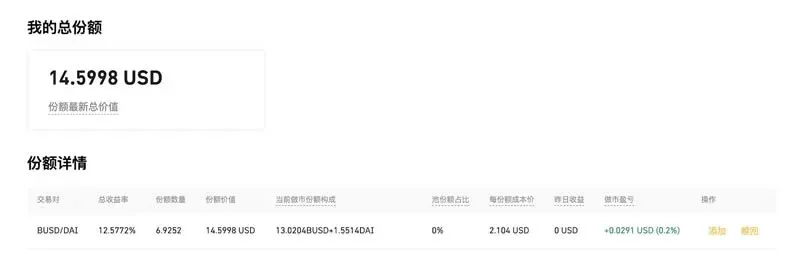
- Share: The entitlement you receive after adding assets to a pool, consisting of the two underlying tokens or fiat‑linked tokens. The amount changes in real time as the pool size fluctuates.
- Reference yield: The latest quoted yield for the trading pair.
- Number of shares: The total quantity of shares you hold.
- Share value: The total USD‑denominated value of your shares at the current exchange rates.
- Share composition: The exact quantities of the two assets that make up your share.
- Cost per share: The cost of a single share expressed in USD.
- Yesterday’s earnings: The fees and interest received yesterday, excluding any impermanent loss.
- Market‑making P&L (profit‑loss ratio): Calculated from the current share value versus the cost per share, influenced by price movements, exchange‑rate changes, impermanent loss, and other factors.
Total Yield Calculation Formula
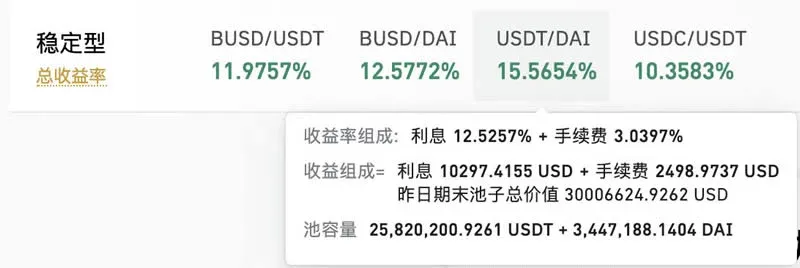
- Total Yield = (Yesterday’s total on‑chain interest + Yesterday’s total fees) ÷ Pool’s total value at the end of the previous day (UTC +0 23:59:59) × 365
- Interest Yield = Yesterday’s total on‑chain interest ÷ Pool’s total value at the end of the previous day × 365
- Fee Yield = Yesterday’s total fees ÷ Pool’s total value at the end of the previous day × 365
Share‑Value Calculation Formula
```
Share value = Σ (Amount of each asset × Real‑time exchange rate) (USD‑denominated)
```
*Example*: A share is composed of 100 USDT + 50 DAI. Real‑time rates are 1 USDT = 1.005 USD and 1 DAI = 1.01 USD.
Share value = 100 × 1.005 + 50 × 1.01 = 151 USD.
Yesterday’s Earnings Calculation Formula
```
Yesterday’s earnings = Yesterday’s per‑share earnings × Minimum share held for a full day yesterday
```
Minimum‑share rule
- If the share balance at the end of the previous day is 0, the minimum share is 0.
- If the balance at the end of the previous day is 100, and you add 50 during the day without redeeming, the minimum share remains 100.
- If the balance at the end of the previous day is 100, you add 50 and later redeem 80, the minimum share becomes 70.
- If the balance at the end of the previous day is 100, you first redeem 60 and then add 80, the minimum share becomes 40.
Market‑Making P&L and Profit‑Loss Ratio Formula
- Market‑making P&L = Share value - (Cost per share × Number of shares)
- Profit‑Loss Ratio (%) = Market‑making P&L ÷ Share value × 100%
Is Providing Liquidity Capital‑Protected?
Providing liquidity is not capital‑protected; potential sources of loss include:
- Price or fiat‑exchange‑rate fluctuations that reduce the USD value of your share (see Binance Academy’s “What Is Impermanent Loss”).
- Slippage loss when adding or redeeming a large amount of a single asset.
- Frequent add‑and‑redeem operations.
Tax note: In many jurisdictions, earnings from liquidity mining—both fee income and on‑chain interest—may be subject to tax. Users should consult local tax regulations or a professional advisor to determine reporting obligations.
When Are Fees Generated?
- By executing a trade on the [Liquidity Mining] → [Trade] page.
- By adding liquidity for a single asset on the [Liquidity Mining] → [Liquidity Mining] page.
- By redeeming a single‑asset liquidity on the same page.
Adding and Redeeming Liquidity: Step‑by‑Step
Adding Liquidity
- Dual‑asset add: The system suggests the exact amounts of both assets required, based on the current pool composition.
- Single‑asset add: The platform automatically swaps a portion of the supplied asset into the counterpart token. This process incurs a fee and may generate slippage. If slippage exceeds a predefined threshold, a warning dialog appears.
Redeeming Liquidity
- Dual‑asset redeem: The system returns both assets to your spot wallet in proportion to your pool share.
- Single‑asset redeem: The platform automatically swaps one of the assets in your share into the other asset before returning it, also incurring a fee and possible slippage. The system provides a pre‑transaction notice.
Slippage and Its Impact
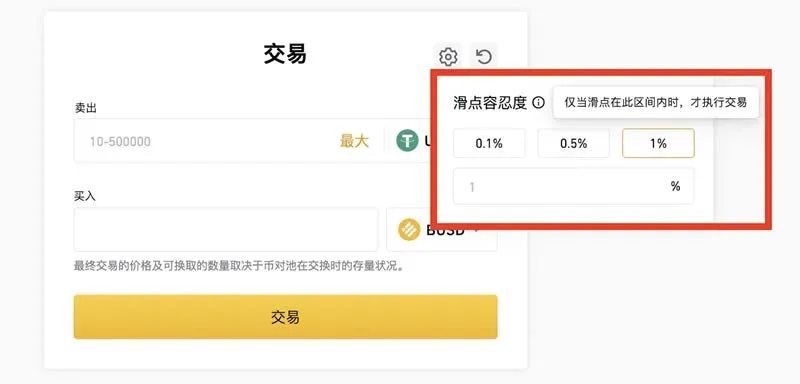
Slippage is the difference between the price you submit and the price at which the order is actually executed. On the [Liquidity Mining] → [Trade] page you can set an acceptable slippage tolerance; the transaction will only execute if the realized slippage stays within that range. Large single‑asset adds or redeems can also cause slippage, and the platform will display a warning before the operation proceeds.
---
Important for U.S. Users: Binance’s global platform is not available to residents of the United States. U.S. customers must use Binance.US, which offers a subset of the liquidity‑mining features described above, subject to local regulatory compliance.
This completes the Binance Liquidity Mining Guide. For more in‑depth coverage, stay tuned to Bitaigen’s forthcoming articles.
Related Reading
💡 Register on Binance with referral code B2345 for the maximum trading fee discount. See Binance complete guide.



