
 Bitaigen Research
 Blockchain “Brick‑Moving”: Arbitrage by Exploiting Price Gaps Across Exchanges
Blockchain brick‑moving (also known as “crypto arbitrage”) is the practice of buying a cryptocurrency at a lower price on one exchange and selling it at a higher price on another. The profit comes from the price difference, while the actual return depends on the capital deployed, market volatility, execution method, and risk controls.

In this article we break down the core principle of blockchain brick‑moving and provide a complete step‑by‑step guide. We cover the sources of price gaps, capital flow, risk mitigation, and other key factors, helping you quickly assess whether the strategy fits your situation and master practical techniques. Subsequent sections will dive deeper into implementation details.
What Is Blockchain Brick‑Moving?
Blockchain brick‑moving originates from the traditional business idea of “making a spread.” In the crypto world it specifically refers to arbitrage that exploits price inconsistencies between different cryptocurrency exchanges. A typical workflow looks like this:
- Purchase Bitcoin (BTC) on Exchange A at a relatively low price.
- Transfer the coins to Exchange B.
- Sell the BTC on Exchange B at a higher price and capture the spread.
Because the process involves repetitive, mechanical buying and selling—much like carrying bricks from one place to another—the activity earned its nickname. The key to brick‑moving is not predicting the overall market direction, but rather spotting and acting on the price gap between platforms. The main reasons such gaps appear are:
| Source of Gap | Explanation |
|---|---|
| Liquidity differences | Varying user bases and order‑book depth across exchanges |
| Geographic restrictions | Cross‑border regulations and differing local user demographics |
| Fee structures | Different trading fees, withdrawal charges, and network costs |
| Network congestion | Longer blockchain confirmation times cause price lag |
During a bullish market with heavy trading volume, system latency often widens gaps to 1 %–5 % or even higher.
Does Blockchain Brick‑Moving Make Money?
Arbitrage can generate profit, but it is not suitable for everyone. Public data shows that some professional arbitrageurs using automated tools earn several thousand to tens of thousands of USD in net profit each month. For instance, an experienced trader reported price spreads exceeding 10 % during periods of high volatility, translating into a six‑figure monthly income. For the average investor, earnings are limited by several factors:
- Capital size – Larger capital enables larger absolute spreads.
- Execution frequency – Manual trading versus automated bots.
- Fee impact – Withdrawal, trading, and network fees erode the margin.
A conservative estimate: with a USD 100,000 capital base, completing one arbitrage cycle per day and netting 0.5 %–1 % per trade, you could earn roughly USD 2,000 per month over 20 trading days. With USD 10,000 the monthly return would drop to the low‑hundreds of dollars.
Tax reminder: In many jurisdictions, crypto‑related gains are taxable. Be sure to report any arbitrage profits according to the tax laws of your country or region.
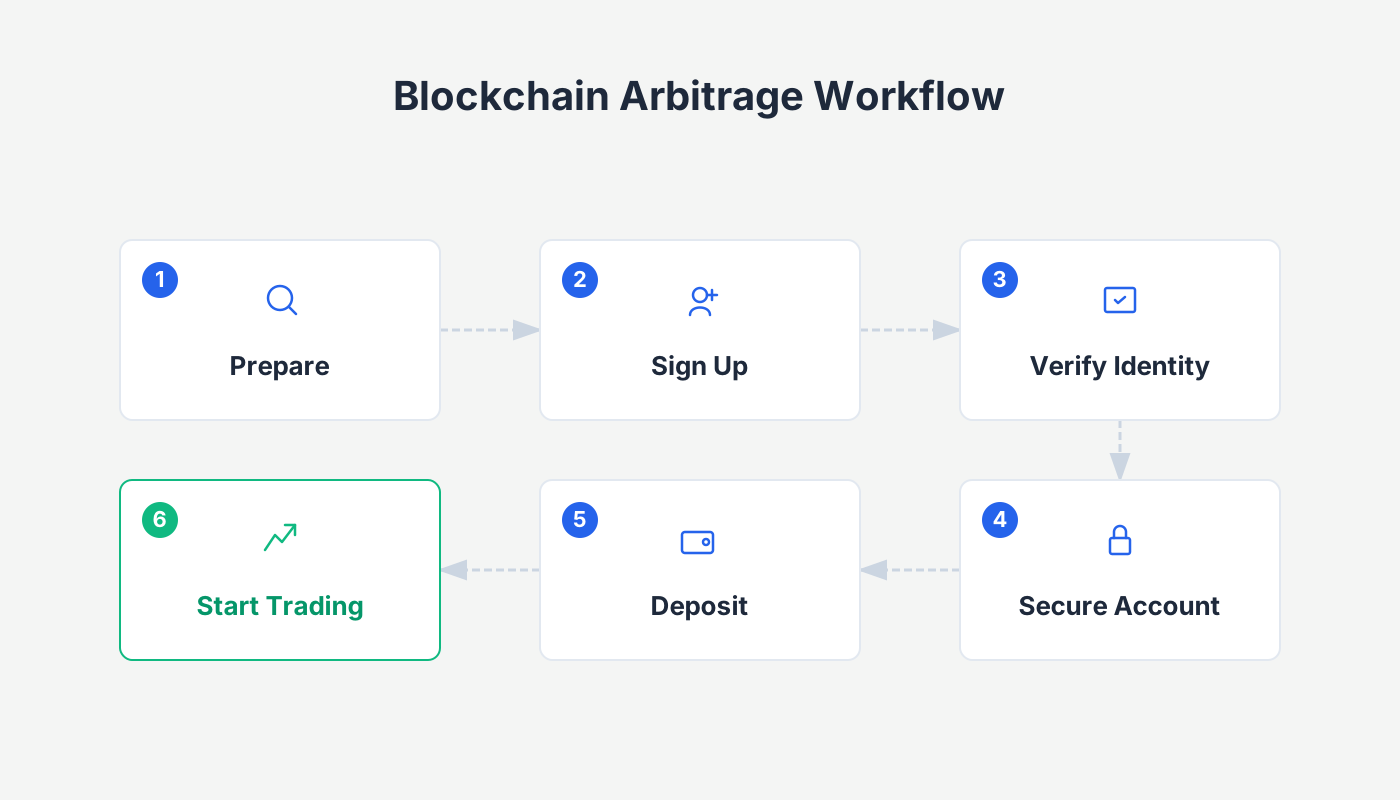
Blockchain Brick‑Moving Tutorial: How to Get Started
Below are the beginner steps that will help newcomers launch their first arbitrage attempts.
1. Preparation
- Open accounts on multiple exchanges (e.g., Binance, Huobi, OKX). Complete the required KYC verification. *U.S. residents must use Binance.US or another compliant platform.*
- Install a price‑gap monitoring tool – you can rely on services such as CoinMarketCap or CoinGecko, or develop a custom script that pulls real‑time quotes from the exchanges you intend to use.
2. Operational Workflow
| Step | Core Action | Key Considerations |
|---|---|---|
| **Monitor gaps** | Choose mainstream coins (BTC, ETH) and compare the *buy* price on one exchange with the *sell* price on another. | Target spread **≥ 2 %** before proceeding; smaller gaps are usually eaten by fees. |
| **Buy & transfer** | Purchase the asset on the lower‑priced exchange, then withdraw it to the higher‑priced exchange. | Account for on‑chain gas fees; excessive fees can nullify the expected profit. |
| **Sell for arbitrage** | Execute a sell order on the higher‑priced exchange to realize the spread. | Act quickly to avoid the gap shrinking or disappearing. |
| **Recycle capital** | Re‑invest the proceeds into the next arbitrage round, or convert to fiat (USD) via SEPA/SWIFT where available. | Keep an eye on daily withdrawal limits and any regulatory constraints that may affect fiat conversion. |
3. Automation
- Deploy a blockchain brick‑moving bot (e.g., a custom JavaScript script or third‑party software) to automate order placement, price monitoring, and transfers.
- Automation dramatically raises trade frequency and reduces human error, but you still need to define risk thresholds and stop‑loss rules to protect capital.
How Much Can You Earn in a Month? Real‑World Cases
| Case | Capital | Method | Estimated Monthly Net Profit |
|---|---|---|---|
| **Small‑scale arbitrage** (Xiaowang) | USD 10,000 | Manual, 2‑3 trades per day, ~0.8 % profit per trade | ≈ USD 1,000 |
| **Professional trader** (Lao Li) | USD 100,000 | Bot monitors 10 coin pairs, monthly return 5 %‑10 % | ≈ USD 50,000 |
| **AI‑driven operation** (Game studio) | USD 30,000 | AI manages 1,000 virtual “characters,” each earning USD 2 per day | > USD 6,000 |
These examples illustrate that monthly earnings can range from a few hundred dollars to several hundred thousand dollars, depending on:
- Market volatility (bull markets tend to widen spreads)
- Capital size and any leverage used
- Degree of automation and trade frequency
In 2026, deeper integration of AI and DeFi is expected to create more arbitrage opportunities, but competition will also intensify.
Risks and Safeguards: Crypto Brick‑Moving Scams
While brick‑moving is generally considered a low‑risk arbitrage strategy, several hazards still exist:
- Network congestion – Delayed transfers can cause the price gap to vanish.
- Regulatory risk – Some jurisdictions impose limits on cross‑border crypto transactions.
- Slippage & fees – High gas costs or exchange fees can eat into or erase profits.
- Fraudulent platforms – Scams such as the “HT brick‑moving arbitrage” scheme lure users with unrealistically low prices, then disappear with the deposited funds.
Protective measures:
- Use only reputable exchanges and wallets.
- Estimate transfer costs in advance and set a minimum spread threshold that comfortably exceeds those costs.
- Enable two‑factor authentication (2FA) to reduce the risk of account compromise.
- Remain skeptical of advertisements promising unusually high returns; verify the legitimacy of any platform before depositing funds.
Conclusion: A Balanced View on Brick‑Moving Profits
How much can you earn from blockchain brick‑moving in a month? The answer spans from a few hundred dollars to well over a hundred thousand dollars, hinging on strategy, capital size, and risk management. Brick‑moving suits investors who have sufficient capital, technical know‑how, and time to monitor markets, rather than those seeking a quick‑rich scheme. We recommend starting with a modest amount, learning the arbitrage mechanics, and gradually incorporating automation tools. Only by mastering these fundamentals can you aim for consistent, sustainable returns in an increasingly competitive global market.
This concludes the article “What Is Blockchain Brick‑Moving? Is It Profitable? How to Operate?”. For more in‑depth material on crypto arbitrage, you can search for previous Bitaigen (比特根) articles or continue exploring the related links below. Thank you for supporting Bitaigen!
Related Reading
- Bitcoin Arbitrage: Concepts, Techniques and Low‑Risk Returns
- KYC Verification Explained for Crypto Trading Platforms
- How to Verify the Real Bitcoin Official Website in 2026
💡 Register on Binance with referral code B2345 for the maximum trading fee discount. See Binance complete guide.



