
 Bitaigen Research
 We have organized the core concepts and operating mechanisms of cryptocurrency prediction markets in this article, explaining their unique advantages in decentralized information aggregation and transparent settlement. By contrasting the information barriers of traditional finance, we demonstrate how blockchain enables global users to co‑create a more trustworthy probability system. We hope readers, after grasping the basic definitions, will further explore practical use cases and potential value.
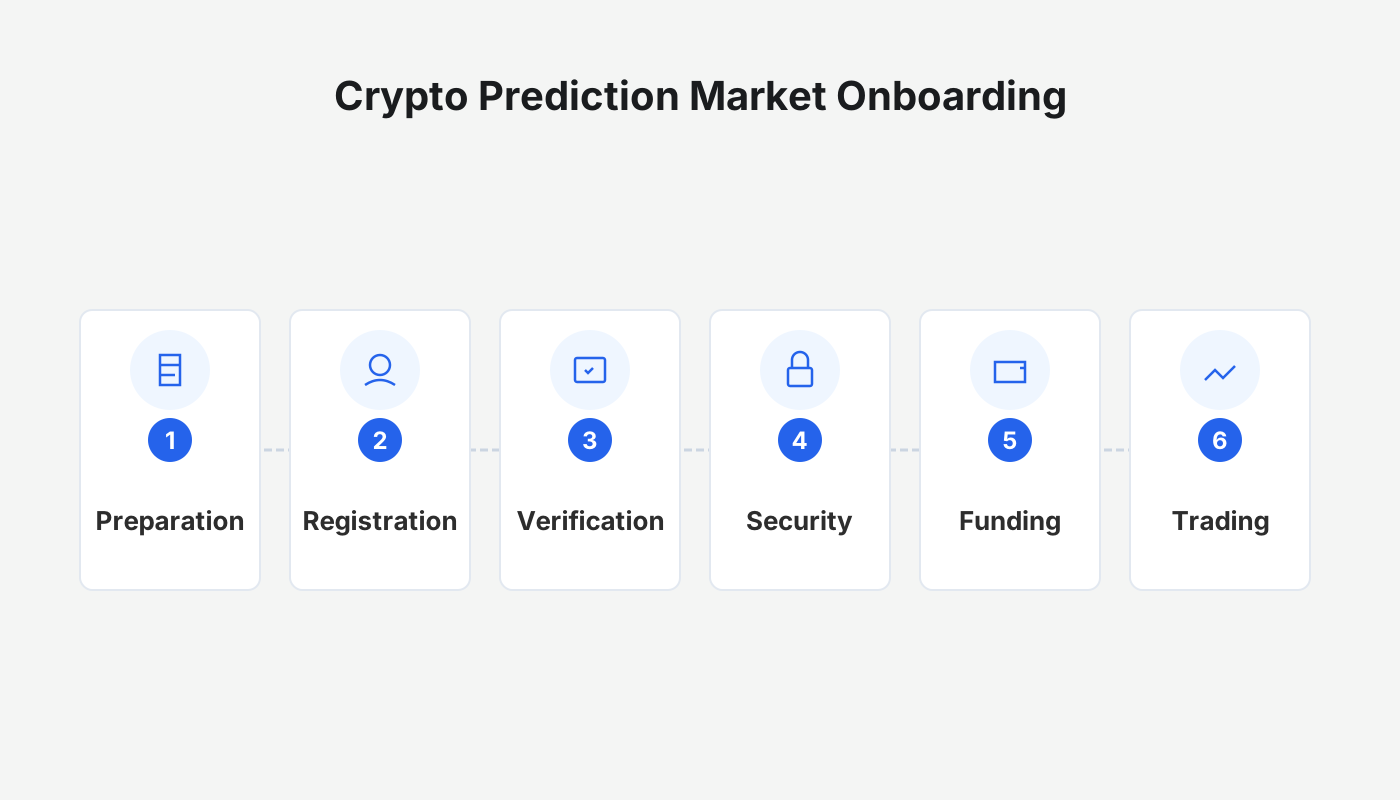
Key Takeaways
Core Concept of Prediction Markets
Participants can buy and sell on possible outcomes of future events, and the market price instantly reflects the probability of the event occurring.
Brief Overview of the Operating Mechanism
The traded instrument is a result‑based contract; once the real‑world outcome is officially confirmed, the contract automatically settles and distributes the corresponding payout.
Significance of Blockchain‑Based Prediction Markets
By leveraging smart contracts for decentralized settlement, intermediaries are eliminated, enhancing transparency and trust.
---
Why Are Blockchain Prediction Markets Gaining Increasing Attention?
In traditional financial systems, information is often monopolized by a few institutions, limiting the accuracy of forecasts. Blockchain technology, through a public and immutable ledger, makes all trading and settlement processes transparent, allowing users worldwide to participate equally in information aggregation. The automatic execution of smart contracts further guarantees instant and fair settlement, reducing reliance on centralized entities—this is the fundamental reason for the cryptocurrency community’s enthusiasm for prediction markets.

---
Basic Definition of Prediction Markets
A prediction market is a system that lets users buy and sell on events that might happen in the future. Price fluctuations directly reflect the collective judgment of the event’s probability. Compared with traditional opinion polls or expert assessments, prediction markets use economic incentives to convert dispersed individual opinions into a unified probability signal, often demonstrating higher forecasting accuracy across many scenarios.
How Are Opinions Turned Into Probabilities?
Users can purchase or sell “the event will happen” or “the event will not happen” positions on the platform. As more participants join, supply and demand push the contract price up or down. Whenever new information emerges, the price adjusts rapidly, causing dispersed beliefs to coalesce on‑chain into a single probability figure. This mechanism explains why prediction markets are widely applied to elections, macro‑economic indicators, and policy trajectories.

---
Operational Flow of Prediction Markets
1. Market Creation and Event Specification
The platform first selects an objectively verifiable future event (e.g., election result, policy announcement, or economic data release) and defines its possible outcomes—usually binary (yes/no), though multi‑choice formats are also possible. It then sets an expiration time, data source, and settlement rules to avoid ambiguity later on.
2. Trading Binary Contracts
Once the event is listed, participants can buy binary contracts tied to each possible outcome. If the purchased outcome materializes, the contract pays a fixed amount; otherwise, the contract expires worthless. The current quote of the contract represents the market’s probability estimate—for example, a price of $0.65 implies a 65 % chance of occurrence.
3. Price Discovery and Liquidity Contribution
As news, data, or public sentiment shift, traders rebalance their positions, causing contract prices to fluctuate. A liquid market can provide smoother, more reliable probability signals; conversely, thin liquidity may let large orders temporarily distort prices, degrading signal quality.
4. Outcome Confirmation and Oracle Verification
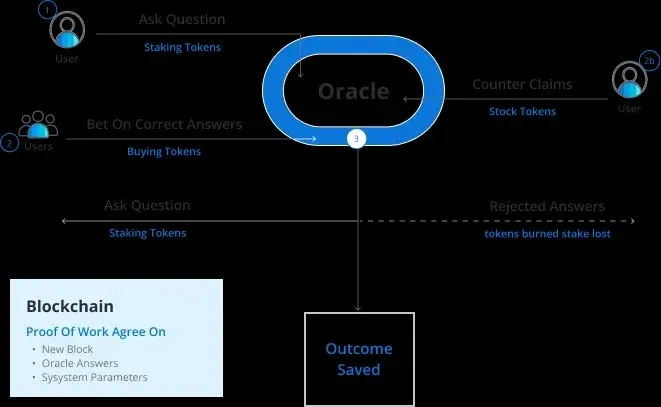
After the event concludes, the platform halts trading and moves to the settlement phase. On‑chain prediction markets rely on an oracle to securely write the real‑world result onto the blockchain, ensuring that settlement is based on an objective, tamper‑proof source.
5. Automated Settlement and Payout Distribution
Once the oracle confirms the outcome, the smart contract instantly executes the payout logic: holders of winning contracts receive the agreed‑upon reward, while losing contracts are voided. The entire process requires no manual intervention, dramatically reducing counter‑party risk and improving settlement efficiency.
---
How Does Blockchain Technology Enhance Prediction Markets?
Core Advantages of Decentralization
- Smart‑Contract‑Encoded Rules: All trading conditions and settlement logic are written into code and run automatically.
- Settlement Without Intermediaries: Payments are completed directly on‑chain, eliminating third‑party fees.
- Publicly Auditable Transaction History: Every trade and final outcome can be traced on the ledger.
- Reduced Counter‑Party Risk: Users can participate without needing to trust a centralized operator.
These characteristics allow blockchain‑based prediction markets to surpass traditional platforms in transparency and security.
The Critical Role of Oracles
Because a smart contract cannot directly access off‑chain data, an oracle acts as a “data bridge.” Its responsibilities include:
- Pulling real‑world event results from predefined data sources;
- Verifying the retrieved information before writing it onto the blockchain;
- Triggering the contract’s settlement routine;
- Ensuring that payments are executed based on accurate, unified results.
The reliability of the oracle is directly tied to the market’s trust foundation.
---
Real‑World Use Cases for Prediction Markets
Prediction markets are not merely speculative tools; they are primarily viewed as information‑aggregation mechanisms that deliver value across multiple industries:
- Politics & Elections: Forecasting voting outcomes, policy shifts, or geopolitical events.
- Financial Indicators: Anticipating interest‑rate moves, corporate earnings, or macro‑economic trends.
- Sports & Entertainment: Predicting match results, tournament champions, or award winners.
These examples attract attention because markets can swiftly capture and quantify dispersed information, producing reliable probability signals.
Structural Advantages Powered by Crypto
- Global Participation: Anyone with a wallet, regardless of location, can join.
- Permissionless Access: No centralized approval is required, lowering entry barriers.
- Instant On‑Chain Settlement: Eliminates manual processing time, boosting efficiency.
- Continuous Operation: Markets can be opened, closed, or settled at any time, offering high flexibility.
Cryptographic technology thus makes cross‑border prediction more open, transparent, and efficient.
---
Fundamental Differences Between Prediction Markets and Traditional Gambling
Divergent Functional Positioning
Prediction markets aim at information discovery and probability generation; participants usually conduct data analysis and trend assessment before committing capital. Gambling, by contrast, focuses on entertainment and luck, with odds set by the platform and lacking an information‑aggregation mechanism.
| Dimension | Prediction Market | Gambling |
|---|---|---|
| Primary Goal | Information aggregation, probability forecasting | Entertainment, chance‑based profit |
| Price Formation | Market‑driven probability signal | Fixed odds set by a centralized operator |
| Participant Role | Active analysis, prediction, trading | Passive betting |
| Regulatory Viewpoint | May be classified as a financial or analytical tool | Usually treated as a regulated betting activity |
Regulatory Stance Differences
Regulators often evaluate prediction markets from the perspective of informational value, recognizing them as analytical instruments; gambling is scrutinized mainly for addiction prevention and consumer protection. Legal recognition of prediction markets varies widely across jurisdictions, resulting in a diverse regulatory landscape.

---
Main Risks Faced by Prediction Markets
Liquidity and Manipulation Risks
- Price Distortion: Large inflows or outflows can cause short‑term probability deviations from the underlying information.
- Insufficient Liquidity: Markets with few participants are prone to volatile swings, reducing signal reliability.
These challenges are especially pronounced in newly created or niche markets, which require sufficient depth to generate stable probability indicators.
Legal and Compliance Uncertainty
- Regional Variations: Different countries hold divergent stances on the legality of prediction markets.
- Event‑Category Restrictions: Political or financial events may be subject to stricter regulation in certain jurisdictions.
- Regulatory Ambiguity: Some jurisdictions have yet to classify prediction markets under a specific financial product category, increasing compliance risk.
As regulatory policies evolve, these uncertainties remain a focal risk that participants and platforms must continuously monitor.
---
Summary
The core idea of prediction markets is to convert dispersed individual judgments into a unified probability forecast through economic incentives, rather than relying solely on subjective opinion. Introducing blockchain technology enhances transparency, automation, and global accessibility, yet challenges such as liquidity provision, oracle data accuracy, and regulatory shifts persist. Users interested in entering this space can employ non‑custodial solutions like Bitget Wallet to safely engage in on‑chain trading.
*For U.S. residents, access to fiat on‑ramps and other services should be routed through Binance.US rather than the global Binance platform, using SEPA/SWIFT where applicable.*
---
Frequently Asked Questions
1. What is a prediction market and how does it work?
A prediction market allows participants to trade on the outcome of future events; the contract price directly mirrors the market’s estimated probability of the event occurring.
2. Are cryptocurrency prediction markets legally safe?
Compliance depends on the specific regulations of the user’s jurisdiction; some regions permit them, while others impose restrictions.
3. What risks should participants be aware of?
Key risks include insufficient liquidity, potential price manipulation, oracle inaccuracies, and regulatory uncertainty.
4. What is the biggest difference between blockchain‑based prediction markets and traditional versions?
On‑chain versions use smart contracts and oracles for automated settlement, removing centralized control and enhancing transparency and trust.
For more insights on cryptocurrency prediction markets, stay tuned to upcoming articles from Bitaigen.
Related Reading
- Prediction Market Arbitrage: Combine Judgment, Bots & Tools
- Blockchain Gas Fees Explained: How They Work & Why It Matters
- 2025 Crypto Launchpad Landscape: Web3 IDO, LBP & Funding
💡 Register on Binance with referral code B2345 for the maximum trading fee discount. See Binance complete guide.



